
Shorter-term rates will fall. The future of longer-term rates is uncertain.
By David Enna, Tipswatch.com
Just a few days ago, on Aug. 22, the U.S. Treasury auctioned a reopened 30-year Treasury Inflation-Protected Security with a real yield to maturity of 2.055%. And then, a day later, a lot changed. Did we just see — for the time being — the last TIPS auction with a real yield higher than 2.0%?
It could be. Bond markets shifted mightily in the aftermath of Federal Reserve Chairman Jay Powell’s short, but very direct, speech Friday to the Jackson Hole Symposium on monetary policy. Watch it here:
Some key quotes:
Inflation has declined significantly. The labor market is no longer overheated, and conditions are now less tight than those that prevailed before the pandemic. Supply constraints have normalized. And the balance of the risks to our two mandates has changed. …
The upside risks to inflation have diminished. And the downside risks to employment have increased. …
The time has come for policy to adjust. The direction of travel is clear, and the timing and pace of rate cuts will depend on incoming data, the evolving outlook, and the balance of risks. … With an appropriate dialing back of policy restraint, there is good reason to think that the economy will get back to 2 percent inflation while maintaining a strong labor market ….
The limits of our knowledge—so clearly evident during the pandemic—demand humility and a questioning spirit focused on learning lessons from the past and applying them flexibly to our current challenges.
My reaction: “Hell of a speech.” Why? Because Powell clearly laid out the Fed’s plan to begin lowering interest rates (probably 25 basis points next month) and also implying that the decade-long period of aggressive monetary stimulus was a “lesson in consequences.” Now that the U.S. is recovering from a 40-year high in inflation, Powell’s reference to humility was appropriate.
Powell’s speech set off a strong rally in both U.S. stocks and bonds, with Treasury yields falling across all maturities. The 30-year TIPS that auctioned Thursday with a real yield of 2.055% closed Friday at 1.97%. Not a huge move, but the fall in shorter-term maturities was more dramatic, with the 5-year TIPS real yield falling 12 basis points in a single day.
At Friday’s market close, the full spectrum of medium- to long-term TIPS closed with real yields below 2.0%. I think that is significant because 2.0% is an attractive historic target for TIPS purchases. Take a look at the trend in 10-year real yields over the last 21 years, showing how rarely investors could hit that 2.0% mark over the last 14 years:
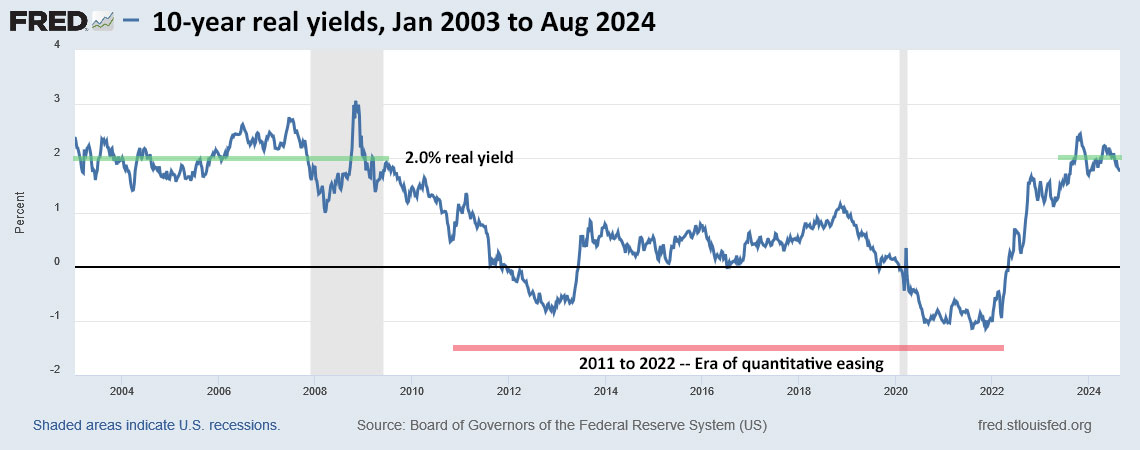
On the above chart, I have noted the years of the Fed’s moderate to aggressive policy of quantitative easing, which was openly forcing Treasury yields lower. That policy could continue while inflation remained under control, as it did for years. But then came the 2020 pandemic and severe economic distress. The Fed and Congress acted together to flood money into the U.S. economy at a time of severe supply disruptions, creating the rather obvious potential for high inflation.
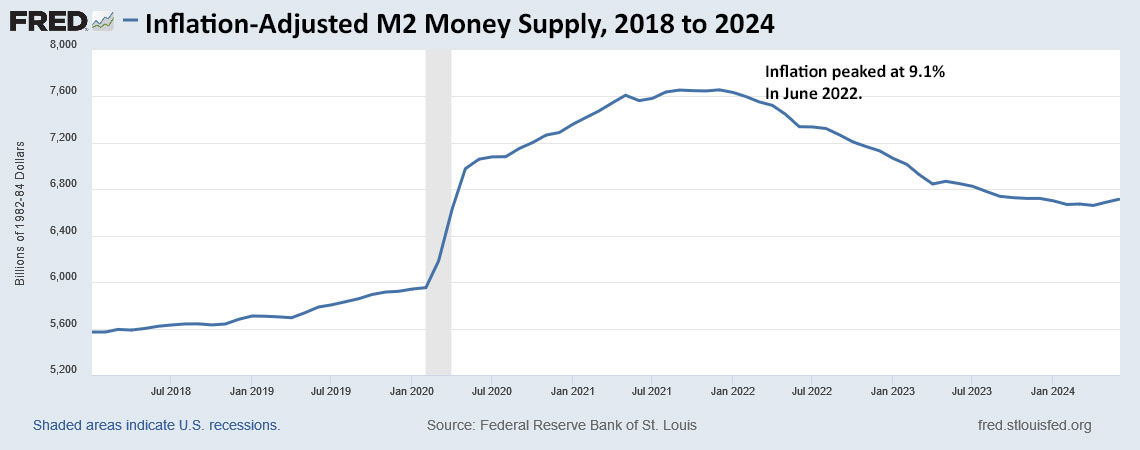
A new era of the new era
Because of the humbling lessons learned, I believe the Fed isn’t going to shut down its focus on controlling inflation even if the U.S. economy slips into a sight decline. So that means medium- to longer-term interest rates could continue near today’s fairly high — but normal — levels for some time. But shorter-term rates will decline as the Fed moves to lower its federal funds rate by 150 to 200 basis points over the next 18 months.
One predictable effect of declining U.S. interest rates is a matching decline in the value of the U.S. dollar, as foreign investors shift some bets to other currencies. The U.S. dollar has fallen more than 5% since late June. The end result of that should be –eventually — somewhat higher U.S. inflation, which in turn should stabilize longer-term Treasury yields.
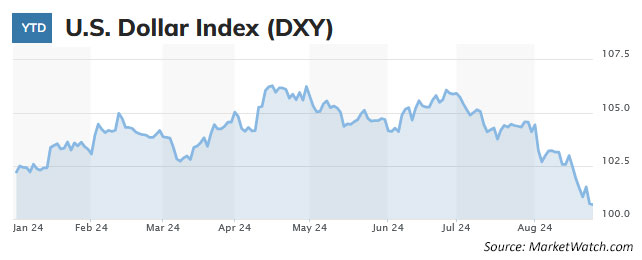
One potential effect of a weaker dollar would be higher oil prices, but so far we haven’t seen much of an effect, possibly because of the potential of weaker international economies.
Real yields have been volatile throughout 2024, and I would expect that trend to continue, while potentially sinking lower.
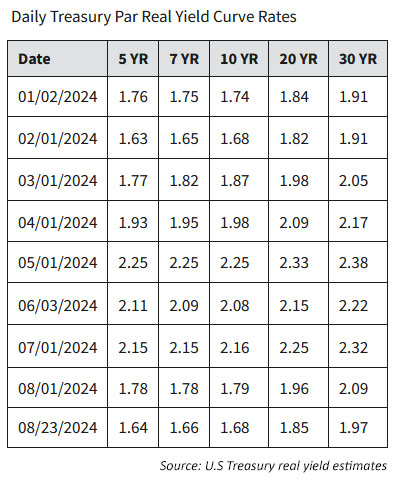
So, in my opinion, we could see 20- to 30-year real yields at times again rise above 2.0% even as the 5-year real yield sinks lower. The yield curve is steepening and that should continue. Keep in mind that the U.S. Treasury needs to continue to issue debt to cover massive U.S. deficits. If the Fed isn’t buying that debt, market forces should result in stable or higher longer-term interest rates.
Back in February 2010, when the Treasury resumed issuing 30-year TIPS, the yield curve was quite steep, with the 5-year TIPS yielding 0.55%, the 10-year at 1.55%, and and the 30-year at 2.22%. Was that normal? It seemed like it at the time.
In summary, I think we are entering a time of almost certainly lower short-term interest rates and murkily uncertain medium- to longer-term yields. A lot will depend on the fate of the U.S. economy and what actions the Fed would take if things again hit “crisis mode.”
As Powell said Friday, “That is my assessment of events. Your mileage may differ.”
* * *
Follow Tipswatch on X (Twitter) for updates on daily Treasury auctions and real yield trends (when I am not traveling).
Feel free to post comments or questions below. If it is your first-ever comment, it will have to wait for moderation. After that, your comments will automatically appear. Please stay on topic and avoid political tirades. NOTE: Comment threads can only be three responses deep or the display breaks on the mobile site. If you see that you cannot respond, create a new comment and reference the topic.
David Enna is a financial journalist, not a financial adviser. He is not selling or profiting from any investment discussed. I Bonds and TIPS are not “get rich” investments; they are best used for capital preservation and inflation protection. They can be purchased through the Treasury or other providers without fees, commissions or carrying charges. Please do your own research before investing.


 Treasury Inflation-Protected Securities
My 2 cent, both interest rates and inflation will remain higher than everyone expects because of 2 drivers with no solution.
2 driving factors.
Again my 2 cents and only time will tell on this subject..
This was posted on the IBond Mega Thread, so I cannot take credit for finding this. Beginning 1/1/2025, you can no longer get paper IBonds on you federal tax return. Therefore, you cannot circumvent the $10,000 individual yearly limit using this method.
https://www.treasurydirect.gov/research-center/faq-irs-tax-feature/
I am posting an article Sunday morning.
Glad to have prepaid the upcoming overseas vacation. I guess there are still a few municipals with good equiv yields for those in high tax states. Has anyone ever done foreign bonds with better yields? Are folks resigned to lower yields or buying Sogo shosha or something else?
In the last year, travel companies have been aggressive about getting full payment early, either by offering discounts or declaring upcoming price increases if you don’t pay. I hate prepaying when I can make nearly 5% on my cash savings. But the upcoming price increases have tipped the balance toward pre-paying with a cash-back credit card. Foreign bonds or currency speculation? Not for me.
Foreign bonds – too volatile in funds. Major hassle to buy direct.
“If the Fed isn’t buying that debt, market forces should result in stable or higher longer-term interest rates.”
This is just a hypothetical question, realizing that the real life is very different: say that the Fed does not exist, bond market is 100% efficient, and buyers are completely rational – would inflation stay at 0%? Would short term rates (real=nominal) be very close to 0? Would longer term rates curve upwards towards some number at 30-50 years? Noone has ever figured out what that magic curve should look like, have they?
If the Fed didn’t exist, and Congress was running massive deficits, inflation would still exist.
Only if they were allowed to increase the money supply by something like QE. I’m not an economist and might be wrong but deficit spending alone shouldn’t cause inflation. Without QE it’s just money moving from the private sector to the government but there’s no increase in the money supply. Deficit spending wouldn’t be sustainable without QE because over time the bond buyers would demand higher yields until the government couldn’t afford to borrow without raising taxes. In my opinion QE in conjunction with shutting down the economy caused the inflation. Hey let’s print lots of money increasing demand but shutdown production reducing supply what could go wrong? There needs to be limits on monetary policy so that never happens again.
Is there any chance or scenario where the ibond fixed rate at least stays at 1.3% in November?
I think there is a chance it will stay at 1.3%, but that will depend on how much lower the 5- and 10-year TIPS yields sink in September and October. My original (very early) analysis earlier this month predicted the rate would drop to 1.2%. But as 5- and 10-year yields drop, that 1.3% I Bond rate is starting to look very attractive.
I agree with most of David’s analysis. However, IMHO, mixed with my wishful thinking, mostly markets overreact. This time, it is no different. One bad (July) jobs report does not make a trend. Labor market and the economy is doing better than recent numbers show (I am an IT guy not an economist – not sure if that is good or bad). Fed will cut rates much slower than the market is expecting. So, for me, I will will milk short-term Treasury bills into, at least, the second half of 2025. Compunding on any inclome is a cherry on top. Yes, yield curve will normalize, and I (also) believe that treasury bonds will have normal (4+%) rates. It could work perfectly for me then to put away some of our cash away for a long time so that my dear wife has to just collect coupons. How much and what am I missing?..as always, great exchanges on this blog.
Annuities anyone?
Thanks for the detailed analysis. I agree that real yields will drop in the medium-term. However, I would not be surprised to see another burst of inflation and higher rates in the next 10-15 years (which could make the high yields of 2023-24 look modest by comparison).
One thing I don’t understand is why real interest rates were so high in the 1990s despite relatively low inflation. Is there any scenario that could push real yields to 3-4% without a major uptick in inflation? If we ever see real yields that high again, I would buy long-dated TIPS without hesitation.
TIPS began being issued in 1997 and were a new product and the market didn’t have a great idea on how to price them. Both 5- and 10-year TIPS issued in 1997 had real yields of 3.4% or higher. In 1997, the nominal 10-year Treasury was yielding above 6% and close to 7% at its high. So the TIPS breakevens were in the range of 2.6% or less. By Jan 2000, a 10-year TIPS got a real yield of 4.34%. and the 10-year nominal was at 6.8%. So the breakeven was about 2.5%, still in the reasonable range. So I guess the point is 1) the market didn’t fully know how to price TIPS, and 2) nominal yields were also quite high, pushing real yields higher.
Lower dollar also usually means higher gold prices, as does inflation… in general.