
Newspaper companies once had a near-monopoly on local advertising. But the best businesses have to keep adapting.
By David Enna, Tipswatch.com
Today, after 38 1/2 continuous years, I let my subscription to the printed Charlotte Observer expire. I hoped to never see this day: My wife loves the printed paper and I worked at the Observer for 34 years. But the printed paper’s death spiral finally pushed me over the edge.
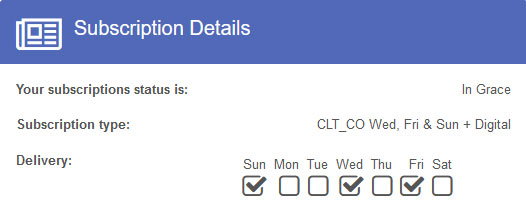
Officially, the Observer says my subscription is “In Grace,” which I think means it is heading to heaven. And probably the Observer will continue delivering it for a week or two to see if I change my mind. I intend to keep my digital subscription.
Keep in mind that The Observer — with a 138-year history — was once a very high-quality newspaper, twice winning the public service Pulitzer and a few others in past decades. At one point, in the early 1990s, the newsroom employed about 225 journalists and had a daily subscription count of about 225,000.
The corporate parent, McClatchy Corp., went bankrupt in 2020 and was acquired by a hedge fund, Chatham Asset Management. Today, the newsroom is down to about 35 journalists, backed up by a corporate team that copy edits a dozen papers each day. The design of the printed papers is done in the Philippines. The print circulation today is probably about 10,000, but McClatchy is pretty secretive on that topic.
When I see my former co-workers around town, I always ask, “Do you still get the printed Observer?” The answer is almost always “no.” I was a holdout because my wife pores over the printed paper and I do the crossword every day (with a pen).
“In an age in which print has become cost-prohibitive and is limited by early deadlines, The Observer must transform its business,” the newspaper’s editor, Rana Cash, wrote in a letter to readers.
I have heard from several friends who called the circulation help desk over the past year to complain about delivery problems. They were encouraged to drop the print subscription and just go digital. In other words: “We know print is doomed.”
Observer journalists still do quality work, when and where they can. And I will continue to read that work online. But my commitment to print died from a thousand pin-pricks:
No more morning delivery. A couple months ago, the Observer announced it was going to reduce its publication schedule from six days a week to three: Sunday, Wednesday and Friday. Plus, instead of having a carrier deliver the paper, it would be sent by U.S. mail.
That change went into effect a week ago, and so far I have received the Friday paper on Monday (our mail arrives after 5 p.m.) and the Sunday paper on Tuesday. Both papers contained content that was up to 4 days old by the time it reached me. The Friday paper that arrived Monday had an article saying Hurricane Helene was approaching the Florida coast. Actually, it hit land on Thursday evening and caused massive damage in the Carolinas on Friday.
Conclusion: The printed Observer can no longer cover breaking news.
No price cut. My latest subscription bill, which I didn’t pay, was for $21.45 for four weeks. As a retired employee, I was still getting a discount, but the price had been rising in recent years. The Observer quotes its “published rate” at $34.99 a week. I hope nobody is actually paying that.
Newspapers across the country often encourage readers (who are mostly elderly, let’s admit it) to sign up for automatic credit card renewals. And then, they just keep raising prices hoping the old folks don’t notice. Don’t sign up for auto-renewal!
No newsroom. I worked on the Observer’s online team in the center of the newsroom for 20 years and then got laid off in 2016. A few years later, when Covid struck, the Observer moved everyone out of offices in an uptown tower, and then eventually closed the newsroom forever.
I can’t imagine working at a newspaper without a newsroom, because interactions between news-gathering reporters feed knowledge and inspiration. You can’t get that on a Zoom call.
No future for local print journalism. I used to describe the Charlotte Observer as a manufacturing company that produced a product each day and delivered it to your home. That meant expenses — beyond the newsroom — for presses, ink, paper, trucks, gasoline, delivery, etc.
Meanwhile, journalism has shifted from print to digital, where distribution costs are near zero for each added subscriber. Readers prefer news that is updated 24 hours a day, and available on phones, tablets and computers. The near-zero cost of adding additional subscribers is why the New York Times and Washington Post allow me to renew my subscriptions for $1 a week, year after year.
(I still get the printed, home-delivered Wall Street Journal, although I stopped paying for it two years ago, while retaining a digital subscription. I guess the Journal wants — or needs — me as a print reader. A weird side note is that the Journal in our area is printed on the Observer presses six days a week.)
The lessons
Sorry for veering off topic today. But the point is, when you are investing in any industry, keep in mind the potential for a series of death-spiral events. Intel Corp., for example, is struggling today because of its emphasis on PC computing. Microsoft though, has expanded its hold on the work place and cloud-computing and is thriving.
Quality journalism is extremely important, especially on the local level. Who will be our watchdogs? Who will shine light on government spending and abuses? I urge you to support quality journalism, both locally and nationally. And that probably means a digital, not print, subscription.
Here are my digital subscriptions, which I will gladly continue as long as prices remain reasonable:
- The Charlotte Observer
- The Wall Street Journal
- Bloomberg
- The New York Times
- The Washington Post
- Barron’s
And FYI, USA Today is currently offering a legit $1 for one year subscription. (Just don’t forget to cancel after the year.)
* * *
Follow Tipswatch on X (Twitter) for updates on daily Treasury auctions and real yield trends (when I am not traveling).
Feel free to post comments or questions below. If it is your first-ever comment, it will have to wait for moderation. After that, your comments will automatically appear. Please stay on topic and avoid political tirades. NOTE: Comment threads can only be three responses deep. If you see that you cannot respond, create a new comment and reference the topic.
David Enna is a financial journalist, not a financial adviser. He is not selling or profiting from any investment discussed. I Bonds and TIPS are not “get rich” investments; they are best used for capital preservation and inflation protection. They can be purchased through the Treasury or other providers without fees, commissions or carrying charges. Please do your own research before investing.


 Treasury Inflation-Protected Securities
I didn’t know your background, David. No wonder you’re such a great writer and effective communicator.
Between the column and the comments, a great deal of territory was covered, but several problems were missed. It isn’t just the print industry that’s in trouble.
“Death spiral” is the correct term. Big Journalism drives another nail in its own coffin as a matter of policy now. By choosing sides to the point of mis-reporting or not-reporting accurate information about events and issues of the real world in favor of supporting one side or damaging the other, media is destroying the essence of what makes it important–its credibility.
The move to digital delivery of its product, information, is only a delaying tactic as the publication, paper or electronic, misrepresents itself into irrelevance. Once the reader decides that what is being presented as fact is instead either opinion or untrue, what’s the reason to continue reading, no matter what medium the words appear on?
That leaves us as an uniformed electorate, unable to trust the “wrong” sources, and eventually unable to identify the truth even when it’s honestly presented to us.
The NYT has offered a $1/wk. promo for years. Every year, when my subscription rate gets bumped up to full price, I call and threaten to switch to the Wash. Post if they don’t continue my promo rate (WaPo has a similar offer).
My promo rate was always extended.
Strange that you would write this today. I have had a digital subscription to my local paper for many of the same reasons mentioned. That a strong local press is the only thing keeping local officals accountable. However, for some reason a print edition showed up in my driveway yesterday and I was shocked as I thought it was just some advertisement dropped off by a local business. I didn’t even take it out of the bag before throwing it in the recycle bin. I used to love reading the Sunday paper. It just isn’t worth it anymore.
In my opinion there’s a place for local print newspapers but they will never be successful with their current business model. Why waste time reporting national and international news in a local paper? I would buy a local paper for local news and not the type of local news stories I read in my area. I’ve learned the hard way that local government is the most corrupt government. They put the feds to shame. My neighborhood had a dispute with a county agency. I did some digging through FOIA requests and found out the county had a long history of polluting the area and I passed this info on to local reporters from a few different papers. The reporters were shocked, but in the end none of them covered the story because I was told off the record the county threatened their access. That’s the kind of story I want to read about not mind numbing school board minutes or national stories that are a week old by the time I get the paper.
Not every local newspaper is the same and sometimes larger papers in the same state will cover the stories that local papers are afraid to cover. I wouldn’t give up on getting out the information. Go to a local TV station that has a segment on unsolved problems with companies or the government.
For me, living in Northern VA, it is slightly cheaper to get the Sunday only Washington Post delivered (with unlimited free digital access) than to have a digital only subscription. I discovered this a few years ago, when I called to change to digital only and was talked into keeping the Sunday only delivery at a reduced price that is supposed to last for my lifetime.
I page through the Sunday paper to see if I have missed anything, but most of what I see there was online a few days earlier. The Sunday paper also used to include dozens of manufacturers coupons, but they have now disappeared.
The demise of print journalism is an unfortunate reality, and I have also been forced to seek other means and sources for the news. I currently maintain digital subscriptions for the NY Times and with Bloomberg which recently turned the paper BusinessWeek into a monthly publication.
I wondered if you have tried any of the news aggregator efforts that try to bring together multiple news sources to a single site. I have experimented with a few such as Google News, Artifact (which I liked but it recently folded) and currently trying Ground News. These sites typically allow users to select the categories of news content you want to read and allow you to exclude sources, or content that is not of interest. Ground News is also trying to show readers political bias and factual basis for news stories using a series of algorithms. They also have a section dedicated to local news.
With so many different sources of digital information and news available on the web and the uncertainty of what is true versus fiction I am always looking for help with curated content and the ability to filter the results to my interests.
I have tried Apple News, and it is fine but couldn’t replace my existing subscriptions and it isn’t cheap. I sometimes use MSN and Yahoo News because they offer free links to content that is otherwise behind a paywall (including Charlotte Observer stories, weirdly enough). Also, the SmartNews app is an interesting one because you can customize the content.
David, I too, was a print journalist, the worked as labor and economic editor/writer for state government. It is important to keep a thriving news organization at the local level.
I have a similar list of digital subscriptions and partially do it as a way to underwrite the industry. Unfortunately most consumers receive their “news” from unreliable sources.
Keep up your valuable resource on financial and economic issues.
Brent Fine
Thank you for this article, David. I loved my WSJ print edition because it allowed me to read detailed articles at my own pace without new banners popping up on the screen. I also realized that the amount of articles I read in the print version (vs the electronic version) was much, much higher because the info was right there in front of me rather than having to search a website with a keyword or “subscribe” to a particular author. Alas, the WSJ raised my print subscription offer by 33% and that is a bridge too far for me. Finally, for those who regard print newspapers as some environmental disaster, I would argue that rampant purchases of junk by Americans is the real environmental disaster. I recycled all of my newspapers. People also seem to forget how much energy is required for the server farms used for digital media (and that was before AI came onto the scene). Thanks again.
To make matters worse, those copy editors are about to be replaced by AI, if that hasn’t happened already. Much of the routine business news you see is already AI assisted or generated.
On the bright side, digital makes “long form” journalism possible in a way print never could. As a former sportswriter, I am impressed by the quality and depth of writing on The Athletic site. And they do it on a daily basis.
I also covered a couple of wars and X is an amazing source for immediate and visceral reporting on the wars in Ukraine and the Middle East. X is often a cesspool of misinformation and lies but if you know where to look and how to contextualize, it has transformed war reporting. And my local police and city officials use it effectively to tell the public where roads are blocked or where there is police activity.
I have subscribed to The Athletic almost from the beginning. Unfortunately, the articles have become progressively worse and more and more clickbait. Only reason I reupped last time is I was able to get a $1 a week deal through the NY Times which also gave me access to Wordle which I play with my family daily. That includes the NY Times which I find myself reading infrequently. I believe in the need for good journalism but I wonder what the economic model is to pay for it where I as a reader feel it is a good value.
I have been getting my “local” newspaper digitally for a few years after having problems with the doorstep delivery (hmm, makes me think . . . perhaps Doordash has a new delivery opportunity). The paper then went to USPS delivery. My neighbors also get their copies days after publishing (with content that are already days old).
The “local” paper has virtually no local stories (maybe one, a few state articles and then a bunch of content from the parent USAToday). I still subscribe as I do find the latter articles of interest (and a few comics I like).
I get the most useable local content from a digital source which I just gave a donation to. We also still have a few printed (and digital) local sources that you can get at stores/etc.
I also subscribe to the physical Time magazine which I appreciate for more in-depth information. The Atlantic also has great content. Digitally also do NYT, Washington Post and Bloomberg.
It is indeed a very sad situation and the almighty dollar (and investors) drive a lot of it. I now see that CNN is going to a paywall.
David, your discussion of Intel and the changing landscape for businesses makes me think of the spellbinding book I am reading (actually listening; the author narrates and is fantastic) — “The End of the World is Just Beginning” by Peter Zeihan. The title is a bit sensational and depressing, but the author weaves an incredible perspective of how we got to now and what can (will, in his mind) transpire over the next decades. He foretells the collapse in globalization we are in the midst of and the implications
This is a good book review https://www.noahpinion.blog/p/book-review-the-end-of-the-world
For environmental reasons I am happy to see printed daily papers fade away. “…You can’t get that on a Zoom call” is the statement of your blog today which is most on my mind. I agree that coworkers need to be in the office so that they can develop each other, including reigning in the occasional out of touch ideas.
It does not bother me that my work from home colleagues are able to tend to home needs and proximal offsite urgencies during their workday; what bothers me is the inadequate service provided to customers mostly due to lack of oversight and daily modeling, training.
I do not mind your occasional drift to topics outside of Tips, and I hope that you continue to allow your readers to contribute in the same fashion.
For more than a decade of online work, I started working at 6 a.m. from home (often six or seven days a week) posting everything new, then eating breakfast and walking a mile to the office. Eventually, bosses put an end to that, which meant I had to get up an hour earlier every morning, at 4:50 a.m. In my case, the combination of home/office work was actually very productive and efficient.
I rolled newspapers for a small town paper in North Texas in the sixth grade and then after rolling the papers delivered them six days a week on my bicycle, throwing them on my customers porches. I collected the $.35 a that the paper cost on a weekly basis, usually on a Saturday and then took the proceeds down to the newspaper office where Mr. Flowers would tally everything up and I would get paid on what I had collected. I worked at my college newspaper in various capacities, usually as an editor and enjoyed the experience immensely. Our college paper published five days a week. I now support three weekly newspapers in small towns in far West Texas and enjoy being able to pick up the physical paper on a Thursday and enjoy it over lunch or with the next morning’s coffee. In addition to the passing of the dependable delivery of large metro papers, journalism isn’t what it used to be either. The free dissemination of information and having a physical written forum for the discussion of ideas seems to now have been replaced by an obsessive concern with so-called disinformation and cutting people’s microphones off when “those in charge” don’t want to hear what they have to say.
This brings back memories. I did the same thing on the island of Maui, in the late 70’s/early 80’s. I still remember being forced (by the bossmen at the paper) to ride my bike and deliver in a literal hurricane one day. 12 years old and got my first taste of management vs. labor, lol.
I also had a newspaper route, worked at two college newspapers, then at a suburban Chicago newspaper before moving to the Observer in 1982. Despite the death spiral (which became depressing) working at a newspaper and in a newsroom was incredibly rewarding and exciting. Every day was new adventure.
Change can be hard at our age, but I do enjoy my “digital” newsletter from you, even when it may seem to veer off, which it actually did not. Intel is a mess but it also failed to focus in the right areas and started to try to do too many things. Strategy is important and good ones succeed while bad ones…..don’t.
I’m down to the digital subscriptions for WSJ, NYT, and my local paper, the Detroit Free Press. Keep in mind that many libraries offer free on line subscription to WSJ.
FYI, the Detroit Free Press has a new story today quoting me on I Bonds: https://www.freep.com/story/money/personal-finance/susan-tompor/2024/10/03/what-fed-rate-cuts-ahead-could-mean-for-cds-i-bonds-and-savers/75450701007/
Great read.
Susan Tompor does a great job on personal finance articles. Somehow TIPS were not mentioned in this piece.