
The BLS over time: ‘A tin can tied to my coat tail‘
This article is republished by permission of the authors.
By Philippa Dunne & Doug Henwood / TLR Analytics
We have worked closely with the Bureau of Labor Statistics for decades and, in the belief that people are more likely to value what they understand, are adding some historical context, focusing on the early days at the Bureau, to the ongoing discussion of the many probable repercussions of President Trump’s firing of Commissioner Erika McEntarfer last week.

The Bureau of Labor Statistics was established in 1884 to study the many issues affecting working men and women. In the words of the first commissioner, Carroll D. Wright, the mission was to conduct “Judicious investigations and the fearless publication of the results.” That was a tall order for a team of three on a $25,000 budget!
Since their founding, the BLS has published more than a thousand monthly employment reports, and this is the first time a commissioner has been fired directly after the release of one of those reports.
There have been accusation of data manipulation, some apparently substantiated, and there is one suspect dismissal that was cloaked as a retirement-age requirement.
Leading into the 1932 election, President Herbert Hoover announced that the Great Depression was almost over, based on the fact that the employment rate had grown by 4% in the previous month. Francis Perkins, who was soon to become President Franklin D. Roosevelt’s Secretary of Labor, pointed out that his statement was inaccurate, the jump was caused by seasonal Christmas hiring, not permanent jobs, something she believed Hoover would have understood on his own. And Ethelbert Stewart, then BLS chief, had told Hoover this.

Hoover continued to make the claim, as did his Secretary of Labor, William N. Doak, and the press approached Stewart for his opinion. He was direct in his criticism, which Doak tried to refute, and then gave Stewart a public ” tongue-lashing for daring to contradict his chief.”
Although details of Stewart’s departure from the BLS are somewhat unclear, Time reported under the lede, “Last week the Government’s foremost expert on joblessness found himself jobless,” that although Stewart was supposedly forced into retirement by his age, many disputed that. Stewart himself rejected the term “retired,” adding, “Don’t put it that way. I’ve had a tin can tied to the end of my coat tail.”
In 1971, President Richard M. Nixon ordered the BLS statistician who pointed out that a fall in the unemployment rate from 6.2% to 5.6% was likely caused by a “statistical quirk” be identified, and fired. And in the coming months when the assistant commissioner Harold Goldstein pointed out that one decline in the unemployment rate was “marginally significant,” and another “sort of mixed,” Nixon cancelled the briefings that traditionally followed the release of the monthly jobs report. Rumor has it that Senator William Proxmire, known as a critic of wasteful government spending, requested that the Bureau report directly to the Joint Economic Committee on which he served so they could have discussions free of political spin.
Nixon also believed the BLS included a “Jewish Cabal” out to get him, which led to the “Nixon Jew count,” where H.R. Haldeman supervised an investigation into BLS employees with “Jewish-sounding names.” In what Timothy Noah once described as the “last known act of official anti-Semitism conducted by the United States government,” thirteen employees identified as Jewish were moved into positions that did not involve compiling the politically sensitive employment reports.
It’s easy to think BLS staff, and Dr. McEntarfer herself, were exhibiting the fearlessness Wright was committed to, but releasing and correcting data is just what the BLS does. Years ago, an economist there told us it is indeed painful to release unusually large benchmarks, but “we do it anyway.”
Looking back to the early days of the BLS, there’s a good bit of colorful language. Amid the ongoing debate concerning founding a bureau that concentrated only on the world of work, one senator argued, “A great deal of public attention in and out of Congress has been given to the American hog and the American steer. I submit, Mr. Chairman, that it is time to give more attention to the American man.”
Perhaps that should have been man and woman, and within its first three years the BLS published a study of woman working in “manufactories” in big cities.
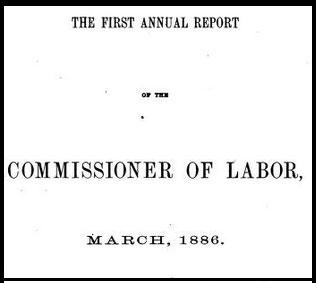
Commissioner Wright’s first annual report provided information on the character and potential causes of industrial depressions in a global context.
Here’s a timeline of the development of the many data sets, and we’ve put together some highlights.
Publications in the 1880s included the first consumer expenditure survey, and in the next decade the BLS looked into the effect of tariffs on wages and prices, and investigated the effects of machinery on employment, production and productivity in Hand and Machine Labor.
Later BLS added producer and consumer price indexes, industrial accidents, and in 1915 began their monthly surveys of employment and payrolls, now the Current Employment Statistics program. The first Monthly Labor Review was published that year, and the BLS signed cooperative information agreements with the states the following year.
BLS’s expertise is long-standing. By the 1940s they were training international economists and statisticians, and in 1959 they set up the Household Survey, now officially known as the Current Population Survey. Soon after they conducted comparative studies of international unemployment rates, and of federal and private-sector compensation.
In the 1960s, BLS began recording occupational injuries and illness, and the first job openings reports were produced. The full JOLTS report would be later.
Data on workers with disabilities appeared in 2009, on green jobs in 2012, and that same year BLS Tweeted for the first time!
During the COVID pandemic BLS added questions about job-site respiratory illnesses, and began tracking much-needed data on indigenous populations in 2022. That was long in the making. BLS is now using QCEW data to identify populations facing violent weather events.
True to their mission of accurate impartial investigations of labor conditions, BLS established the Business Research Advisory Council and the Labor Research Advisory Board in 1947. In 2000 the BLS, together with the Bureau of Economic Analysis, founded the Federal Economic Statistics Advisory Committee, in 2007 the long-standing labor advisory board was renamed the Data Users Advisory Council, and in 2010 the BLS put together the Technical Advisory Committee.
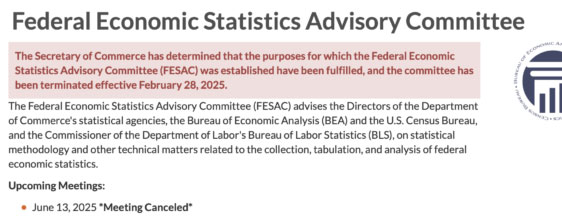
All of these committees, made up of experienced and unpaid professionals in economics and related fields, were disbanded by President Trump in late March.
The boards were established to monitor data quality, evaluate BLS methodologies, and suggest improvements. This work was intended to be ongoing — technology changes, and pressure from administrations varies — which made the statement that members had “fulfilled their mission,” as advisors to the BEA were told, downright humorous.
At the time, former BLS Commissioner Erica Groshen commented that given the Committees’ mandate, “I would say that if an administration wanted to try to manipulate data, then they would not want these advisory committees to be around.”
The monthly payroll reports the BLS has published since their founding covered the Great Depression, all manner of lesser recessions, wars, and the effects of inflation spikes. Many of those reports were far worse than the limpid July report that caused Erika McEntarfer to lose her job. President Barack Obama had to accept huge monthly declines, and a -0.9% benchmark revision, multiples of average at the time. President Joe Biden was accused of having cooked the books when the unusually large benchmark revision to 2024 payrolls came out late last August, just two months before the election. (Of course, he was no longer the candidate, but if the BLS were tampering with the records to favor the Democrats, they were doing a lousy job.)
In her history of the BLS, Janet Norwood notes that many of the problems faced in the early days of the BLS are “unresolved to this day.” A major problem then and now is low and late response rates. As early as 1885 a state commissioner argued with appealing candor, “If questions are asked of five hundred men indiscriminately, and two hundred … give answer, those two hundred will not be average representatives of the whole five hundred. They will, on average, have more brains than the other three hundred. The very fact that they answer, while others do not, shows this.”
The revisions that sent President Trump to a place no has ever been before, firing an experienced commissioner because a report was not flattering to the current economy, are caused in large part by such late responses. Response rates have been declining for some time, and former Commissioner Groshen believes some of that decline has been driven by a loss of confidence in public data, and a growing disregard for public research. An inadequate budget also gets a nod. With the BLS’s current, nominal, budget slashed by eight-percent, BLS staff will probably be unable to follow up on particularly pesky sectors, like public education, as they once did.
Bureau of Labor Statistics employees have long argued that with proper funding they could update their data series in order to make them more timely and accurate. For example, the Department of Labor designed the weekly unemployment claims series as an administrative tool, which is why it can sometimes be misleading in gauging unemployment. The series includes a wealth of regional and demographic data that could be restructured as an economic indicator, a kind of early warning system, that would give policy makers notice on developing weakness they could then address, and those who want the 411 on national employment for market reasons would have more timely data as well.
The other is funding an update of the Quarterly Census of Employment and Wages. As we often mention, QCEW covers 97% of the employment universe as defined in the establishment survey, but is released with a lag. We won’t have data for the first quarter of 2025 until early September. And recent budget cuts just pushed that forward from late August.
The decision to cut the BLS budget, and staff, was made by the current administration. When the administration disrupted the carefully crafted structure, including remote work, the BLS had put together to deal with the fact they were moving into a space 40% smaller than the one they had occupied, and budget cuts were announced, many analysts raised red flags suggesting these disruptions could lead to larger revisions in upcoming releases.
Correlation, of course, does not imply causation — we could be seeing big downward revisions because the labor market, driven by all the unknowns and supply disruptions, is weakening more than we knew. That would make the birth/death model too additive, as often happens in downturns, which the BLS took into account during the pandemic, hence the very small benchmarks in 2020 and 2021.
But that possibility doesn’t erase the question. How quickly will the administration’s actions cut into the quality of the BLS’s data, respected around the world as the gold standard, and crucial to our creditors?
* * * About the authors * * *
Philippa Dunne and Doug Henwood are co-editors of The Liscio Report, an independent newsletter geared to traders. The Liscio Report was founded in 1992 by John Liscio, and is known for monthly surveys of state tax data and related forecasts, and independent analysis of macro-economic trends.
Dunne joined The Liscio Report in 1996 to work on special projects, and in 1997 began full-time work as the “research department.” Henwood, a widely recognized economic analyst, caught the attention of John Liscio early on and as the “resident wise man” crunched and analyzed stats from the report’s very first days.
TLR Wire is published weekly by TLRAnalytics with this aim: “No ideology, no agenda, just a straight take on breaking economic data.” You can subscribe here.
—————————

Donate? This site is free and I plan to keep it that way. Some readers have suggested having a way to contribute. I would welcome donations. Any amount, or skip it, your choice. This is completely optional.
—————————
Follow Tipswatch on X for updates on daily Treasury auctions and real yield trends (when I am not traveling).
Feel free to post comments or questions below. If it is your first-ever comment, it will have to wait for moderation. After that, your comments will automatically appear. Please stay on topic and avoid political tirades. NOTE: Comment threads can only be three responses deep. If you see that you cannot respond, create a new comment and reference the topic.
David Enna is a financial journalist, not a financial adviser. He is not selling or profiting from any investment discussed. I Bonds and TIPS are not “get rich” investments; they are best used for capital preservation and inflation protection. They can be purchased through the Treasury or other providers without fees, commissions or carrying charges. Please do your own research before investing.


 Treasury Inflation-Protected Securities
Is it starting already?
From last week (https://www.bls.gov/cpi/notices/2025/methodology-changes-2025.htm):”With the release of October 2025 data on November 13, 2025, the Bureau of Labor Statistics (BLS) will remove long-term care (LTC) insurance from the health insurance index. Changes in the market for LTC insurance have made it out of scope and ineligible for pricing in the CPI market basket.”So, with an ever growing population of boomers now needing LTC and the supply of cheap immigrant labor to provide that care being sucked away, I wonder what direction the price of LTC services will go? Yep, better remove that element from the CPI calculation.
I do hope that if one can prove actual premeditated and deliberate tweaking of CPI components to artificially keep reported CPI low, then it will be possible to do a class action lawsuit when the next administration comes in to effect all the retroactive adjustments required to make all TIPS holders completely whole. I guess the same thing for Social Security COLA adjustments, all the various AGI cutoffs in already filed tax returns and so on and so on. Basically to make this so incredibly painful for the government that no future president will ever attempt to cook the CPI books again.
Nothing has actually changed (yet) at the BLS, with the same people in charge, minus the commissioner. Long-term care insurance (which I ended up ditching a few years ago for a buyout settlement because of annual soaring costs) has morphed into all sorts of alt versions, difficult to understand and difficult to define. But it is definitely a high-inflation product.
Thanks for posting this US history lesson.
Administrations will come and go, and the truth cannot be hidden for too long before it becomes apparent.
The US Treasury will honor their commitments I’m quite certain.
Campaigning does not ever stop till everyone is a covert! Then democracy dies comrade. We just need to convince ourselves that porfolio losses are good. Glad did not bet my retirement on Safe gov issues. I even avoided the index/inflation payout on my annunities since its standard for insurance companies just to change their measurements with common sounding names. Sounded so good when younger.
But if the theory is that Trump is purposely understating inflation and that his election is an anomaly and that the democrats are ethically pure and their reelection in 2028 is inevitable, wouldn’t they correct the market basket in 2029 creating a big one time bump up in inflation and inflation indexed securities? Therefore the wise investor should be stocking up in anticipation of the 2029 bump up.
The next Administration could do that but you still wouldn’t be made whole.
If, for the next few years, the Administration understates 5% inflation as 2% inflation, you would earn less interest. The principal adjusts, so, after a year, your TIPS would be worth $1020, then $1040.4, then 1061.208. At 5% inflation adjustment, after a year, your TIPS would be worth 1050, then 1102.5, then 1157.625. At the point, you’re missing out on $2 in interest for every $1000 invested. A future adminstration could adjust the principal but they’re never going to give back the missing $2.
In fact, it’s not at all certain what a future Administration would do. Restoring TIPS probably wouldn’t be a campaign issue and it probably wouldn’t be a priority. I imagine the priority would be “honest inflation numbers.”
Thanks, David, that was a fantastic historical look at the BLS. I passed it on to Sen. Cassidy’s office after I called and talked to one of his assistants. Cassidy is chairman of the committee that will have a hearing on the BLS commissioner nominee.
I told his assistant that he was fooled by RFK Jr. that he wouldn’t fool with the vaccine approval process. Now he has a second chance to stop a nominee who is not qualified to head an agency because of his past comments about BLS and his ties to the Heritage Foundation, plus his denial of the 2020 election results.
I emphasized to the assistant that our ability to maintain credibility with world financial markets will be hurt if there is an appearance of interference with the process of putting out credible statistics on the economy. It could lead to a lack of investment in our bonds and much higher interest rates.
I hope that the books will not be cooked as others have asserted is possible. But frankly I grow weary of the relentless narsasistic personality in the headlines. Just want the markets to function properly.
I am working on protecting my mental health. My current project is to go back and study past US history. Times have been a lot tougher. So hopefully we get through all this.
We are in uncharted ground for our country.
Thanks for sharing this article. It provides important perspective on what we are seeing with Trump.
“President Joe Biden was accused of having cooked the books when the unusually large benchmark revision to 2024 payrolls came out late last August, just two months before the election. (Of course, he was no longer the candidate, but if the BLS were tampering with the records to favor the Democrats, they were doing a lousy job.)”
This is a reference to the record negative 800,000 jobs revision. If the authors are trying to shore up my faith in BLS numbers they too are doing a sub-stellar job.
One interesting sideline to this is that President Trump repeatedly says this huge 2024 jobs revision was made a week AFTER the election, when actually it was more than two months before the election. He even gives a specific date, Nov. 15, 2024. It actually happened Aug. 24, 2024.
It’s one thing for a political opponent to falsely accuse then President Biden of cooking the books in the middle of a presidential campaign. That’s part of the political game to do everything possible to gain an advantage. Never-mind it contradicts the whole other narrative about him not being with it enough to be running the government. One can’t be out of it and also be so cunning at the same time.
But it’s a whole other thing for current President Thump to falsely accuse the BLS administrator of rigging the data she is responsible for gathering for political reasons when there is no campaign at all just because the numbers reflected poorly on his policies.
Not only “no campaign” but no actual evidence cited that she “rigged” anything. Just another among so many wild fact-free assertions from this president and/or his often-unqualified subordinates.
News media (this link is from CNBC but it was not alone) reported that Stephen Bannon was one of the people moving behind the scenes for Trump to nominate E. J. Antoni of the Heritage Foundation.
https://www.cnbc.com/2025/08/11/trump-antoni-bls-statistics.html
From an August 1 interview between Bannon and Antoni, whom Trump would then nominate:
Bannon: “What the hell is going on there? And have we put in our own person into BLS? Is a MAGA Republican that President Trump knows and trusts, are they running the Bureau of Labor Statistics yet, sir?”
Antoni: “No, unfortunately, Steve, we still haven’t gotten there. And I think that’s part of the reason we continue to have all these different data problems.”
For anyone who still has the quaint notion that the “we” being “served” by civil servants is “we, the people,” i.e., the public and various institutions (certainly not least the Federal Reserve) who need reliable government statistics, it’s interesting to see who these guys actually mean when they say “we.”
Video at: https://www.msn.com/en-us/news/politics/trump-hires-data-chief-who-agreed-with-steve-bannon-s-call-for-maga-republican-to-control-jobs-data/ar-AA1KoaaV
A good summary, thank you, David.
I place substantial emphasis on Trump’s February/March 2025 terminations of the committees of volunteer (i.e., unpaid) experts who had been advising the government (BLS, Census, etc.) on ways to ensure the accuracy of its statistics.
And I remember that Trump didn’t just fire Erika McEntarfer (who was originally confirmed to her position by an overwhelmingly bipartisan Senate vote of 86) because statistical releases displeased him. He asserted that she had intentionally rigged the statistics.
And I see that the nominee to replace her comes from the Heritage Foundation, the source of Project 2025. And I contemplate that Trump’s budget director, a principal author of that Project document, has said that he wants federal civil service workers to feel traumatized (his word, not mine)(do a simple web search for Russell Vought traumatic) and to dread coming to their jobs–and so, despite media observations that only the BLS commissioner is a political appointee, I have doubts that the expert professional staff of BLS will be left in peace to do their jobs without interference or intimidation. A doubt further increased by the adminstration’s intention to cut the BLS budget.
None of the above are the actions of an administration which seeks maximum statistical objectivity and reliability and will let-the-chips-fall-where-they-may.
Then I also remember that this president is still claiming that the 2020 election was stolen from him, and that his nominees for cabinet (and other) positions, when testifying to Senate committees, still won’t acknowledge that he lost that election (because, if they did, they would never have become his nominees). And I think of the way this administration is purging information about climate change from federal government websites. And that the administration is about to launch a “review” of the Smithsonian museums for the alleged failure of their exhibitions to “celebrate American exceptionalism.” And the administration’s claim that U.S. tariffs are paid only by foreign companies, not ultimately by U.S. consumers. And so on with other examples . . .
And I conclude that this is an administration which decides policy (or spin) first, and then tries to torture, or outright eliminate, any facts which conflict with its predetermined “reality.”
And so, although I try not to fall prey to conspiracy theories, I am experiencing a loss of confidence in future BLS statistics, but unable to figure out what it may mean for our household’s portfolios of I Bonds and TIPS, during the rest of this administration, and/or after this administration has passed from office.
Well said. You’re describing actions and events that are common to dictators. Whether justified or not, I continue to have faith that TIPS and I-bonds are still good investments and won’t be materially affected by the current administration in the long run.
So what could happen to I-Bonds? (A) changes to how the fixed rate is determined. (B) minor changes to how inflation is calculated that reduce the rate (less than 1.0%). (C) major changes to how inflation is calculated (more than 1.0%). (D) nothing. (E) anything else?
Even as I agree with your dictator comment – IMO, the most likely is still (D) nothing; but the only reason for calm is the expectation that any malfeasance will be obvious and known in advance. There is still essentially no “market risk” nor “principal risk” for I-Bonds to cause me to want to jerk money out in fear.
However any holders of 0.0% – 1.0% fixed rate I-Bonds may consider their rate insufficient. These are not competitive against CDs, MMs, or nominal T-Bills, and not within the margin of safety against malfeasance if (B) should occur without recourse.
Also, there is a more basic poor customer service risk, and a free-floating cybersecurity risk, both associated with lower staffing levels. May be a side point, but still worth mentioning.