
Core inflation held at 2.6%, a 5-year low for a completed year.
By David Enna, Tipswatch.com
FYI, comments have now been closed on this article. Discussion was going strictly political.
U.S. inflation rose 0.3% on a seasonally adjusted basis in December, the Bureau of Labor Statistics reported today, with annual inflation holding steady at 2.7%, same as reported for November.
The annual rate ended up higher than expectations, but that was balanced off by a lower-than-expectations increase for core inflation, which removes food and energy. Core inflation increased 0.2% for the month and held steady at 2.6% for the year. So this looks like a fairly mild inflation report.
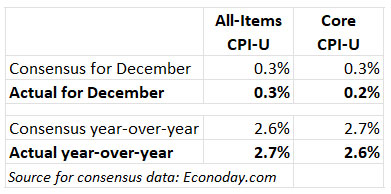
The December report closes the books on 2025 with an annual rate of 2.7%, down from 2.9% in 2024. That’s progress, but overall inflation remains too high.
The BLS noted that shelter costs increased 0.4% for the month and are up 3.2% for the year. Shelter costs will continue to be an “iffy” indicator because the BLS collected no survey data in October, which may slightly suppress inflation numbers for several months. Also in the report:
- Food at home prices rose an alarming 0.7% in December and are now up 2.4% for the year. The December number reverses a several-month trend of mild food-price increases.
- Five of the six major grocery store food group indexes increased in December. Costs of fruits and vegetables rose 0.5%; bakery products, 0.6%; dairy products, 0.9%. However, prices for meat, poultry and fish declined 0.2% in December and egg prices fell 8.2%.
- Gasoline prices, which fell 0.5% in December, helped lower all-items inflation. Gas prices fell 3.4% over the year.
- Electricity prices also fell 0.1%, but are up 6.7% for the year.
- Piped gas service prices rose 4.4% for the month are are now up 10.8% for the year.
- Costs of new vehicles were flat for the month and up only 0.3% for the year.
- Costs of used cars and trucks fell 1.1% for the month and are up 1.6% for the year.
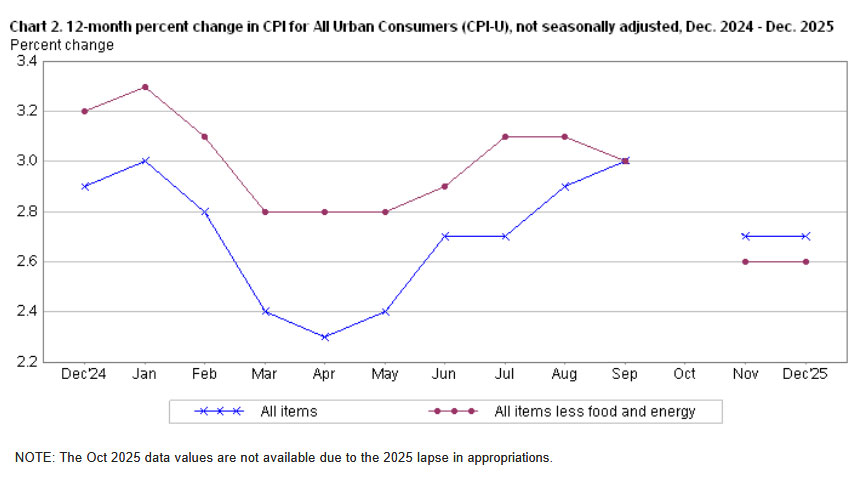
Here is the trend for all-items and core inflation throughout 2025, a wild ride that includes a gap for missing data in October and let’s say “questionable” data for November. The December data offer a tiny bit of clarity:
What this means for TIPS and I Bonds
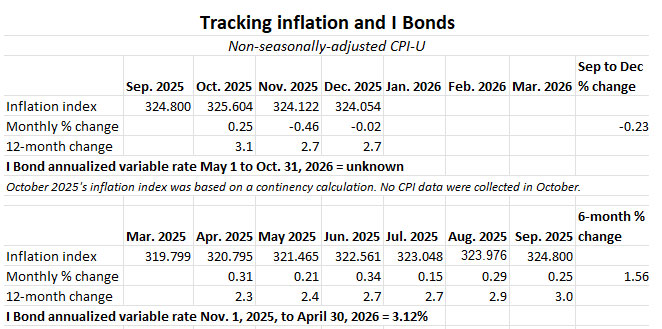
Investors in Treasury Inflation-Protected Securities and Series I Savings Bonds are also interested in non-seasonally adjusted inflation, which is used to adjust principal balances on TIPS and set future interest rates for I Bonds. For December, the BLS set the inflation index at 324.054, down 0.02% from the November number.
For TIPS. The December inflation index means that principal balances for all TIPS will decline 0.02% in February, after falling 0.46% in January. However, for the year ending in February, TIPS balances will have increased 2.68.%. Here are the new February Inflation Indexes for all TIPS.
For I Bonds. The December report is the third of a six-month string that will determine the I Bond’s new variable rate, to be reset May 1. Inflation in the months of October to December has declined 0.23%, which at this point would result in a variable rate of -0.46%. However, this trend will likely reverse (possibly strongly) in January to March. So it’s too early to focus on the likely variable rate.
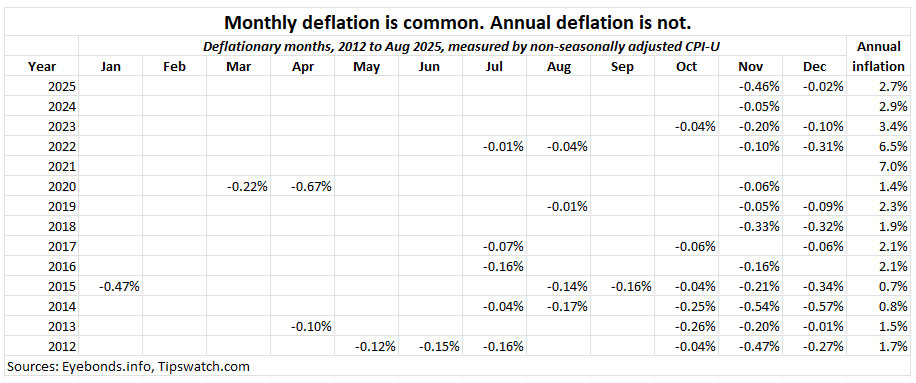
Non-seasonally adjusted deflation is common in the months of November and December, when holiday discounting kicks in. That is why the CPI is seasonally adjusted. Over the year, these variances balance out.
What this means for future interest rates

Beyond any other “brewing crisis” factors, I’d say this report does not support a cut in interest rates by the Federal Reserve in January. Inflation retreated slightly in 2025 but remains well above the Fed’s goals. Add to that threats of criminal indictments and Jerome Powell’s strong response, and you get some sort of gridlock. The current Fed is not going to bend to pressure.
The positive from the report is that core inflation came in slightly below expectations, and the annual rate of 2.6% marked a 5-year low for a completed year. But questions about shelter data remain, so the Fed may put off further cuts. Here is the reaction of Jeff Schulze, head of economic and market strategy at ClearBridge Investments, reported by Bloomberg:
“While investors will cheer this release as further evidence of disinflationary progress, the Fed will remain in ‘wait and see’ mode given the uncertainty until more distance came be put between the data and the shutdown. This release is positive for risk assets and increases the odds that the Fed will provide additional monetary policy support in 2026.”
—————————
Donate? This site is free and I plan to keep it that way. Some readers have suggested having a way to contribute. I would welcome donations. Any amount, or skip it, your choice. This is completely optional.
—————————
Follow Tipswatch on X for updates on daily Treasury auctions and real yield trends (when I am not traveling).
Feel free to post comments or questions below. If it is your first-ever comment, it will have to wait for moderation. After that, your comments will automatically appear. Please stay on topic and avoid political tirades. NOTE: Comment threads can only be three responses deep. If you see that you cannot respond, create a new comment and reference the topic.
David Enna is a financial journalist, not a financial adviser. He is not selling or profiting from any investment discussed. I Bonds and TIPS are not “get rich” investments; they are best used for capital preservation and inflation protection. They can be purchased through the Treasury or other providers without fees, commissions or carrying charges. Please do your own research before investing.


 Treasury Inflation-Protected Securities
David – I some questions about EE bonds. Right now the rate on EE bonds is at 2.5%. I consider this to be moderately attractive given the tax deferral, compounding and state tax exemption and the fact that many bank money market rates are at around 2% or less.
But the EE bond rate seems to fluctuate from around 4% many years ago, I think it was 6% briefly in the 90s, to near zero not too long ago to the 2.5% that it is now.
Do you have any understanding on how Treasury arrives at the EE bond rate? Is the 2.5% rate something we can rely on for the foreseeable future?
Thank you.
I haven’t focused on finding a formula to predict the EE Bond fixed rate, which is permanent for the life of the bond. I suspect it is somewhere in the range of the 0.65 ratio used for I Bonds but applied to some nominal Treasury maturity, but I haven’t be able to nail that down. If you hold for 20 years, the original investment is doubled, creating a return of 3.53%.
H David,
I don’t know where else to ask this question so I apologize if it is out of context to the discussion.
Is it possible to move Series I Savings Bonds from my Treasury Direct Account to my bank or brokerage account?
If this is not possible can my wife and I consolidate our accounts into one account at Treasury Direct?
Thank you for all of your work over the years.
Robert
If this is not possible can my wife and I consolidate our accounts into one account at Treasury Direct?
YES. Here is a link to the FAQ in Treasury Direct.
How Do I…? — TreasuryDirect
How do I transfer savings bonds from my TreasuryDirect account to another TreasuryDirect account?
Thank you, Doug.
Robert
Thank you Doug for your response on transferring I Bonds.
I Bonds can only be held at TreasuryDirect, however. They cannot be moved to a bank or brokerage.
I thought so.
Thank you.
Robert
David
Based on your sense of the data, is now a good time to buy an I-bond or is it better to wait until we get a few more months past the shutdown period?
Thank you for writing TIPSwatch Bob
I will write my annual I Bond “Buying Guide” soon. I plan to post it Sunday, Jan 25. I will say that I would not be eager to buy I Bonds in January. A wiser move will be to wait it out until mid-April, which I will explain in that article. The shutdown isn’t really the issue; it will be to see how real yield and inflation trends evolve.
The threat to independence of US institutions is a fundamental threat to the value of TIPS (I know, obvious to say). I’ll be curious if the coming 10-year TIPS shows any weakness in the market for that reason. I’m still planning on buying, but it does worry me.
I suppose there’s a possible risk-scenario calculation here. If our risk case is that the official inflation is depressed from 2026-2028 by say 0.2% per year, then does that change the balance of nominal vs TIPS bonds we might choose to allocate assets to. We may look at the breakeven rate and say we’re still fine with that, for instance.
November Producer Price Index for final demand was just reported as 3.0% for the last twelve months. Core PPI was up 3.5% for the same period. Since PPI is measured at the wholesale level, it is considered a leading indicator of CPI which is measured at the consumer level.
And here it is:
https://x.com/USAttyPirro/status/2010886969518170452?s=20
The Wall Street Journal’s (WSJ) opinion section and editorial board have been consistently critical of President Trump’s tariffs, particularly regarding their potential (and observed) effects on inflation and the broader economy. As of early 2026, with tariffs implemented starting in 2025 (including broad ones announced in April 2025, often referred to as “Liberation Day” tariffs), the WSJ has highlighted several key points in its editorials and opinion pieces:
For the most up-to-date or specific editorials, check the WSJ Opinion section directly (wsj.com/news/types/editorials), as their views have evolved with implementation and economic data through 2025-2026. Recent reporting suggests tariffs contributed modestly to inflation above the Fed’s 2% target (e.g., ~0.5 percentage points per some estimates), but not the rampant levels many feared initially.
AI
Bernie, nice AI content there. If you want to declare the Wall Street Journal “libtards,” that’s fine. I am going to respect your opinion. However, I really do respect the Wall Street Journal as a sane source of news and commentary, and certainly not even slightly liberal.
I don’t. That would be categorically ignorant.
David, you do great work here. Keep it up! I learn coming here.
The WSJ is the most respected and reliable right-leaning news source in the country. No other comes close. They have an opinion about tariffs rooted in classic conservative free trade ideology which used to be the position of the Republican Party (and the Clinton Democratic Party). What bothers me about politics is if a Democratic President had instituted such an extreme tariff policy, putting aside the the chaos we’ve seen from this administration and just focusing on that one policy, Republicans would most assuredly be going apoplectic with criticism and framing it as a liberal tax scheme. But not a word of that from Republicans now because it’s a president of their party implementing it. Achieving and retaining power, influence, and money is the currency in D.C.We don’t have to play that game here. Instead of comparing 2.9% inflation in 2024 with 2.7% inflation (with questionable data) in 2025, we should go back to April when inflation was 2.3% just before the tariff announcement. We’ll never know, but it’s not unreasonable to assume without these onerous tariffs, inflation would be under 2.0% by now. Add that rising unemployment (4% in 2024, 4.4% in 2025), lower consumer confidence, and $2 trillion more in debt despite tariff revenue, and one can understand the position of the WSJ Editorial Board.
The WSJ is still a very good as a source of not only business news, but geopolitical news. I look for signs of slippage and though I have seen some, it is not widespread and is more in the business reporting than geopolitical.
The opinion pages are garbage and were always best avoided. I began reading them again upon Trump’s election. Opinion pieces (other than the editorial board) are sometimes trial balloons, more often telling readers what the admin will do next and justifying it. Sometimes they seem to be actual direct messages, particularly detailed ones to SCOTUS as to how to justify something or decide a case. Following the Nick Fuentes/Tucker Carlson interview, they ran opinion pieces on the subject every day for over a week, to try to influence the narrative – essentially a PR whitewash campaign.
The editorial board is schizophrenic. They wanted Trump, but now that they have him they are upset about a few policies that he said he would do, tariffs being the most prominent.
The more history I read, the more often I find “trade” as a key element of a nation’s success.
Another key element of a nation’s success or an expanding economy is often technological development.
The President hates trade and endorses Victorian-era technology.
Thank you for a great website and all the useful information you provide.
I notice the comment on the November CPI release (2.7% on December 18) included words such as “messy”, “encouraging”, “convoluted” and “suspect”. Would you think this report validates the November report? Your summary above seems somewhat positive.
Great question. I think the December report inches us toward reality. Shelter remains the great unknown. The annual inflation rate for shelter fell from 3.6% in September to 3.0% in November. That was highly suspect. The December report put it at 3.2% annual. I think that is probably still underestimating shelter-cost increases, maybe slightly? But … inching toward reality. Michael Ashton posted a detailed analysis, diving into the weeds: https://inflationguy.blog/2026/01/13/inflation-guys-cpi-summary-december-2025/
He says: “As with everything else, we need to wait and see how this evolves once we get a few more months of decent data.”
Can you remind us how a negative I Bond inflation component (unlikely by the time we get to April notwithstanding) impacts the composite rate? I know I Bond composite rates can never be negative, but I forgot how a negative inflation component is handled.
For illustration purposes, let’s use round numbers. Let’s say you own an I Bond with a fixed rate of 1.0%. And let’s say the 6 month inflation component ends up being -0.3%. Is the composite rate calculated by subtracting the deflation rate from the fixed rate to get a composite rate of +0.7%? Or does the inflation component first get zeroed out and the fixed rate of 1.0% becomes the entire composite rate? I’m guessing it’s the former.
I realize this isn’t the likely scenario come April but the current numbers beg the question. Thanks.
If you end up with a negative I Bond variable rate (this is very rare), the negative number will be subtracted from the fixed rate to get the new composite rate, which cannot fall below 0.0%. In the history of I Bonds back to 1998, there have been only two negative variable rates, most recently -0.80% for the period ending in March 2015 and going into effect in May 2015. The resulting fixed rate was 0.0% and composite rate was 0.0%. In May 2015 the 5-year TIPS had a real yield of -0.22%, making the I Bond the preferred investment.
And at the current mid-point of this ibond reset, the future cannot be ignored…”clearly” the trend is in…could be a 0.0% effective rate depending on BLS staff continuing passing of the loyalty test.
“principal balances for all TIPS will decline 0.02% in February, after falling 0.46% in January
“inflation is up, so my TIPS balance declines??
I really don’t know TIPS, at all! Why would this be?
This is the way TIPS work and as noted in the chart, there will be a month or two of deflation in many years. But in the end TIPS balances will be up 2.7% for the year ending in February.
Since it’s on the subject. Here is a link to a CNBC article about December’s inflation.
https://www.cnbc.com/2026/01/13/cpi-inflation-december-2025-breakdown.html?utm_source=firefox-newtab-en-us
Good article.
David – I hope it was helpful. Or at least interesting.
David, thanks for the update – and happy new year.
I think you meant “mixed-bag” instead of “mixed-bad inflation report” in the second paragraph?
I will cheer when annual CPI falls below 2.5%. Maybe 2026 will be the year, but I’m not holding my breath.
I meant to go back and delete the mixed-bag reference entirely, but forgot. Thanks for reminding me, and for the alert.
”U.S. inflation rose 0.3% on a non-seasonally adjusted basis in December” should be seasonally adjusted basis.
You are correct! This is fixed; thanks for the alert.
or fell 0.02% non-annualized
All I can say is I was shocked to pay $12 a pound for ground beef last week!
Most people in the US don’t give much thought to the many factors influencing retail pricing of various agricultural products. For example:
“The price of hamburger per pound depends on several key factors that shape market availability and consumer preferences. Regional differences greatly impact pricing due to transportation and local supply chain costs. Meat quality, including fat content and the cut of beef used, also plays a central role. Premium types—such as organic or grass-fed beef generally command a higher price because of their production methods and perceived health benefits.” https://latestcost.com/average-cost-hamburger-per-pound-united-states/
Also, BLS’ data already includes average national prices considering a number of these product (but perhaps not weather, etc.) variables. According to Macrotrends, the BLS December 2025 report was a US average ground beef price of $6.69 as one component in overall food prices. https://www.macrotrends.net/3141/us-ground-beef-prices
Although it is difficult to defend the rise of agricultural goods prices in retail stores generally (although those have been rising steeply since about 2002), one needs to look at the many factors at work, some of which are overlooked in raw statistical data — local drought and other inclement weather conditions, herd sizes, property taxes, insurance rates, local retail store profit margins, etc. Farmers and ranchers at the production level face many uncertainties, and there are many levels in the supply chain in the product journey from, for example, beef on the hoof somewhere in Texas, Kansas or Wyoming and ground beef wrapped in cellophane in a local retail store.
What was the criminal indictment?
Nor is there a threat of one.
DOJ can inquire about the use of public funds, no?
Bernie
Yes, there was a clear threat from grand jury subpoenas. Will there be an indictment? Probably not.
Who made the threat?
From ChatGPT: A grand jury subpoena indicates that a grand jury—an investigative body convened by a prosecutor—is seeking information or testimony as part of a criminal investigation. … It’s a criminal investigation and that is threatening to anyone receiving a subpoena.
If I receive public funds and go over budget and an inquiry is received from whoever is in oversight of those funds then my obligation is to cooperate; not go to the cameras and claim to be a victim.
The cost overruns are substantial and invite independent review despite the Feb being independent otherwise.
I think this is what’s being missed. But there is no evidence Bernacke is being indicted. Nor is there evidence that he’s refusing to cooperate withe the investigation.
Stat tuned.
If someone thinks removing Powell is because of cost overruns, I have some swamp land to sell you.
lol at thinking this is about Bernanke (and at thinking this is all an above board normal thing and not the political retribution it really is).
FYI to all, great editorial posted by the Wall Street Journal. Here is a gift link: https://www.wsj.com/opinion/jerome-powell-subpoena-federal-reserve-department-of-justice-donald-trump-bill-pulte-jeanine-pirro-b6913599?st=A52cEB&reflink=desktopwebshare_permalink
“In the annals of political lawfare there’s dumb, and then there’s the criminal subpoena federal prosecutors delivered Friday to Federal Reserve Chairman Jerome Powell. President Trump would do himself and the country a big favor by firing those responsible for this fiasco.”
Thank you!
This paragraph hints at some facts which never arrive:
“Alas, someone forgot to tell the rest of the Administration to let the matter go. Our sources say Bill Pulte of the Federal Housing Finance Agency wrote a report that made its way to Jeanine Pirro, the U.S. Attorney for Washington, D.C. Ms. Pirro’s office sent the subpoena, though Attorney General Pam Bondi no doubt signed off. Presumably the gambit is to catch Mr. Powell for lying to Congress regarding the office renovations or scrounge for details in search of some other so far undetected offense.”
Do you feel he should cooperate if the DOJ has asked for information? Or should he maintain his independence despite receiving public funds?
The President has been openly pressuring Powell and attempting to limit the independence of the Fed.
Grand Jury subpoenas are not a “review” nor even an “audit.” They’re the sharp end of a criminal investigation.
Nevertheless, trying to get answers from a $1 billion in cost over runs that you are responsible for is pretty consistent with what we’ve seen so far from this administration. I’m sorry that they involve people you admire, but it is pretty important to obtain answers as to why. Powell has had plenty of opportunity to do so and has ignored the legal process. I for one am glad that can now lead to consequences.
Your response assumes we live in normal times with an administration that has pure intentions, neither of which is the case, and ignores the reality of what has happened over the past year. The POTUS has insulted, demeaned, and lied about the Fed chair ad nauseum for doing his job, attacking the independence of the Federal Reserve which is one of the bedrocks of our modern economy. Every former Fed chair having worked under presidents of both parties, and a bipartisan chorus of lawmakers have torched the administration for launching a politically motivated criminal investigation that is rooted in retribution, as has been the case with this DOJ from inception at the public direction of the POTUS. It is unprecedented,it is dangerous, it is beneath the office of the presidency, it is shocking, and it is wrong.
I assumed nothing in my comment. Intentions are not my concern. As stated, Billion dollar cost over runs and the ignoring a regulating authority are my concern and I am glad somebody is looking into it. What your comment boils down to is: Powell should get a pass because “Trump was mean, and some other people said he was mean too, plus I don’t like him” Powell was actually warned about these costs and delays many months ago. It’s all just politics man, Relax. Life is much better, and simpler when you don’t allow people to live rent free in your head.