10-year TIPS reopening auction gets real yield of 1.734% to weak demand

By David Enna, Tipswatch.com

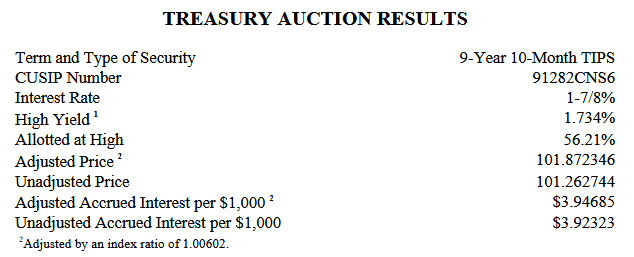
One day after the Federal Reserve acted to lower short-term interest rates, the Treasury’s offering of $19 billion in a reopened 10-year Treasury Inflation-Protected Security — CUSIP 91282CNS6 — drew surprisingly weak demand from investors.

The auctioned real yield to maturity for this 9-year, 10-month TIPS ended up at 1.734%, well above the “when-issued” market prediction of 1.684%. This TIPS had been trading on the secondary market with a real yield of 1.69% just before the auction’s close.

Also, the bid-to-cover ratio was a weak 2.20, the lowest in three years for this term. Conclusion: investor demand was lousy.

So the auction goes down as a flop for the Treasury, but a good deal for investors, drawing a real yield to maturity about 4 basis points higher than market trading.

Nevertheless, 10-year real yields have fallen sharply through much of 2025. The originating auction for this TIPS got a real yield of 1.985% on July 24. Its coupon rate was set at 1.875% by that auction.

Definition: The “real yield to maturity” of a TIPS is its yield above official future U.S. inflation, over the term of the TIPS. So a real yield of 1.734% means an investment in this TIPS would provide a return that exceeds U.S. inflation by 1.734% for 9 years, 10 months.

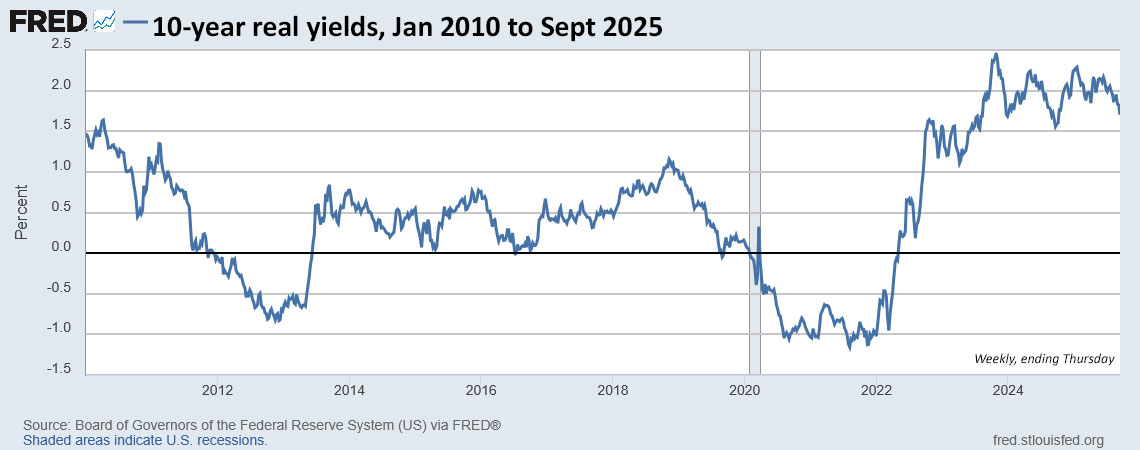
Here is the year-to-date trend in the 10-year real yield, showing the steady downward trend since early summer, as expectations grew for Fed rate cuts:

Click on image for larger version.

Pricing

Because the auctioned real yield was below the coupon rate of 1.875%, investors paid a premium unadjusted price of 101.262744. In addition, this TIPS will carry an inflation index of 1.00602 on the settlement date of Sept. 30. With that information we can calculate the cost of a $10,000 par value purchase at this auction:

  • Par value: $10,000
  • Actual principal purchased: $10,000 x 1.00602 = $10,060.20
  • Cost of investment: $10,060.20 x 1.01262744 = $10,187.23
  • + accrued interest of $39.47

In summary, the investor paid $10,187.23 for $10,060.20 principal on the settlement date of Sept. 30. From that point on, the investor will earn accruals matching future inflation, plus an annual coupon rate of 1.875% for 9 years, 10 months.

Inflation breakeven rate

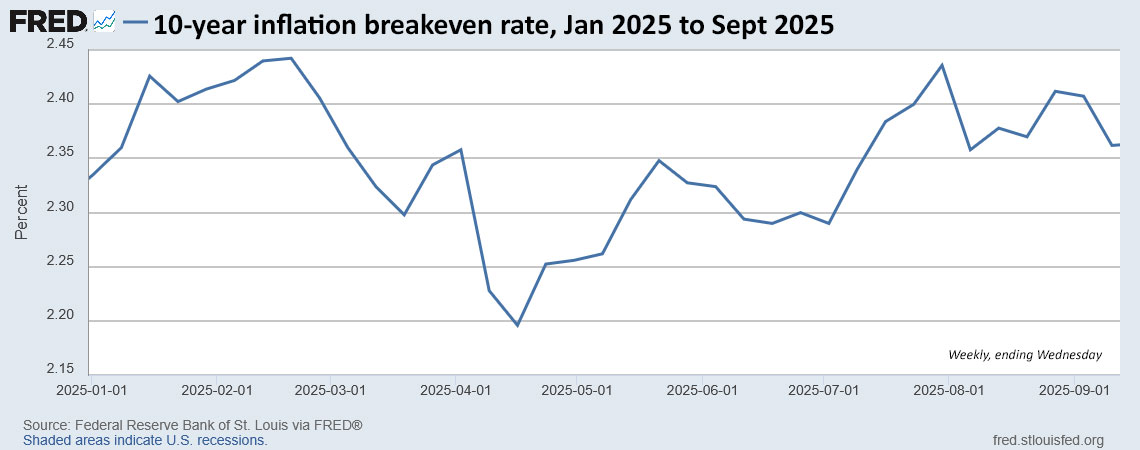
At the auction’s close, the 10-year Treasury note was trading with a nominal yield of 4.10%, giving this TIPS an inflation breakeven rate of 2.37% — down from 2.40% before the auction’s close. The result is more or less in line with recent results for this term.

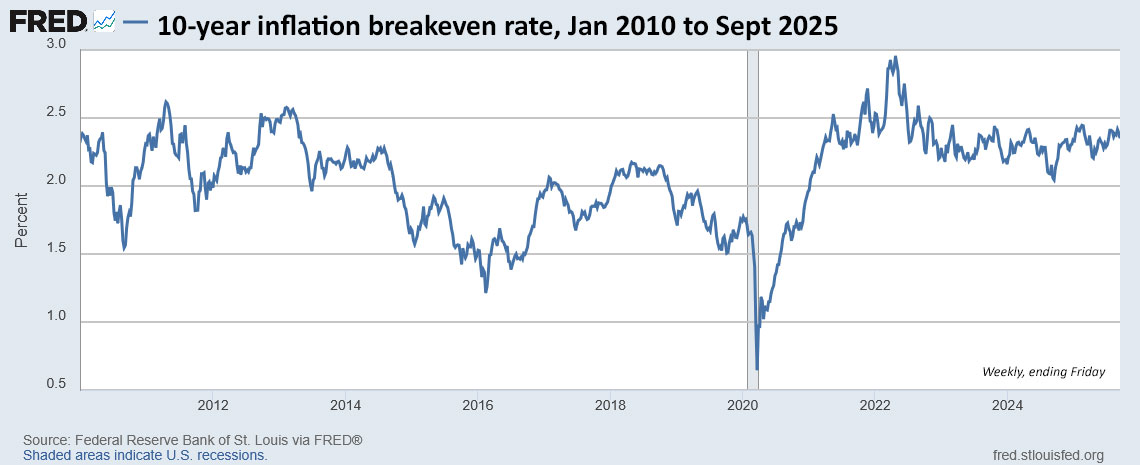
Here is the trend in the 10-year inflation breakeven rate year-to-date. Inflation expectations have been rising since tariff disruptions complicated things in April:
Click on image for larger version.

Reaction to the auction

While the auction result wasn’t way out of line, the lack of demand was surprising. Investors could be trying to calculate the effect of future Federal Reserve rate cuts on bond yields and potential inflation? Or maybe investors aren’t interested in inflation protection? (I’d say that would be odd as the Fed launches rate cuts while U.S. inflation is running at 2.9%.)

I suspect that investors are trying to sort out what will be coming in 2026, as the Federal Reserve moves to new leadership. This is from a follow-up Bloomberg article:

The TIPS drew 1.734%, about five basis points higher than their yield in pre-auction trading. By that measure it was the worst 10-year TIPS auction — of which there are six per year — since 2017.

Interest-rate strategists expected the auction to benefit from perceptions that Fed independence is at risk, which could stoke demand for inflation protection. The auction result suggests that the threat has peaked, said Gang Hu, managing partner at Winshore Capital Partners and a specialist in inflation markets.

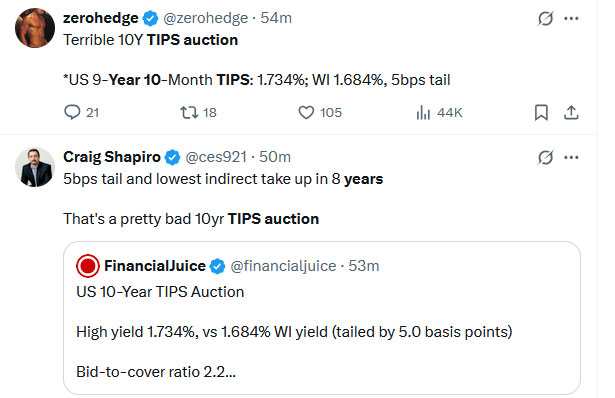
The auction also drew ridicule from investors on X:
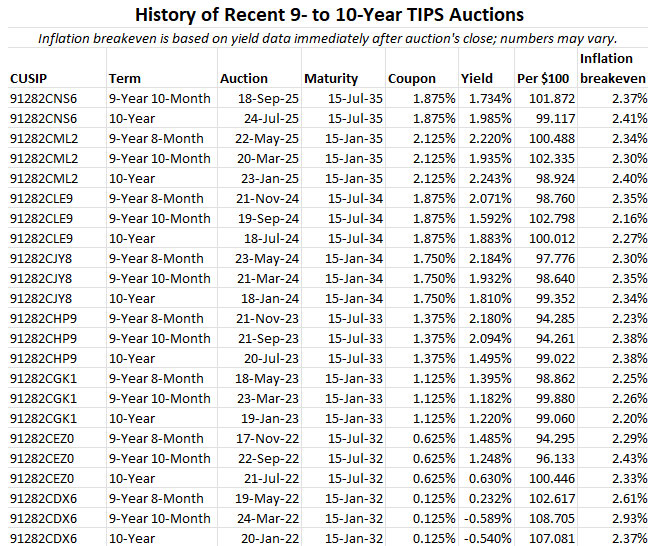
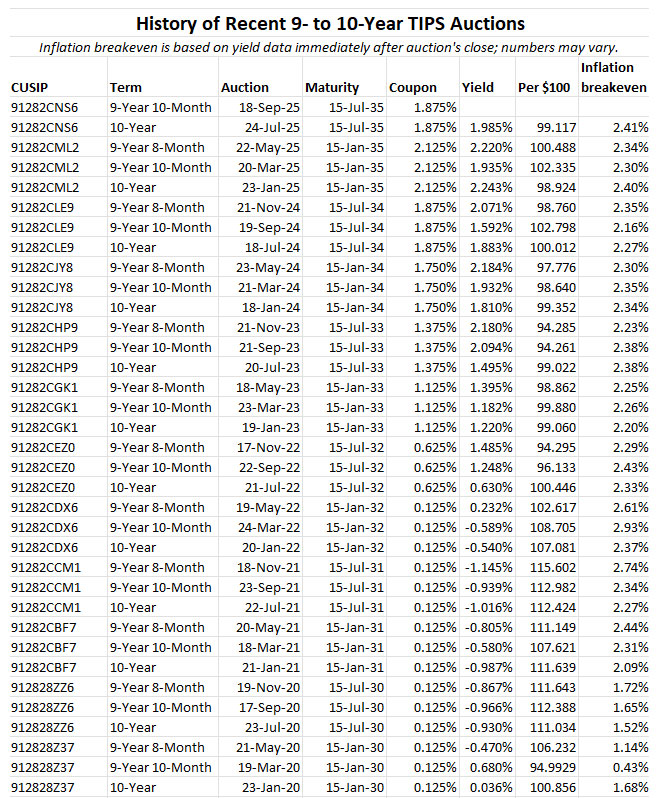
CUSIP 91282CNS6 will get one more reopening auction on November 20, and then a new 10-year TIPS will be offered at auction in January. Here are results for recent auctions of this term:
—————————

Donate? This site is free and I plan to keep it that way. Some readers have suggested having a way to contribute. I would welcome donations. Any amount, or skip it, your choice. This is completely optional.

PayPal link / Venmo link

—————————

Follow Tipswatch on X for updates on daily Treasury auctions and real yield trends (when I am not traveling).

Feel free to post comments or questions below. If it is your first-ever comment, it will have to wait for moderation. After that, your comments will automatically appear. Please stay on topic and avoid political tirades. NOTE: Comment threads can only be three responses deep. If you see that you cannot respond, create a new comment and reference the topic.

David Enna is a financial journalist, not a financial adviser. He is not selling or profiting from any investment discussed. I Bonds and TIPS are not “get rich” investments; they are best used for capital preservation and inflation protection. They can be purchased through the Treasury or other providers without fees, commissions or carrying charges. Please do your own research before investing.
Posted in Federal Reserve, Inflation, Investing in TIPS, Tariffs | Tagged , , , , , | 18 Comments

10-year TIPS reopening will mark a shift in yields

Are we entering an era of lower real returns?

By David Enna, Tipswatch.com

The U.S. Treasury on Thursday will auction $19 billion in a reopened 10-year TIPS, CUSIP 91282CNS6. This will be a notable auction because the real yield to maturity is likely to fall to a two-year low, a level not seen at auction since July 2023.

CUSIP 91282CNS6 had its originating auction two months ago, on July 24, when its real yield to maturity came in at an attractive 1.985%. The coupon rate was set at 1.875%. But in the last two months, real yields have dipped fairly dramatically.

This TIPS trades on the secondary market, where it closed Friday with a real yield of 1.69% and a price of 101.64. The price is at a premium because the real yield has dropped below the coupon rate. You can track the current yield and price on Bloomberg’s Current Yields page.

Definition: The “real yield to maturity” of a TIPS is its yield above official future U.S. inflation, over the term of the TIPS. So a real yield of 1.69% means an investment in this TIPS would provide a return that exceeds U.S. inflation by 1.69% for 9 years, 10 months.

One day before Thursday’s auction closes at 1 p.m. ET, the Federal Reserve is highly likely to cut short-term interest rates by 25 basis points and signal that future rate-cutting is coming in an effort to support a sagging job market. The 25-basis-point cut is already priced into CUSIP 91282CNS6’s yield, but comments by Fed chair Jerome Powell Wednesday afternoon could set the bond market roiling. In other words: Expect volatility in the hours leading up to the auction.

Here is the trend in the 10-year real yield over the last 15 years:

Click on image for larger version.

The chart shows that the current real yield of 1.69% remains historically attractive, but has fallen well off the October 2023 high of about 2.55%.

Pricing

At Friday’s close, CUSIP 91282CNS6 was trading with a real yield of 1.69% and a price of 101.64. In addition, on the auction’s settlement date of September 30, this TIPS will have have an inflation index ratio of 1.00602. With that information, we can estimate the cost of a $10,000 par value investment at the auction:

  • Par value: $10,000
  • Accrued principal on settlement date: $10,000 x 1.00602 = $10,060.20
  • Cost of investment: $10,060.20 x 1.0164 = $10,255.19
  • + accrued interest of about $39.47

Again, this is an estimate based on Friday’s closing price. In this scenario, the investor would pay $10,255.19 for $10,060.20 of principal on the settlement date, and from that point on would earn inflation accruals plus a coupon rate of 1.875% until maturity. Things will change before Thursday, but this gives you an idea.

Inflation breakeven rate

The 10-year Treasury note closed Friday with a nominal yield of 4.06%, giving this TIPS a current inflation breakeven rate of 2.37% –in line with recent auctions of this term. That means CUSIP 91282CNS6 will out-perform a nominal 10-year if inflation averages more than 2.37% over the next 9 years, 10 months. Inflation over the last 10 years, ending in August, has averaged 3.1%.

Here is the trend in the 10-year inflation breakeven rate over the last 15 years, showing the fairly stable pattern since the closing months of 2022:

Click on image for larger version.

Thoughts

Real yields for TIPS of short- to medium-terms have been falling over the last several months, in anticipation of future rate-cutting by the Federal Reserve. This could indicate a trend that will continue well into 2026, especially if the U.S. economy dips into recession. Or … it could be an overshoot to the low side. The Federal Reserve on Wednesday may help clarify this issue (but probably won’t).

I will not be a buyer at this auction because I have my sights on the January 2026 auction of a new 10-year TIPS, to add 2036 to my TIPS investment ladder. Will real yields be quite a bit lower by then? Maybe. I’ll wait it out.

Keep in mind that despite the boost from tariff revenues, the federal deficit is highly likely to continue increasing for years into the future. That will mean more borrowing and — potentially — higher yields. Note that the 20-year TIPS still has a real yield of 2.17% and the 30-year, 2.43%.

Relevant side note: This TIPS auction size of $19 billion will be the highest in history for any 10-year TIPS reopening. This is a 12% increase over last year’s September auction at $17 billion.

Also, note that if you have a brokerage account, there is no compelling reason to buy this TIPS at auction versus on the secondary market, unless you plan to make a small purchase at TreasuryDirect.

The advantage of buying at auction, especially through TreasuryDirect, is that even small-lot purchases will get the auction’s high yield. The advantage of the secondary market is that you can see exactly the price and real yield you will be receiving. The negative is that you may face a small bid-ask spread. Most of the time, it doesn’t make a huge difference, but if you see a real yield you like, know that you can probably get it on the secondary market without dealing with the auction’s uncertainty.

This TIPS auction closes Thursday at 1 p.m. ET. Non-competitive bids at TreasuryDirect must be placed by noon Thursday. If you are putting an order in through a brokerage, make sure to place your order Wednesday or very early Thursday, because brokers cut off auction orders before the noon deadline.

I will be posting the auction results soon after the close on Thursday. Here is a history of auction results for this term over the last 5 years:

—————————

Donate? This site is free and I plan to keep it that way. Some readers have suggested having a way to contribute. I would welcome donations. Any amount, or skip it, your choice. This is completely optional.

PayPal link / Venmo link

—————————

Follow Tipswatch on X for updates on daily Treasury auctions and real yield trends (when I am not traveling).

Feel free to post comments or questions below. If it is your first-ever comment, it will have to wait for moderation. After that, your comments will automatically appear. Please stay on topic and avoid political tirades. NOTE: Comment threads can only be three responses deep. If you see that you cannot respond, create a new comment and reference the topic.

David Enna is a financial journalist, not a financial adviser. He is not selling or profiting from any investment discussed. I Bonds and TIPS are not “get rich” investments; they are best used for capital preservation and inflation protection. They can be purchased through the Treasury or other providers without fees, commissions or carrying charges. Please do your own research before investing.
Posted in Inflation, Investing in TIPS, Retirement, TreasuryDirect | Tagged , , | 18 Comments

U.S. inflation rose 0.4% in August, higher than expected

Annual all-items inflation rose to 2.9%, the highest level since January

By David Enna, Tipswatch.com

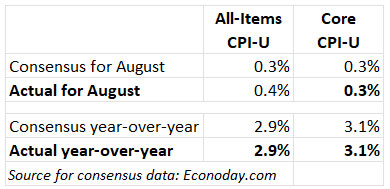
In what could be a crucially important report, the Bureau of Labor Statistics reported today that seasonally adjusted U.S. inflation rose 0.4% in August, higher than expected. The annual rate rose to 2.9%, up from 2.7% in July.

Core inflation, which removes food and energy, rose 0.3% for the month and held steady at 3.1% for the year. This matched expectations — meaning that overall this report should not raise market alarms. However, U.S. inflation remains too high.

The BLS noted that shelter costs rose 0.4% for the month, the highest monthly rate since January. The annual rate fell from 3.7% in July to 3.6% in August. More from the report:

  • Food at home costs rose a troubling 0.6% for the month and are now up 2.7% year over year. The index for fruits and vegetables rose 1.6% for the month. Costs for meats, fish and eggs have increased 5.6% over the last year.
  • Gasoline costs increased 1.7% in August after falling 1.9% in July. Gas prices are down 6.6% over the last year.
  • Costs of new vehicles, which have been fairly stable throughout 2025, rose 0.3% for the month and are now up 0.7% for the year.
  • Costs of used cars and trucks popped 1.0% higher for the month and are up 6.0% for the year.
  • Medical care services costs fell 0.1% for the month but are up 4.2% year over year.
  • Airline fares rose 5.9% in August, after rising 4.0% in July.
  • Apparel costs rose 0.5% for the month but are up only 0.2% year over year.

Overall, this August report shows inflation continuing to run at a fairly high level, but so far there appears to be no dramatic “instant” effect from U.S. tariffs on imports. Here is the trend for all-items and core inflation over the last year, showing the steady march higher in all-items inflation since April:

What this means for TIPS and I Bonds

Investors in Treasury Inflation-Protected Securities and U.S. Series I Savings Bonds are also interested in non-seasonally adjusted inflation, which is used to adjust principal balances for TIPS and set future interest rates for I Bonds. For August, the BLS set the inflation index at 323.976, an increase of 0.29% over July.

For TIPS. The August report means that principal balances for all TIPS will increase 0.29% in October, after rising 0.15% in September. Here are the October Inflation Index Ratios for all TIPS.

For I Bonds. The August report is the fifth of a six-month string that will determine the I Bond’s new inflation-adjusted variable rate, which will be reset November 1 and eventually roll into effect for all I Bonds. Inflation from April to August has increased 1.31%, which would translate to a variable rate of 2.62%. One month of data remains and we are probably looking at a new variable rate of 3.0% to 3.2%, higher than the current 2.86%.

See historical data on my Inflation and I Bonds page.

What this means for the Social Security COLA

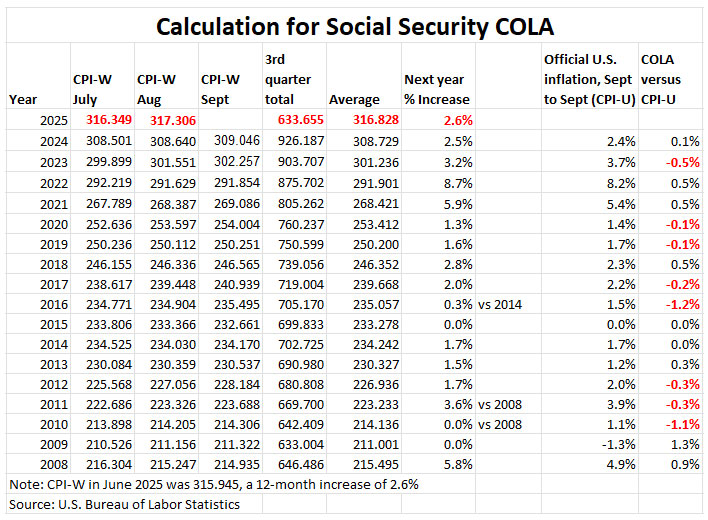
The Social Security cost-of-living adjustment is based on an unusual inflation index – CPI-W – and is determined by averaging the indexes for July, August and September and comparing that number to the same average for the year before. For August, the BLS set the CPI-W index at 317.306, an increase of 0.30% over the June number.

With one month to go, here is where we are:

We are probably looking at a COLA of 2.7% once the September number rolls out on October 15. There is still a shot that my projection of 2.8% will work out.

What does this mean for future interest rates?

Although U.S. inflation remains too high, I believe the Federal Reserve will move forward with a 25-basis-point cut to short-term interest rates next week. A cut of 50 basis points should off the table. From this morning’s Bloomberg report:

While the report underscored that inflation remains above the Federal Reserve’s target, the reassurance that tariff hikes aren’t obviously sparking a generalized escalation in price pressures reinforced expectations for Fed policymakers to cut interest rates by 25 basis points at the Sept. 16-17 meeting.

From the Wall Street Journal:

In recent weeks, more Fed officials, including Chair Jerome Powell, have suggested that softer labor market conditions should give the Fed more comfort that they can assume price increases will be a one-off. … (T)he overall inflation picture in the first six months of the year wasn’t as ugly as many feared it would be in the wake of the tariff increases.

So it is highly likely that a rate cut is coming next week. What happens next will depend on the status of the U.S. job market.

—————————

Donate? This site is free and I plan to keep it that way. Some readers have suggested having a way to contribute. I would welcome donations. Any amount, or skip it, your choice. This is completely optional.

PayPal link / Venmo link

—————————

Follow Tipswatch on X for updates on daily Treasury auctions and real yield trends (when I am not traveling).

Feel free to post comments or questions below. If it is your first-ever comment, it will have to wait for moderation. After that, your comments will automatically appear. Please stay on topic and avoid political tirades. NOTE: Comment threads can only be three responses deep. If you see that you cannot respond, create a new comment and reference the topic.

David Enna is a financial journalist, not a financial adviser. He is not selling or profiting from any investment discussed. I Bonds and TIPS are not “get rich” investments; they are best used for capital preservation and inflation protection. They can be purchased through the Treasury or other providers without fees, commissions or carrying charges. Please do your own research before investing.
Posted in Federal Reserve, I Bond, Inflation, Investing in TIPS, Retirement, Social Security, Tariffs | Tagged , | 23 Comments

When rates decline, I Bonds get more attractive

By David Enna, Tipswatch.com

Last week, I noticed something very interesting: The real yield of the most recent 5-year TIPS fell on the secondary market at one point to 1.08% and closed the week at 1.10%.

CUSIP 91282CNB3 had its originating auction on April 17, 2025, generating a real yield to maturity of 1.702%. So its real yield has fallen a remarkable 60 basis points, at a time when the Federal Reserve has done nothing. The yield is falling in anticipation of possible substantial future cuts.

But that isn’t the most interesting thing, which is this: The real yield of a 5-year Treasury Inflation-Protected Security now exactly matches the fixed rate of the current Series I Savings Bond at 1.10%. That fixed rate is the I Bond’s “real yield” — its above-inflation return. After 5 years the I Bond can be redeemed without any penalty, making it a very close match to the TIPS, except that:

  • Interest earned on the I Bond is tax-deferred. Not true for the TIPS unless it is held in a tax-deferred account. In a traditional IRA, the TIPS loses its state income tax exemption. That won’t happen with an I Bond.
  • The redemption date is flexible — after 1 year with a 3-month interest penalty, or 5 years with no penalty, or any time period the investor chooses up to 30 years. The TIPS has a defined maturity date — in this case April 15, 2030.
  • The I Bond continues to compound interest payments until it is redeemed or matures. A TIPS pays out its coupon rate twice a year, and so that amount does not compound.
  • The I Bond cannot ever lose a penny of value, while the TIPS will lose accrued principal at times of deflation.

Conclusion: When an I Bond has a fixed rate of 1.10%, it is a superior investment to a 5-year TIPS with a real yield of 1.10%.

Shelter in the storm

I call I Bonds a “relic” investment because they have arcane rules for rate-setting that allow yields to stay steady for a full six months after any purchase. In addition, since yields are tied to inflation, I Bonds aren’t directly linked to market interest rate trends.

For that reason, when the Fed begins a rate-cutting cycle, I Bonds can become a very attractive investment. Even an I Bond with a 0.0% fixed rate — remember those? — will at least provide an annual return equal to U.S. inflation. That isn’t guaranteed for other investments in a time of severe rate cutting.

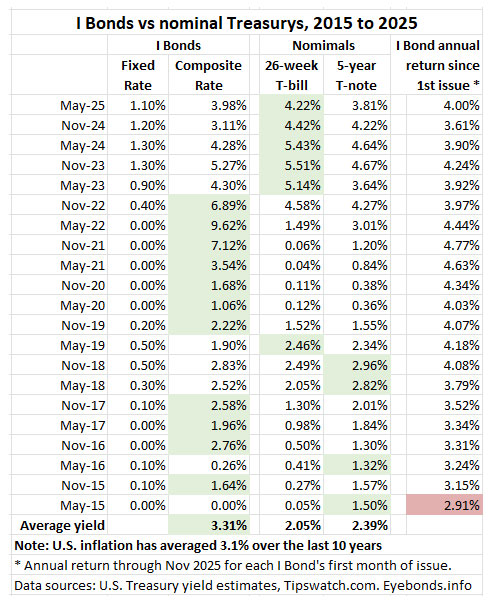
Here is a comparison of opening composite rates for I Bonds versus then-current yields for 26-week Treasury bills and 5-year Treasury notes over the last 10 years. For much of that decade, I Bonds had a superior yield.

Since May 2023, T-bills have had higher yields, leading many investors to move out of I Bonds and into T-bills. That decision makes sense as a short-term move, but the yields often have been fairly close.

Next week, the Federal Reserve is likely to lower its federal funds rate to a range of 4.00% to 4.25%, the first cut in rates since December 2024. That will move the effective federal funds rate to about 4.06%, just a bit higher than the I Bond’s current composite rate of 3.98%. As future cuts roll in, short-term rates are likely to fall below the I Bond’s yield, even if the November rate reset lowers the I Bond’s fixed rate.

In the chart, look at the yield comparisons from November 2016 through November 2022. For much of that time, the I Bond composite rate was higher — sometimes much higher — than the return of nominal Treasurys. This was the reason investors flooded into I Bonds through October 2022.

Why did I Bonds have an advantage? Because they track official U.S. inflation, often with a fixed-rate topper (currently 1.10%) that builds on top of inflation.

The joy of tracking inflation

Again, look at the chart: From July 2015 to July 2025, U.S. annual inflation has averaged 3.1%. All I Bonds issued over that period have had an average annual return of 3.31%, easily outperforming the average for the 26-week T-bill (2.05%) and 5-year T-note (2.39%).

If you bought a 10-year Treasury note on November 2, 2015, you received a nominal return of 2.20%, lagging annual inflation by 90 basis points. If you bought an I Bond on that same day, you’ve received a 3.15% annual return, matching inflation over the next 10 years.

For every I Bond rate reset since 2015, the annual return has matched or exceeded U.S. inflation except for one: I Bonds issued in May 2015 have had a return of 2.91%. The reason for the slight lag? The May 2015 I Bond started off with a six-month composite rate of 0.00% because of severe deflation over the preceding six months (-1.40% from October 2014 to March 2015).

The point is: Even I Bonds with a 0.0% fixed rate will out-perform nominal Treasurys in an era when the Federal Reserve cuts rates to a level below inflation.

For anyone asking, “Do I Bonds accurately track inflation?” this chart provides the answer. Since 2011, the I Bond’s inflation-adjusted variable rate (excluding any fixed rate) has exactly matched average annual inflation over that period, at 2.66%. During those years, the 4-week T-bill average yield has been 1.36%.

We won’t go back to zero, right?

Treasury Secretary Scott Bessent wrote an opinion piece for the Wall Street Journal last week criticizing the Federal Reserve for — among other things — its aggressive quantitative easing actions over the last decade-plus, resulting in abuses of “cheap debt.”

Successive interventions during and after the financial crisis of 2008 created what amounted to a de facto backstop for asset owners. This harmful cycle concentrated national wealth among those who already owned assets. … Instead of accountability, presidents and Congress have expected intervention when their policies falter.

I agree with Bessent that the Fed overstepped its mandate in launching repeated levels of aggressive quantitative easing — cutting short-term rates to near zero and forcing longer-term rates lower through aggressive bond-buying. Those actions — along with major fiscal stimulus from Congress and both Presidents Trump and Biden — opened the inflationary floodgates.

So … is there is any risk of that happening again? Over the next year, under current Fed leadership, I could see U.S. inflation hanging in the 3.0% range and the federal funds rate dropping to around 3.5%. That would be risky, but okay if inflation goes no higher.

President Trump, however, is moving aggressively to get a majority of his supporters on the Federal Reserve’s rate-setting Open Market Committee. Trump has expressed a desire to have interest rates lower by 300 basis points, which would put the federal funds rate in the 1.25% to 1.50% range.

That would almost certainly be inflationary and the bond market would be enraged. The result could be even higher medium- and longer-term interest rates, including for mortgages. The Fed can’t directly control those longer-term rates, unless it launches another round of quantitative easing to force them lower. Could that happen? I hope not. Let’s hope the “next” Federal Reserve remembers lessons of the recent past.

Conclusion

I Bonds — even with a 0.0% fixed rate — could be attractive as an alternative investment if inflation surges higher and bond yields again head toward zero. And even if that doesn’t happen, I Bonds will continue to offer a solid, predictable, and super-safe return.

Does this mean you should hang on to all those 0.0% fixed-rate I Bonds? No. I see the logic in rolling over low-fixed-rate I Bonds for higher-fixed-rate versions or other investments you consider attractive. I no longer own 0.0% fixed-rate I Bonds — those have been rolled over to versions with fixed rates ranging from 0.9% to 1.3%. Rolling over is a good strategy for some investors.

Whatever you decide, I Bonds remain an interesting, very safe, attractive investment when used as a secondary cash reserve.

Forecast: I Bond’s fixed rate is likely to fall to 0.90%

Confused by I Bonds? Read my Q&A on I Bonds

Let’s ‘try’ to clarify how an I Bond’s interest is calculated

Inflation and I Bonds: Track the variable rate changes

I Bonds: Here’s a simple way to track current value

I Bond Manifesto: How this investment can work as an emergency fund

—————————

Donate? This site is free and I plan to keep it that way. Some readers have suggested having a way to contribute. I would welcome donations. Any amount, or skip it, your choice. This is completely optional.

PayPal link / Venmo link

—————————

Follow Tipswatch on X for updates on daily Treasury auctions and real yield trends (when I am not traveling).

Feel free to post comments or questions below. If it is your first-ever comment, it will have to wait for moderation. After that, your comments will automatically appear. Please stay on topic and avoid political tirades. NOTE: Comment threads can only be three responses deep. If you see that you cannot respond, create a new comment and reference the topic.

David Enna is a financial journalist, not a financial adviser. He is not selling or profiting from any investment discussed. I Bonds and TIPS are not “get rich” investments; they are best used for capital preservation and inflation protection. They can be purchased through the Treasury or other providers without fees, commissions or carrying charges. Please do your own research before investing.

Posted in Cash alternatives, Federal Reserve, I Bond, Inflation, Savings Bond, Treasury Bills | Tagged , | 28 Comments

Forecast: I Bond’s fixed rate is likely to fall to 0.90%

By David Enna, Tipswatch.com

In two months, probably on Halloween morning, the Treasury will announce a new fixed rate, inflation-adjusted variable rate and composite rate for U.S. Series I Savings Bonds purchased from November 2025 to April 2026.

And I have bad news for I Bond investors: The fixed rate is likely to fall from the current 1.10% to 0.90% at the reset. Of course, this is still up in the air, depending on how real yields track over the next two months. But the path looks pretty clear.

The forecast

The I Bond’s fixed rate is its “real yield” — the yield above future inflation. It is important because it is permanent, staying stable for potentially 30 years. So if you bought an I Bond in 2014 with a fixed rate of 0.2%, it will continue to have a 0.2% fixed rate for the life of the bond. Purchases through October 31, 2025, have a fixed rate of 1.10%.

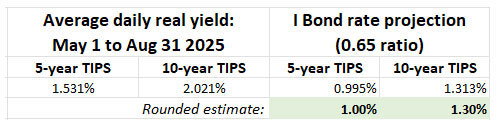
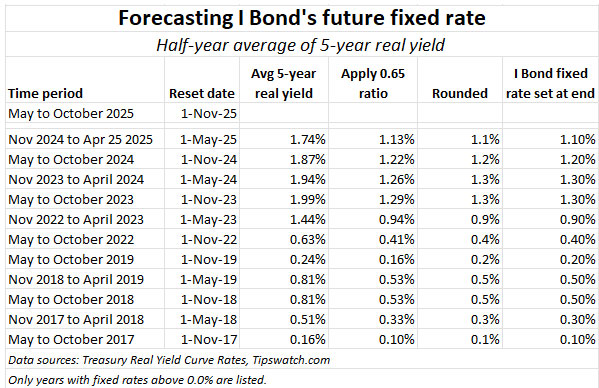
The Treasury has no announced formula for setting the I Bond’s fixed rate, meaning there is no calculation required by law or regulation enforcing the process. It is up to a decision by Treasury officials. However, I Bond watchers have settled on a forecasting tool that seems to work: Apply a ratio of 0.65 to the average 5-year TIPS real yield over the preceding six months. This formula has worked without fail at least since 2017.

With two months to go, I looked at 5-year real yield data from the date of the last reset on May 1, 2025, to the close of Aug. 29, 2025. Looking at just that data, the forecast is for a new fixed rate of 1.00% at the reset.

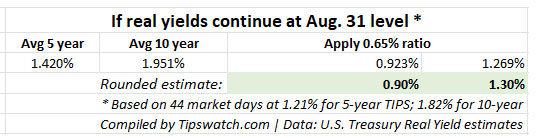
I added the 10-year TIPS information just because it is interesting — using the 10-year real yield data you get an new I Bond fixed rate of 1.30%, much more attractive. The spread between the 5-year real yield (currently 1.21%) versus the 10-year (1.82%) is amazing. But it also probably irrelevant because the forecasting formula has only worked using the 5-year TIPS real yield.

So, with two months of data yet to come, the I Bond’s new fixed rate would be 1.00%.

Extending the forecast

Now, let’s assume real yields hold steady at current levels through the month of October. That’s a bit iffy because the Federal Reserve is likely to cut short-term interest rates on September 17, and the 5-year TIPS real yield tends to move with those decisions. At this point, however, I think the rate cut is priced in.

In this chart, I added 44 days at current market real yields, which lowers the 5-year real yield average to 1.420% and in turn drops the 0.65 ratio to 0.923%, resulting in a new fixed rate of 0.90%. The forecast using the 10-year real yield remains at 1.30%, but I don’t believe it is relevant.

Keep in mind: The I Bond’s fixed rate is always rounded to the one-tenth decimal point. That means a further fall to 0.80% is unlikely.

As of today, I project a new I Bond fixed rate of 0.90%.

This chart demonstrates the accuracy of this projection method for every year back to 2017. (Of course, we can’t be sure the current administration will continue on this course.)

What this means

One immediate conclusion is that the I Bond’s current permanent fixed rate of 1.10% and composite rate of 3.98% for six months is attractive. I Bond investors who haven’t bought the full 2025 allocation ($10,000 per person per calendar year) should consider making a purchase before November 1.

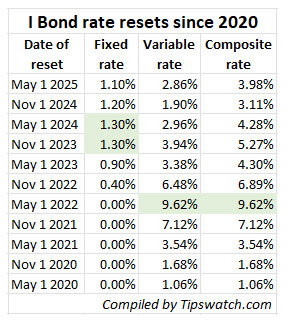
Hard to say just yet, but the new variable rate could be around 2.8% to 3.0%, resulting in a new composite rate pretty close to the current 3.98%. But a higher fixed rate, which is permanent, is always preferable. Here is the trend in I Bond rates over the last five years:

In 2022, we got that gaudy 9.62% variable rate for six months, but it was tied to a fixed rate of 0.0%. After a year or two, investors were dumping that investment, which is currently yielding 2.86%. The fixed rate of 1.30% that came later was much more attractive, in my opinion, as a long-term investment.

In January, would I be buying I Bonds with a fixed rate of 0.90%? Not in January, probably, but later in the year, yes. I’d probably wait until mid-April to see the trend in real yields and inflation.

As the reset date approaches, I will be writing more on this topic. This article is meant as a heads-up for investors speculating that we could get a boost in the fixed rate, which is unlikely.

And, again, we can’t be sure the Treasury won’t simply ditch our much-trusted 0.65 ratio and set the I Bond’s fixed rate in a radically different way. (Not likely, I hope.)

FYI: I focused this article on future rates and didn’t attempt to explain the investing purposes of I Bonds or their intricacies. You can find a lot of that information in these links:

Confused by I Bonds? Read my Q&A on I Bonds

Let’s ‘try’ to clarify how an I Bond’s interest is calculated

Inflation and I Bonds: Track the variable rate changes

I Bonds: Here’s a simple way to track current value

I Bond Manifesto: How this investment can work as an emergency fund

—————————

Donate? This site is free and I plan to keep it that way. Some readers have suggested having a way to contribute. I would welcome donations. Any amount, or skip it, your choice. This is completely optional.

PayPal link / Venmo link

—————————

Follow Tipswatch on X for updates on daily Treasury auctions and real yield trends (when I am not traveling).

Feel free to post comments or questions below. If it is your first-ever comment, it will have to wait for moderation. After that, your comments will automatically appear. Please stay on topic and avoid political tirades. NOTE: Comment threads can only be three responses deep. If you see that you cannot respond, create a new comment and reference the topic.

David Enna is a financial journalist, not a financial adviser. He is not selling or profiting from any investment discussed. I Bonds and TIPS are not “get rich” investments; they are best used for capital preservation and inflation protection. They can be purchased through the Treasury or other providers without fees, commissions or carrying charges. Please do your own research before investing.

Posted in Cash alternatives, Federal Reserve, I Bond, Inflation, Savings Bond | Tagged , , | 34 Comments