Fidelity’s outlook for TIPS: Clear skies, but threat of fog?

Somehow I own a fractional share of the Fidelity Inflation-Protected Bond Fund (FINPX) and so I get its annual and semi-annual reports. As I’ve noted before, the managers of this fund – William Irving and Franco Castagliuolo – are unusually frank in their ‘managers overview’ in each report. So their opinions perk my interest.

You can read the Sept. 30, 2012, report here.

TIPS have been an incredible investment over the last two years, combining safety with decent capital returns. This Fidelity fund, FINPX, has seen a year-to-date increase of 7.15% in net asset value. That nicely tops Vanguard’s Total Bond Market gain of 4.26% in net asset value. (Uh … I own the Total Bond Market, not FINPX, a decision I made at the perfectly wrong time of spring 2011.)

Below are some excerpts from their report, which I think lays out pretty well the positives and potential negatives of TIPS (fund) investing. On the one hand, we know that the Federal Reserve is committed to keeping interest rates very low in the near- and even mid-term future. And then there is the impending fiscal cliff, which in a worst-case scenario could cause deflationary pressures. Although the Fidelity managers don’t mention this, serious deflation would boost traditional Treasuries, but could ravage TIPS, which are an inflation-protection investment.

The one thing TIPS investors – especially those investing in funds like FINPX – might lose sleep over is a ‘miracle’ resolution of these problems, causing a stock market boom, employment growth, economic expansion. In those conditions, almost certainly, TIPS yields will rise, along with the overall Treasury market.

TIPS yields are sensationally low. Wildly low. Bubbly low. On the other hand the Federal Reserve presents a nice bodyguard for TIPS investors: Keeping rates ultra low by manipulating the Treasury market, while at the same time prompting inflationary fears, which in turn increases the attractiveness of TIPS.

question one

    Question 2


Posted in Investing in TIPS | 1 Comment

Next up: 5-year TIPS reissue auctioning Dec. 20, 2012

The Treasury on Thursday will announce its last 2012 auction of a Treasury Inflation-Protected Security, mostly likely a reopening of CUSIP 912828SQ4 which matures on April 15, 2017.

UPDATE 12/13/12: The Treasury confirmed today that the auction is a reissue of CUSIP 912828SQ4 … read the announcement.

This creates a 4-year, 4-month TIPS – the shortest maturity TIPS you can buy directly from the Treasury. It carries a coupon rate of 0.125%, but the yield to maturity is likely to around -1.551%, where this issue was trading Friday on the secondary market. Buyers will be paying about a 7% premium upfront to get that 0.125% coupon rate.

Attractive? No. This TIPS has only one thing going for it – it matures in 4 years, 4 months. Otherwise, it guarantees a return of 1.55% below inflation during a time of relatively mild inflation. The return is likely to end up being about 1%. You can do better with a 5-year bank CD — some are offering 1.8% today on a 5-year CD.

If you are a big hedge fund looking to park money safely, or a foreign national bank stashing reserves, this TIPS makes sense. Otherwise, there is one very important alternative you should consider:I Bonds at glance

  • Have you made your I Bond purchase for 2012? If not, this is an investment you need to make before Dec. 31. An I Bond will pay the rate of inflation over the next five years, when you can sell it without penalty. This investment is a no-brainer versus a 5-year TIPS — inflation rate versus inflation rate minus 1.55%.
  • I Bonds carry a base interest rate, which is currently zero, plus an inflation-adjustment interest rate that changes every May and November. The current rate through April 30 is 1.76%. An I Bond you buy before Dec. 31 will pay an annual rate of 1.76% over the next six months.
  • There are also key tax advantages to I Bonds, since the federal income tax is deferred until the bond is sold. You can hold an I Bond 30 years without paying any tax. With a TIPS, all income is taxable in the current year, even the inflation adjustment to principal, which you don’t receive until the TIPS matures.
  • Why is Dec. 31 important? The problem with I Bonds is each person is limited to a $10,000 purchase each calendar year (plus an option to get paper I Bonds instead of an income tax refund.) If you buy $10,000 today, you can buy another $10,000 in January.

I suspect that most people reading this blog have already bought I Bonds up to the limit in 2012. But if you haven’t, I suggest going to TreasuryDirect.gov to start the process today. There is no fee, no commission. Your money is 100% invested with the U.S. government.

Posted in I Bond, Investing in TIPS, Savings Bond | 3 Comments

Tempting short-term investment: TIPS maturing April 15, 2013

Reader Joe pointed out that current pricing on the TIPS maturing April 15, 2013, has moved to a positive yield, while almost the entire TIPS ladder is negative. At this point, it is substantially positive:

short

Tempting, isn’t it? This TIPS has a coupon rate of 0.625% and is selling at a discount, resulting in a yield of 0.739%. That’s attractive, but the TIPS will mature in 4 1/2 months, so it’s definitely a short-term investment.

There’s a thread discussing this issue in the Bogleheads forums, dating back to June but with posts continuing through this week. Experts there agree it is an intriguing investment in theory, but it reality will generate very little income in the short remaining time period, less than 0.2% on the money invested. Still, that is better than a six-month Treasury (0.13%) and even better than a one-year (0.18%).

Why the pricing anomaly? With oil and gas prices declining, we are currently in an inflation downswing, and the ‘fiscal cliff’ raises a specter of deflation. TIPS are inflation protection, and there is little chance of much inflation at all before April 2013. So there is no ‘inflation premium’ on this issue. In fact, a couple months of deflation could nearly wipe out its positive return.

There is little risk in this investment, though, so it could be interesting for someone parking short-term cash, which is going to earn near-zero anyway.

Posted in Investing in TIPS | 4 Comments

Surprise: A TIPS auction without a record-low yield

I was on vacation last week and away from computers and the Internet (mostly), so I didn’t get a chance to write about Wednesday’s reissue auction of CUSIP 912828TE0, effectively creating a 9-year 8-month TIPS.

Read the Treasury’s announcement.

Demand for this issue was relatively weak, resulting in a yield to maturity of -0.720%, just above the record low yield for a 10-year Treasury Inflation-Protected Security, which is -0.750%, set by this same TIPS was it was reissued in September. A week ago, it looked like this reissue would generate at yield of about -0.83%. Just before the auction, experts were predicted a yield of 0.746%.

That’s significant. We’ve been waiting to see the yield on TIPS, which has been plummeting for about 18 months, start to bottom, or even rise. There’s no reason to say we’ve hit bottom yet, but this auction wasn’t a record low and that is a milestone.

Since January 2011, there have been twelve 10-year TIPS issues and reissues, and the yield has declined in ten of those auctions. A chart:

10-year tips auctions


Posted in Investing in TIPS | 1 Comment

Next up: Reopening of a 10-year TIPS, auctioning on Nov. 21, 2012

Treasury announcementThe U.S. Treasury announced today it will reissue a 10-year Treasury Inflation-Protected Security, CUSIP 912828TE0, effectively creating a 9-year 8-month TIPS.

Read the announcement.

What we know: This TIPS has a coupon rate of 0.125%, the lowest the Treasury offers on a TIPS. It also has a record-setting history in the world of 10-year TIPS:

First auction: On July 21, 2012, with a record-low yield to maturity of -0.637%.

First reissue: On Sept. 20, 1212, with a record-low yield of -0.75%

And now we have the second reissue coming Nov. 21, and we can expect another record low yield. Since this security trades on the open market, we can check its current price.

At this point, a week away from the auction, it looks like the yield to maturity will set another record low, dipping to about -0.83%. That means buyers are willing to accept 0.83% less than the rate of inflation over the next 10 years. It also means this TIPS is pretty darn pricey.

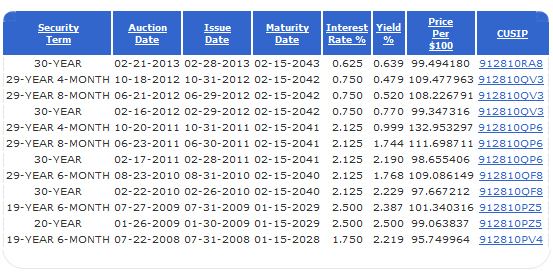
Not too long ago (who remembers January 2011?) a 10-year TIPS auctioned with a yield of 1.17%. It’s been a long, steady decline since then, mostly caused by Federal Reserve manipulation of the Treasury market (QEs), but also fear of economic collapse in Europe and lingering fears of inflation in the United States (still dormant today.)

Here are recent 10-year TIPS auctions for some historical perspective:

10-year TIPS auctions

Because buyers at next Thursday’s auction will be getting a coupon yield that is a wild 0.956% above the actual yield to maturity, they will be paying big money for this issue — somewhere around $109 for every $100 of value. Ouch. You really have to fear future inflation to pay that price, in my opinion.

The breakeven rate. The national election Nov. 6 has set off fears of a financial crisis ahead (like we didn’t know the fiscal cliff was looming a month ago?). This has socked the U.S. stock market and strengthened U.S. Treasuries.

The yield on a traditional 10-year Treasury closed today at 1.58%, down from 1.78% on Election Day. When traditional Treasury rates fall, TIPS yields almost always follow. A buyer can look at the ‘breakeven inflation rate’ to see which is the better ‘bargain.’

Today, that 10-year breakeven rate is a rather high 2.41%. That means a buyer of this TIPS needs inflation to run at 2.41% over the next 10 years to beat an investment in a traditional Treasury. (The inflation rate over the last 12 months was 2.2%, by the way.)

This reissue will continue a nearly 18-month trend of declining TIPS yields. Until that trend breaks, TIPS are not an attractive investment for a small investor.

Posted in Investing in TIPS | Leave a comment