Bad news: Medicare costs for 2026 are surging at triple the rate of inflation

Part B costs, deductibles and IRMAA surcharges will all increase at least 9.7% next year.

By David Enna, Tipswatch.com

It was bad enough when we learned on Oct. 24 that Social Security benefits would increase 2.8% for beneficiaries in 2026, less than the U.S. rate of inflation at 3.0%.

And now, the really bad news: The Centers for Medicare & Medicaid Services announced in mid-November that monthly costs for Medicare Part B premiums, annual deductible and IRMAA surcharges will rise by a much higher amount, about 9.7% for 2026.

The Social Security Administration has already started posting 2026 benefits and cost summaries on its site. Just log in to SSA.gov and navigate to the messages area where you can find your full .pdf summary.

If you planned poorly for tax year 2024, you may be meeting up with IRMAA, the Income-Related Monthly Adjustment Amount. These surcharges can be lofty, so it’s smart to plan ahead to limit these costs.

See the fact sheet prepared by the Centers for Medicare & Medicaid Services for more detail. Here is a summary of the price and income-level changes for 2026:

  • The Part B deductible is rising 10.1% to $283.00.
  • The Part B base monthly premium is rising 9.7% to $202.90.
  • The IRMAA surcharge costs for Part B are rising 9.7%.
  • The IRMAA surcharge costs for Part D (drug plans) are rising about 6%.
  • The IRMAA income tiers that trigger the surcharges are increasing at a lower rate, all below the inflation rate of 3.0%.

Let’s dive into the key Medicare changes for 2025.

Part A premium and deductible

Most people who reach age 65 go on Medicare Part A, even if they are still working. Medicare Part A covers inpatient hospital, skilled nursing facility and some home health care services. About 99% of Medicare beneficiaries do not have a Part A premium since they have at least 40 quarters of Medicare-covered employment.

Although coverage is generally free, Part A has some sizable deductibles and coinsurance costs, and those will be rising about 3.6% in 2026.

Keep in mind that most people on Medicare have a Medigap or Medicare Advantage plan that will cover all or most of the Part A deductible and coinsurance amounts. For example, all standardized Medicare Supplement (Medigap) plans, A through N, provide coverage for Part A coinsurance, and most also cover all or most of the Part A deductible costs.

Part B: Medical insurance

Medicare Part B can be described as covering “outpatient services,” things like doctor visits, some lab tests, an annual wellness exam, diabetes screenings, etc. Medicare Part B generally pays 80% of approved costs of covered services, and you pay the other 20%. Some services, like flu shots, COVID vaccines and a wellness visit, may cost you nothing.

Part B deductible. Before Medicare pays anything, you have to meet your Part B deductible each year. The annual deductible for all Medicare Part B beneficiaries will be $283 in 2026, an increase of $26 from the annual deductible of $257 in 2025. Once the deductible is met, Medicare and Medigap plans will cover some or all of your Part B costs.

Part B premium. The standard monthly premium for Medicare Part B enrollees will be $202.90 for 2026, an increase of $17.90 from $185 in 2025. This Part B premium is paid by all people on original Medicare and is incorporated into Medicare Advantage pricing, which may or may not result in a baseline monthly cost.

So, for most people on original Medicare, Medicare Part B is going to cost $202.90 a month for the premium, plus the cost of the $283 deductible. That’s a total cost of $2,717.80 a year for 2026, up about 9.7% from this year’s costs.

And then … IRMAA

Since 2007, a beneficiary’s Part B monthly premium is based on reported income, known as MAGI, or modified adjusted gross income. According to the Social Security Administration handbook, for Medicare’s purposes MAGI is adjusted gross income (line 11 of your 2024 federal income tax form) plus tax-exempt interest.

Note that I mentioned your 2024 income tax return. That’s the one you filed earlier this year and now, in November, CMS announced the IRMAA surcharge brackets applied to that 2024 return. In other words, you could not know the surcharge levels until after the fact. And this is a rather brutal surcharge, because going just $1 over any limit can trigger thousands of dollars of one-year costs.

CMS says about 8% of people paid the IRMAA surcharges in 2024, and the number is probably higher for 2025 and going into 2026. It’s important to note that people on Medicare Advantage plans continue to pay the Part B premium, and are also subject to the IRMAA surcharges. And keep in mind that for a couple, the costs are doubled because each person pays the surcharge.

Part B. Here are the 2026 Part B total premiums and surcharges for high-income beneficiaries, which apply to income reported on your 2024 tax return:

Annual income of $218,000+ for a couple may sound like a lot, but the lower IRMAA levels can easily be reached through Roth conversions, stock sales to fund a major purchase, a new pension starting up, etc. Be aware of the potential to trigger the IRMAA surcharges and plan around that possibility.

Part D. Medicare income-related surcharges also apply to Part D, the drug program which is offered by private insurers working with Medicare. Part D premiums vary by plan, but the Part D surcharges are deducted from Social Security benefit checks or paid directly to Medicare.

People in Medicare Advantage plans don’t pay a separate Part D premium, since those plans include Medicare Advantage Prescription Drug (MAPD) coverage. But Part D is built into Medicare Advantage, and the IRMAA surcharge still applies.

Be aware of IRMAA

If you are just a couple years away from going on Medicare, it’s a great idea to plan your total income for this year to avoid triggering IRMAA surcharges two years later. The surcharges last only one year and then get reset the next year. The costs can be substantial for people hitting the top IRMAA tiers.

And I repeat: When you filed your federal tax return in early 2025 for the 2024 tax year you could not know what these IRMAA brackets or surcharges would be. They were just announced Nov. 14. They are called the “2026 IRMAA levels” but apply to your 2024 tax return.

When you file your 2025 return next year, realize that you won’t know the relevant IRMAA levels until November 2026, many months after you have filed. Your only option is to use these ‘2026’ bracket levels as a guideline. It’s a crazy system.

You can appeal an IRMAA ruling

The Social Security Administration has very specific rules that will allow you to get a waiver of the IRMAA surcharge, if you meet certain criteria for a “life-changing event,” which include:

  • Work stoppage
  • Work reduction
  • Employer settlement payment
  • Death of spouse
  • Divorce
  • Loss of pension income

You’ll need to fill out IRS Form SSA-44 to request the waiver.

Final thoughts

Starting in January, the COLA increase will boost the average Social Security payment by about $56 to an average monthly benefit of $2,071. That’s an annual increase of about $672. Unfortunately, higher Medicare Part B costs will eat up about $241 of that increase for a beneficiary paying the base rates. And that doesn’t include potential increases in costs of Part D and supplemental pans.

We all hate the IRMAA surcharges, but I think it is fair for people with more wealth to carry a higher burden of Medicare costs in a system that is struggling. What isn’t fair is the ridiculous “cliff” structure of these surcharges, with just $1 in higher MAGI income potentially resulting in thousands of dollars of increased costs. And add to that the fact that the IRMAA levels aren’t announced until months after you file your tax return.

Sometimes I feel the need to remind younger people: “Medicare is not free.” There are expenses and for some people the costs can be lofty. I am fortunate to say — so far — my payments into Medicare have been higher than the services I have received. That means I am healthy. I’ll take that trade any day.

Original Medicare with a good supplement is very good insurance and worth the cost. But … don’t pay more than you need to. Keep an eye on IRMAA.

—————————

Donate? This site is free and I plan to keep it that way. Some readers have suggested having a way to contribute. I would welcome donations. Any amount, or skip it, your choice. This is completely optional.

PayPal link / Venmo link

—————————

Follow Tipswatch on X for updates on daily Treasury auctions and real yield trends (when I am not traveling).

Feel free to post comments or questions below. If it is your first-ever comment, it will have to wait for moderation. After that, your comments will automatically appear. Please stay on topic and avoid political tirades. NOTE: Comment threads can only be three responses deep. If you see that you cannot respond, create a new comment and reference the topic.

David Enna is a financial journalist, not a financial adviser. He is not selling or profiting from any investment discussed. I Bonds and TIPS are not “get rich” investments; they are best used for capital preservation and inflation protection. They can be purchased through the Treasury or other providers without fees, commissions or carrying charges. Please do your own research before investing.

Posted in Inflation, Medicare, Retirement, Social Security, Taxes | Tagged , , , , | 32 Comments

‘Bond King’ has a dire view of long-term Treasurys

Gundlach: ‘Treasurys look vulnerable to me’

By David Enna, Tipswatch.com

A few years ago, I was working in the kitchen and listening to CNBC in the background. A guest came on and talked, talked, talked about debt investments and risks. The CNBC anchors, apparently in awe, said nothing and just let him talk for 10 minutes straight.

Gundlach

The guy was talking sense. I thought: Who is this guy? I ran over to the TV to catch his name: Jeffrey Gundlach.

That was the first time I heard of Gundlach, who is sometimes called “The Bond King.” He is the billionaire founder of investment firm DoubleLine Capital and a man who likes to speak his mind.

Gundlach appeared last week on an episode of Bloomberg’s Odd Lots podcast, hosted by Joe Weisenthal and Tracy Alloway. He raised lots of controversial topics, including a withering argument against the booming private credit market, which he considers very risky. But he also warned of dangers in the Treasury market and stock market.

Here is the podcast in full, streaming on YouTube:

While some might consider Gundlach’s arguments alarmist, my conclusion is: This guy makes a lot of sense. Stocks are overpriced. Bonds are overpriced. Private investments are a powder keg. Government deficits are out of control. If he is right (he says he is right 70% of the time), we might need to reconsider our view of risks in financial assets.

Let’s focus on U.S. Treasurys. Gundlach says:

Yeah. I’m concerned about the financing of long-term Treasurys, primarily because we are issuing a lot of them. And there’s inflationary policies that are being run and probably likely to be further doubled down upon when Jerome Powell leaves as Fed chairman. …

I’ve heard different numbers out of President Trump. He wants rates at 2%, 3%, but inflation is running above 3% on the headline CPI. And it’s not likely to come down to the Fed’s 2% target. …

And so there’s a lot of interest in artificially lowering lowering interest rates and perhaps taking the maturities of Treasurys ever increasingly to under one year in maturity. A lot of investors aren’t aware of the fact that something like 80% of all Treasurys issued in the last 12 months … are less than one year. …

This time, all interest rates are outside of the two year are higher than they were before the Fed’s first rate cut. That just never happens historically. …

And I’ve been saying this for five years now, that the secular decline in interest rates at … long-term maturities is over. In fact, in the next session, long-term interest rates are likely to go higher, not lower. …

And so where we stand on fixed income is we don’t like long term during the next recession. The deficit is going to go up because it always goes up during a recession. … So what happens if the deficit goes from 6% of GDP to 10% of GDP, or 12% of GDP, or 14% of GDP?

All of those are possible. What happens is that you have to blow up the entire system, because all the tax receipts would go to interest expense. We’re already at a large percentage, or about $1.4, $1.5 trillion of the $7 trillion budget is now interest expense. Of course, we have a $2 trillion budget deficit. So there’s only $5 trillion of taxes. And, you know, 30% of that is going to interest expense and that is going to go higher.

Gundlach goes on to predict that by 2030 — under current spending and tax policies — if a severe recession hit, the budget deficit could go to 120% of incoming tax revenue.

Well, by around 2030, you would have 120% of tax receipts going to interest expense, which of course is impossible. So that means that something has to happen. … So long-term Treasurys look vulnerable to me.

At this point in the podcast, Gundlach has been talking for about 15 minutes without any interruption or break. Tracy Alloway jumps in with: “Jeff, first of all, I hesitate to ask a question here because, you know, we could just let you go on.” I laughed. And then he launches into opinions on the stock market (overvalued), private credit (a dangerous “illusion”), foreign investments, gold, emerging-market debt (which he likes), the value of the dollar and even an oddball proposal for a tax on older Americans.

The entire podcast is worth a listen.

Thoughts

Gundlach is an aggravating truth-teller, sort of like the prophets that got stoned to death in the Bible. But there is no denying that the United States is running a $2 trillion deficit at a time of solid economic growth. That should not be happening. It should not be allowed to continue, but it will continue for potentially five more years.

Let’s be honest. We are all aware that this is rather terrifying problem that can’t be solved under current political conditions. So we end up ignoring it. And the end result could be higher long-term interest rates, possibly much higher, no matter how much cutting the Federal Reserve attempts at the short-term end of the curve.

If the nominal yield rises to 6% on the 10-year Treasury note, we could easily see a real yield of 3.25% to 3.50% on the 10-year TIPS. That would result in a hard hit for investors in bond funds and TIPS funds. It is something to think about.

Holders of I Bonds and TIPS held to maturity would survive. The resulting higher real and nominal yields would look attractive, but at least I Bonds and TIPS provide protection against a surge in inflation.

Do we need to rethink the theory that a 2.0%+ real yield is “historically attractive”? Possibly, if the U.S. economic future looks nothing like the past two decades. At this point, I am staying the course with a conservative asset allocation.

Confused by TIPS? Read my Q&A on TIPS

TIPS in depth: Understand the language

TIPS on the secondary market: Things to consider

TIPS investor: Don’t over-think the threat of deflation

Upcoming schedule of TIPS auctions

—————————

Donate? This site is free and I plan to keep it that way. Some readers have suggested having a way to contribute. I would welcome donations. Any amount, or skip it, your choice. This is completely optional.

PayPal link / Venmo link

—————————

Follow Tipswatch on X for updates on daily Treasury auctions and real yield trends (when I am not traveling).

Feel free to post comments or questions below. If it is your first-ever comment, it will have to wait for moderation. After that, your comments will automatically appear. Please stay on topic and avoid political tirades. NOTE: Comment threads can only be three responses deep. If you see that you cannot respond, create a new comment and reference the topic.

David Enna is a financial journalist, not a financial adviser. He is not selling or profiting from any investment discussed. I Bonds and TIPS are not “get rich” investments; they are best used for capital preservation and inflation protection. They can be purchased through the Treasury or other providers without fees, commissions or carrying charges. Please do your own research before investing.
Posted in Federal Reserve, I Bond, Inflation, Investing in TIPS, Treasury Bills | Tagged , | 57 Comments

10-year TIPS reopening auction gets real yield of 1.843% to lukewarm demand

By David Enna, Tipswatch.com

The Treasury’s reopening auction today of a 10-year TIPS, CUSIP 91282CNS6, generated a real yield to maturity of 1.843% for its 9-year, 8-month term. That result was above the “when-issued” market prediction of 1.824%, which indicates investor demand wasn’t strong.

I had speculated that investors would be wary of this auction because inflation accruals for all TIPS have not been set for the month of December, just 12 days away. This may not be Earth-shaking, but it is unprecedented. Read about that here: “This week’s 10-year TIPS auction will be a test case for uncertainty.”

However, the bid-to-cover ratio for this auction was 2.41, which is a fairly normal result. So demand was probably lukewarm, not disastrous.

CUSIP 91282CNS6 trades on the secondary market, and earlier this morning it was trading with real yields in a range of 1.81% to 1.82%. So the auction result of 1.843% clearly showed investors demanded a higher-than-market yield for the $19 billion offering.

That’s a good result for investors.

Definition: The “real yield to maturity” of a TIPS is its yield above official future U.S. inflation, over the term of the TIPS. So a real yield of 1.843% means an investment in this TIPS would provide a return that exceeds U.S. inflation by 1.843% for 9 years, 8 months.

Here is the trend in the 10-year real yield over the last 2 1/2 years, showing the rather dramatic swings, potentially indicating a lack of confidence in the U.S. Treasury market overall:

Click on image for larger version.

Pricing

Because the auctioned real yield of 1.843% was a bit below the coupon rate of 1.875%, this TIPS was priced at a slight premium — an unadjusted price of 100.279542. It also will carry an inflation index of 1.01127 on the settlement date of Nov. 28. With that information, we can calculate the cost of a $10,000 par value investment at this auction:

  • Par value: $10,000.
  • Principal as of settlement date: $10,000 x 1.01127 = $10,112.70.
  • Cost of investment: $10,112.70 x 1.00279542 = $10,140.97.
  • + accrued interest of $70,07.

In summary, an investor purchasing $10,000 par value of this TIPS will pay $10,140.97 for $10,112.70 in principal as of the Nov. 28 settlement date. From then on, the investor will earn accruals matching future U.S. inflation, plus an annual coupon rate of 1.875% on inflation-adjusted principal. The accrued interest will be returned at the first coupon payment on Jan. 15, 2026.

Inflation breakeven rate

At the auction’s close, a nominal 10-year Treasury note was trading with a yield of 4.00%, giving this TIPS an inflation breakeven rate of 2.16%, well below recent trends. This would seem to indicate the market is pricing in weakness in the U.S. economy (and resulting lower inflation), or could simply be an outlier caused by the uncertainty over the accuracy of future inflation indexes.

Here is the trend in the 10-year inflation breakeven rate over the last 2 1/2 years:

Thoughts

The value of any TIPS at maturity (and to a great extent on the secondary market) is based on this calculation:

Par value x inflation index

The Treasury sets inflation indexes for every day of the year, which allows TIPS to be priced properly at all times on the secondary market. See the indexes for November.

The last reference inflation index for any TIPS is for November 30 at 324.77253, which was determined by the September CPI report. The December indexes would have been set by the October inflation report, which doesn’t exist. The Treasury will need to do some sort of workaround, and reveal the results very soon.

So today’s auction was staged in a vacuum, lacking full information about values for December 1 and beyond. The effect will be quite small in the short term but financial markets don’t like uncertainty.

Investors at today’s auction probably got a bit higher yield because of the uncertainty.

Here are recent results for 9- to 10-year TIPS auctions:

Now is an ideal time to build a TIPS ladder

Confused by TIPS? Read my Q&A on TIPS

TIPS in depth: Understand the language

TIPS on the secondary market: Things to consider

TIPS investor: Don’t over-think the threat of deflation

Upcoming schedule of TIPS auctions

—————————

Donate? This site is free and I plan to keep it that way. Some readers have suggested having a way to contribute. I would welcome donations. Any amount, or skip it, your choice. This is completely optional.

PayPal link / Venmo link

—————————

Follow Tipswatch on X for updates on daily Treasury auctions and real yield trends (when I am not traveling).

Feel free to post comments or questions below. If it is your first-ever comment, it will have to wait for moderation. After that, your comments will automatically appear. Please stay on topic and avoid political tirades. NOTE: Comment threads can only be three responses deep. If you see that you cannot respond, create a new comment and reference the topic.

David Enna is a financial journalist, not a financial adviser. He is not selling or profiting from any investment discussed. I Bonds and TIPS are not “get rich” investments; they are best used for capital preservation and inflation protection. They can be purchased through the Treasury or other providers without fees, commissions or carrying charges. Please do your own research before investing.

Posted in Inflation, Investing in TIPS | Tagged , | 6 Comments

This week’s 10-year TIPS auction will be a test case for uncertainty

AI image for “investor facing inflation uncertainty.” Perchance.org.

By David Enna, Tipswatch.com

The U.S. Treasury on Thursday will auction $19 billion in a reopened 10-year Treasury Inflation-Protected Security, CUSIP 91282CNS6, creating a 9-year, 8-month TIPS. This will be especially interesting because it will be the first-ever TIPS auction with an initial month of inflation accruals based on uncertain statistics.

The uncertainty is the direct result of the 43-day U.S. government shutdown, which furloughed all but one employee of the Bureau of Labor Statistics. No inflation data were collected in October, and at this point no inflation index has been set for non-seasonally adjusted inflation in October. That index will be the basis of December inflation accruals for all TIPS.

The end result is that the BLS or Treasury will have to employ some sort of workaround to define an October inflation index, as I discussed in this posting: “Nov. 13, 2025: The Inflation Day that wasn’t.” The workaround will probably result in a monthly inflation number of about 0.25%, probably close to reality, but no one is going to know for certain.

Let’s hope the Treasury announces a calculated October inflation index before Thursday’s auction. It will have to name a number before December 1 to allow proper pricing of TIPS on the secondary market.

How is the market going to react to this uncertainty? We will find out Thursday.

CUSIP 91282CNS6 had an originating auction on July 24, 2025, which generated a real yield to maturity of 1.985% and a coupon rate at 1.875%. Since then, real yields have declined a bit. This TIPS closed Friday on the secondary market with a real yield of 1.83%.

The secondary market is already pricing in the “October inflation uncertainty” so it should be a fairly good indicator of Thursday’s auction result. But a lot can change before Thursday, and $19 billion in an auction offering could be a lot for a shaky market to absorb.

Here is the trend in the 10-year real yield over the last 15 years, showing the recent decline as the U.S. economy appears to be weakening and the Federal Reserve ponders a series of future rate cuts. However, a real yield of 1.83% remains historically attractive:

Click on image for larger version.

Pricing

CUSIP 91282CNS6 closed Friday with a real yield to maturity of 1.83% and a price of 100.39 — at a slight premium because the real yield is now below the coupon rate of 1.875%. Also, on the settlement date of Nov. 28, this TIPS will carry an inflation index of 1.01127.

With that information, we can estimate the cost of a $10,000 par investment in this TIPS, based on Friday’s close:

  • Par value: $10,000.
  • Principal purchased as of Nov. 28: $10,000 x 1.01127 = $10,112.70
  • Cost of investment: $10,112.70 x 1.0039 = $10,162.18.
  • + accrued interest of about $70.07.

In summary, an investor at Thursday’s auction might pay around $10,162 for $10,112.70 of principal on the settlement date of Nov. 28. From then on, the investor will earn inflation accruals matching future inflation, plus an annual coupon rate of 1.875%. The accrued interest will be returned at the first coupon payment on Jan. 15, 2026.

This is an estimate based on Friday’s close. Market conditions will change by Thursday’s auction, but this can be a guide for investors.

Inflation breakeven rate

Because the nominal 10-year Treasury note closed Friday with a yield of 4.15%, CUSIP 91282CNS6 currently has an inflation breakeven rate of 2.32%, in line with recent auctions of this term. This means the TIPS will outperform the nominal Treasury if inflation averages more than 2.32% over the next 9 years, 8 months.

Here is the history of the 10-year inflation breakeven rate over the last 15 years, showing that inflation expectations have been holding well above 2.0% since the summer of 2021:

click on image for larger version.

Thoughts

I’ve been hearing from a lot of readers who intend to sit out TIPS investments until we get some certainty on accurate inflation numbers. That won’t come this week. Investors are going to have to accept at least one month (December) of iffy inflation accruals. It’s not a huge deal, but it is still a deal.

I won’t be an investor because I am still targeting the Jan. 22, 2026, auction of a new 10-year TIPS, to fill the 2036 rung on my TIPS investment ladder. So far, getting a fairly good real yield looks likely.

Some people may want to dip into this auction with the theory that the current uncertainty could result in weak demand and a strong real yield. That’s a possibility, but impossible to predict. Investors can use Bloomberg’s Current Yields page to see how CUSIP 91282CNS6 is trading in real time, but Thursday’s auction could swing in another direction.

This TIPS auction closes Thursday at 1 p.m. EST. Non-competitive bids at TreasuryDirect must be placed by noon Thursday. If you are putting an order in through a brokerage, make sure to place your order Wednesday or very early Thursday, because brokers cut off auction orders before the noon deadline.

Of course, there is no requirement to buy at the auction since this TIPS trades on the secondary market. The advantage of buying at auction, especially through TreasuryDirect, is that even small-lot purchases will get the auction’s high yield.

The advantage of the secondary market is that you can see exactly the price and real yield you will be receiving. The negative is that you may face a small bid-ask spread. Most of the time, it doesn’t make a huge difference, but this auction could be an exception.

I will be posting the auction results on Thursday soon after the 1 p.m. ET close. Here are results of 9- to 10-year TIPS auctions over the last 5 years:

Confused by TIPS? Read my Q&A on TIPS

TIPS in depth: Understand the language

TIPS on the secondary market: Things to consider

TIPS investor: Don’t over-think the threat of deflation

Upcoming schedule of TIPS auctions

—————————

Donate? This site is free and I plan to keep it that way. Some readers have suggested having a way to contribute. I would welcome donations. Any amount, or skip it, your choice. This is completely optional.

PayPal link / Venmo link

—————————

Follow Tipswatch on X for updates on daily Treasury auctions and real yield trends (when I am not traveling).

Feel free to post comments or questions below. If it is your first-ever comment, it will have to wait for moderation. After that, your comments will automatically appear. Please stay on topic and avoid political tirades. NOTE: Comment threads can only be three responses deep. If you see that you cannot respond, create a new comment and reference the topic.

David Enna is a financial journalist, not a financial adviser. He is not selling or profiting from any investment discussed. I Bonds and TIPS are not “get rich” investments; they are best used for capital preservation and inflation protection. They can be purchased through the Treasury or other providers without fees, commissions or carrying charges. Please do your own research before investing.
Posted in Inflation, Investing in TIPS, TreasuryDirect | Tagged , , | 10 Comments

Nov. 13, 2025: The Inflation Day that wasn’t

Kinkaku-ji, Kyoto’s “Golden Pavillion,” first constructed in 1399, rebuilt in 1955.

By David Enna, Tipswatch.com

I am writing this from a hotel room in Kyoto, Japan, 14 hours ahead of Eastern Standard Time. Today is Friday. I believe it is also Friday (but very early) in the United States.

After 43 days of political nonsense, the U.S. government shutdown has now ended, which means I probably will be able to fly home next week. It also means that collecting very important economic statistical data can begin again.

The White House said this week that September and October jobs reports may never be released, even though data were collected for September before the shutdown. The same is true for the October inflation report, since no price data was collected for that month.

White House press secretary Karoline Leavitt announced this while taking one last shot (actually, probably not the last) at Democrats. From Politico:

“Democrats may have permanently damaged the federal statistical system with October CPI and jobs reports likely never being released,” Leavitt told reporters. “All of that economic data released will be permanently impaired, leaving our policy makers at the [Federal Reserve] flying blind at a critical period.”

Kevin Hassert, President’s Trump’s top economic adviser, later clarified that October jobless data will eventually be released, but without an official unemployment rate figure. “That’ll be for just one month,” he said.

The inflation report

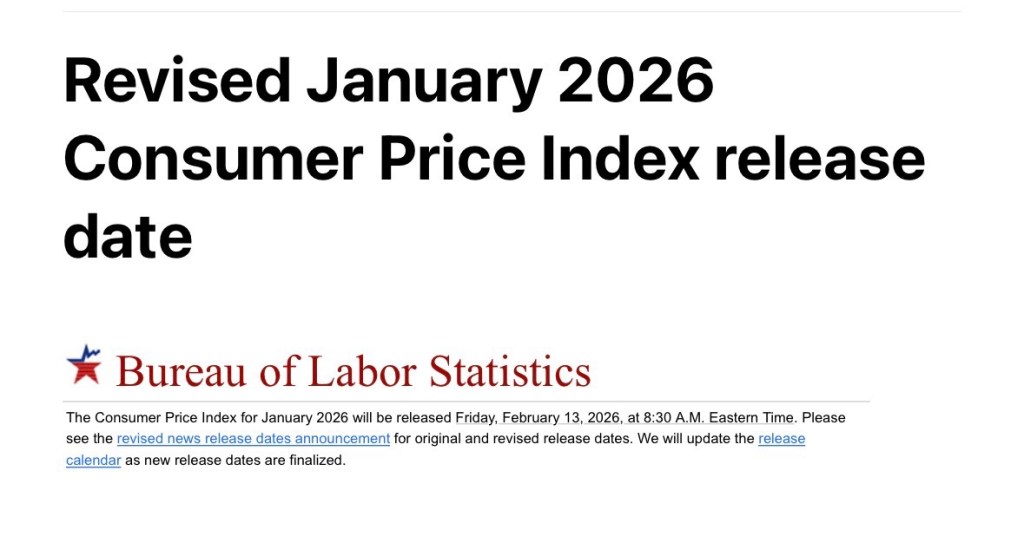
Since no price data were collected last month, there is no way to produce a conventional inflation report for October. Nevertheless, a sort-of-official calculated CPI number will have to be announced, and soon, because that will determine inflation accruals for Treasury Inflation-Protected Securities in December, just 17 days away.

Those daily inflation indexes (such as these for November) are crucial for pricing TIPS in the secondary market. Without some sort of index, traders won’t be able to value TIPS accurately. And since we will be getting a calculated CPI estimate, the TIPS market is going to feel some turbulence.

The Bureau of Labor Statistics has posted this note on its site:

BLS will announce revised news release dates on this page as they become available. We appreciate your patience while we work to get this information out as soon as possible, as it may take time to fully assess the situation and finalize revised release dates.

Without the October inflation report the Treasury will probably rely on a calculated non-seasonally adjusted inflation number for October, as noted in the Code of Federal Regulations

If the CPI-U for a particular month is not reported by the last day of the following month, we will announce an index number based on the last 12-month change in the CPI-U available. Any calculations of our payment obligations on the inflation-indexed savings bonds that rely on that month’s CPI-U will be based on the index number that we have announced.

The exact formula is a bit complicated for a lowly journalist, as you can see here:

I am going to guess the October inflation number will end up being around 0.25% based on this 12-month calculation. The October CPI index should be something around 325.6. We’ll see.

The BLS or Treasury will need to announce something soon because the TIPS market will get shaken without data on future market values.

In a report on October 25, Bloomberg speculated on unease in the TIPS market because of potentially inaccurate inflation indexes in December:

The segment of the US Treasury market that offers investors protection against rising consumer prices is headed for uncharted waters …

Jonathan Hill, head of US inflation strategy at Barclays Capital Inc., said the lack of data or questionable data will create stresses in the TIPS market:

If the October CPI isn’t published by the end of November, “the fallback comes into effect,” not just for TIPS but also for inflation swaps, derivative contracts in which a floating interest rate is exchanged for a CPI-based payment, Hill said. “It’s something that’s never come into effect before.”

Even if the data are published on time, doubts about its quality may create volatility, Hill said. …

Interest-rate strategists at Morgan Stanley said in a report this week that “concerns over deteriorating CPI data quality” related to “weaker data collection amid the government shutdown may be weighing on investor demand” for the $2 trillion TIPS market.

It’s worth noting that the real yield of a 10-year TIPS has been holding fairly steady during this shutdown crisis — falling from 1.87% on September 2 to 1.83% at the close on Thursday. During that same period, the nominal yield of a 10-year Treasury note fell from 4.28% to 4.11%. So it is possible that uneasiness over accurate inflation accruals is having an effect on the TIPS market.

Thursday’s reopening auction of a 10-year TIPS — CUSIP 91282CNS6 — should give us some idea of market demand. I plan on posting a preview to that auction sometime on Sunday (or whatever time it is in Japan).

Eventually, when the November and December inflation reports are released based on standard collection of data, the inflation numbers should return to accuracy. This should be — we hope – only a temporary disruption of the TIPS market.

But the continuing resolution only extends government funding to January 30. Will this damaging game start again in 2026?

—————————

This image has an empty alt attribute; its file name is tips4.jpg

Donate? This site is free and I plan to keep it that way. Some readers have suggested having a way to contribute. I would welcome donations. Any amount, or skip it, your choice. This is completely optional.

PayPal link / Venmo link

—————————

Follow Tipswatch on X for updates on daily Treasury auctions and real yield trends (when I am not traveling).

Feel free to post comments or questions below. If it is your first-ever comment, it will have to wait for moderation. After that, your comments will automatically appear. Please stay on topic and avoid political tirades. NOTE: Comment threads can only be three responses deep. If you see that you cannot respond, create a new comment and reference the topic.

David Enna is a financial journalist, not a financial adviser. He is not selling or profiting from any investment discussed. I Bonds and TIPS are not “get rich” investments; they are best used for capital preservation and inflation protection. They can be purchased through the Treasury or other providers without fees, commissions or carrying charges. Please do your own research before investing.
Posted in Inflation, Investing in TIPS | Tagged , , , | 11 Comments