
Financial planner Allan Roth has an idea for using TIPS for retirement security.
By David Enna, Tipswatch.com
It’s no secret that I am not a huge fan of mutual funds and ETFs that invest in Treasury Inflation-Protected Securities, because of my long-standing strategy to buy individual TIPS at good yields and hold them to maturity.
I’m sticking to that view, which dates all the way back to May 2011, when I wrote an article: “Why I am exiting Fidelity Inflation Protected Bond (FINPX)” explaining that I had made an 18.6% profit in the fund over three years, and was ready to depart. I wrote:
My feeling is that TIPS yields are well below the historical norm, and eventually the trend will return to normal. … The TIPS fund is booming with the current surge in Treasury securities. I think that will pass.
Strange thing: A year later Fidelity also exited FINPX, converting it into FIPDX, the Fidelity Inflation-Protected Bond Index Fund. That fund has had a total annual return of 2.18% over the last 10 years — not exciting, but it beats the 1.58% return of Vanguard’s Total Bond Fund (BND).
I understand that a lot of people want to combine inflation protection with the simplicity of an ETF, and TIPS funds can fill that need. But volatility in these funds can be a problem for investors seeking to fill specific income needs in the future. One bad year — like we had in 2022 — can derail longer-term bond investments.
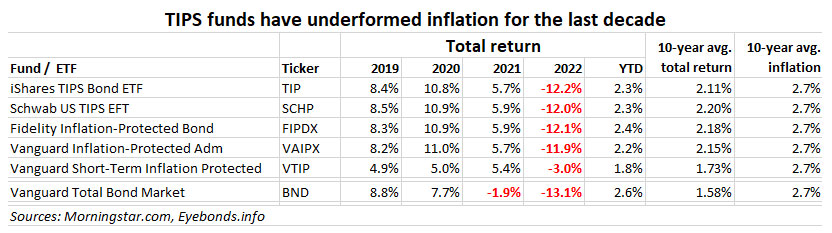
Have TIPS funds failed us?
Yes, these big TIPS funds failed to keep up with inflation. And that is utterly embarrassing at time when inflation was surging to a 40-year high.
That happened for two reasons: 1) The Federal Reserve’s repeated bouts of quantitative easing sent real yields deeply negative for much of the last decade, ensuring that this investment would lag inflation, and then 2) a massive 250-basis-point increase over the last 15 months sent TIPS values plummeting. Moving from a 10-year real yield of -1.04% in March 2022 to 1.53% at Friday’s close put a pounding on TIPS funds (and the entire bond market).
Morningstar took on this issue June 12 with a Jeffrey Ptak article with a savage headline: “The Inflation Hedge That Cost Investors 17% of Their Purchasing Power.” Ptak pointed out that investors poured money into TIPS funds after seeing 10%+ plus returns in 2020, followed by a growing surge in U.S. inflation.
Most of those investors flocked to TIPS funds seeking an inflation hedge. But they got more than they bargained for, with TIPS selling off sharply in 2022 as real yields reversed direction. All told, the average inflation-protected securities fund fell 9.5% in 2022. Taken together with the 7.5% inflation rate that year, investors in TIPS funds saw a 17% loss of purchasing power in 2022.
The author points out that using TIPS funds as trading vehicles has given investors even worse performance — buying at highs and selling out at lows.
While TIPS funds can serve a useful purpose, the data we analyzed suggests that investors have struggled to use them successfully in practice. They’ve chased returns, allocating more to TIPS funds after they’ve gained and fleeing when they falter. Thus, they have little to show for their efforts: By our estimates, the average dollar invested in TIPS funds lost 0.70% per year over the 10 years ended April 30, 2023.
I can’t argue with the premise of this article, even though it is negative about the usefulness of TIPS investments. But the author hits the main point I have been stressing for a decade: Buy individual TIPS and hold them to maturity.
Other investors might want to consider bypassing TIPS funds altogether and instead investing directly in individual inflation-indexed Treasuries. To be sure, this is administratively burdensome, as the investor must select the appropriate TIPS maturities and maintain their portfolio over time. But it’s inexpensive and a TIPS ladder might give a buy-and-hold investor seeking the inflation guarantee peace of mind.
Allan Roth’s ‘new 4% rule’

Allan Roth, a well-known author and hourly-fee financial adviser (one I have used in the past and will use again) made waves in the financial world last year when he suggested using a 30-year ladder of TIPS investments to guarantee a safe inflation-adjusted 4% withdrawal rate over that span.
That Oct. 24, 2022, article titled “The 4% Rule Just Became a Whole Lot Easier” detailed a technique for building a TIPS ladder — taking advantage of highly positive real yields — that could produce a 4.3% annualized real withdrawal rate for 30 years with no risk.
One day later, Roth’s idea launched a heated discussion and thorough analysis on the Bogleheads forum, generating 329 posts in just a couple days.
In December 2022, Morningstar weighed with an analysis of this idea by the site’s director of research, John Rekenthaler. He wrote:
With some effort, investors can create a TIPS portfolio that does, in fact, provide inflation-adjusted certainty of returns.
There’s even a website, Tipsladder.com, that provides a tool for designing a TIPS ladder based on the 4% withdrawal rate. (One complicating factor is that there are no TIPS maturing from 2034 to 2039. The solution is to buy a larger supply of TIPS maturing in 2033 and 2040 to cover the gap, or possibly to use I Bonds to help fill the gap.)
Roth’s Big Idea: A new TIPS ETF
On May 30, Roth wrote an article for ETF.com titled “An ETF Proposal for the 4% Rule.” He pointed out the problems with trying to build a 30-year TIPS ladder with equal amounts maturing each year:
1 It was complex and took hours to buy each of these bonds, with many of the trades not going through the first time.
2 The bid/ask spreads from buying a very small number of bonds were large and therefore took from returns.
3 While the cash flows average 4.38%, from buying a small number of bonds, the annual payouts varied a bit from that average. You can’t buy fractional amounts of TIPS as you can in a fund.
An ETF could easily solve all three of these problems.
Roth calls his ETF idea the Safe Withdrawal Rate ETF, or SWR for short. Here is how he says it could work:
The prospective consumer clicks on the SWR website to see its current real yield and annualized real cash flow. As of the time of this writing (May 2023), it would show 1.70% and 4.27%, respectively.
With a few simple clicks, one buys SWR with the intent never to sell. Let’s use $100,000 in this example. The authorized participant aggregates this purchase with many others to buy large volumes of TIPS to build the ladder ….
Then all the consumer or the ETF issuer has to do is nothing other than hold it forever. As the underlying TIPS mature, SWR would distribute the annual amount, $4,270 in this case, plus accumulated inflation.
The value of the ETF would decline over time as the TIPS mature, and would eventually reach zero in 30 years. Roth says, “In other words, SWR would be a self-liquidating ETF.” The funds could be offered in different maturities, of course. And the expense ratio in theory could be low (Roth suggests 0.05%) because no trading would happen once the fund is set.
Reaction to the idea
Roth’s idea prompted a June 16 article from Morningstar’s John Rekenthaler with the title “TIPS Ladder Funds Don’t Yet Exist, but They Should.” He points out that a such a fund would offer three advantages:
First, TIPS ladders are unique. No current fund behaves similarly. In a fund world dominated by me-too products, being different is valuable.
Second, TIPS ladders aren’t just distinctive—they’re distinctive and useful. True inflation hedges are rare. …
Third, TIPS ladders are laborious for retail investors to construct.
OK, but why not just buy a single-life annuity paying out lifetime fixed interest of maybe 6%? The problem is inflation, as Rekenthaler notes:
Why accept 4.27% from an immolating investment when one can buy a lifetime annuity that currently pays more, and which carries no expiration date? Two reasons. First … the annuity’s lifetime feature cuts both ways. Second, if inflation is substantial the real value of a nominal distribution, as made by annuities and conventional bonds, shrivels. Twelve years of 6% annual inflation halves purchasing power.
Inflation protection is the reason this SWR ETF idea is attractive. Rekenthaler points out that “every inflation-adjusted penny from a TIPS ladder is known in advance … No other investments can make such a claim.” He concludes:
Retirees need simple, effective methods for protecting their portfolios against inflation’s ravages. A TIPS ladder fund would expand their current options. It’s time for this idea to arrive.
Final thoughts
Building a long-term TIPS ladder is a laborious process, but at this point with real yields at decade-plus highs, it’s an investing opportunity for anyone who wants to preserve capital and ensure future cash flows, no matter the future rate of inflation.
Of course, for the risk-free strategy to work, the ladder-builder needs to commit to holding to maturity, using only money that can be set aside for years.
Roth’s ETF idea would simplify the process, but could face investor push-back over the idea of holding a 20- to 30-year investment to maturity, even if it was providing an inflation-adjusted, continuous return of 4.3% a year. Many of my readers, I think, would prefer the freedom to build their own TIPS ladders to meet specific needs.
But this kind of investment would simplify the process of funding retirement spending, and bring risk-free inflation protection to an entirely new market. Would it be too complicated for the average investor to grasp? Would the expense ratio truly be ultra-low, eliminating the need for self-building a TIPS ladder?
I like to see it happen.
• Confused by TIPS? Read my Q&A on TIPS
• TIPS in depth: Understand the language
• TIPS on the secondary market: Things to consider
• Upcoming schedule of TIPS auctions
Disclosure: I own VTIP in a traditional IRA account. I use it as a holding fund to make future purchases of individual TIPS.
* * *
Feel free to post comments or questions below. If it is your first-ever comment, it will have to wait for moderation. After that, your comments will automatically appear. Please stay on topic and avoid political tirades.
David Enna is a financial journalist, not a financial adviser. He is not selling or profiting from any investment discussed. I Bonds and TIPS are not “get rich” investments; they are best used for capital preservation and inflation protection. They can be purchased through the Treasury or other providers without fees, commissions or carrying charges. Please do your own research before investing.


 Treasury Inflation-Protected Securities
Now that iShares iBonds Term ETFs exist it would be great to get a review of then on this site
I might at some point. Hard to gauge the appeal at this point.
FWIW, IShares IBonds offers a series of non-rolling nominal Treasury, Muni, and Corporate (Investment and HY) ETFs. Fees range from .07%-.35% so you buy those knowing the YTM if held to maturity at any point in time. The share price rises/falls daily as mark-to-market of the underlying bonds. Therefore, a framework has been built for a non-rolling set of TIPS ETFs should a distributor decide it is worthwhile to offer.
I have used Ishares debt Muni and Corporate ETF’s (IBT* series). They operate in a way that is contrary to your statement. That would be a closed end fund. You do not lock in your YTM. The ETF’s are buying bonds as they get towards the end of their term as these funds increase in size over time. This was a killer as the bond market experienced increased rates and the bonds behind the ETF’s were being purchased for a higher yield.
I would refer you to IShares IBonds maturity case study (https://www.ishares.com/us/literature/presentation/ibonds-series-case-study-en-us.pdf) that shows the performance from beginning to end for each matured ETF. My takeaway is they were very close to the initial YTM except for the HY Bond tranches. As for maturing bonds, within the year of termination, IShares puts the proceeds into short term money instruments so there should have been little reinvestment risk.
Thanks for the info. I believe it confirms my statement. This is taken from the Case Study. “The monthly income distributions and final NAV payment will vary as bonds are entering the portfolios at different yield levels.”
Pingback: Followup: Bloomberg reports huge outflows from TIPS funds | Treasury Inflation-Protected Securities
I am considering setting up my first ladder from 2029 to 2039 using tipsladder.com. If I intend to hold until maturity, and do not need interest income prior to the start of the ladder, it seems that selecting “Lowest inflation adjusted principal” option is generally best. In this situation is there ever a reason to select the highest yield option?
I ran the two scenarios and the differences are pretty slight, especially in the later years. Going with the lowest inflation-adjusted principal might mean you are buying newer TIPS versus older TIPS, so the coupon rate could be much lower in many of those years. The highest yield version generates slightly more income at a slightly higher cost. In this case, you might choose the TIPS for each year that you can purchase at the par cost you desire.
I don’t buy mutual funds or ETFs. I especially never buy bond funds (can I say that?). All funds have annual fees. You are always at the mercy of the fund manager (who also takes part of the fee from you). I am not even going to talk about “loads”, other than to say they should be completely avoided. Most funds are allowed to hold, sometimes, a lot of cash. Do you want that? They are “managed” by a guy who probably doesn’t know any more about the markets than you do. Most mutual funds can be gated meaning they can halt redemptions any time the manager thinks it should, usually the same time you really want to make a redemption.
Just buy stocks and Treasuries directly. It is easy now. There are no commissions to buy or sell stocks or Treasuries at the big brokers, Schwab, Vanguard, probably Fidelity. Just use your brain and learn how to do it. It’s not too difficult (although timing to buy a Treasury at auction the same day another one matures requires some attention).
I will make one exception for those who really like stocks. A low fee ETF that mimics the SP500 is probably okay, like VOO or SPY. Berkshire Hathaway owns only two ETFs, VOO and SPY last I looked. This is an easy way to diversify if you are into stocks. I don’t own any, since I can get 5% APY in T-bills now.
As for TIPS, I am not enthusiastic about paying annual federal income tax on unrealized income. Maybe it’s just me.
From an academic study. The average annual return on the stock market of 10% is generated by 5% of the companies. The rest return about the same as Treasury bills over time. Individual stocks seem like a bad gamble.
The cap-weighted indexes look terribly skewed at this time for any decent diversification.
Morningstar took on this issue June 12 with a Jeffrey Ptak article with a savage headline: “The Inflation Hedge That Cost Investors 17% of Their Purchasing Power.”
How did Roth’s ladder protect purchasing power over this same period? Doesn’t a 30-year ladder have a duration of over 10 years? If so, the owner of a $1 million laddered TIPS portfolio built at the beginning of 2022 has a year-end statement showing a value under $800,000 based on my back-of-the-envelope calculation. Wouldn’t Ptak’s headline read “30-Year TIPS Ladder – The Inflation Hedge That Cost Investors 25% of Their Purchasing Power”?
Of course, Roth is talking about building a set-it-and-forget it TIPS ladder TODAY that would mature out each year for 30 years, except for the gap years. So, first of all the ladder would be built with today’s higher yields and none of the negative yields of early 2022. It would have a known return if held to maturity. Second, the market value fluctuations are irrelevant since each TIPS would be held to maturity and pay out with full inflation accruals. (Your brokerage would continue to report market value, which you could ignore … except if you need to take RMDs from the total. So it would be wise to have money to pay the RMDs outside of the TIPS ladder.)
How can I calculate the impact of holding a 20-30 year ladder in a taxable brokerage account? Using tipsladder.com I can see the income available to spend, but I’m worried that the TIPS ‘phantom’ income especially in the early years of the ladder would push my taxes higher, thus making it hard to calculate my expenses.
Or, maybe this ladder is best left to a tax advantaged account?
This form of ladder is designed around providing yearly income, but I’d guess it would work best in a tax-deferred account. You’d pay taxes on the money you withdraw each year, but not on the annual inflation accruals.
David.
There has been a lot of discussion on Bogleheads recently about the concept of simulating a non-rolling TIPS ladder with a combination of three rolling TIPS funds whose weighted duration matches that of the non-rolling TIPS ladder. This approach does require periodic maintenance to keep the weighted duration in sync, but it has the advantage that one could build a long ladder even if one only had a modest amount to build with.
Do you have any thoughts about this approach?
This is totally beyond my level of expertise. I love the Bogleheads, but I can’t try to match their level of financial nerdiness.
Roth does not explain why he puts excess capital into the 2040 ladder rung. This seems like an inefficiency since the need for the cash flows, 2033-2039, would have passed. If, in his ladder, the 2040 has to be sold to meet the needs of earlier years, the cash flow guarantees would be lost.
Pfau handles the problem differently (How Much Can I Spend in Retirement?, 2017) and would put all the capital for 2033-2039 into 2032. At maturity in 2032, TIPS would exist for the missing years and would be purchased to complete the ladder.
To mitigate the interest rate risk looming in 2032 with Pfau’s approach, one could instead increase the capital in each of the first seven years of the ladder using a portion at maturity for current expenses then buying the new 10 year TIPS with the remainder to fill out the ladder over time.
I like this idea of trying to fill the 2034 to 2039 “on the fly” by purchasing 10-year TIPS in the future. But that does create reinvestment risk, as you note. In the article written last year, Roth buys a 5x allocation in the 2032 purchase and a 4x purchase in 2040, with the idea of selling off some of those shorter-term TIPS each year in the final years of the gap.
The beauty of Roth’s approach is that it locks in today’s high yields. And you can sell combinations of your 2033+2040 TIPS to fund the purchase of 2034-2039 TIPS when they are issued without loss of principal, no matter what interest rates do in the meantime.
With the issue of a TIP that matures in 2033 this year the gap in a TIP ladder will be from 2034-2039. There are several ways to attempt to address this gap of six years.
T Lee reports that Pfau addresses this by putting the funds for the gap in 2033 and when the 2033 TIPs mature, uses those funds to purchase TIPs that mature in 2034-2039. This approach will eliminate interest rate risk since you wait for the 2033 bonds to mature, but it will leave you wide open to reinvestment rate risk. You will be stuck with whatever real rates exist in 2033.
Another approach would be to by extra amounts in your first six rungs of your ladder, 2024-2029. When the 2024 rung matures you buy your 2034 rung and so on. This again, eliminates any interest rate risk but still leaves you exposed to reinvestment rate risk. That reinvestment rate risk will be diversified, but it will still be there.
Then there is Roth’s approach where you place half of the funds needed for the gap in 2033 and half in 2040. In 2024-2029 you purchase TIPs that mature in 2034-2039 funded by selling a combination of your 2033 and 2040 TIPs. The combination of TIPs sold is picked so that the average duration of the TIPs sold matches the duration of the TIPs bought. This eliminates interest rate and reinvestment rate risk.
Yes…reinvestment risk…thank you.
Roth’s ETF idea is very similar to an inflation adjusted annuity without the mortality credits. With the availability of TIP’s, inflation adjusted annuities are rather straightforward for an insurance company to setup and would provide their owners with an even higher return than Roth’s ETF. Since no insurance company offers inflation adjusted annuities anymore, I wonder what I’m missing.
My daughter is in TIAA, and I think they have a variable annuity based on TIPS. I’ve been meaning to check it out for her.
Forunately, I also got out of Bond funds (MFs, & ETFs – never again into them) a while ago. The idea of escape clause may help some but it may lead to many escapes (aka almost-many-trades) impacting others. Roth has a good idea but not for me. As always, David’s post has a real good instructive value. I remain a fan of creating customized personal individual bond holdings portfolio, TIPS in my and my wife’s roollover IRA accounts only, and, of course, holding them to maturity. Also, my commitment to I Bonds, since about 15 years now, remains steadfast.
Correct me if I’m wrong, but if you hold your TIPS fund to its duration it’s pretty much the same as holding a TIPS bond of the same duration as far as all this. In other words, it’s largely a mark-to-market psychological thing because you see your TIPS fund’s gyrations every day, whereas most people don’t see any daily change in their bonds at TD. But I think the end result is the same, as long as you don’t panic and sell your fund at a loss.
A typical TIPS fund has no maturity date, so it can’t be held “to maturity.” You can match the duration to your investing timeline, which helps minimize the interest rate risk. But the problem arises if 2022 was your target year and you just had a total return of -12%. In the case of the TIPS ladder, you can guarantee an actual, inflation-adjusted return in the future, which will be paid at maturity: par + inflation accruals + coupon rate along the way.
That’s been my thought, but I think the reinvestment rate could be the killer. As TIPS mature and are reinvested in new TIPS, the real rate could be negative in the future.
I think the strategy exists today based on real rates again being positive now.
Anybody else know about this?
The TIPS ladder that Roth describes is a non-rolling retirement spending ladder. In theory cash flows are spent on current expenses when they are received. There is no reinvestment.
You are indeed right that people are more interested in TIPS due to their real yields. Remember, the classic Bengen 4% spending rule worked for a 50-50 portfolio which had a real yield of about 1.4% during the time period he studied. When TIPS real yields get above that number the Total Return investment community joins the Safety-First crowd and gets interested in them.
I wonder what would happen if I were to buy one of these funds and pass away 10 years later? I suppose the simplest option would be for someone to inherit the income stream. I don’t think I’d have a problem with that, but others might. I imagine lump sum payouts would be problematic given the design of the fund.
It’s a good question. I suppose there could be terms for an “escape clause” under certain circumstances. Or, it is possible that the ETF could trade with its value rising and falling based on its fixed-term real yield. It market yields rose, its value would go down. It market yields fell, its value would go up. Trading this as an ETF wouldn’t effect the base portfolio. But trading could be super slim.
If you build a TIPS ladder in an IRA account, at least you can name primary and secondary beneficiaries.
No reason these can’t/wouldn’t be marketable. When you buy it costs the market value of the income stream based on the current yield curve. As long as you hold you get payments. When you sell you get the market value of the stream of payments you give up. So really it is a bond, just one that pays out big coupons until the principle is exhausted.
Although it’s conceptually a ladder, I think bond managers would use some more flexible duration matching approaches to eliminate interest risk. Then they could aggregate a bunch of these together and then just manage the pool rather than each ladder. That’s part of how they make money.
A Prudent investor does not put all eggs in any one basket. You have to ask yourself is it worth it for only x% allocation. A 20-30 year maturity only appeals to the young, who have no real money yet. I got Ibonds, no tips.
No bond funds or ETFs for me either. I have been whipsawed by others jumping in or fleeing funds, happily in the distant past now.
Wall Street likes to create new vehicles to confuse investors and maintain profits, but Paul Samuelson said investing should be as exciting as watching paint dry. Allan Roth’s big idea about a ladder yielding 4% real was explained in a university professor’s letter to the Wall Street Journal 25 years ago.
To be clear, I still have a core holding in BND in my traditional IRA. It hasn’t been pretty but I don’t trade in and out of it. I will use that in the future to pay RMDs and leave my TIPS holdings running to maturity. … TIPS were first introduced in 1997 and had gaudy real yields of 3.5%+ . Those were exceptionally solid investments.
The I bonds 1998-2001!
Yields north of 3% and maximum of 30K initially. Of course back then everyone ‘knew’ bonds were for suckers…..
I bought a lot of those back then, the ones with a 3% fixed rate, when you could buy $30,000 a year. I also inherited a bunch. I actually have what I consider “a little too much” in I-bonds now (lol). I have to think now about how to deal with hefty tax bills at maturity. I’ll probably cash out some before maturity at years 28, 29, 30. I have to do the math.
I have a small amount of those because I didn’t have much cash to spare back in those days. Looking back, it feels like I got away with something and I wish I’d been able to buy more.