
By David Enna, Tipswatch.com
We got a surprise announcement yesterday that should surprise no one: Fitch Ratings downgraded the Issuer Default Rating on U.S. debt to ‘AA+’ from ‘AAA,’ with a stable outlook.
This follows by almost exactly 12 years a similar action by Standard & Poors, which downgraded U.S. debt to an AA+ rating on Aug. 6, 2011. S&P has never lifted that downgrade and still has U.S. debt rated as AA+.
The reason Tuesday’s announcement was a surprise is that it precedes a potential — and very likely — U.S. government crisis by two months. From a USA Today report:
Once lawmakers get back to Capitol Hill in mid-September, the House and Senate will be in session for roughly three weeks until the Sep. 30 deadline to pass a federal budget. On Oct. 1, a new fiscal year begins. If lawmakers cannot push through 11 out of 12 separate spending bills, after passing just one before the August recess, the country will face a government shutdown. …
“We should not fear a government shutdown,” Rep. Bob Good, R-Va., declared at an event outside the Capitol this week. “Most of the American people won’t even miss it if the government is shut down temporarily.”
There is little doubt a shutdown is coming. A number of Republicans are pushing for deeper spending cuts than they got in May’s debt-ceiling compromise. A factor that few people realize: The compromise includes language that enforces a 1% cut in federal spending if all 12 appropriations bills are not passed, and each bill must now get a separate vote (they’ve been grouped together in the past in “omnibus” spending bills). From a New York Times report:
The debt-limit agreement imposes an automatic 1 percent cut on all spending — including on military and veterans programs, which were exempted from the caps in the compromise bill — unless all dozen bills are passed and signed into law by the end of the calendar year. Mandatory spending on programs such as Medicare and Social Security would be exempt.
In essence, a few Republican House members could force BOTH a government shutdown and a 1% automatic spending cut, simply by failing to pass one of the 12 appropriations bills.
All this has been known for months, but it took the calendar turning to August for the fire to burn hot. Fitch Ratings saw the fire and acted.
Fitch’s reasoning
Fitch Ratings on Tuesday released a Rating Action Commentary that explains its reasoning. Here are key elements:
Ratings Downgrade: Fitch noted expected fiscal deterioration over the next three years, a high and growing U.S. debt burden, and the erosion of governance reflected in repeated debt limit standoffs and last-minute resolutions.
Erosion of governance. Fitch noted:
- A steady deterioration in U.S. governing standards over the last 20 years.
- Repeated debt-limit political standoffs and last-minute resolutions that have eroded confidence in fiscal management.
- Economic shocks, tax cuts and new spending initiatives that have contributed to successive debt increases over the last decade.
- Limited progress in tackling medium-term challenges related to rising Social Security and Medicare costs.
Rising deficits. Fitch noted: “We expect the general government (GG) deficit to rise to 6.3% of GDP in 2023, from 3.7% in 2022, reflecting cyclically weaker federal revenues, new spending initiatives and a higher interest burden.”
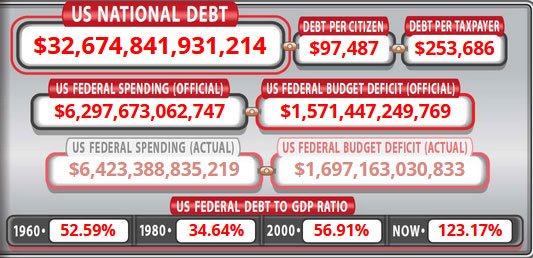
In a nice bit of timing, the U.S. Treasury on Tuesday issued its “Latest Debt to the Penny” report on Tuesday, just before the Fitch announcement. This is an ugly trend:
- Total U.S. public debt, Aug 1, 2023 = $32.6 trillion
- Total U.S. public debt, Aug 1, 2018 = $21.3 trillion
- Total U.S. public debt, Aug 1, 2013 = $16.7 trillion
So in just 10 years, the U.S. public debt has nearly doubled and this increase is not slowing down, especially with much higher interest payments adding to the burden.
Potential for recession. Fitch noted: “Tighter credit conditions, weakening business investment, and a slowdown in consumption will push the U.S. economy into a mild recession in 4Q23 and 1Q24, according to Fitch projections. The agency sees U.S. annual real GDP growth slowing to 1.2% this year from 2.1% in 2022 and overall growth of just 0.5% in 2024.”
Reaction to the downgrade
Let’s watch the CNBC coverage:
Fitch immediately took heat for this decision and naturally the reactions fell along party lines.
White House press secretary Karine Jean-Pierre said, “It defies reality to downgrade the United States at a moment when President Biden has delivered the strongest recovery of any major economy in the world.”
In a statement, Senate Majority Leader Chuck Schumer, D-N.Y., said the Fitch downgrade reflects “reckless brinksmanship and flirtation with default” by House Republicans and that they “must never push our country to the brink of default again.”
Another Biden administration official called this the “Trump downgrade,” attempting to pin the blame on the former administration.
Louisiana’s former Republican Gov. Bobby Jindal tweeted: “S&P downgraded US credit under Obama, and now Fitch has downgraded US rating under Biden. The excessive spending and borrowing must stop.”
Sigh. Could just ONE politician step forward and say, “Both parties caused this problem and both parties will have to work together to solve it”?
All of this parallels what happened in 2011 when S&P downgraded U.S. debt to the same AA+ rating. That downgrade was called “Black Monday” because it caused a 5.5% one-day drop in Dow Jones Industrial Index. It seems unlikely that we will see a similar fall today because financial markets have become inured to these crises. Bloomberg’s report this morning noted, “In financial markets, the move was met with what amounts to a shrug.”
What was really surprising in 2011 is that U.S. Treasurys strengthened after the downgrade and interest rates fell as the stock market roiled. This chart shows the massive moves in Treasurys and the stock market in August 2011:

Again, I don’t expect to see a similar pattern in August 2023. I’ll close with this from Joachim Klement, head of strategy at Liberum Capital, quoted by Bloomberg:
“We think the downgrade of the US credit rating will not have a material impact on equity markets, US Treasuries or the US dollar. While the downgrade came at a surprising moment, it is not unjustified given the large deficit of the US government and the lack of projected deficit reduction in the coming three to five years. But there is no reason to sell US Treasuries or demand an increased risk premium, in our view, since there is no alternative to Treasuries in global bond markets, nor is there any material default risk in the coming decade, in our view. All in all this is a tempest in a teapot.”
Will the downgrade cause me to abandon investments in U.S. Treasurys? No.
Any thoughts? Solutions? Strategies? Post them in the comments area below.
* * *
Feel free to post comments or questions below. If it is your first-ever comment, it will have to wait for moderation. After that, your comments will automatically appear. Please stay on topic and avoid political tirades.
David Enna is a financial journalist, not a financial adviser. He is not selling or profiting from any investment discussed. I Bonds and TIPS are not “get rich” investments; they are best used for capital preservation and inflation protection. They can be purchased through the Treasury or other providers without fees, commissions or carrying charges. Please do your own research before investing.


 Treasury Inflation-Protected Securities
“Sigh. Could just ONE politician step forward and say, ‘Both parties caused this problem and both parties will have to work together to solve it’?”
Your question pre-supposes that politicians are reasonable and rational people primarily motivated to improve the country as public servants. Sadly, the reality seems to be they are instead possessed by a reflexive need to demonize the other side irrespective of the particular facts and circumstances of any given topic. I primarily blame our primary system and hope that, someday, migrating to a system more like Rank Choice Voting could reduce the current outsized influence of the political fringe elements of society.
On a more positive note, thanks for so much for this site. I’m 57 and about a quarter of my net worth is now in 5 and 10 year original issue TIPS (in a retirement plan to avoid the phantom tax) that I will hold to maturity and see as the uber-safe part of my portfolio. No so much as “wealth” protection but more purchasing power protection – which is the important thing for ‘safe’.
Thanks for reading. I have long talked about trying to have 15% to 20% of a portfolio in ultra-safe investments like TIPS, I Bonds, nominal Treasuries, bank CDs. That’s what works for me. Not for everyone, I suppose.
It’s not jingoistic to say that this country is the best economy in the world, although we are certainly pushing that status to the limit. When you look at Japan’s decades long stagnation, the continually dropping birth rates in other east Asian countries like Korea and Taiwan, Europe’s much larger debt crisis and continuing issues integrating Eastern Europe with the powers in the west, the UK in a death spiral following Brexit, the Chinese government just making up or hiding numbers to try to convince the world they are still growing, there aren’t that many better options.
I am overweight emerging markets on stocks, but there is no way I would buy debt in countries like India, Brazil, South Africa, or Indonesia. Contra to some politicians, our educational institutions and business structure still draw thousands of people from all over the world to study and work. And unless one plans to emigrate from the United States, you will be paying in dollars for your expenses in retirement. 2017-2022 has shown that even despite political and pandemic shocks, the US is still very resilient.
I guess you can only hope for the best and in the mean time, enjoy the best interest rates in decades that may even go higher.
TIPS bond laddering is now far more interesting with long-term TIPs yielding over 2%. Rolling my own inflation indexed annuity is very attractive.
A TIPS portfolio can last 30 years with a withdrawal rate of over 4%.
Yes, totally true. I wrote about this TIPS ladder strategy here: https://tipswatch.com/2023/06/26/can-we-build-a-better-tips-etf/
I have been nibbling in with purchases in the 2029 to 2043 range. Should I go beyond 2043 when I will *supposedly* be 90? I probably won’t.
Can anyone explain how the US government will not ultimately default on its debt?
It is clear to me that there is no appetite for reducing spending on the order needed to actually pay back the debt. Therefore, I don’t think we will.
My guess is will result in, first, hyper-inflation as the debt is monetized. Then, ultimately when the US dollar is worthless, to the creation of a new currency (e.g. the New Dollar), which will knock zeroes off the end of the old currency, such as has been done in numerous other countries, numerous times.
I’d love to be wrong. How am I?
As long as the Treasury can print money (by borrowing) and the Fed supports it, the U.S. won’t default on its debt. (But that would be inflationary.) The problem Fitch sees is that political quagmires could shut the government and enforce a hard debt limit, which could lead to default. Inflation expert Michael Ashton recently wrote on this topic: https://inflationguy.blog/2023/08/02/three-colliding-macro-trends/
No, I get that they can print money and it would be inflationary. I’m talking about what happens after that. At some point, the printing stops because the creditors will refuse to keep borrowing when they know they are being repaid in essentially worthless USD.
So, yes, theoretically the US gov’t could “repay” all of its debt right now, but then it would still need to borrow more to keep going and who would want to lend them money at that point? It ends at some point and I’m saying it certainly end with their debt not being repaid. I cannot see any other way and I’ve not been read anything that would convince me that’s incorrect. Thanks.
The US is in one of those situation where we are still too big to fail. And it’s not like our competition is doing much better at controlling their debt spending either.
If you believe in the Fourth Turning (William Strauss and Neil Howe) we are in the Crisis part of a regular, repeating cycle of history. Like crises of the past (WW2/Depression, Civil War, Revolutionary War and so on back in time) a crisis period entails political and social separation, financial crises, growing dysfunction and distrust in government — sound familiar to what we are experiencing today?
Howe, in his new (and riveting) book, The Fourth Turning is Here, deftly lays out the four distinct repeating periods, how they come about and how each generation affects and is affected by these periods — High (most recently post WW2), Awakening (1960s/70s), Unraveling (from Reagan to Post 9/11) and Crisis (Great Financial Crisis – 2033??).
The bad news — we’re in for some turbulent times ahead before we clear out the disfunction. The good news — on the other side of this we will experience another High (like post WW2) where there will be more solidarity, a more functional government, low crime, conventional values, large middle class and more civic pride. A period of cooperative “can do”.
Certainly sounds better than where we are, but I am concerned about the transition.
It sounds like an interesting book and I made a note to look for it, but I am not convinced that there is some kind of built in cycle that guarantees that the society will emerge from it renewed in a kind of 1950s way which sounds like what is being described. Particularly, in the mid term future i.e. mid 21st century.
Rob, check out a very good interview with Neil Howe https://www.youtube.com/watch?v=2Bdn8sSE8Rs
The book is very well written and researched and a real perspective changer.
In order to get through the crisis, it calls for sacrifice from all, a getting along and bringing community together (think of WW2) and afterwards, that continues into the High and then the Baby Boomers ruin it all :))
I’ll be interested in your thoughts about the other side of this crisis period after you read the book.
Minn – You wanted my opinion. I read the first of the two books focusing on the Fourth Turning prophecy. I’m not sold on the theory that there are similar repeating generational cycles, roughly 4 per century? The first book was written in 1997. I don’t remember that societal disillusionment was setting in that early, maybe for me personally, but we had balanced budgets, relative peace and Seinfeld was tops in the ratings. But it must have been brewing for the authors to have picked up on it. But the disillusionment became obvious with dot.com and then hit hard with 9-11. For a book written in 1997 they did make some astute observations. Such as the tensions today over personal rights between generations, etc. They also predicted that the near 50/50 split in politics would give way to a dominant party in control. I think we can see this shaping up as well.
They seemed to be focused on a coming financial crisis that would ultimately over some years bring a realignment of the financial system. That was a fairly bold prediction considering the progress that was being made in balancing the budgets. Dot.com was yet to come and we did have that initial crisis in 2008 with the banking crisis. They did allude to other possible shocks, terrorism, bioweapons, etc. that could upset the predictions. I don’t know if they expected that we would have all of these shocks. They predicted that due to the financial realignment that is coming, the Boomer generation would have to forfeit much of their expected entitlements and reorient themselves towards a non consumption life style. They went as far to say that the Boomer generation would be more accepting of death rather than be a financial medical burden on society. We’ll see. They may not have any say in the matter. The financial reorientation should be starting by now but it hasn’t exactly. Many Boomers are still living the good life. They predicted that Boomers will never retire but be hired by various organizations to serve as respected sages. They also predicted that Boomers would settle in places like the Pacific Northwest, Northern CA and New England, kind of like they are all grey haired pony tailed hippies, but they didn’t explain how they would afford to live in such places if their retirement income was going to be impaired. I found the predictions about Boomers to be the most entertaining in the book.I agree though that there is a significant risk to retiree income and other benefits in coming years and decades.
The were way off in predicting that immigration would be heavily reduced by the 2000s due to what they called ‘nativism’. Whereas, we have the uncontrolled open border. There doesn’t appear to be any movement to change that either. The political solutions being offered are to take some families into your home since the motels are full. They also called the Millennial generation the most talented generation in history. Yes, true for some, there are a lot of computer whizzes out there, but some in that generation are also living in tent cities addicted to fentanyl.
So, in the end, I do not see the social groundwork laid to move from presumably the restructuring of the US financial system that is playing out now to a well functioning communitarian oriented society. I also do not see the comparisons between the present ‘crisis’ and WWII. I think we could be in for a long term period of social and economic disorder.
I really like economist Ruchir Sharma’s takes on where we’re headed. He believes that we’ve been in a “bailout” culture since the GFC, and its hard to argue against that. When you think about much we de-risk many parts of people’s lives now, the sad irony is that government’s overreach into every aspect of people’s lives (retirement, health care, child care, food assistance, income-assistance, housing assistance, tax cuts, tax breaks, etc.) is so enormous that no wonder we’re on an unsustainable path. Increased spending and lack of revenue collection is just simple math, and it creates even more risk for everyone in the long-run when real sacrifice will be necessary, like another 9-11-01, war, or catastrophic climate event. Our debt should not be this high with such low unemployment, PERIOD. There are 1.6 jobs for every job seeker, so transferring money to people not to work or spending it on programs that doesn’t train the future workforce should come with a limit. Constantly creating a culture that forgives bad choice (like student loan forgiveness for useless degrees) reinforces the notion that DEBTS DO NOT MATTER. That sort of Modern Monetary Theory only works on the assumption that people will always be coming into the workforce and paying taxes, but the MMT’s forgot to take into account the idea that many younger generations are now choosing not to work regularly, but instead freelance a few months here and there. Couple with an aging population drawing entitlements from those shrinking revenue pools and you have even bigger debts ahead. That will only increase with medical advances keeping people alive longer. I work in government purchasing, and I can tell you from firsthand experience, that revenue is not the main problem; it’s the inability to say no to frivilous spending projects that net zero return on investment. Not all spending is frivilous; some is very necessary, but a large portion is completely useless and nets ZERO return, something most of us reading these columns would never tolerate in our own household budgets. Many of the decision makers I work with are financially illiterate, and idealogically driven. They are quick to spend unused funds for programs that barely impact the end-users, but usually the vendors the most. Until government procurement systems are modernized away from par level requirements, there will always be enormous waste and an unprepared supply chain like we witnessed with Covid. The gigantic size of government has made it difficult to track expenditures, and identify inventory. Think about those Covid stimulus checks…I was sent one, but I was still employed, and really didn’t need it. Total waste. I’m sorry to rant, but David opened up the column here for responses, so I figured, why not! LOL. I remember reading a demographer’s prediction for this decade back in 2020 in an Investopedia column, and he stated that is the decade of “peak humanity.” Aging populations worldwide, slower growth, scarcity of resources, dysfunctional governments, you name it. You’d think the prospects of all these problems would be a call to action, but apparently not, especially when you have pettu politicians who think default, shutdowns, uncontrolled spending and other non-action is an answer. God I hope somebody has an answer. Here’s a link to a Ruchir interview. He’s also been on Bloomberg, and CNBC:
https://www.cnn.com/videos/business/2023/04/13/exp-banking-crisis-inflation-ruchir-sharma-041203pseg1-cnni-business.cnn
Jason, thank you for this lucid, informative response.
You can remove this entry if it is too far off topic, but in the interest of soliciting thoughts from financial minds I would like to see what people think of the 5th profile provided at the following URL:
https://finaid.umich.edu/getting-started/estimating-costs/family-profiles
It is supposed to show that the true cost of attending university is $0.00
Looks like a very false illustration to me. Is this why the deficit is so high, being trained (educated) to loose.
I am sure these examples are true for some very lucky students. (Yes, several examples pretend that loans are “free.”) It would also be easy to find examples of grads with $100,000+ in debt from attending Michigan or any other university.
How so? $115k for a family of five is solidly middle class, and it said the family was using the post-9/11 GI Bill, which implies that one of them is or was a military service member.
Thank you for pointing that out. Reading about the 9/11 GI Bill I see that it does cover all tuition when qualifying for the maximum benefit. So instead of being “very false” I would like to change my words to “grossly deceptive.”
The entire webpage intends to show that attending university is free of cost to the student. An educational institution should focus on protecting its students which in this case requires clarity in the cost of attending.
You say “In essence, a few Republican House members could force BOTH a government shutdown and a 1% automatic spending cut, simply by failing to pass one of the 12 appropriations bills.”
But there is no requirement that House votes be along party lines. The accurate statement is it will take 218 members of the US HoR to force both a government shutdown and a 1% automatic spending cut…”
Yes votes are yes votes and no votes are no votes — the total of either is not dependent on the party of the voter. 218 no votes and the bill(s) fail; 218 yes votes and they pass.
It’s hard to argue that politics has become extremely partisan over the last few years…how else do you explain the almost uniform defense of Trump among Republican legislators when 2/3 of Americans think Trump has committed crimes?
That certainly was not true in the Watergate era. Politicians were able to put country ahead of party
As politicians have felt their control over the populace slip since 2006 to 2008 they have relied on more polarization at their level to create control through fear. Not a conscious choice, just the inevitable and logical repeated throughout history. Expect more of the same moving forward based on societal complexity researchers.
It’s not just politicians who have become extremely partisan. Your example (and the statistics you cite) are a perfect illustration. It’s actually just 51% of Americans who think he has committed crimes. (source is NYT) Yet the headlines scream “majority” which gets mentally extrapolated to 2/3. A similar case could be made about Biden or the Clintons.
My point is not that one party is better than the other. They both are dysfunctional. And the “system” is broken when We The People somehow categorize 211 “no” votes for a bill different than 7 “no” votes. Somehow “separation of powers” and “checks and balances” became D over R (or R over D) instead of Legislative over Executive.
It is hard to imagine there does not exist a Bill (a.k.a “solution”) to any problem before Congress that cannot easily get 218 “yes” votes if the members voted for the text of the Bill instead of the “party line” resistive headline.
And it cuts both ways — this is not a “one party” problem.
Harry and others, let’s keep the focus of the discussion on the budget deficit and political gridlock.
I am curious what you and other commenters here think of diversifying (against sovereign risk) the Fixed Income portion of one’s portfolio by having of portion of it residing in BNDX instead of BND, VGIT, or GOVT.
For instance, replacing a 60% VT/40% BND portfolio with 60% VT/20% BND/20% BNDX.
I’ve seen discussions on this in various places over the years, but the prevailing idea has always been credit quality is much more important in your fixed income portion of your portfolio than diversity.
I guess my counterargument is that most US residents are heavily overweight in US assets even if they’re diversified in their equity allocation (using VT or both VTI/VXUS) because all of their fixed income is US-based as well as their FDIC-insured accounts, real estate, pensions, etc. This recent downgrade just makes me think this more.
Thoughts from people?
The general advice I follow is to have fixed income investments in the currency you will be spending, so for me that is U.S. dollars.
Hi Scott,
I have 5% in BNDX and 5% in VWOB for a total of 10% international allocation in my fixed income portfolio. Like you, I wanted diversification over credit quality. Plus, like you said, I was overweight US assets, but also realized that owning US large cap assets already gives you indirect international exposure since 40% of their revenues come from outside of the US, so I didn’t see the need for a larger non-US allocation. I also noticed the long-term returns on international bonds were just as good as international stocks in many cases.
The deficit is out of control. The cause is two-fold, spending is high and taxes are down. Interestingly the party that spends is also the party that cuts taxes. See – https://shawnpheneghan.wordpress.com/2023/03/17/who-is-responsible-for-debt/
I always say the 2 easiest thing for Congress to do are 1) cut taxes and 2) raise spending. For decades.
Fitch has popped the 5-10 Yr TIPS YTM. Buy now or let it play a bit?
Thx, dale
I bought a little of the 2042 TIPS today at about 1.97%. Who knows? Yield was better than my last purchase.
I bought a little of the 2 year a few days ago. I was pleased.
You wrote: Sigh. Could just ONE politician step forward and say, “Both parties caused this problem and both parties will have to work together to solve it”? Well guess what, the libertarian party has been shouting this for years…it’s the only fiscally responsible political party in existence, blows my mind that the majority hasn’t fled the left and right to come join us in the middle!
Unfortunately the modern Libertarian Party has gotten into culture war issues and owning the libs. They are just too extreme for a lot of people. I think many folks would like to get back to the era of the 1960’s and 70’s, where the parties were less ideologically polarized, but politics were different and there are some unambiguous positives, like the purging of former KKK members from the Democratic Party.
In order to pay down the debt, the government first has to eliminate the annual deficit and generate a surplus. It hasn’t done that since Clinton’s second term in office over two decades ago. That took bipartisanship and a combination of tax increases, spending cuts, and a booming economy. Our politics today are even more divided and extreme than back then. Retaining or regaining power is always the priority over solving our problems. Democrats are reluctant to cut domestic spending. Republicans don’t want to raise taxes. And the consequences of non-cooperation don’t seem dire because they can always print and borrow more money.
Here are three possible solutions:
1) Term limits
2) Balanced Budget Amendment
3) Lifting the income cap on Social Security Tax so all income is included.
I will assume we won’t be able to have a balanced annual budget for decades, but there should be some effort to lower the deficit. We are no longer in a Covid crisis, a housing crisis, a dot-com crisis or even a recession. Now is the time.
The late Senator William Proxmire used to issue what he called his Golden Fleece awards highlighting absurd projects and pork barrel spending funded by the federal government. I have great doubt that things have changed to any degree.
I remember these awards, so I did some quick research. When Sen. Proxmire stopped issuing the awards in 1988 (35 years ago), the total U.S. debt was $2.6 trillion. Today it is $32.6 trillion. He was a great guy. From Wiki: “Proxmire was reelected in 1958, 1964, 1970, 1976 and 1982 by wide margins, including 71 percent of the vote in 1970, 73 percent in 1976 and 65 percent in 1982. In both of his last two campaigns, Proxmire refused contributions and spent less than $200 out of his own pocket, which covered the expenses related to filing re-election paperwork, and he mailed back unsolicited contributions.”
He caught a bit of flack for letting his government health insurance pay for his hair transplant. Small potatoes
Forbes 2021
https://www.forbes.com/sites/adamandrzejewski/2021/06/30/us-senator-william-proxmires-golden-fleece-award-turns-46-years-old/?sh=134b28e5283a
Great article and thank you for everything that you have shared through this website. I especially recognize and appreciate the most appropriate use of “Sigh” within the article.
Perhaps the banks (those that own the banks) and the oil and insurance companies (those that own the oil and insurance companies) own us all (the indentured servants) … The world keeps spinning though.
I agree with Catherine, very good article.
The problem is our political system is broken and the chance to a reasonable approach to deficit/debt reduction is near to impossible. Republicans refuse to raise taxes and see enforcement of tax laws the same as a tax increase. Democrats want to protect all social programs at all cost, but are more sanguine to cuts if some taxes can be raised.
It all leads to gridlock, similar to a lack of debate on the immigration issue.
Unless common sense returns to our political discussion we are doomed to a massive debt crisis.
Great article, thanks!