
This is positive news, but uncertainties remain.
By David Enna, Tipswatch.com
I am writing this on a sunny Tuesday afternoon in Stockholm, Sweden, so I plan to be brief, to the point, and then get on to exploring this beautiful city.
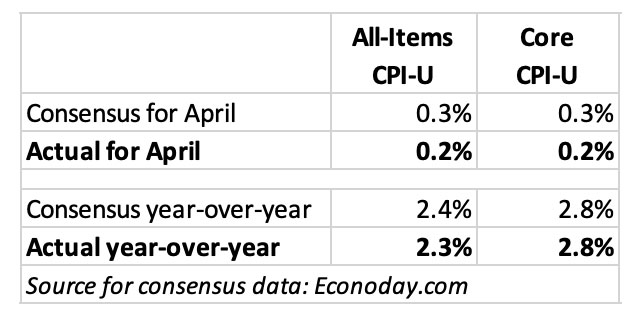
The Consumer Price Index for All Urban Consumers increased 0.2% on a seasonally adjusted basis in April, after falling 0.1% in March, the U.S. Bureau of Labor Statistics reported today. Over the last 12 months, U.S. inflation increased 2.3%, down from 2.4% in March. Both of those numbers were below expectations.
Core inflation, which removes food and energy, came in at 0.2% for the month, also below expectations, and held steady at 2.8% year over year.
Although these numbers could be seen as a positive surprise, Barron’s had been estimating all-items inflation at 0.2% for the month, so economists may have been wavering in the 0.2% to 0.3% range. Clearly, the full effects of U.S. tariffs on imports weren’t felt in April, but should be reflected more in May’s numbers.
Nevertheless, annual inflation of 2.3% was the lowest level since February 2021. That is significant.
The BLS noted that a 0.3% increase in the cost of shelter accounted for more than half of the overall increase in inflation. Shelter costs were up 4.0% for the year, a number that remains stubbornly high. Also from the report:
- Gasoline prices fell 0.1% for the month and are down 11. 8% year over year.
- The costs of food at home fell a surprising 0.4% in April, and are now up just 2.0% year over year.
- The BLS said costs of meats, poultry, fish and eggs fell 1.6% in April but are up 7.0% over the last year. (Egg prices fell 12.7% for the month.)
- Apparel costs, which could soon be greatly affected by tariffs, fell 0.2% for the month and are down 0.7% for the year.
- Airline fares fell 2.8% in April and are down 7.9% for the year.
- The costs of motor vehicle insurance rose 0.6% in April after falling 0.8% in March.
- Prices for new vehicles, also likely to be hit by future tariffs, were flat for the month. Many auto makers announced price freezes in April to soothe consumer fears of high tariffs. In addition, the BLS made changes to its leased car calculations, which could have had a minor effect on the totals. See this for more information.
It’s clear that the April inflation report isn’t showing much (if any) effect from U.S. tariffs that began to roll out early in the month. Many importers front-loaded orders to get inventory in before tariffs were applied. That could be the reason you’d see an item like apparel costs decline instead of rise.
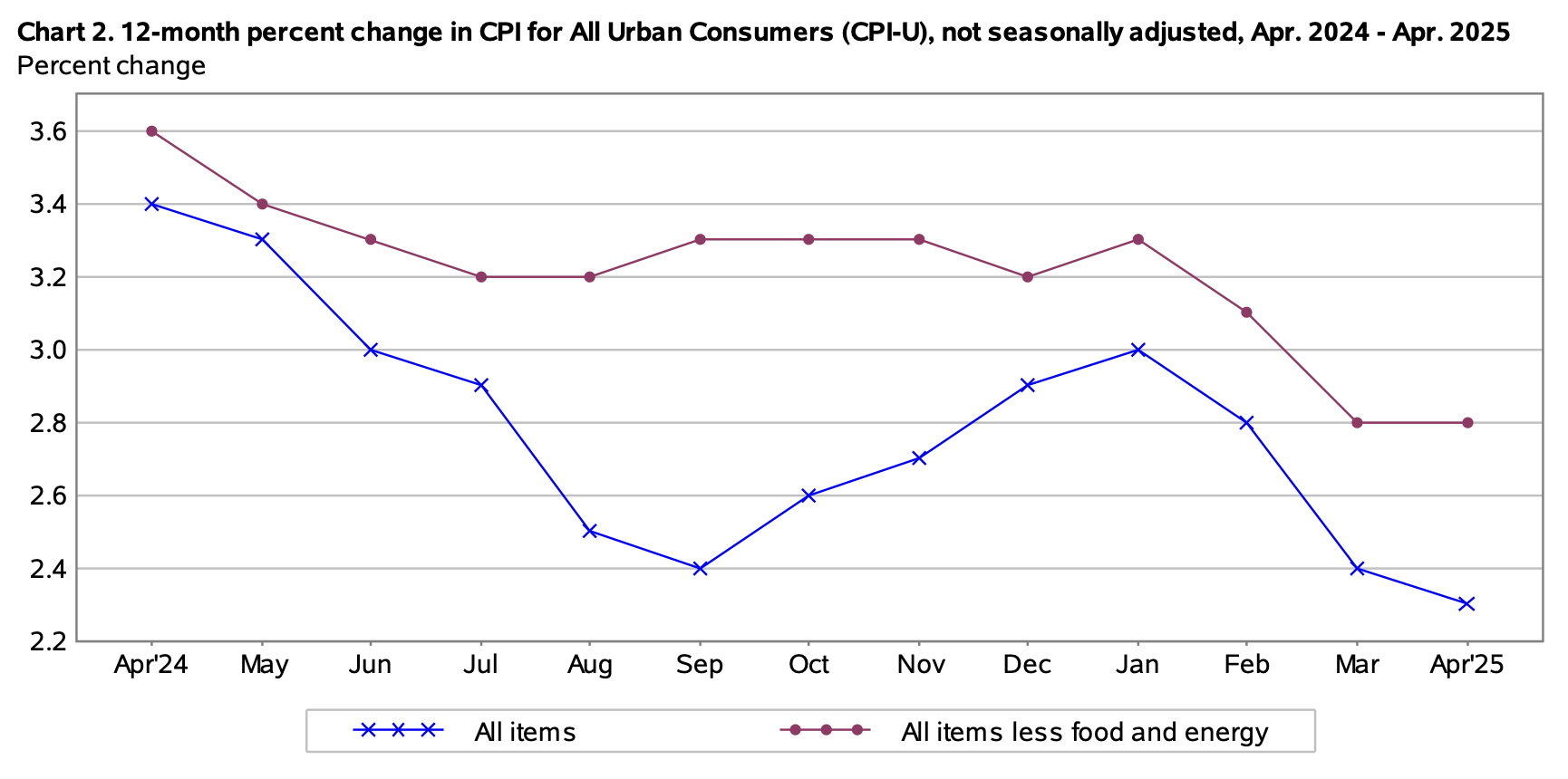
Here is the overall trend for U.S. inflation over the last 12 months, showing the continued declines in both all-items and core inflation.
What this means for TIPS and I Bonds
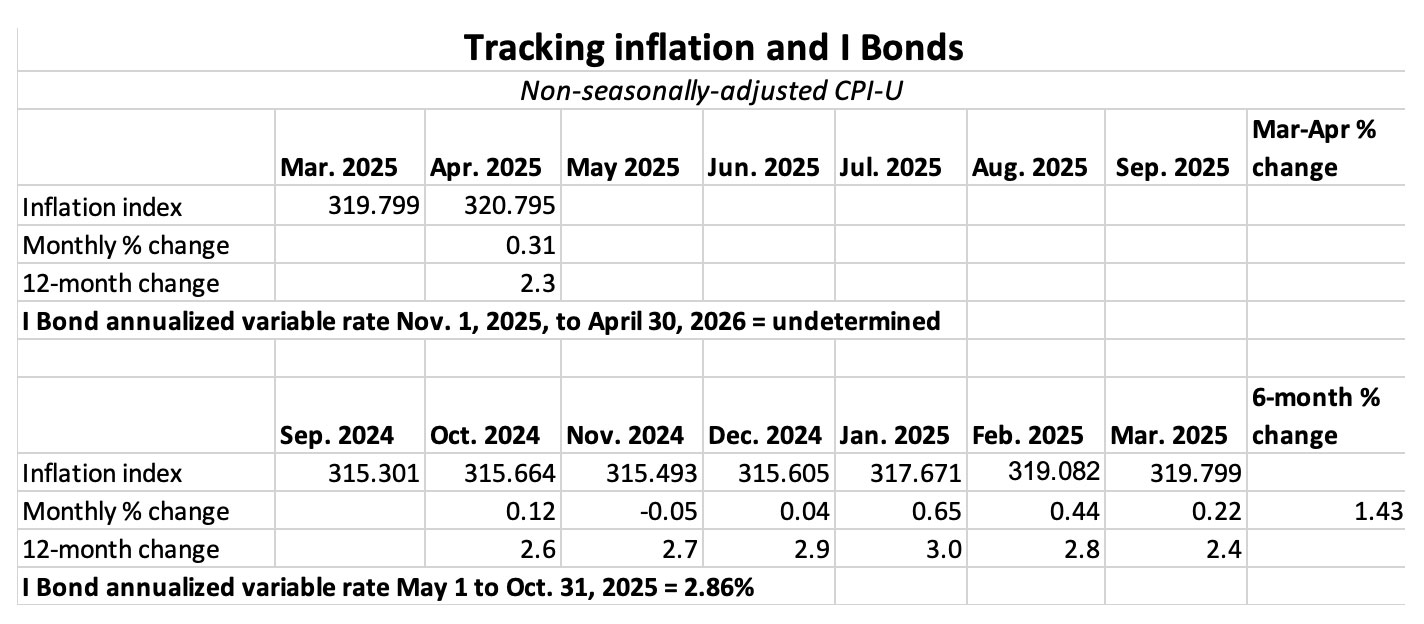
Investors in Treasury Inflation-Protected Securities and U.S. Series I Savings Bonds are also interested in non-seasonally adjusted inflation, which is used to adjust principal balances on TIPS and set future interest rates for I Bonds. The BLS set the April index at 320.795. an increase of 0.31% over the March number.
For TIPS. April inflation means that principal balances for all TIPS will increase 0.31% in June, after an increase of 0.22% in May. For the year ending in June, TIPS principal balances will have increased 2.3%. Here are the new June Inflation Indexes for all TIPS.
For I Bonds. The April inflation report is the first of a six-month string that will determine the I Bond’s new variable rate, which will be reset on November 1. So far, inflation has increased 0.31% and we have a long way to go before things get meaningful. The numbers:
What this means for future interest rates
Who knows? Since the Monday announcement of a potential tariff deal with China, both real and nominal interest rates have been increasing moderately, especially for the longer-term issues. The 10-year real yield is trading today at 2.13%, up 5 basis points from Friday’s close.
There is no question that the data in this April inflation report paints a positive picture of gradually falling prices, but the U.S. economy faces a lot of unknowns: tariffs, a looming debt-limit crisis, expanding future budget deficits. This is from Bloomberg’s morning report:
The downside surprise in the CPI doesn’t mean tariffs aren’t impacting the economy, it just means they aren’t showing up in the data yet. Wait-and-see is still the name of the game, and until that changes, the Fed will remain on the sidelines. (Ellen Zentner at Morgan Stanley Wealth Management)
In our view though, it is still too early to judge the inflationary impact of new tariffs. The modest pass-through in April likely reflects pre-tariff inventory being cleared, not a lack of pricing power. That buffer may not last. (Lale Akoner at eToro)
This report is significant for its timing, as it is the first month following the announcement of the tariffs. However, it doesn’t offer an honest reflection of how businesses may ultimately respond to higher costs throughout 2025. … The parade of uncertainty continues as the hard data continues to provide mixed messages. (Stephen Kates at Bankrate)
My feeling is that moderate April inflation should help speed up the Federal Reserve’s moves to begin cutting short-term interest rates. But there is still no clarity. So I am not “banking” on rate cuts until mid-2025, at least.
* * *
Follow Tipswatch on X for updates on daily Treasury auctions and real yield trends (when I am not traveling).
Feel free to post comments or questions below. If it is your first-ever comment, it will have to wait for moderation. After that, your comments will automatically appear. Please stay on topic and avoid political tirades. NOTE: Comment threads can only be three responses deep. If you see that you cannot respond, create a new comment and reference the topic.
David Enna is a financial journalist, not a financial adviser. He is not selling or profiting from any investment discussed. I Bonds and TIPS are not “get rich” investments; they are best used for capital preservation and inflation protection. They can be purchased through the Treasury or other providers without fees, commissions or carrying charges. Please do your own research before investing.


 Treasury Inflation-Protected Securities
And a 10% tariff translates into a nice uptick in Ibonds CPI component in November. An estimate of…?
The bond market now appears uninterested in the effect of tariffs on the economy. Its sees a US government planning to borrow more and collect less during an economic boom. I think the national policy is likely to increase state and local government borrowing as well. I guess it is a good thing that the supply of money is infinite.
I hope you get to have a herring and mashed potato dinner while in Stockholm.
I grew up in very Swedish Rockford, Ill., and love herring, lingonberries, Swedish pancakes, Swedish meatballs, etc.
I’ve read about a food stall in Stockholm, I believe at the waterfront, called Nystekt Stromming. If I ever go to Stockholm, I would have to seek it out.
The stand is not far away for a lunch. (But my wife won’t eat this!)
I agree 100% that the cost increases of tariffs are NOT in these numbers. However, I say that since MOST (keyword) have been postponed for 90 days or so. Point being, these tariffs were a warning shot to get the attention of other countries to come to the negotiating table. Most never went into effect.
Only a few deals have been made so far, but it has only been about a month into the 90 day period. There’s still about two months of negotiations. If it looks like deals are coming and the 90 suspension is almost up, I guarantee the clock will be reset and tariffs will remain postponed.
Except a 10% baseline tariff is expected to remain on all imports.
And 34% tariff to be paid on goods China, correct? These have changed often enough, and with enough special cases that I lose track. And I see de minimis tariffs are (as of an hour ago) now going to 54% or $100 flat rate for items valued under $800.
Sorry to burst your bubble, but there haven’t been any trade deals done; not even with the UK. let alone “a few”.