

By David Enna, Tipswatch.com
The U.S. government is highly likely to shut down on Wednesday, with the beginning of a new fiscal year. This is political theater, and the real danger is that the leading actors are both Republicans and Democrats, perfectly willing to go to the brink.
Escalating the threat, the Trump administration this week told federal agencies to prepare for mass firings (not furloughs) if the government shuts down. The Office of Management and Budget said the firings should target any federal program that is “not consistent with the President’s priorities.” From the Politico report:
The move marks a significant break from how shutdowns have been handled in recent decades, when most furloughs were temporary and employees were brought back once Congress voted to reopen government and funding was restored.
Politico quoted an OMB official saying programs that will continue include Social Security, Medicare, veterans benefits, military operations, law enforcement, Immigration and Customs Enforcement, Customs and Border Protection and air traffic control.
Scene II: Cue the Democrats, who pushed back at the firing threat. Or maybe I should say “shoved back,” with House minority leader Rep. Hakeem Jeffries telling the budget director to “get lost.”
Wonderful, huh? As things stand now, a government shutdown — whether short- or long-term — seems a certainty. Both political parties are welcoming the crisis for potential political gain.
What’s this all about?
The government will shut down Wednesday unless lawmakers are able to break their impasse and reach a deal to keep federal funds flowing. Republicans have offered a plan to maintain current spending levels through Nov. 21. That plan passed the House by a 217-212 vote, but was rejected the Senate, where 60 votes are needed for passage.
Democrats have offered an alternative to keep current spending going through Oct. 31 — but with a rider to add more than $1 trillion in spending to extend Obamacare subsidies that are set to expire at the end of the year. Democrats also want to roll back already-approved Medicaid cuts. The GOP says “no.”
Democrats are using the shutdown threat as leverage to restore healthcare spending that was eliminated in the One Big Beautiful Bill (OBBB). Republicans are highly unlikely to agree to that, but have offered to negotiate “in the future” once the shutdown is averted. But at that point Democrats would no longer have leverage.
Behind this is a failure by Congress to to pass a collection of 12 spending bills that would keep the government funded through fiscal 2026. Without approval of those bills, a continuing resolution is needed to keep much of the government going. So far, not one of the spending bills has passed both houses of Congress, which means a government shutdown would be widespread.
The most recent government shutdown occurred during President Trump’s first term, from Dec. 22, 2018, to Jan. 25, 2019.
Treasury issues aren’t threatened
This isn’t a “debt-limit crisis,” like we saw in 2023. The OBBB, passed in August, increased the U.S. debt limit by $5 trillion. So the Treasury will be able to continue to issue Treasury bills, notes and bonds, along with U.S. Savings Bonds. For that reason, you aren’t seeing any disruption in 4-week T-bill yields:
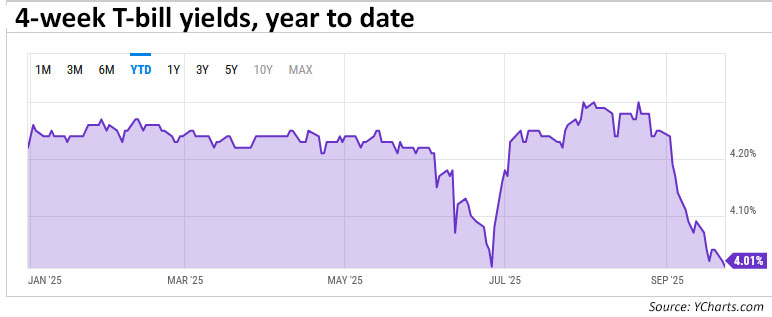
If investors believed T-bills would not be paid off at maturity, you would be seeing the 4-week yield rising sharply. That’s not an issue in this crisis. Instead, yields are falling in line with the Federal Reserve’s decision to cut short-term rates on Sept. 17.
I repeat: There is no risk of a government default, which would be far more serious than a shutdown.
However, some Treasury officials are likely to be furloughed (or maybe even fired), and others will be required to work without pay during the shutdown. That means Treasury services and statistical collection and reporting are going to be impaired.
For example, a shutdown could delay release of the crucially important September inflation report, due Oct. 15. That report will determine both the I Bond’s new variable rate and next year’s cost-of-living adjustment for Social Security. From a Reuters report:
A prolonged shutdown risks delaying or canceling key economic data releases investors use to assess macroeconomic trends, such as the monthly employment and inflation reports, analysts at Nomura said in a note this week.
Sept 30 update: Recent reporting from many sources indicates that a government shutdown will delay statistical reporting by the Bureau of Labor Statistics. The Department of Labor (which includes the BLS) has prepared a contingency plan for the shutdown:
- The Labor Department’s working employees will be reduced from 12,916 to 3,141.
- The BLS is listed in the group that will “completely cease operations.”
- Economic data that are scheduled to be released during the lapse will not be released.
- All active data collection activities for BLS surveys will cease.
- A reduction in quality of data collected might impact the quality of future estimates produced.
- The BLS website will not be updated with new content or restored in the event of a technical failure during a lapse.
What happens in a shutdown?
The potential for large-scale firings by the Trump administration adds a unique twist to this crisis. Those firings might not be legal and court challenges would be likely. However, widespread furloughs — meaning no pay even if you are required to work — are going to happen.
The non-partisan Committee for a Responsible Federal Budget prepared a Q&A on government shutdowns earlier this year.
In prior shutdowns, border protection, in-hospital medical care, air traffic control, law enforcement, and power grid maintenance have been among the services classified as essential, while some legislative and judicial staff have also been largely protected. Mandatory spending that is not subject to annual appropriations – such as for Social Security, Medicare, and Medicaid – also continues.
Some examples of the likely effects:
- Social Security. Benefit payments would go out, but benefit verification and card issuance would cease.
- Food inspection. During the 2018-2019 shutdown, the FDA restored some food inspections a few weeks into the funding lapse for products that were considered high-risk.
- National parks. In 2013, the National Park Service turned away millions of visitors to more than 400 parks, national monuments, and other sites. NPS estimated the shutdown led to more than $500 million in lost visitor spending.
- Air travel. During the 2018-2019 shutdown, air travel was strained as a result of air traffic controllers and TSA agents working without pay.
- Health. The National Institutes of Health (NIH) would be prevented from admitting new patients or processing grant applications.
- Environmental. During the 2013 shutdown, the EPA halted inspections for 1,200 sites that included hazardous waste, drinking water, and chemical facilities.
- IRS. Essential IRS functions would continue, but some workers would be furloughed and others would be required to work without pay. I suspect some IRS auditors could get ornery in this scenario.
Will the government save money?
Hard to say this time, given the threat of widespread firings instead of furloughs. Generally, after a shutdown concludes furloughed workers receive back pay, even if they were not working. The CRFB says this:
While many federal employees are forced to be idle during a shutdown, they … are now guaranteed back pay, negating much of those potential savings. OMB official estimates of the 2013 government shutdown found that $2.5 billion in pay and benefits were paid to furloughed employees for hours not worked during the shutdown. …
Shutdowns also carry a cost to the economy. The Congressional Budget Office (CBO) estimated that the 2018-2019 shutdown reduced Gross Domestic Product (GDP) by a total of $11 billion, including $3 billion that will never be recovered.
What’s the solution?
Since both sides are digging in — aggressively — it seems highly likely that the government will shut down Wednesday. The blame game is already at 100 decibels with Republicans saying Democrats are refusing to pass a “clean continuing resolution” and Democrats saying Republicans are refusing “to lower health care costs for Americans.”
I suspect the Republicans will win in the end, getting a continuing resolution to fund the government into November. There is no way the GOP will accept a $1 trillion increase in government spending by rolling back legislation passed two months ago.
The Trump administration’s threat to fire federal workers in areas “not consistent with the president’s policies” was a nuclear escalation — and probably not even necessary. But it could indicate the White House will welcome an extended government shutdown.
Eventually, it could take a stock or bond market revolt to bring the crisis to a close.
—————————

Donate? This site is free and I plan to keep it that way. Some readers have suggested having a way to contribute. I would welcome donations. Any amount, or skip it, your choice. This is completely optional.
—————————
Follow Tipswatch on X for updates on daily Treasury auctions and real yield trends (when I am not traveling).
Feel free to post comments or questions below. If it is your first-ever comment, it will have to wait for moderation. After that, your comments will automatically appear. Please stay on topic and avoid political tirades. NOTE: Comment threads can only be three responses deep. If you see that you cannot respond, create a new comment and reference the topic.
David Enna is a financial journalist, not a financial adviser. He is not selling or profiting from any investment discussed. I Bonds and TIPS are not “get rich” investments; they are best used for capital preservation and inflation protection. They can be purchased through the Treasury or other providers without fees, commissions or carrying charges. Please do your own research before investing.


 Treasury Inflation-Protected Securities
Pingback: What happens if the government shuts down? - Apex Money
The filibuster is an artificial invention. The Republicans can pass it through the Senate without any Democrat votes, as they have continuously watered it down over the years to not apply to Supreme Court nominees and now lower level cabinet nominees. It makes no sense that Democratic priorities, which are generally policy oriented (i.e. new programs) require 60 votes but Republican priorities (redirecting spending or cutting taxes) only require 50 plus the VP.
I’d say probably not, but who knows these days?
First allow me to say that I’m an independent voter. This being said: The majority of American voters put the Republicans in full control of the government. Republicans are in control of both houses of Congress and the Presidency. Therefore, it’s up to the Republicans to pass a budget. The Democrats have no power. If the Republicans need some Democrats to pass a CR then the Republicans need to give the Democrats something for their vote. This is how the government was designed to work. Refusing to work with Democrats lays the blame squarely on the Republicans if there is a shutdown. The first time I can recall the Republicans shutting down the government was when Newt Gingrich was speaker of the house, and Republicans have been shutting down the government since then.
Is there a purpose to this madness? Sadly, all of this seems to reflect where the American voter is: lashing out and being manipulated daily by social media algorithms and podcast hosts.
No doubt. Here at Tipswatch we don’t do that.
Thank you Mr. Enna for this detailed, important and informative article. It is much needed in these perilous times in our country.
Note: The second from last paragraph has one misspelled word:
The Trump administration’s threat to fire federal works (workers) in areas “not consistent with the president’s policies”.
I always appreciate careful reads. Thank you!
That is an easy one to pass over thinking it is correct.
The Bureau of Labor Statistics’ September Consumer Price Index (CPI) report, scheduled for October 15, 2025, could be delayed if a federal government shutdown occurs because the BLS would suspend data collection and operations, according to Reuters and Seeking Alpha.
Dr, this is my personal nightmare. However, this is the September report and data should already be collected.
My proposal has always been ZERO benefits for ALL politicians. You get the average American salary, which Google spits out to be $66,622 in 2025. You don’t get premium healthcare. If Medicare is so good, fine, you use it then. ZERO retirement benefits. Get your constituents to setup a 401K that you have no access to. NO investments are allowed to be made by you or any relatives while serving. NO special outings at hotels, restaurants or countries. You want to spend your money to go to a 5 star restaurant in Europe? Fine, use your vacation time and money to do it. The only travel allowance given is to and from DC in order to do business for the people. This will be provided by the Feds. The individual states will decide how much it wants its people to allow to go back and forth. Lastly, you are required to have your children use public schools. You want them to have a good education? Good, I bet you’ll try harder to make the schools better.
And of course, term limits. However, I think if all of this was implemented, then getting politicians would be similar to the military. It would take a real person that is enthusiastic to SERVE his/her country. Instead of people looking to game the system and get rich.
Congress wants a pay raise? Fine, make sure the economy grows, keeps inflation minimal and hope that the salary of the average American goes up. Medicare not working as good as you thought (or promised)? Good, now maybe you’ll actually work harder to change the kinks in it. You want to be able to invest in your own stocks and make other investments? Good. You’ll probably want to only serve a minimal time and get back to the real money instead of whatever your constituents choose you to invest in.
Once you are out of office then your life goes back to what the Americans are dealing with in the real world. This gives a little more incentive to actually do your job and fix whatever you ran on I’d say.
Then only wealthy people could afford to be Senators or Representatives. Millionaires are already over-represented in Congress. There’s very few AOCs.
We have the best politicians that money can buy.
Spot on FrankJabbott, and Agreed, ThomT (…insider trading is great for politicians (poor Martha stewart)! And not one of THEM is divesting themselves of their own “Riches” they espouse taking from their Rich cohorts, including AOC who went in “poor” and now lives in the lap of luxury while her granny still can’t afford whatever it was she couldn’t afford..no matter, it always comes back that the burden is borne by we working class schlocks…
Agree with everything except the cheap shot on AOC which contradicts the important point you are making about government ethics. It doesn’t matter what people think of her politics, on this issue she has the moral high ground — zero investments in stocks while in office and zero tolerance for insider trading by members of Congress. She wants it banned, and rightfully so. She is one of the few who gets it on this issue and they should all follow her lead on it (but we know they won’t).
And the ‘honest’ ones are the ones that stay bought.
Not intended as any type of “shot” Marce. Merely stating that the very people espousing Tax the Rich rhetoric are benefactors, themselves, of questionable dubious gains that they are not divesting themselves of. Shouldn’t they ALL be setting the FIRST example BEFORE sticking their hands in the taxpayers’ pockets?
i’m apolitical by nature, but have no tolerance for the double standards set by government officials. Again, poor martha stewart…
Not in this case. She is doing exactly what you advocated for, no stock investments, no insider trading, and she is a sponsor of the Bipartisan Restoring Faith in Government Act, which aims to ban members of Congress and their immediate family from trading or owning individual stocks. I’m not a fan of all her positions, but she is walking the walk and leading on this issue, and should be commended for it.
I agree, a simple solution to this government shutdown nonsense is that you mandate that congressman will not get paid a penny during any shutdown. Of course who can approve this? Congress….not
Any representative who is already wealthy won’t mind a temporary delay in their pay.
“So far, not one of the spending bills has passed both houses of Congress, which means a government shutdown would be widespread.”
God forbid they should do their jobs and actually pass legislation.
”There is no way the GOP will accept a $1 trillion increase in government spending by rolling back legislation passed two months ago.”
I would frame that demand as a restoration not an increase. But whatever you want to call it, it is money that helps people who do not get health insurance from their employer afford it.
When our politics wasn’t hopelessly broken, the two sides would put the people first and reach a compromise. They would care about government workers losing their paychecks. This time does look and feel different.
Last time Schumer caved. I do n’t see that happening again. They won’t get what they want, but they will get something after a lot of pain and political pressure.
Good points. And your comment caused me to ask Google: “Will Congress continue to be paid during a government shutdown?”
The answer: “Members of Congress continue to receive their salaries without interruption during a government shutdown. This uninterrupted compensation is a direct consequence of the Twenty-Seventh Amendment, which establishes a unique framework for congressional pay. Congressional salaries are not dependent on the annual appropriations bills.”