
Note: Because this inflation report was delayed, it came on a day when I am doing extensive, nonstop traveling in Australia. I won’t be able to post an inflation analysis until much later in the day, possibly overnight in the U.S. Sorry.
UPDATE: Real my full analysis, “January’s mild inflation report comes with ‘qualifications’ “
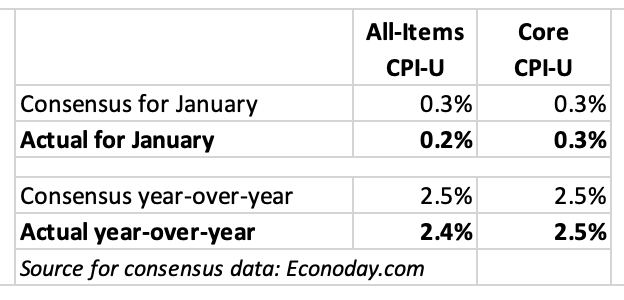
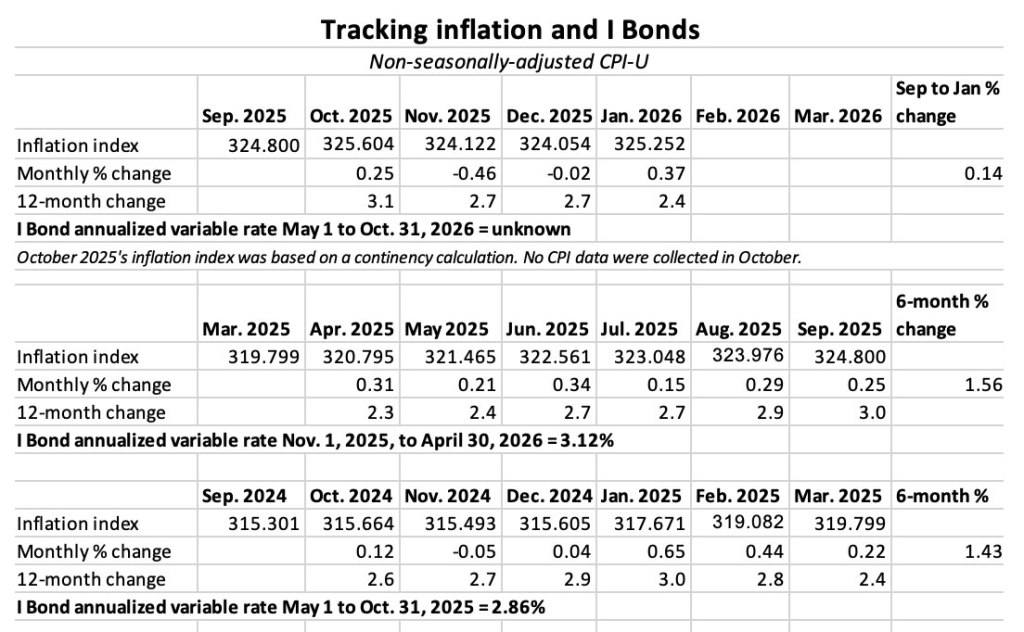
I will create a new post later today (Australia time is 16 hours ahead of the East Coast). For now, here is the update on non-seasonally adjusted CPI-U, for I Bond watchers:
UPDATE: Real my full analysis, “January’s mild inflation report comes with ‘qualifications’ “


 Treasury Inflation-Protected Securities
Gas prices down 7.5% resulting from OPEC oil production increases has a lot to do with offsetting the impact of tariffs on inflation, but that doesn’t mean there hasn’t been a an impact.
CNBC reported:
Inflation would likely be at the Fed’s target absent Trump administration policies on tariffs and immigration, said Mark Zandi, chief economist at Moody’s. Tariffs levied by President Donald Trump on a host of trading partners have put upward pressure on prices, as many businesses pass at least some of those import taxes on to U.S. consumers, economists said. Immigration policy has also put some upward pressure on prices for services by reducing labor supply, they said.
From the the AP:
Sweeping taxes on imports have cost the average American household nearly $1,200 since Donald Trump returned to the White House this year, according to calculations by Congress’ Joint Economic Committee.
Using Treasury Department numbers on revenue from tariffs and Goldman Sachs estimates of who ends up paying for them, found that American consumers’ share of the bill came to nearly $159 billion — or $1,198 per household — from February through November.
Also remember that those impacted by the ACA subsidies having expired pay double their last year’s premium or more, which does not show up as inflation. That’s 20 million Americans. And I seem to remember that there was a home inflation impact on the numbers last month that was skipped entirely until spring Inflation is most certainly being undercounted even if this report is accurate.
OPEC has kept significant oil production cuts in place all year, with around 3.24 million barrels per day (bpd) of cuts continuing into the first quarter of 2026 to support market stability. The inflation rate has come way down over the last many months.
“OPEC+ is managing a delicate, staggered increase in oil production, adding 137,000 barrels per day (bpd) in late 2025 (October-December) while pausing further hikes for the first quarter of 2026 to stabilize prices amidst potential supply gluts. The group is unwinding previous voluntary cuts to regain market share.”
This is what caused oil prices to drop, not anything we did here in America. And what made it rise a few years ago? The pandemic reopening,msuppoy chain issues, and the Russian invasion of Ukraine.
One of the most significant elements of the U.S. strategy has been targeting Russia’s energy revenues, since oil and gas are central to Moscow’s ability to finance its war.
a. Banning or Restricting Russian Energy Imports
Early in the conflict, under President Biden, the United States banned imports of Russian oil and gas to reduce revenue flowing to the Kremlin and to exert economic pressure.
b. Sanctioning Oil Companies and Related Entities
The U.S. Treasury has imposed sanctions on major Russian oil producers — including Gazprom Neft and Surgutneftegas — and on hundreds of ships, traders, and energy officials that support Russian oil exports. These measures aim to choke revenue that funds the war.
The sanctions also target vessels in the so-called “shadow fleet” (ships that help Russia export oil despite other restrictions).
c. Price Caps on Russian Oil
The U.S., working with the G7 and other allies, put in place a price cap policy on Russian oil: coalition countries’ service providers are barred from supporting Russian oil shipments above a set price, reducing Kremlin profits while helping stabilize global markets.
Where are you getting this info from? That amount of oil is a tiny fraction of world output and from would I read would at best reduce US gas prices by 2.4 cents a gallon. The effect on overall inflation would be .02%.
”The eight members of OPEC+ raised production quotas by about 2.9 million barrels per day from April to the end of December 2025, equating to about 3% of global demand.”
https://www.reuters.com/business/energy/opec-leans-towards-resumption-oil-output-increases-april-sources-say-2026-02-13/#:~:text=The%20eight%20members%20raised%20production,because%20of%20seasonally%20weaker%20consumption.
Where did you get your numbers from?
I was using the numbers you mentioned. The 137,000 per day increase. I looked at the monthly prices since they started the increases and it hasn’t changed enough to account for all of the the drop in gas prices, and the drop in gas prices would barely move the cpi.
I do have faith in folks at BLS despite the very likely pressure from up top. There is a certain benefit to civil service “bureaucrats” and they were extremely helpful when we measured producer and consumer medical price inflation independent of BLS.
As noted in the NYT article, about 25% of the whole CPI measure is rental price of an owned home – it’s a metric that absolutely no one experiences. Most folks have either no mortgage or a fixed rate mortgage so their cost didn’t change, but the measure did if their home could have been rented out for more in 2026 than in 2025. Another 7% is rent, which has stabilized at around 2% inflation.
Measuring inflation is very hard and the process they use is robust but very much depends on people and businesses replying to complex surveys. Consumers keep extraordinarily detailed spending diaries, businesses reply to very extensive supply cost surveys, ….and when I started we could get great response rates to surveys and now it’s really hard given we’re surveyed constantly.
Consumers ability to substitute and change behaviors is often poorly measured. My expertise was in medical and prescription drug care foregone or delayed due to cost. Generic substitution, prioritizing medications, 1/2 dosing, pharmacist review, skipping and consolidating medical visits, …all get missed in short term surveys. I’m sure every other major product area (food and dining out, transportation, …) has some other nerdy set of academic and private economists who follow that data set. And it’s a good thing – they like we 15 or so years ago watched for misalignment in our versus BLS measures. When a data set didn’t look right, we’d often get answers to a question very quickly. Little Brother is watching, too 😉
I’ve posted before about having a personal inflation rate. It is important as those who dine out regularly and have a drink or two with dinner (hopefully not breakfast) have experienced a very different inflation rate from folks who have always, or now, chosen to eat at home more often.
I’ve also noticed every year all some increases in costs for services.
I expect having fine food prepared and served by others may continue to cost a little more each year going forward as it has in the past.
I don’t expect these things would cost less unless we entered a depression.
News from the Government…..Job numbers better than expected, Inflation falling rather significantly; oh, and Mexican cartel drones were shot down coming over the border. Errr….
I have noticed that most material items have stopped jumping up in price.
I’ve noticed over my long life that few things ever go down in price, except maybe some food items (sometimes) and the price of fuel (both up and down).
The report seems fairly correct from what I experience at this point.
I agree – and it’s a great time to sneak in real price increases at wholesale or retail to boost margins. You can always discount for savvy customers. And then, marginal businesses tend to not win in the competition.
I sense, anecdotally, that the marginal businesses in my local community are the ones closing. They’ve seemed slow for years, prices high, and don’t have a loyal customer base. New restaurants come and go very quickly.
Just for the record, The New York Times reported this CPI release as straight objective news, under a headline stating that inflation eased in the first month of the new year, without a single mention in the entire article of the possibility that Trump’s repeated pressure on the BLS, his shuffling of its leadership, and his demand for lower Fed interest rates may be calling the statistics’ own reliability into question.
However, all of the leading reader comments on the article do so, citing real-world expenses of real-world people who are unable to name anything (i.e, anything that really matters) that’s going down in price and also unable to name anything (i.e., anything that really matters) that’s going up by only 2.4% year-over-year.
https://www.nytimes.com/2026/02/13/business/inflation-cpi-report-january.html
I’ve worked for the government for years. I wouldn’t worry about people cooking the books because Trump is pressuring them. I don’t work for BLS but I’ve never had anyone pressure me to lie or mislead the public in ANY administration. I’d be more concerned about the downsizing last year. Many of the experienced people who could retire or were close to retirement took that offer, and some groups lost a lot of experience. I don’t know the situation at BLS but my guess is a lot took the DRP offer and retired. The newer people might still be getting up to speed. Many federal workers are still very upset over how the downsizing happened, so I just don’t see them changing numbers in Trump’s favor. If that was asked, there would probably be leaks and whistleblowers everywhere.
I don’t agree with the official numbers, but I disagree with how they weight different categories and the overall formula they use. I think it shows a lower number than what someone in the bottom half of the economy experiences in real life. That was not created by the current administration though.
It sure doesn’t feel like inflation is down when I go food shopping.
Any month now we should see the tariff-induced inflation pick up.
I get confused by these inflation reports. It certainly doesn’t feel like inflation is declining. And with the dollar having dropped about 10% over the year against a basket of currencies, how can inflation seriously be only running at 2.4%? Since a large portion of the imports we buy are not only are tarrif-ed but bought with a dollar declining in value, isn’t our purchasing power declining (meaning real inflation is increasing) on most of the things we import?
Any thoughts on this aspect of inflation?
Your right, you never know when inflation is going to pick up due to Tariffs, but I heard some recent good news. The courts and congress are opposing Trump’s liberal use of Tariffs more and more. Some Tariffs appear to be going down as a result. We will all see.
Well, the Supreme Court has yet to weigh in, though they’ve been sitting on the decision for quite a while. The arguments sounded pretty confident they would side with Congress continuing to have the constitutional powers here, but then it’s been radio silence.