

U.S. stock and bond markets are ‘resilient,’ but how long can that last?
By David Enna, Tipswatch.com
Feeling a bit of financial panic? Can’t blame you. But let’s take a closer look.
The U.S. stock market had started a slight decline before the U.S. began bombing Iran on February 28. Since then, the Standard & Poors 500 index has suffered four straight weeks of declines, its longest losing streak since 2023, according to Barron’s.
The Nasdaq Composite has fallen in nine of the past 10 weeks, something it hasn’t done since 2022. The U.S. bond market has also been hit, with long-term yields rising to highs for the year on Friday. The 20- and 30-year Treasury bonds could break through the 5% barrier at any time.
With the price of oil topping $100 a barrel — and staying there — gasoline prices in the United States have increased to a national average of $3.94, up 34% in one month. Diesel fuel now retails at $5.25 a gallon, up 41% in one month.
These fuel prices — and the inevitable pass-through costs for delivery services, electricity, home heating, fertilizer, transportation, etc. — are going to boost U.S. inflation, possibly dramatically. If this crisis continues, the situation will be dire for the U.S. economy.
But not yet. The overall U.S. stock market has not entered a bear market (meaning a decline of 20% from the previous high) or even a correction (10% from the high). The S&P 500 is currently 6.2% below its all-time high of 6,932, reached on Dec. 24, 2025.
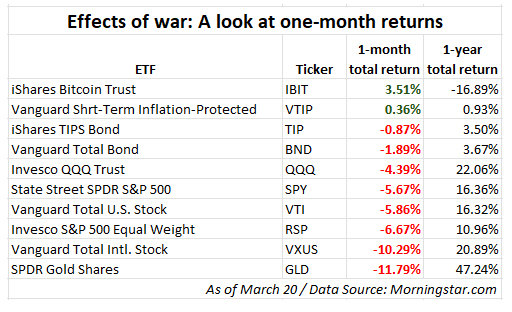
In this chart, note that the best performer over the last month has been Bitcoin, but ignore that. It was down 16.89% over the last year and is a highly speculative investment. Same for the gold ETF, GLD, the worst performer over the last month but up 47.24% over the last year. I don’t focus on Bitcoin or gold, but I included them here for comparison.
The more mainstream investments — the S&P 500, total stock market, total bond market, Nasdaq QQQ, S&P 500 equal weight — are all down substantially, but not enough to mark a correction, let alone a bear market. However, the total international stock market, represented by VXUS, has now entered correction territory, down 10.4% from its 52-week high.
Those of you old enough to remember a true bear market (not like the 33-day event in 2020) know that eventually fear and panic set in, causing sharp across-the-board selling. The saying goes, “Stairs up, elevator down.” The average bear market lasts 9 to 18 months. We aren’t there yet.
TIPS? Not so bad. Note that Vanguard’s short-term TIPS ETF, VTIP, has been the best performer of the mainstream holdings, eking out a meager total return of 0.36% for the month. The broader-based TIPS ETF, TIP, is down just 0.87% over the month.
If you are holding individual TIPS to maturity, the current market chaos is meaningless as long as you view the value of your holdings as par value x inflation index. As inflation rises, these holdings will increase in value. Plus, rising yields for longer-term TIPS present buying opportunities for investors still building out ladders.
Near future looks dim
There doesn’t seem to be a quick solution to the fighting in Iran, which has been steadily escalating. President Trump was threatening to strike Iran’s power plants and critical infrastructure today unless the Strait of Hormuz was opened. (FYI, I was writing this Sunday afternoon.) Iran responded that it would “completely close” the strait if its infrastructure is attacked. From the New York Times:
Ebrahim Zolfaghari, an Iranian military spokesman, vowed that his country would strike infrastructure used by Israel, the United States and American allies — including desalination plants that are a lifeline for much of the Middle East. …
Israeli officials have told the public to expect a protracted campaign.
Monday morning update
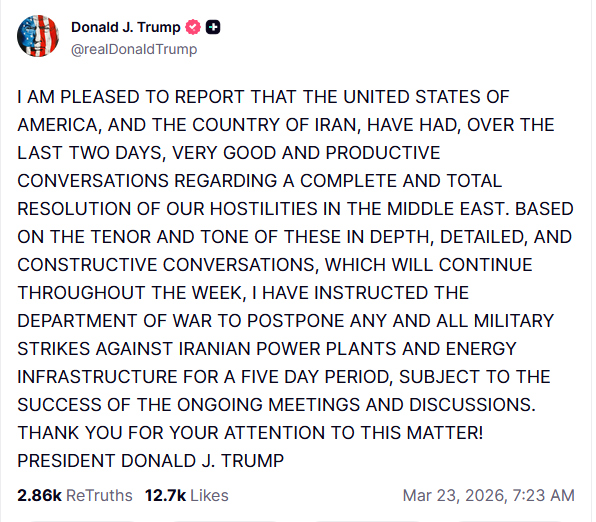
In a Truth Social post, Trump said the United States will postpone further strikes on Iranian power plants and energy infrastructure for five days following “productive” talks between Washington and Tehran. In reaction, at 7:30 a.m. the S&P 500 futures were up 2.1%. Oil prices immediately dropped by about 13%.
Iran did not immediately comment on Trump’s statement. The original Truth Social post was later pulled down (possibly because it contained a typo in the third word?) Most news organizations continued to report this update. So here we go. A moment of good news, but very confusing news. About 45 minutes later, Trump reposted the message with the typo corrected:
From the New York Times:
President Trump did not elaborate on the details of how Iran and the United States might agree to “a complete and total resolution” of their hostilities. Analysts have said it was difficult to identify a possible offramp for the conflict.
And then, within the hour, Iran news media reported that there were no current talks between the U.S. and Iran. (However, talks may be ongoing with 3rd-party Gulf states). From Bloomberg:
Iran’s semi-official Tasnim news agency is now also reporting Iran is not in talks, and there have been no talks, with Trump. It cites an unnamed senior security official. Trump’s social media statement is “psychological warfare,” Tasnim says.
A prolonged battle with Iran is going to mean 1) higher oil and gas prices extending well into the future, 2) an extended period of higher inflation in the United States, and 3) a massive increase in U.S. military spending at a time of ultra-high federal deficits. Add to that: 4) a highly unhappy voting populace in the fall mid-term elections.
Under these circumstances, the financial markets would have to abandon resiliency. We definitely could see a bear stock market, falling bond market and a true slowdown in the U.S. economy. Prediction: If we get to a situation this dire, the president will have to accept a cease-fire deal — one that keeps the current Iranian regime in power and retaining some influence over events in the Mideast.
Of course, I am not a geopolitical strategist, and this is just my opinion. I hope I am wrong.
Is there a strategy for investors?
My wife and I have a conservative asset allocation in stocks — 35% — and if we actually entered a bear market, we would probably look to add to stock holdings in funds like VTI and VXUS. But I have to admit feeling uneasy about the safety of all U.S. investments in this unpredictable long-term environment.
Your opinion is as good as mine. What are you thinking and are you making any changes in your investments in reaction?
—————————
Donate? This site is free and I plan to keep it that way. Some readers have suggested having a way to contribute. I would welcome donations. Any amount, or skip it, your choice. This is completely optional.
—————————
Follow Tipswatch on X for updates on daily Treasury auctions and real yield trends (when I am not traveling).
Feel free to post comments or questions below. If it is your first-ever comment, it will have to wait for moderation. After that, your comments will automatically appear. Please stay on topic and avoid political tirades. NOTE: Comment threads can only be three responses deep. If you see that you cannot respond, create a new comment and reference the topic.
David Enna is a financial journalist, not a financial adviser. He is not selling or profiting from any investment discussed. I Bonds and TIPS are not “get rich” investments; they are best used for capital preservation and inflation protection. They can be purchased through the Treasury or other providers without fees, commissions or carrying charges. Please do your own research before investing.


 Treasury Inflation-Protected Securities
We have 95%+ in Savings, T-Bills, I-Bonds, and TIPS. I put the rest into equity funds, primarily high-dividend international, just so I could have something to watch go up and down.
The plan is succeeding marvelously!
Honestly, the situation is so chaotic, the region is so destabilized, the justifications are so murky, the explanations are so misleading, and the market reaction is so volatile that it counterbalances the positive outcomes by our extraordinary military and makes it impossible to make any predictions or draw any conclusions about where we go from here.
What I do know is that inflation, which is about to jump again, would be tamed by now if not for ridiculous extreme illegal tariffs and war policy choices, employment is teetering, many of our allies want nothing to do with us after the way they’ve been treated, and our national debt, already a huge red flag, is exploding before our eyes to the tune of $1 billion per day!!! because of actions, and inaction. And the insanity and desperation is so acute that we have now chosen to allow Russia and Iran!!! to sell their oil which they will use to fund their aggression even as we fight against them totaling $14 billion in revenue to Iran! Hope, and funding our own enemies, are not winning strategies.
It’s almost like we need George Costanza to do the exact opposite of everything being done to improve our circumstances.
What am I doing? I’m holding on for dear life that cooler heads and rational behavior will prevail over ego, incompetence, and faux machismo. Declare victory. It’s TACO time.
Picking up some of the longer dated TIP bonds for others at these higher real rates. Wow, the rates have changed a lot from just a few short years ago.
Talking about BUYING in bear market territory is easy. Executing is another story. Emotions, including those unconscious, take over at the time of fear and panic. Even though I am experienced (old) and should know better it would *still* happen to me.
So, I have *ALREADY* entered two GTC limit orders to BUY when price drop reaches 20% from the most recent high.
If VXF, today $206, declines to $175 (52-week high $222 x ~80%) then the BUY order will execute.
If VTI, today $325, declines to $275 (52-week high $343 x 80%) then the BUY order is excecuted.
I just couldn’t resist the moves on 30Y TIPS that I bought them on Friday and locked in a real rate of 2.73%. I was hoping that it will slide further today and see 2.8% but I think I am being too greedy there 🙂
David,
I don’t who to believe. Trump is a certified BS artist, which means he doesn’t even know when he’s lying. My adage is this: watch what he does, not what he says.I’ve had about 1/3 of money in CDs and money markets for a while. While my stocks had appreciated quite a bit, I took some money off the table earlier this year, but I’m down about 5% in my equity holdings in the last few weeks.Our country is headed for a financial crisis in the next year or two. Taxes on highest earners have been cut so much the amount of tax revenue will not be able to keep up with debt we’re accumulating.
Trump wants to replace income tax revenue with tariffs, which hits the lowest-income earners the worst. This will slow the economy and if Ai starts replacing workers at a high percentage, then US. tax receipts will not only decline, it will likely put us in a debt spiral.
Both sides of the aisle don’t seem to want to deal with the debt, which could be manageable if we tackled it now. Andrew Yang suggested taxing the “bots,” which makes sense if jobs are replaced with AI. It’s now a good situation for our children and grandchildred.
I don’t [know] who to believe.
Trump: Well, not me, believe me.
Have been 1/3 in cash equivalents for some years (at least enjoying some good money market rates for the last few years. If we descend into a bear market, I will be buying.
I have about a fifth of my money in the TSP. I moved all of that into the G-fund a while back. I had a fair bit in cash in my other investments and have been buying the dips, though maybe I am premature in doing that. I have a high tolerance for investment pain. LOL!
Thanks for your report. Indeed, to avoid uneasiness about the Mideast situation would take iron (or titanium) financial fortitude.
One thing I’ve done to make the best of the lower prices is moved some shares of an international index fund from an IRA (Inot textbook asset location) to my taxable account to satisfy part of the RMD this year. The move of course generates a tax, but that’s true of any RMD (except a QCD). But since the transferred shares will have a lower cost basis than before the war began, I will just hope that eventually the fund will reach and exceed the previous high. I was definitely a little early on that transfer, but it was a modest amount and I still have more of the RMD to satisfy, so I can transfer more if the index falls further.
Good strategy and this seems to make sense for ideal asset allocation. This is my first year for an RMD. I have made a QCD and I am holding off on withdrawing the rest until later in the year. The leftover amount is sitting in cash earning 3.3%, but safe.
Yes, my plans are somewhat similar. So far between a couple of QCDs, the share transfer, and one straight RMD, I still have 80% of my RMD to go. Almost all of that is in CDs at my brokerage purchased at various times in 2025 when interest rates were hovering just above/slightly below 4.0%. That’s a comfort.
resist the urge to view this as an endless open ended quagmire … identify winners who recalibrate as this unfolds and eventually resolves – because it will be resolved: zero chance the world just sits and watches the straits of hormuz drag the entire planet’s economic systems down and into the dumpster – it gets resolved but who might wins irrespective of how this is accomplished? Western Canadian Petroleum and Western Canadian Infrastructure would be one imo – identify secure jurisdiction energy producers along with their support structures and land packages.
The unpredictability of the world is one reason I have been buying TIPS right along with you over these years – they do help cradle my addled brain, along with a soft pillow, for a good nights sleep.
resist the urge to view this as an endless open ended quagmire … identify winners who recalibrate as this unfolds and eventually resolves – because it will be resolved: zero chance the world just sits and watches the straits of hormuz drag the entire planet’s economic systems down and into the dumpster – it gets resolved but who might wins irrespective of how this is accomplished? Western Canadian Petroleum and Western Canadian Infrastructure would be one imo – identify secure jurisdiction energy producers along with their support structures and land packages.
The unpredictability of the world is one reason I have been buying TIPS right along with you over these years – they do help cradle my addled brain, along with a soft pillow, for a good nights sleep.
I’m not selling or buying. I am doing Roth conversions on the dips.
That’s the silver lining, for sure.