Up next: New 5-year TIPS will auction April 23, 2015

The Treasury will announce later this morning that it will be offering a new 5-year Treasury Inflation-Protected Security at auction on Thursday, April 23. This will be CUSIP 912828K33. Update: Here is the announcement.

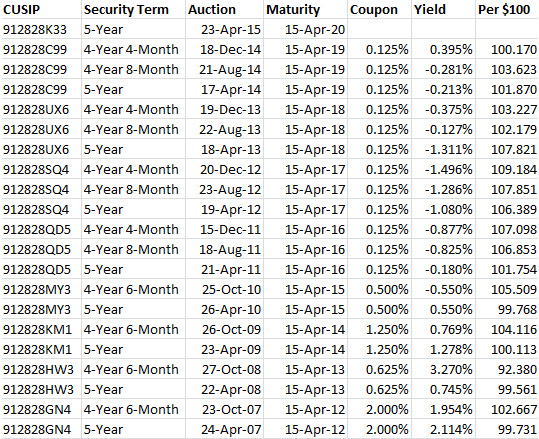
The market for 4- to 5-year TIPS has changed dramatically since the Treasury’s last auction of this term, on Dec. 18, 2014, when a a 4-year, 4-month TIPS auctioned with a yield of 0.395%, highest in 4 1/2 years.

Today we are looking at a yield in the range of -0.26%, a decline of 65 basis points since December. But that’s still well above the record low of -1.496% for the auction of a 4-year, 4-month TIPS on Dec. 20, 2012.

Because the lowest-possible coupon rate for this TIPS is 0.125%, buyers will likely be paying up at next Thursday’s auction, somewhere around $101.92 for $100 of value to produce a yield to maturity of -0.26%. (A lot can change in a week, of course.)

Inflation breakeven rate. With the 5-year Treasury currently yielding about 1.33%, this sets up an inflation breakeven rate of 1.59% for this TIPS, meaning that it will outperform a 5-year nominal Treasury if inflation averages more than 1.59% over the next 5 years. Inflation has been running at 0.0% over the last 12 months.

Alternatives. The 5-year term sets up good comparisons with other ultra-safe investments. For example, you can buy an I Bond today and be assured that you will earn at least the inflation rate over the next five years. That return will be 0.26% better than the return of this TIPS, and so an I Bond – as weak as it seems right now – is a better investment.

Another alternative is 5-year insured bank CDs, which pay 2.00% to 2.25% right now at several banks. The 2.25% return sets up an inflation breakeven rate of 2.51% for this TIPS. If you don’t believe inflation will average higher than 2.51% over the next 5 years, the bank CD is a better investment.

Why buy it? I like the 5-year term, and I was a buyer last December when the yield hit a favorable 0.395%. But next Thursday’s auction will be interesting mainly to big-money investors like central banks, pension funds and hedge funds — where small-dollar alternatives make no sense. I suspect many small investors will pass and look for better alternatives.

Here is the history of all 4- to 5-year TIPS auctions since 2007:
5 year TIPS

Posted in Investing in TIPS | 3 Comments

Here we go again: TIPS yields are diving toward the negative

BunnyI hate to be negative, but the current trend in the Treasury market has me thinking evil thoughts. Why? Yields on Treasury Inflation-Protected Securities have dropped to levels negative to inflation for maturities all the way up to 9 years. There are 39 TIPS currently trading on the secondary market, and yields are negative on 23 of them.

This is great if you own TIPS you want to trade or if you are invested in TIPS mutual funds. The value of your holdings has ‘soared’ – as much as Treasurys ever soar – in the brief time since Valentine’s Day. Here’s a chart for that time, comparing the TIP ETF, which holds the full range of TIPS, with the SPY ETF, invested in the S&P 500.

TIP vs. SPY

Click on image for larger version

My evil thoughts arise because I’d like to be a net buyer of TIPS, buying more than mature each year as part of a super-safe allocation in my heading-to-retirement portfolio. But right now TIPS are off the table, and I’d certainly shy away from TIPS mutual funds. And I Bonds – another trusty, super-safe investment – are about to enter a six-month period paying zero interest. Bank CDs – paying about 1% for a 1-year CD and 2.25% for a 5-year – might be a more acceptable alternative, although hardly desirable.

I’ve called TIPS the ‘Energizer Bunny’ investment in the past – they just keep going and going. Look at a 5-year TIPS. Last year’s December reopening auction resulted in a yield of 0.395%, highest in 4 1/2 years. Today, the yield on that same TIPS is -0.505%, down a shocking 90 basis points in five months. And yet the inflation index for that TIPS is .997; there has been less-than-zero inflation since this TIPS was first issued in April 2014.

Here are factors driving TIPS yields down:

  1. Central banks around the world are trying to inflate their currencies with asset-buying programs, resulting in 10-year bonds in Switzerland paying -0.11%; in Germany, 0.17%; in the Netherlands, 0.33%; in more-risky Portugal, 1.68%. You can get 1.88% in the non-risky United States, and that is where money is flowing.
  2. A crucial turning point came March 18, when Federal Reserve Chair Janet Yellen gave a decidedly wish-washy view on future short-term interest rate increases in the United States. She said: “Just because we removed the word ‘patient’ doesn’t mean we’re going to be impatient” in raising rates. The market interpreted this – correctly, I think – that the Federal Reserve lacks the courage to begin raising interest rates until inflation is above – possibly well above – its target of 2%.
  3. Yellen’s comments weakened the dollar, with the Euro gaining about 3% in value since her statement. It also ignited just a touch of inflation fears, which had been dormant after months of mild deflation. This makes TIPS more appealing, even at these low yields.
  4. If you suspect inflation will rise again to around 2%, TIPS are still the relative ‘bargain’ of the Treasury market. A 10-year TIPS currently has an inflation breakeven rate of about 1.81%. This number usually averages in the 2.0% to 2.2% range, so TIPS remain cheap against nominal Treasurys. That also increases demand.

Just as a rough guideline, I often say that TIPS mutual funds would be appealing to me when the TIP ETF reaches $110. This would happen when the 10-year yield rises to about 0.90%, a long way up from the current 0.07%.

But consider this: The TIP ETF closed at $111.51 on March 13, less than one month ago. Since then it is up 2.7%, and the Energizer Bunny dances on.

Posted in Investing in TIPS | 11 Comments

Deflation breaks (slightly), as US inflation rises 0.2% in February

The Consumer Price Index for All Urban Consumers (CPI-U) increased 0.2% in February on a seasonally adjusted basis, the U.S. Bureau of Labor Statistics reported today. Over the last 12 months, US inflation was flat – 0.0%.

February’s slight increase was expected, because gasoline prices rose 2.4% in the month, after falling 18.7% in January. Overall, the energy index rose 1.0%. Food prices were up a moderate 0.2%. But prices for used cars and trucks were up a sharp 1.0% and medical care commodities rose 0.7%. Apparel was up 0.3%.

‘Core inflation,’ which strips out food and energy, was also up 0.2% in February and has risen 1.7% over the last 12 months.

Holders of Treasury Inflation-Protected Securities and I Bonds are also interested in the non-seasonally adjusted CPI-U, which determines the inflation adjustment to TIPS principal and the future interest rate paid on I Bonds. In February, the inflation index stood at 234.722, up 0.43% over January’s number. But inflation was almost exactly flat over the last 12 months; the February 2014 number stood at 234.781.

Today’s numbers mean holders of TIPS will see gradual increases in principal in April, after several months of deflationary declines. Holders of I Bonds are almost certainly going to see six months of zero interest at the next adjustment on May 1. That adjustment will be based on inflation from September to March 2015, which is currently running at -1.39% with only one month to go. A large negative number will also wipe out any fixed rate the I Bond pays – up to that number – but an I Bond’s principal never declines and its interest rate can never go below zero.

I have updated my Tracking Inflation and I Bonds page to reflect these new numbers. See also my previous posts: TIPS versus I Bonds during deflationary times and Deflation strikes hard in January: What does it mean for TIPS and I Bonds? .

I’d suspect that today’s inflation number will have little effect on the Federal Reserve’s decision to raise short-term interest rates later this year. Oil prices have been declining recently, which should lead to stable gasoline prices as we head into summer.

Here is the 12-month trend in seasonally adjusted CPI-U:

Year of Zero Inflation

Posted in I Bond, Inflation, Investing in TIPS | Leave a comment

10-year TIPS reopens with a real yield of 0.2%, nearly a 2-year low

The Treasury just announced that its reopening auction of CUSIP 912828H45 auctioned with a real yield (after inflation) to maturity of 0.2%, the lowest yield for an 9- to 10-year TIPS at auction since May 2013.

This Treasury Inflation-Protected Security has a coupon rate of 0.25%, so that means buyers at today’s auction had to ‘pay up’ slightly to get that coupon rate. However, because this TIPS has an inflation index of 0.98686, the adjusted price worked out to $99.16 per $98.68 of value, but par is guaranteed to rise to at least $100 at maturity.

Today’s yield was much lower than looked likely just two days ago, when this TIPS closed on the secondary market with a yield of 0.425%. The dramatic dip in yields came after the Federal Reserve announced it would be cautious in raising short-term interest rates this year. That move boosted the TIPS market because 1) short-term interest rates will remain very low for the near term and 2) the Fed indicated – once again – that it is willing to risk rising inflation if it results in job creation and rising wages.

Inflation breakeven rate. A nominal 10-year Treasury is trading right now at 1.97%, creating an inflation breakeven rate of 1.77%, about 5 basis points higher than the breakeven rate of a week ago, but still solidly in the ‘cheap’ range, indicating this TIPS is attractive versus a traditional Treasury.

Reaction to the auction. The TIP ETF, which holds a broad range of maturities, was trading down most of the day, but after the auction closed at 1 p.m., its price moved upward, indicating declining yields and a positive reaction to the auction.

TIP ETF

Bloomberg’s report on the auction noted the effect the Federal Reserve’s cautious statement had on the TIPS market:

The U.S. Treasury Department can thank the Federal Reserve for the surge in demand at Thursday’s auction of inflation-protected bonds.  … “The Fed backing away from its harsh stance frees inflation expectations to rise a little bit more,” said Jim Vogel, head of interest-rate strategy at FTN Financial in Memphis, Tennessee.

Posted in Investing in TIPS | Leave a comment

Janet Yellen speaks, and …. what just happened to TIPS and Treasurys?

Federal Reserve Chairman Janet Yellen

Federal Reserve Chair Janet Yellen

The Treasury market soared across the board Wednesday after the Federal Reserve indicated it would move cautiously in increasing short-term interest rates.

  • The yield on a 10-year nominal Treasury fell to 1.93%, a drop of 13 basis points from Wednesday’s close. But this remains far from the year’s low of 1.68% set on Feb. 2.
  • The real yield on a 10-year TIPS dropped to 0.23%, a dramatic drop of 19 basis points from Wednesday’s close, but still above the year’s low of 0.03% set on Feb. 2.

All this came on the eve of reopening auction today of CUSIP 912828H45, a 9-Year 10-Month Treasury Inflation-Protected Security with a coupon rate of 0.250%. And it certainly isn’t good news for anyone planning to bid at today’s auction. (Non-competitive bids must be placed by noon.)

What did the Federal Reserve do? Early news reports yesterday indicated that the Fed lifted its ‘patient’ language and signaled that a rise in short-term interest rates was likely this summer. But just as quickly, the the Fed backed off. From an excellent analysis in today’s Wall Street Journal:

That was a big surprise for investors, who were factoring in a greater probability the Fed would begin to increase rates from near-zero levels in June. The result: Stocks surged, Treasury yields slumped and the dollar tanked against the euro. …

Why the switch? One thing that changed since December is the dollar has gotten even stronger. That happened as central banks around the world have been rowing in the opposite direction of the Fed, unleashing a flood of monetary stimulus. …

Now, inflation is running below the 2% the Fed is aiming for. And the dollar’s rise, which is weighing against the prices of imported goods, makes it even more unlikely the Fed will hit its target anytime soon. …

If Fed Chairwoman Janet Yellen wanted to mitigate the dollar’s rise, she succeeded—for now—even as she injected an aura of patience while removing the word “patient.”

If you want to know more, you can read the Fed’s Open Market Committee statement, which hints at the debate within the Federal Reserve. All economic indicators are pointing toward gradually higher interest rates, but the Fed is fighting against a wave of monetary easing across the globe.

  • “Labor market conditions have improved further, with strong job gains and a lower unemployment rate.”
  • “Inflation is anticipated to remain near its recent low level in the near term, but the Committee expects inflation to rise gradually toward 2 percent over the medium term.”
  • ” … the Committee today reaffirmed its view that the current 0 to 1/4 percent target range for the federal funds rate remains appropriate. In determining how long to maintain this target range, the Committee will assess progress–both realized and expected–toward its objectives of maximum employment and 2 percent inflation.”
  • “When the Committee decides to begin to remove policy accommodation, it will take a balanced approach consistent with its longer-run goals of maximum employment and inflation of 2 percent.”

In her news conference, Yellen tried to soften things further, saying that “just because we removed the word ‘patient’ doesn’t mean we’re going to be impatient.”

This language suggests that the Fed is very gently nudging investors toward interest rate increases later this year, and that’s still possible by summer or early fall. It doesn’t seem like the type of language that would cause Treasury yields to plummet or the dollar to drop in value, but that’s exactly what happened. Markets are funny.

But let’s be clear: Higher interest rates are coming.

Checking in on that TIPS auction

This could be a volatile day in the stock, bond and currency markets – the dollar is already up strongly in European markets after yesterday’s plummet. The euro is trading right now at $1.067 per dollar, after soaring over $1.10 yesterday.

Bloomberg’s Current Yields shows the 10-year nominal Treasury trading at 1.94% and the 10-year TIPS that is reopening today at 0.21%. That creates an attractive 10-year inflation breakeven rate of 1.73%, about where it stood last week. TIPS are cheap against nominal Treasurys, but a yield of 0.21% isn’t good enough as we are about enter a period of gradually rising interest rates.

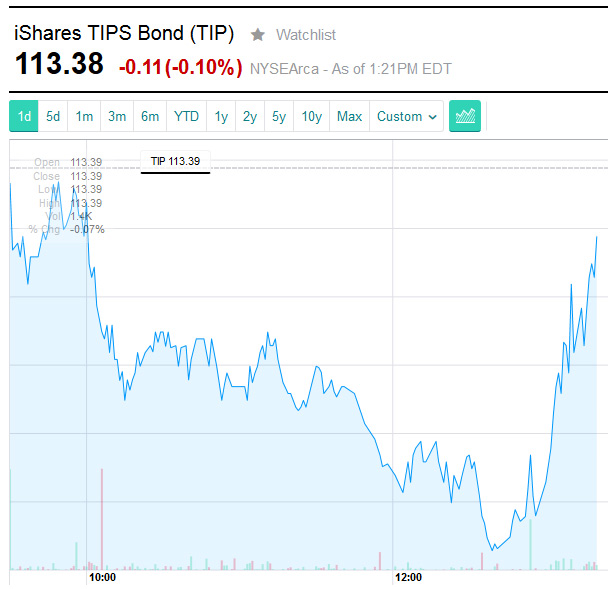
The TIP ETF just opened trading at $113.40, down slightly this morning but up an incredible 1.8% since last Friday’s close. A rising price indicates declining yields. TIPS investors: The trend is working against you.

I’ll be posting the results of the auction after the 1 p.m. closing.

Posted in Investing in TIPS | 4 Comments