Treasury drops Series I Savings Bond fixed rate to 0.0%

Savings-Bond-IThe US Treasury just announced that is it lowering the fixed rate paid on Series I Savings Bonds to 0.0% for bonds purchased from Nov. 1, 2014, to April 30, 2015. It also announced that the new variable (inflation-adjusted) rate for I Bonds will be 1.48%, as I predicted back on Oct. 22.

This means I Bonds purchased through April 30, 2015 will carry a composite, annualized rate of 1.48% for six months.

The move to drop the fixed rate to 0.0% is a disappointment, because the fixed rate carries with an I Bond for its entire life, up to 30 years. The variable rate changes every six months for all I Bonds. But the Treasury did follow its typical pattern. With a 10-year TIPS yielding only 0.40% today (plus inflation), there wasn’t much justification in keeping the fixed rate above zero.

The fixed rate dropped to 0.0% in November 2010 and stayed there for three years, until November 2013, when the Treasury surprised everyone by raising the fixed rate to 0.2%. At the time, a 10-year TIPS was yielding 0.52%. That lasted six months, and the rate dipped to 0.1% in April 2014, and now to zero in November 2014.

Prediction. I bought my full allocation of I Bonds ($10,000 per person through TreasuryDirect) back in February, so I locked in that 0.2% fixed rate. I suspect most potential buyers have already purchased their 2014 allocation, so the Treasury won’t be selling a lot of I Bonds through Dec. 31, 2014.

In January, when the 2015 allocation limit reopens purchases, there won’t be any reason to buy, and smart investors will wait until later in 2015 to see if the fixed rate rises again. It will be reset on May 1 and Nov. 2, 2105. So the Treasury won’t be selling a lot of I Bonds in the first quarter of 2015, either.

EE Bonds. The Treasury also gave a little slap to holders of Series EE Savings Bonds purchased after May 2005, which were paying 0.5% interest annually with a guarantee to double the principal balance in 20 years. So if you hold these for 20 years, you get 3.5%. The Treasury today dropped the annual interest rate for all EE Bonds to 0.1%, but the 20-year guarantee still holds.

Posted in Investing in TIPS | 5 Comments

Checking in on TIPS as quantitative easing ends (we hope)

A brief history. The Federal Reserve started its latest round of quantitative easing (QE3, in this case) on Sept. 13, 2012, when it launched a $40 billion per month program to buy mortgage-backed securities. This eventually morphed into ‘Operation Twist’ in December 2012 when the bond buying expanded to long-term Treasurys and bumped up to $85 million a month.

Fed balance sheet

SOURCE: Wall Street Journal

This launched a period of severely low interest rates, especially for Treasury Inflation-Protected Securities. On Sept. 17, 2012, I posted ‘Are TIPS a good investment in 2012?‘ which I answered with one word: No. (But then I rambled on, of course.)

On June 12, 2013, then-Fed-Chairman Ben Bernanke announced a ‘tapering’ of the bond-buying program, which finally ended this month. So for now, there technically is no active QE program, but the Fed continues to hold a massive portfolio of Treasurys and mortgage-backed securities, which at this point it can’t unload. This is from an excellent analysis in yesterday’s Wall Street Journal:

The central bank’s holdings of securities, loans and other assets have increased from $2.825 trillion when the program started to $4.482 trillion. The Fed has said it plans to maintain this level of holdings until after it starts raising short-term interest rates. Eventually, officials expect to reduce the holdings gradually by letting securities mature without reinvesting the proceeds.

What QE has meant for TIPS. My belief is that the September announcement of QE3 and the December 2012 expansion set up TIPS for a mighty fall in 2013. TIPS yields were already extremely low in mid-2013, and a new round of QE set off fears of future inflation, which bolstered the appeal of TIPS. Prices rose and yields fell.

Inflation, however, never became a factor, rising to just over 2% a year in early 2014 before slipping back down to 1.7%. So as the economy improved, and overall interest rates began rising in mid-2013, the appeal of TIPS was declining. A double whammy, resulting in a -8.65% drop in the TIP ETF in 2013.

This chart summarizes what has happened since QE3 was launched in September 2012:

QE ChangeThere are several striking statistics to consider in this chart:

  1. TIPS inflation breakeven rates have plummeted in the two years since QE3 was launched, dropping 50 basis points for a 5-year TIPS, 47 basis points for a 10-year TIPS and 43 basis points for a 30-year TIPS. Despite two years of Fed stimulus, inflation expectations are very low.
  2. The stock market, represented by the S&P 500, has had a great run, rising 36.6%.
  3. Despite that surge in wealth, inflation has been muted – rising just 2.9% overall in the 25 months of QE3.
  4. The yield on a 30-year Treasury has barely budged, rising just 9 basis points. Compare that with the yield of a 5-year TIPS, rising a whopping 167 basis points.

Conclusion. QE3 was expected to bolster TIPS, but that was a false premise back in 2012. Inflation didn’t rise, yet interest rates did eventually rise, and that caught TIPS investors in a bind: yields rising faster than the overall bond market.

On the other hand, today’s very low breakevens for TIPS across the maturity scale make them a much more attractive investment than they were in 2012. And those low breakevens give TIPS investors a ‘margin of safety’ …. because TIPS yields may now rise at a slower pace than the overall bond market, just the opposite of what happened in 2013.

I wouldn’t call TIPS a ‘buy’ in October 2014, but their appeal is rising.

Posted in Investing in TIPS | 2 Comments

30-year TIPS reopening auctions with a yield of 0.985%

The Treasury just announced that the reopening of  CUSIP 912810RF7 – a 29-year 4-month Treasury Inflation-Protected Security – auctioned with a yield to maturity of 0.985%, a bit higher than looked likely this morning.

This TIPS – which first auctioned on Feb. 20 with a yield of 1.495% – carries a coupon rate of 1.375%, so today’s buyers are paying a premium. The adjusted cost is $112.17 per $100 of value, but this includes about 2% of accrued inflation since the original issue.

This is the first 29- to 30-year TIPS auction since February 2013 to come in with a yield under 1%.

Inflation breakeven rate. With a 30-year nominal Treasury currently yielding 3.05%, this TIPS has an inflation breakeven rate of 2.065%, making it very attractive against a traditional Treasury. It means that if inflation averages more than 2.065% over the next 30 years, this TIPS will outperform the nominal Treasury.

TIPS yields had been rising heading into the auction, and CUSIP 912810RF7 closed Wednesday with a yield of 0.922%. So today’s buyers gained from the market weakness (TIPS prices fall when yields rise). Here’s a look at the immediate reaction in the TIP ETF, which looks a bit negative:

TIP Oct. 23

Reaction to the auction

Despite the slight boost in expected yield, Bloomberg reports strong demand for this TIPS reopening, at least from foreign central banks, who are typically ‘indirect bidders’:

Indirect bidders bought 64.5 percent of the $7 billion in Treasury Inflation Protected Securities yesterday, compared with the average of 46.7 percent at the past 10 auctions. … The transaction was rated a “four” by seven primary dealers, based on a scale of one through five, with one being a failed auction and five judging the results as outstanding.

The Wall Street Journal managed to write an entire article about weakness in the Treasury markets on Thursday without mentioning the TIPS auction. TIPS don’t get a lot of respect, I realize, but the WSJ did manage to give us this Thursday: ‘Janus Capital makes room for Bill Gross, his sunglasses‘:

Wall Street wants to know how Gross is doing at his new digs. So far, the feedback is hugely positive. Janus CEO Dick Weil described Gross as having, “a positive halo effect for the fixed-income team, but also for the whole firm.”

Well, good for Bill Gross and Janus. Until the next temper tantrum.

Posted in Investing in TIPS | 3 Comments

Quick check-in on today’s 30-year TIPS reopening

The US Treasury is reopening CUSIP 912810RF7 today, creating a 29-year 4-month Treasury Inflation-Protected Security with a coupon rate of of 1.375%. Non-competitive bids (such as through TreasuryDirect) need to be placed by noon, the auction closes for competitive bids at 1 p.m.

This TIPS – first issued in February – trades on the secondary market, so we can get a pretty good idea of today’s price. Here’s where we stand at 10:05 a.m.:

  • Bloomberg’s Current Yields page shows this TIPS trading right now with a yield of 0.94% and a price of about $111.10 per $100 of value. This is up about 5 basis points from when I wrote about this auction last week.
  • The Wall Street Journal’s Closing Prices chart shows this TIPS closed yesterday with a yield of 0.922% and a price of about $111.30.
  • The Treasury’s Real Yields estimate shows that a full-term 30-year TIPS closed yesterday at 0.94.
  • The TIP ETF is currently trading at $113.52, down about 0.25%, which indicates that yields are slightly rising.

So it looks like this TIPS might price with a yield of about 0.95% and somewhere around $111 per $100 of value, which results from the coupon rate of 1.375%.

This is down substantially from recent 30-year auctions, but much higher than the depths of yield we hit two years ago. I’ll post the auction results after 1 p.m. and provide more reaction later.

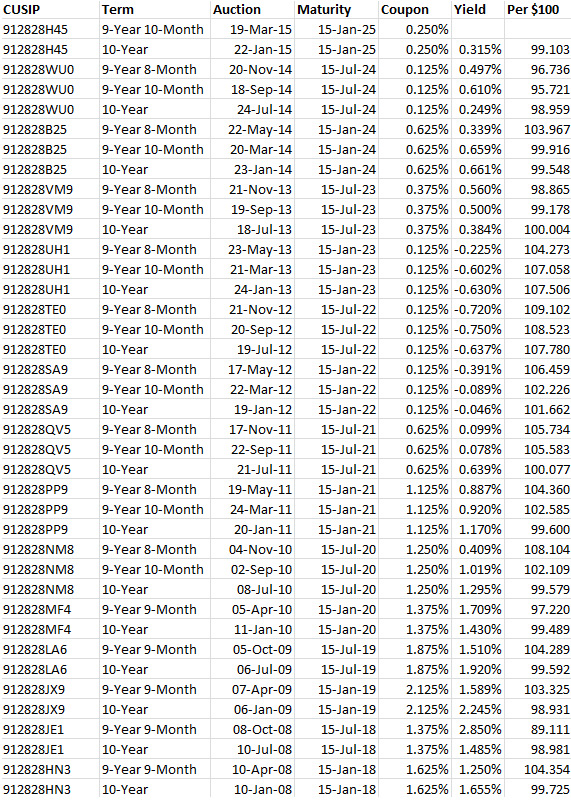
Meanwhile, you can study this … the results of every 29- to 30-year TIPS auction in history:

30 year TIPS

Posted in Investing in TIPS | Leave a comment

September inflation rises 0.1%; new I Bond variable rate will be 1.48%

The Consumer Price Index for All Urban Consumers (CPI-U) increased 0.1% in September on a seasonally adjusted basis, the U.S. Bureau of Labor Statistics reported today. Over the last 12 months, CPI-U (also called ‘headline’ inflation) was up 1.7%.

The September report provided the final piece of data needed to learn the new inflation-adjusted interest rate paid by US Savings I Bonds. The new variable rate – which goes into effect on Nov. 1 – is based on non-seasonally adjusted inflation from March to September 2014.

In March, the CPI-U index stood at 236.293, rising to 238.031 in September. This is a six-month inflation rate of 0.74%, so the new variable rate (annualized) will be 1.48%. I have updated my Tracking Inflation and I Bonds page to reflect these new numbers.

All I Bond holders will eventually get this variable rate for six months, but the date it begins will vary based on the month the I Bonds were issued. Potential I Bond investors can decide to buy before Nov. 1, however, and lock in the current 1.84% variable rate for the first six months, along with the current 0.1% fixed rate for the life of the I Bond.

We don’t know what the Treasury will decide on the fixed rate in November. I have speculated that it will either hold at 0.1% or drop to 0.0%. An increase looks highly unlikely.

In addition, September’s inflation report set the 2015 cost-of-living increase for 70 million Social Security recipients at 1.7%, the third year in a row the increase will be less than 2%.

The inflation report

The BLS reported strong declines in the price of gasoline (-1.0%) and fuel oil (-2.1%), but these declines were balanced off by increases in the costs of food (0.3%), medical care commodities (0.5%) and shelter (0.3%).

The September report again reflects very mild inflation, which has increased just 1.7% over the last 12 months. This is below the Federal Reserve’s target number of 2.0% and danger level of 2.5%, although the Fed uses a different index.

‘Core inflation,’ which strips out food and energy, also rose 0.1% in September and was up 1.7% over the last 12 months.

This chart shows how inflation has eased since the spring of 2014, essentially rising 0.0% over the last three months:

12 month

Posted in Investing in TIPS | 2 Comments