Janet Yellen, the Federal Reserve chair, set off a lot of turmoil in the markets on March 19 by hinting that the federal funds rate – which sets a base for short-term interest rates – could begin rising ‘around six months, that type of thing‘ after the Fed’s bond-buying program ends later this year.
That comment, at a news conference, sent the bond and stock markets into a tizzy. Yellen’s off-the-cuff comment implied that rates could begin rising in mid 2015 instead of late 2015 early 2016, as the markets expected.
Since then, Yellen and the Fed have backed off, saying there is no timetable for increases in the federal funds rate. But the Federal Reserve itself is forecasting that its benchmark rate – now close to zero – will rise at least to 1% at the end of 2015 and to 2.25% by the end of 2016.
So let’s assume that the federal funds rate does rise to 2.25% at the end of 2016. How will that affect the prices and yields of Treasury Inflation-Protected Securities?
 No surprise. Rates are going up. No one can say this for certain, of course, and it depends on three things happening: 1) the U.S. economy must continue to improve, 2) the inflation rate must reach or at least approach the target level of 2%, and 3) the Federal Reserve must have the courage to raise rates when 1 and 2 are achieved.
But if these three things happen – and this is the most likely scenario, in my opinion – we will see the federal funds rate at 2.25% at the end of 2016 (or earlier), and we will see yields rise for both nominal Treasurys and TIPS.
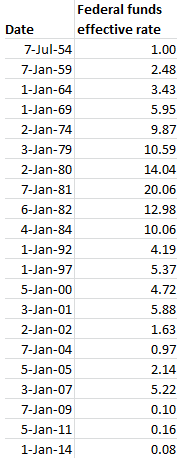
So let’s take a look at the history of the federal funds rate; I have included some numbers from the past in the chart at the right. If you want to see the data, check out this site. What you will find is that 2.25% is a historically low rate. Today’s ultra-low fed rate – at a time when the stock market is hitting all-time highs – looks as out of place as that 20.06% number from January 1981.
So, the point is, there would be nothing extraordinary about a 2.25% fed rate, and in fact, it historically would have been a rate meant to spur economic growth, not deter it.
My next step was to look at times when the fed rate stood at 2.25% and cross-check the then-current yields for nominal Treasurys and TIPS. Here is what I found when I did the calculations on March 27:
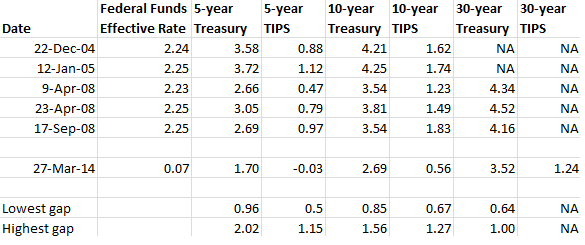 Yes, the data are limited for several reasons: 1) TIPS have been in existence only since 1997, 2) a federal funds rate of 2.25% is relatively rare and 3) 30-year TIPS auctions were halted from October 2011 to February 2010, so there are no comparable data for 30-year TIPS.
But using these numbers as guidelines, I think we can make predictions about where interest rates are headed (not precisely, but an estimate) when the fed funds rate reaches 2.25%. I am using the average of each range to determine these numbers:
- 5-year Treasury yields will increase 149 basis points
- 5-year TIPS yields will rise 82 basis points
- 10-year Treasury yields will rise 120 basis points
- 10-year TIPS yields will rise 97 basis points
- 30-year Treasury yields will rise 82 basis points
- 30-year TIPS yields will rise an undetermined amount
Continuing on with this premise, let’s say the 10-year TIPS yield rises 97 basis points by the end of 2016, reaching a level of 1.53%. That’s perfectly reasonable by historical standards (probably even conservative), and it would equate to a 10-year nominal Treasury rate of 3.89%, creating an inflation breakeven point of 2.36%, also perfectly reasonable.
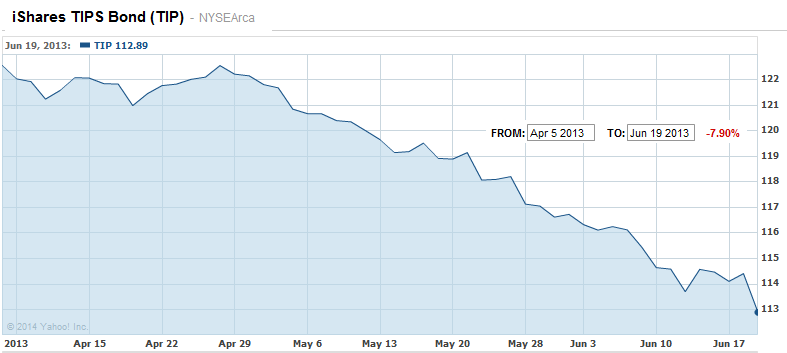
This sort of rise – 97 basis points – is definitely possible. In fact, we saw that happen in less than three months in 2013, when the 10-year TIPS yield rose from -0.74% on April 5 to 0.29% in June 19, a rise of 103 basis points.
What does this mean? If you are invested in a diversified TIPS mutual fund and this scenario plays out, you are going to see a drop in net asset value of about 8%. At the same time, you would benefit from a higher yield in the future.
The TIP ETF, which invests in a broad range of maturities, has a duration of 7.65, meaning its net asset value should decline by 7.65% when yields rise 100 basis points. That played out just as predicted during the 103 basis point rise in the 10-year TIPS from April 5, 2013 to June 19, 2013:
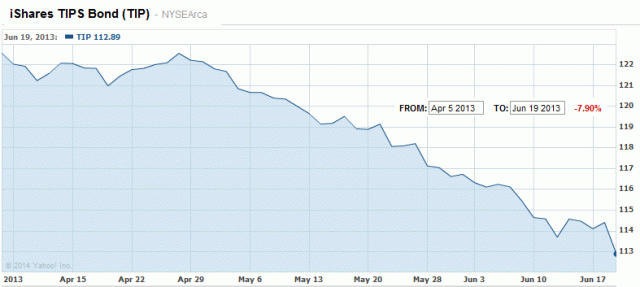
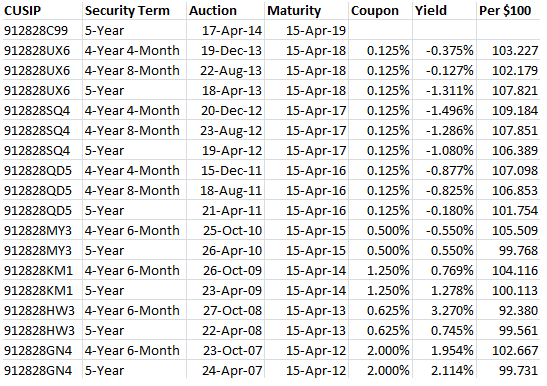
Looking into the future. The TIP ETF currently trades at $111.67, up about 1% so far this year. If it took an 8% hit, its net asset value would drop to $102.75, about where it was trading on Oct. 5, 2009, when a 10-year TIPS was yielding 1.51%.
I repeat: Perfectly reasonable. Will this happen? Who knows? But no one should be surprised if it does.





 Treasury Inflation-Protected Securities
It is true that I could have redeemed it when the rate was 1.9%, and maybe could have earned more…