Next up: New 30-year TIPS will auction Feb. 21, 2013

Treasury logoThe Treasury will announce this tomorrow, but as usual it let some details slip out. On Feb. 21, it will auction a new 30-year Treasury Inflation-Protected Security, CUSIP 912810RA8. Update: Here is the announcement.

The coupon rate and yield to maturity will be determined at auction, but we can guess that the coupon rate will come in around 0.50% or  0.625% and the yield to maturity might be somewhere around 0.59%, based on today’s market.

The longest-maturing TIPS currently on the market, maturing Feb. 15 2042, is trading at a yield of 0.576%. This new issue, which adds a year and increases supply, should get a better rate.

(Some definitions: ‘Coupon rate’ is the actual interest rate the TIPS pays each year, based on a growing principal balance. ‘Yield to maturity’ is the true interest rate a buyer gets. This is set at the auction. Buyers ‘pay up’ when the yield is lower than the coupon rate, or ‘pay down’ when the yield is higher than the coupon rate. In addition to that yield, buyers of TIPS see their principal balance rise with inflation until maturity.)

Deal or no deal? My strategy with TIPS is to buy them and hold them to maturity. I don’t ever look at their prices on the secondary market, I don’t care. Viewed this way, TIPS are a very conservative, very predictable, and very boring investment. The problem with a 30-year TIPS is: Will I live long enough to see it mature? I am 59. I could live to 89.

Or … somewhere in my 80s, I might need to sell this TIPS. If that is the case, I am likely – I’d say extremely likely – to receive a secondary market price well below my original investment. I am going to lose money on a very boring investment. Not nice.

Why will I lose money? The Federal Reserve for the last two years has aggressively bought Treasuries to force down interest rates. At the same time, that Fed action has raised the fear of inflation. Both of those factors have driven TIPS yields down to record lows (although TIPS are now trading a bit above those lows).

I can only point to history, and here is the history of every TIPS 30-year issue and reissue (make special note of the yield column):

30-year TIPS

The history of 30-year TIPS is short because the Treasury halted 30-year auctions from October 2001 to February 2010.

Maybe we live in a ‘new world,’ but when I look at this chart, I see 30-year TIPS issued at 3% to 4% above inflation. OK, that was the ‘old days’ of the Internet boom. Today’s rate is 0.59%. Even in this new world, I would expect 30-year TIPS to be paying at least 1.5% to 2% above inflation — the historical return of all U.S. Treasuries.

Someday – maybe soon, or maybe not – 30-year TIPS will again be yielding 1.5%, or 2%, or more. When that day comes, the secondary-market value of a long-term TIPS yielding 0.6% is going to be crushed.

Example: The October 2012 reissue of CUSIP 912810QV3, a TIPS maturing in February 2042, auctioned with a record-low yield of 0.479%. Because its coupon rate was 0.75%, buyers paid more than $109 per $100 of value for this issue. At one time, the yield on the secondary market dipped to 0.335%, but today, it is selling on the secondary market at $104.20 and yielding 0.576%.

So my advice is, traders beware. TIPS yields have already risen above record lows. This could be the beginning of a long-term trend. (Or not, who knows?)

Buy and holder? I can’t deny the attraction of a positive yield on a TIPS, and it might be a nice addition to your TIPS ladder. If you are sure you can buy and hold, and you are sure you will ignore the secondary market, and you truly fear future inflation … have at it.

Another strategy would be to park your money, or buy a 5-year TIPS, and suffer through a yield that lags inflation. Eventually, you could roll over into higher interest rates.

Why do people buy 5-year TIPS paying -1.34% less than inflation? Because it’s for five years. And then they can reinvest. Thirty years is a mighty long commitment.

Posted in Investing in TIPS | 2 Comments

Wall Street Journal: 2 very different views of TIPS

As one of the world’s most boring investments, Treasury Inflation-Protected Securities generally don’t get a lot of press. But lately, TIPS are getting all sorts of play in the Wall Street Journal, both negative (mostly) and positive (somewhat).

Article No. 1 is ‘Looking for Inflation Protection? Take TIPS off Your Listby Brett Arends. It starts with the classic TIPS dismissal:

Would you buy an investment that was guaranteed
to lose money? That is the situation investors are embracing today in the market for Treasury inflation-protected securities, or TIPS.

Arends makes the case that TIPS, yielding negative to inflation well up the maturity ladder, are a horrible investment:

The effective interest rates on TIPS have collapsed to record lows. It is mathematically impossible now for investors to earn respectable returns from any of them, and in many cases they are a lock to lose money in real, inflation-adjusted terms.

Arends actually is making a perfectly reasonable case. TIPS are expensive, with yields
following traditional Treasuries down to pathetic lows, thanks to two years of Federal Reserve manipulation. (I have down on buying TIPS for the last 18 months.)

My criticism, though, is that Arends is singling out (and ridiculing) TIPS as an investment that is ‘guaranteed’ to produce a negative real yield. Yet Arends admits that TIPS, because of the inflation protection, are preferable to traditional Treasuries, which also yield well below current and likely future inflation. The same is true of bank CDs, short-term
bond funds and money market funds.

The only way to get a ‘real yield’ is to increase your risk level, meaning stocks or commodities or real estate. I think stocks, commodities and real estate are fine for your portfolio, but not for your ‘super safe’ allocation. TIPS might be flawed and expensive, but inflation protection still makes them today’s 2nd best super-safe investment, after I Bonds.

So that leads me to article No. 2, ‘A ‘Bucket List’ for Better Diversification‘ by Jason Zweig, who makes the case for a different sort of portfolio allocation. Zweig suggests that investors replace the traditional stock vs. bonds formula with one that puts investments in buckets tailored for economic conditions:

  • Expansion, stocks and real estate (and possibly commodities)
  • Inflation, TIPS and I Bonds (and possibly commodities)
  • Recession, traditional bonds and bond funds
  • Deflation, traditional Treasuries and insured bank CDs

Zweig ends up endorsing TIPS as an investment, despite their low yields.

How does differsification work in practice? If you own no TIPS, your inflation bucket is perilously empty, and you need to fill it. Otherwise you are gambling that the cost of living won’t rise higher or faster than most people expect—and that is an expensive bet to get wrong.

Investors are predicting an inflation rate over the next 10 years of roughly 2.5% annually, says Gemma Wright-Casparius, manager of the Vanguard Inflation-Protected Securities Fund. If inflation runs higher than that, TIPS will guard you against a loss of your purchasing power. If it doesn’t, you could lose money on your TIPS—but your other buckets should do well.

My personal style is to buy TIPS at auction and hold them to maturity, so there is no risk
of losing money. But at today’s prices TIPS aren’t attractive for that strategy. If you have TIPS maturing this year – like I do – you’re facing tough choices.

Posted in Investing in TIPS | 11 Comments

10-year TIPS auctions at -0.630%, well above record low

The U.S. Treasury announced today that its auction of a new 10-year Treasury Inflation-Protected Security went off with a coupon rate of 0.125% and a yield to maturity of -0.630%, well above the record-low yield of -0.750% for 9-year, 10-month reissue last year in September.

This is the second 10-year TIPS auction in a row that failed to set a record low, a good trend for TIPS buyers who have been seeing yields negative to inflation for nearly two years, well up the maturity ladder.

Read the Treasury’s announcement for CUSIP 912828UH1

Because buyers are getting a yield 0.755% below the coupon rate, they will be paying up for this issue, about $107.50 for every $100 of value.

Posted in Investing in TIPS | 7 Comments

One last look: 10-year TIPS to be auctioned Jan. 24, 2013

Buyers have until noon Thursday to place an order for a new-issue, 10-year Treasury Inflation-Protected Security (CUSIP 912828UH1), so I thought I’d take another look at this issue, which I wrote about last week.

Yes or no? I’m solidly in the ‘no’ category. I predicted (guessed) last week that the yield to maturity would end up being about -0.69%, and that still looks about right. The yield on a 10-year TIPS that matures Jul 15, 2022 (the nearest thing to a 10-year on the market) closed today at -0.748%, slightly lower than last Wednesday’s close of -0.738%.

Negative yield? That’s right, buyers of this 10-year TIPS will be accepting about 0.7% less than the rate of inflation over 10 years. Headline inflation ran at 1.7% in 2012. So take your pick of possible yields for buyers of this issue, compared with competing products:

10-year average inflation rate Resulting TIPS yield 5-year CD I Bond
1.5% 0.8% 1.7% 1.5%
2.0% 1.3% 1.7% 2.0%
2.5% 1.8% 1.7% 2.5%
3.0% 2.3% 1.7% 3.0%
4.0% 3.3% 1.7% 4.0%
5.0% 4.3% 1.7% 5.0%
6.0% 5.3% 1.7% 6.0%

This 10-year TIPS cannot – ever – be better than a US Savings I Bond, which pays the rate of inflation, minus nothing. Plus, an I Bond has tax advantages, better deflation protection and can be sold after one year with little penalty and after 5 years with no penalty. Even a 5-year bank CD is more attractive, I say, because it can also be cashed in with some penalty (shop around for the best deal on that), or reinvested in 5 years when interest rates are likely to be higher.

Breakeven rate? OK,  forget bank CDs and I Bonds, how does this TIPS compare with a 10-year traditional Treasury? The 10-year Treasury closed today at 1.86%, meaning that the inflation breakeven rate for this TIPS will be about 2.56%. That’s rather high. As I pointed out a few weeks ago, a breakeven rate above 2.5% is relatively rare, and indicates that TIPS are getting expensive versus traditional Treasurys.

For the small investor, this TIPS is a loser. Leave it to the hedge funds, big money banks, national banks and even the Federal Reserve, which will be buying this, to be sure, lowering your yield at the same time.

Posted in Investing in TIPS | 2 Comments

Next up: 10-year TIPS to be auctioned Jan. 24, 2013

The Treasury will announce this tomorrow, but I can give you the scoop on next week’s auction: A new-issue 10-year Treasury Inflation-Protected Security. This will be CUSIP 912828UH1. (Update: Here is the Treasury’s announcement.)

The coupon rate? That will be set at auction, but … come on … it will end up being 0.125%, the lowest coupon rate the Treasury will set on a 10-year TIPS.

Yield to maturity? This is much harder to predict with super accuracy. The closest existing issue now trading on the secondary market matures 2022 Jul 15 and it has a yield to maturity of -0.738%, meaning buyers are accepting a rate of return 0.738% below inflation for 10 years. In theory, this TIPS with a maturity six months longer, ought to have a slightly better rate. So maybe around -0.69%?  Just a guess.

Will it set a record low for yield? Good question. It is going to be close. The record low yield for any 9- to 10-year TIPS at auction is -0.750%, for a reissue last year in September. Unless we see a lot of turmoil in the stock market in the next seven days, that record looks pretty safe. In fact, this new issue will probably rise above the -0.720% for a 9-year, 8-month reissue in November 2012.

TIPS failing to set record lows is a nice trend, in my opinion.

Here are the recent auction results for 9- to 10-year TIPS:

10-year TIPSPlease note …. Just two years ago, on Jan. 20, 2011, a 10-year TIPS auctioned with a yield to maturity of 1.17%. That is 1.17% above inflation, instead of today’s 0.7% below inflation. Two years ago, the Treasury market was ‘normal.’ Today it is ‘abnormal.’ And that means this 10-year TIPS should probably be ignored.

Unless … you really, really believe massive inflation is coming around the corner.

Uh .. about that lurking inflation. Today the Bureau of Labor Statistics announced that headline inflation (CPI-U – the one that matters to TIPS buyers) was unchanged in December. For the year, consumer prices rose only 1.7%, down from 3% in 2011.

That sort of presents a double whammy for recent TIPS buyers, who are seeing very low inflation, but earning a yield well below inflation. Ouch. (When you take a yield below inflation, you tend to cheer for higher inflation, as morbid as that sounds.)

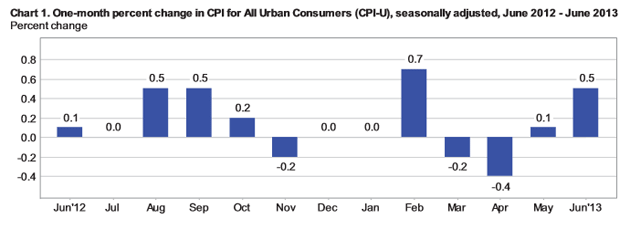
Core inflation, which the Fed wants to keep under 2.5%, rose only 0.1% in December and 1.9% for year year. Here are the monthly increases for headline inflation:

2012 inflation

Posted in Investing in TIPS | 5 Comments