Next up: 10-year TIPS reissue to be auctioned March 21, 2013

The U.S. Treasury will announce Thursday – just a formality – that on March 21 it will auction a reopening of CUSIP 912828UH1, a 10-year Treasury Inflation-Protected Security that was first auctioned on Jan. 24. This creates a 9-year, 10-month TIPS.

This TIPS has a coupon rate of 0.125%, but will end up auctioning with a yield to maturity well below that, probably around -0.526%, where it was trading on the secondary market on Monday. This also means that buyers at the March 21 auction will have to ‘pay up’ to get that 0.125% coupon rate, probably around $106.10 for every $100 of value.

TIPS yields are gently rising, but earning 0.5% less than inflation for 10 years won’t be attractive to a lot of small investors. Buyers who hold to maturity won’t be looking for income, they will be seeking: 1) Capital preservation with a super-safe, conservative investment, and 2) protection against a burst of inflation in the next 10 years. These buyers can ignore the secondary market and just hang on to maturity.

TIPS traders, though, will want to be cautious. Not long ago, every single TIPS ever issued was trading above its original value, as yields to maturity dropped to record low after record low. That trend has now broken, as shown in this chart of recent 10-year TIPS auctions:

10-year TIPS auctions

If the March 21 auction goes off with a yield of -0.52%, it will mark the third consecutive 10-year TIPS auction with a higher (although still negative) yield. Buyers of CUSIP 912828UH1 back in January have already seen its market value decline by about 1%.

The question is always: Where are interest rates headed, and when? Wish I knew the answer.

Breakeven rate. The 10-year Treasury closed Monday at 2.07%, its highest rate for the year. If the TIPS reissue goes off at -0.52%, it sets the 10-year breakeven rate at 2.59%, meaning that buyers are betting that inflation will average higher than 2.59% over the next 10 years. A breakeven rate above 2.5% is considered very high. Keep in mind that inflation in 2012 was only 1.7%.

Posted in Investing in TIPS | Leave a comment

Update on U.S. inflation: Still mild

I was away from my computer last week, and updating a blog with an iPad is pretty much hell on Earth. So, I’m catching up.

On Thursday, the same day as the 30-year TIPS auction, the U.S. announced that ‘headline’ inflation (CPI-U, the one that matters to holders of TIPS and I Bonds) was zero in January. Over the last 12 months ending in January, headline inflation has been running just 1.6%, giving recent buyers of TIPS a double whammy — yields negative to inflation combined with very low inflation.

As this chart shows, holders of TIPS have received zero in inflation adjustment to principal since October:

One-year inflation

Excluding the volatile food and energy categories, core inflation rose 0.3 percent in January. Core prices have risen 1.9 percent in the past year, below the Fed’s inflation target of ‘less than’ 2.5%. This could indicate that the Fed will feel free to continue its aggressive buying of Treasurys. From the Associated Press report:

“As long as inflation readings remain relatively constrained and inflation expectations do not get out of control, the (Fed) has plenty of runway to continue its program,” Dan Greenhaus, chief global strategist at brokerage BTIG, said in a note to clients.

February CPI, however, is likely to tick upward because of sharply rising gas prices.

Posted in Investing in TIPS | 2 Comments

30-year TIPS auctions well above record low

The U.S. Treasury announced today that it auctioned a new 30-year Treasury Inflation-Protected Security, with a coupon rate of 0.625%, and a yield to maturity of 0.639%.  This is CUSIP 912810RA8.

Buyers are getting a yield well above the record low for a 30-year TIPS, 0.479% for a reissue in October 2012. Today’s auction broke a string of five consecutive 30-year TIPS auctions (issues and reissues) that set records lows. I think that is significant.

Here’s the Treasury announcement.

Posted in Investing in TIPS | 9 Comments

A quick note about ‘the bond bubble’

Bill Gross

Bill Gross

Are bonds, especially Treasurys, in a bubble, driven up by by a mob of wild-eyed coupon clippers, fighting to get 0.87% on a five-year traditional Treasury?

I ran across these comments from Bill Gross, co-founder of Pacific Investment Management who is also known as ‘The Bond King,’ while reading a week-old Barron’s. (I get behind, sorry). This is from the annual Barron’s Roundtable, part 3:

The Fed is buying 80% of the Treasury market today. It is remarkable to think that when the Treasury issues debt in the trillion-dollar-plus category, the Fed ends up buying most of it. The Treasury sells it to the banks and primary dealers, who sell it back to the Fed at a higher bid. This is a very different financial system from the free-market capitalism we’ve come to know. And it will continue until inflation exceeds the upper end of the central bank’s target of 2.5% or, by some miracle, we get real economic growth. …

With yields so minimal, an investor is obliged to ask whether investing is worth the risk, given the possibility that the central bank misjudges the situation. … The public doesn’t realize that when yields come down, prices go up, and when yields go up, prices go down. ….

Let me be clear. Bonds are artificially priced, but aside from long-term bonds, there don’t appear to be the elements necessary to pop the bubble. That’s because central banks are buying the majority of bonds, and the cash flow from the existing stock of bonds, when reinvested, as most is, is more than the supply of bonds.

My question is: If one buyer – a buyer than can magically create dollars – is buying 80% of U.S. Treasurys, can you call that a ‘bubble,’ or is it outright market manipulation? Are there great hordes of Americans buying Treasurys? Obviously not, if the Federal Reserve is buying up 80% of the new supply.

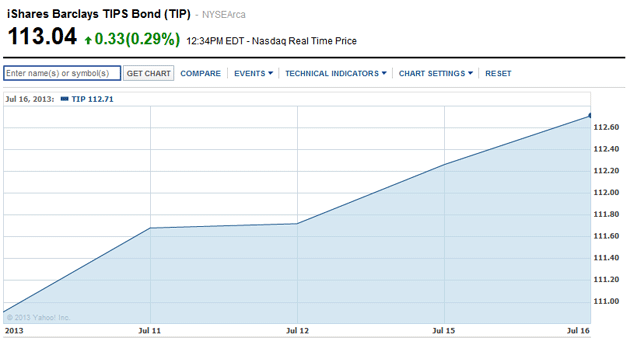
TIPS buyers, though, are bidding against both the Federal Reserve and a large contingent of investors who truly fear future inflation. And that is pushing TIPS up. Here is a 2-year chart of the TIP ETF versus Vanguard’s Total Bond Market ETF:

bnd

These two funds have similar durations, but the Total Bond Market has greatly lagged the returns of the TIP ETF over the last two years. By the way, the Federal Reserve began its market manipulation in mid 2011, and at that point the TIP ETF sharply changed course.

It is not a coincidence. It is market manipulation. Can that continue forever? No.

Are bonds overpriced? Yes. It there a bond bubble? My answer is no. Not at least in the total bond market.

Posted in Investing in TIPS | 1 Comment

Next up: New 30-year TIPS will auction Feb. 21, 2013

Treasury logoThe Treasury will announce this tomorrow, but as usual it let some details slip out. On Feb. 21, it will auction a new 30-year Treasury Inflation-Protected Security, CUSIP 912810RA8. Update: Here is the announcement.

The coupon rate and yield to maturity will be determined at auction, but we can guess that the coupon rate will come in around 0.50% or  0.625% and the yield to maturity might be somewhere around 0.59%, based on today’s market.

The longest-maturing TIPS currently on the market, maturing Feb. 15 2042, is trading at a yield of 0.576%. This new issue, which adds a year and increases supply, should get a better rate.

(Some definitions: ‘Coupon rate’ is the actual interest rate the TIPS pays each year, based on a growing principal balance. ‘Yield to maturity’ is the true interest rate a buyer gets. This is set at the auction. Buyers ‘pay up’ when the yield is lower than the coupon rate, or ‘pay down’ when the yield is higher than the coupon rate. In addition to that yield, buyers of TIPS see their principal balance rise with inflation until maturity.)

Deal or no deal? My strategy with TIPS is to buy them and hold them to maturity. I don’t ever look at their prices on the secondary market, I don’t care. Viewed this way, TIPS are a very conservative, very predictable, and very boring investment. The problem with a 30-year TIPS is: Will I live long enough to see it mature? I am 59. I could live to 89.

Or … somewhere in my 80s, I might need to sell this TIPS. If that is the case, I am likely – I’d say extremely likely – to receive a secondary market price well below my original investment. I am going to lose money on a very boring investment. Not nice.

Why will I lose money? The Federal Reserve for the last two years has aggressively bought Treasuries to force down interest rates. At the same time, that Fed action has raised the fear of inflation. Both of those factors have driven TIPS yields down to record lows (although TIPS are now trading a bit above those lows).

I can only point to history, and here is the history of every TIPS 30-year issue and reissue (make special note of the yield column):

30-year TIPS

The history of 30-year TIPS is short because the Treasury halted 30-year auctions from October 2001 to February 2010.

Maybe we live in a ‘new world,’ but when I look at this chart, I see 30-year TIPS issued at 3% to 4% above inflation. OK, that was the ‘old days’ of the Internet boom. Today’s rate is 0.59%. Even in this new world, I would expect 30-year TIPS to be paying at least 1.5% to 2% above inflation — the historical return of all U.S. Treasuries.

Someday – maybe soon, or maybe not – 30-year TIPS will again be yielding 1.5%, or 2%, or more. When that day comes, the secondary-market value of a long-term TIPS yielding 0.6% is going to be crushed.

Example: The October 2012 reissue of CUSIP 912810QV3, a TIPS maturing in February 2042, auctioned with a record-low yield of 0.479%. Because its coupon rate was 0.75%, buyers paid more than $109 per $100 of value for this issue. At one time, the yield on the secondary market dipped to 0.335%, but today, it is selling on the secondary market at $104.20 and yielding 0.576%.

So my advice is, traders beware. TIPS yields have already risen above record lows. This could be the beginning of a long-term trend. (Or not, who knows?)

Buy and holder? I can’t deny the attraction of a positive yield on a TIPS, and it might be a nice addition to your TIPS ladder. If you are sure you can buy and hold, and you are sure you will ignore the secondary market, and you truly fear future inflation … have at it.

Another strategy would be to park your money, or buy a 5-year TIPS, and suffer through a yield that lags inflation. Eventually, you could roll over into higher interest rates.

Why do people buy 5-year TIPS paying -1.34% less than inflation? Because it’s for five years. And then they can reinvest. Thirty years is a mighty long commitment.

Posted in Investing in TIPS | 2 Comments