
I try to check, at least occasionally, the TIPS inflation breakeven rate – determined by subtracting the current TIPS yield from the current nominal Treasury rate for the same term. A high 10-year breakeven rate (generally above 2.5%) indicates that inflation fear is running high and TIPS are expensive. A low breakeven rate (generally under 2%) indicates that TIPS are inexpensive, at least relative to nominal Treasuries.
In my opinion, a breakeven rate between 1.5% and 2.0% indicates TIPS are an attractive buy, but also may indicate fear of deflation. For TIPS owners, deflation is not a good thing. TIPS protect against inflation. Traditional Treasuries are better to protect against deflation.
5-year breakeven rate
A TIPS maturing Jan 15 2018 is currently trading on the secondary market at -1.446% and the 5-year nominal Treasury closed Monday at 0.72%. That pegs the 5-year inflation breakeven rate at 2.166% – not excessively high, but higher than the current rate of U.S. inflation of 1.8% over the last 12 months.
10-year breakeven rate
There is no TIPS maturing in January 2023, so I am using the TIPS maturing on July 15 2022, which currently trades at -0.751%. The 10-year nominal Treasury closed Monday at 1.78%, setting the 10-year inflation breakeven rate at 2.531%.
While this is not near an all-time high, it is high and indicates that the 10-year TIPS is expensive relative to a 10-year Treasury. Here is a chart of the historical 10-year breakeven rate:
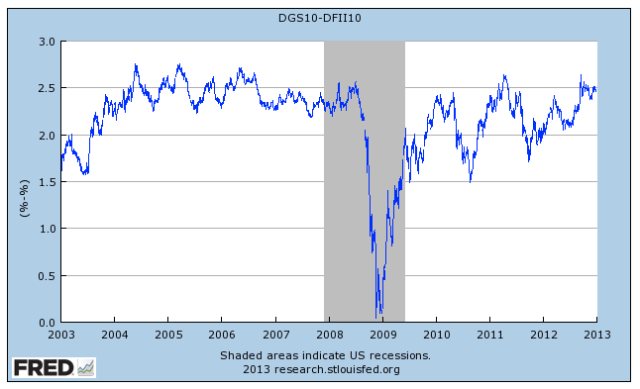
It’s interesting to note how little time the breakeven rate has spent above 2.5% and below 2.0%. The sharp plunge in the breakeven rate in late 2008 made TIPS a screaming buy, for those willing to gamble that deflation would not be severe over a long period. (Very good gamble, even though today’s inflation remains muted.)
But today’s breakeven rate just above 2.5% indicates that TIPS are historically expensive.
The better alternative. The breakeven rate is the perfect illustration of why US Savings I Bonds are superior to TIPS at almost all maturities. Reader Ed sent along this chart that compares ‘real’ yields of TIPS and I Bonds of various maturities:
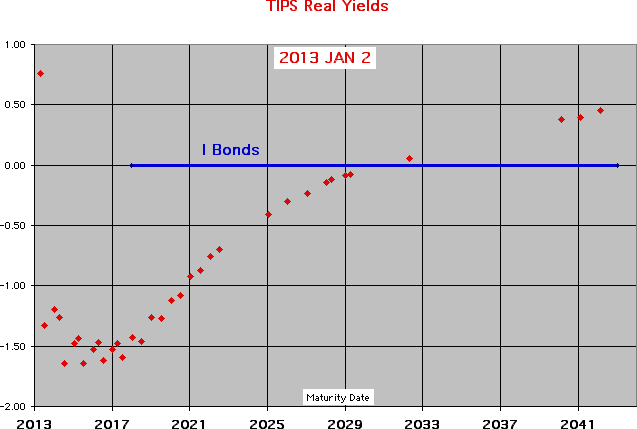
Since I Bonds currently pay the inflation rate – not below the inflation rate – the breakeven rate for an I Bond is the same ultra-low rate as a traditional Treasury: 0.72% for 5 years or 1.78% for 10 years. Plus, I Bonds earn tax-deferred interest that compounds over time.
I Bonds are the last great deal in super-safe investing. The new year opens up your chance to buy another $10,000 per person at Treasury Direct. That’s a no-brainer.


 Treasury Inflation-Protected Securities
David, can you comment on this, or perhaps it’s worthy of an entire article: https://www.cnbc.com/amp/2026/04/22/kevin-warsh-inflation-trend-pce-trump.html The Fed has long favored…