Vanguard’s new short-term TIPS funds: Better than cash?

Vanguard this month launched a family of mutual funds investing in short-term Treasury Inflation-Protected Securities. While investors could duplicate this strategy by simply buying and holding 5-year TIPS to maturity (at zero cost with Treasury Direct), these low-fee funds are intriguing as a possible substitute for cash in your portfolio.

Here are the three share classes, with identical investing philosophies but differing fee structures:

  • Short-Term Inflation-Protected Securities Fund Investor Shares (VTIPX), a traditional mutual fund with a 0.25% purchase fee and an expense ratio of 0.20%. Minimum investment: $3,000.
  • Short-Term Inflation-Protected Securities Index Fund Admiral Shares (VTAPX), a traditional mutual fund with a 0.25% purchase fee and an expense ratio of 0.10%. Minimum investment: $10,000.
  • Short-Term Inflation-Protected Securities ETF (VTIP), an ETF with no purchase fee and an expense ratio of 0.10%. No minimum investment, but brokerage fees might apply.

The purchase fee on the two mutual funds doesn’t apply to reinvested dividends and capital gains. While this fee benefits current shareholders, and is designed to discourage short-term trading, I think the ETF should be the way to go with this investment, especially in a brokerage (like Vanguard) with no commissions and automatic reinvestment of dividends.

However … as Vanguard notes: “The market price of Vanguard ETF Shares may be more or less than net asset value.” This is the case as of Friday, with the market price of the ETF closing at $49.88, and the NAV ending at $49.75. For this reason, the Admiral shares also have appeal, with dividends reinvested.

This is going to be a moderately-traded ETF, with average volume likely to be about 30,000 shares a day, compared to 900,000+ a day for the TIP ETF. Therefore, buyers and sellers should set limit orders, not market orders. Here is how the ETF performed versus Admiral shares in the last five days:

Short-term TIPS

While the ETF and the Admiral shares should have identical performance, the ETF has outperformed in recent days, putting its price above net-asset-value. For this reason, some investors might prefer the more-accurate Admiral shares, despite the 0.25% purchase fee.

Goals of these funds. Vanguard lays out three simple investing goals:

  1. Invests primarily in U.S. Treasury Inflation-Protected Securities with remaining maturities of less than five years.
  2. Seeks inflation protection and income consistent with short-term U.S. Treasury Inflation-Protected Securities.
  3. Principal and interest adjusted for inflation.

Consider N0. 2, income consistent with short-term U.S. Treasury Inflation-Protected Securities. Because TIPS yields have plummeted since mid 2011, short-term TIPS provide income well below the rate of inflation. There are only 14 TIPS with maturities of less than six years, and these have a typical yield of -1.35%. So if inflation averages 2.5% in the next few years, these issues will provide a yield of about 1.15%, which is less than you can get on a 5-year bank CD.

Consider No. 3, principal and interest adjusted for inflation. Well, not quite. Keep in mind that because of No. 2, principal and interest will currently lag inflation by about 1.35%.

Short-term TIPS versus cash. Cash in a money market account or bank savings account, earning maybe 0.04% today (I”m being generous), is going to lag inflation by an even wider margin. That is why I think these short-term TIPS funds could work as slightly more risky substitute for cash.

These TIPS funds aren’t money market accounts and their net asset value will vary. Although there is zero credit risk, there is interest-rate risk and you could lose money.

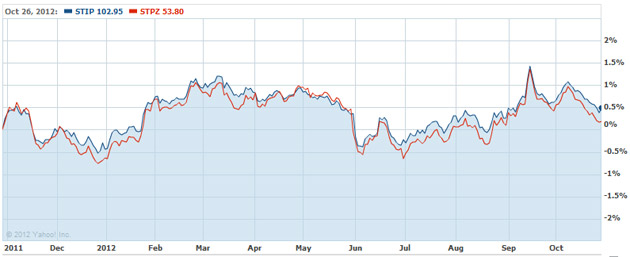
There are two other ETFs that track short-term TIPS — iShares Barclays 0-5 Year TIPS Bond (STIP) and PIMCO 1-5 Year US TIPS Index ETF (STPZ) — and here is how they performed over the last year:
Short-term TIPS funds

Although the price fluctuations aren’t Halloween scary, short-term TIPS funds will see a rise and fall in net asset value.

At this point, Vanguard isn’t listing duration or yield for these brand-new funds, but from the Pimco and iShares funds you can predict a duration of about 2.5%, meaning that net asset value will fall about 2.5% for every 1% rise in yield. If short-term TIPS returned to a more ‘normal’ yield of 0.5% above inflation, investors could see a 4.5% drop in net asset value. So the risk is not extreme, but it is there.

On yield, buyers can expect about 1% in the near term. That’s not great, but it is better than cash.

Other alternatives. If you haven’t invested in US Savings I Bonds this year, you can still buy $10,000 per person before Oct. 31 and get a six-month interest rate of 2.2% and then 1.76% for the next six months, resulting in a combined annual yield of 1.98% in the next year. That’s definitely better than cash, and you avoid any current tax liability.

Another strategy, as I noted above, would be to buy and hold to maturity every new issue and reissue of 5-year TIPS on Treasury Direct. This produces zero cost and zero risk. The next 5-year offering is a reissue on Thursday, Dec. 20, 2012.

Conclusion. I view the Vanguard short-term TIPS funds as a low-risk and low-return investment. Because of the built-in protection against unexpected inflation, these funds are a good alternative to cash, if you can tolerate the small additional risk.

Posted in I Bond, Investing in TIPS | 6 Comments

30-year TIPS reissue auctions at record-low 0.479%

The Treasury just announced that the $7 billion reissue of CUSIP 912810QV3 — creating a 29-year, 4-month TIPS — auctioned with a yield to maturity of 0.479%, a record low for any 30-year issue or reissue. (The principal balance of a TIPS also rises at the rate of inflation, so the 0.4.79% is on top of inflation.)

Here’s the Treasury’s announcement of results.

The previous record low was for this same TIPS when it was reissued on June 21 with a yield to maturity of 0.520%.

Reaction to the auction. The yield ended up inching up – a good thing for buyers – from last week’s secondary market yield of 0.371%. The Wall Street Journal is reporting the auction had ‘solid overall demand’:

The willingness to pay up for long-dated inflation protection now speaks to the fact that all the monetary stimulus being conducted by major central banks–funneling loads of cheap money into the global economy–is making investors nervous about price stability in the future.

Breakeven rate. Since the 30-year traditional Treasury closed today at 3.02%, this TIPS ends up having an inflation breakeven rate of 2.54%, which is fairly high. That means buyers are expecting inflation to average 2.54% over 30 years, which isn’t such a bad bet when a 30-year traditional Treasury is paying just 3.02%. From a Bloomberg report:

“The auction went well — 30-year break-evens are cheap relative to the rest of the curve, and that makes 30-year TIPS look more attractive,” said Richard Gilhooly, an interest-rate strategist at Toronto-Dominion Bank (TD)’s TD Securities unit in New York. “There is still demand for inflation protection given the Fed’s activities. And that demand should grow, resulting in higher break-evens.”

Posted in Investing in TIPS | Leave a comment

Improving yield on Thursday’s 30-year TIPS auction?

The likely yield on the reissue of a 30-year TIPS has been creeping up this week, making this 29-year 4-month TIPS at least slightly more attractive.  If you have been on the fence about this one, you should at least take a look.

It is CUSIP 912810QV3 and carries a coupon rate of 0.75%. This TIPS, which trades on the secondary market, closed Wednesday with a yield to maturity of  0.478%. This is up fairly sharply since last Wednesday, when it closed at 0.371%. The resulting market price for $100 of value has dropped from $110.17 to $107.14. That is almost a 3% drop in a week.

(A buyer of this TIPS will pay more than the principal value because he will get a coupon interest rate of 0.75% for 30 years, on principal that rises with the rate of inflation. So when you see a yield of 0.478%, that means the buyer – after paying up – actually gets 0.478% plus the rate of inflation.)

Even if Thursday’s auction – which closes at 1 p.m. – ends up with a yield of 0.5%, that would be a record low for any 30-year TIPS issue or reissue. The current record is for this same TIPS when it was reissued on June 21 with a yield to maturity of 0.520%.

Breakeven rate? The traditional 30-year Treasury closed today at 2.98%, meaning a TIPS yield of 0.478% results in a 30-year breakeven rate of 2.502%. That is up a bit from last Friday, when it was 2.45% and it is a negative for buyers of this issue.

Oh well. Let’s see what happens Thursday.

Posted in Investing in TIPS | 2 Comments

Better long-term investment: 30-year TIPS or … booze?

Bushmills kegs

The Old Bushmills Distillery attracts about 110,000 visitors a year. By contrast, the Guiness Storehouse in Dublin attracts more than 1 million a year – Ireland’s No. 1 international tourist attraction.

I was touring in Northern Ireland recently and visited the historic Old Bushmills Distillery plant in County Antrim. It was a so-so tour, but a few days later I toured the impressive Guinness Storehouse in Dublin, a fascinating and high-tech homage to hops, malt, yeast and water.

Both Bushmills and Guiness are brands of Diageo plc, the  multinational alcoholic beverages company based in London. It is the world’s largest distributor of premium alcoholic beverages, with an impressive list of brands: Johnnie Walker, Crown Royal, J&B, Windsor, Buchanan’s and Bushmills whiskies, Smirnoff, Ciroc and Ketel One vodkas, Baileys, Captain Morgan, Jose Cuervo, Tanqueray, Guinness … and more.

I have owned Diageo stock (ticker: DEO) in the past and sold it at a nice profit. The visit to Ireland left me with a strange thought: Would a 30-year investment in Diageo, with dividends reinvested, be a better investment than the 30-year TIPS about to be auctioned Oct. 18?

Why even think about this? The premise is an apples-and-oranges stretch, but I think it’s legitimate to  wonder whether buying a high-quality, dividend-paying stock (and reinvesting the dividends) might be a better investment today than a 30-year TIPS, which will pay just slightly over the rate of inflation over 30 years.

Although Diageo’s stock has been on quite a nice run lately, so have TIPS. Neither is ‘cheap’ at current prices. Here is a chart comparing Diageo’s 5-year stock price to the TIP ETF:

DEO versus TIP

The TIP ETF, shown in blue, is up about 20% over the last five years, slightly trailing the performance of Diageo, shown in red. But Diageo has been much more volatile.

Safety. The TIPS completely wins on this measure. A buyer of a Treasury Inflation Protected Security will get his principal back, plus the inflation adjustment, if the TIPS is held to maturity. But if the buyer decides to sell within 30 years, there is a real possibility  that this TIPS will be worth sharply less (even 15-20% less) on the secondary market in coming years.

Diageo’s safety comes with its rock-solid brands of an ‘addictive’ nature and a growing market across the world. But it will be a volatile ride; the chart above shows how Diageo’s stock price plummeted 50% during the financial crisis. In 30 years, what are the chances of corporate mismanagement, accounting fraud, etc.? It is a risk.

Return. The 30-year TIPS will probably auction with a yield about 0.38% above inflation. If inflation runs 2.2% in the next year, the return will be 2.58%. Diageo currently yields 3%, so in the short term Diageo is likely to provide a greater return. The TIPS could yield substantially more in future years if inflation rises, but that is an unknown.

Taxes. Diageo’s dividend will likely be taxed at a lower rate – currently 15% – but that also could change in the future. In addition, a future sale of the stock may get preferable tax treatment. The TIPS interest and inflation adjustment is taxable as income in the year earned, which is a disadvantage. But there is no state income tax.

Reinvesting dividends. The key to my premise was to compare the two investments held over 30 years, with dividends reinvested. In the case of the TIPS, the interest earnings can’t be directly reinvested, but the inflation adjustment adds to the principal. Diageo’s dividends have been steadily increasing – from about $1.25 a share in 2000 to about $2.75 a share in 2012.

If that dividend continues to increase, DEO is likely to outperform the 30-year TIPS, by a wide margin.

But it is a much more risky investment.

At the moment, I probably won’t buy either.

Diageo is fairly pricey right now at $113.94 a share, selling at a P/E ratio of 22.95 for trailing-year profits. But it is expected to earn about $6.49 a share in in the current fiscal year, and $7.25 a share in the next, bringing the P/E down to a reasonable 15.7.

Something to think about in days of ultra-low yields.

Posted in Investing in TIPS | 2 Comments

Higher gas prices pushed consumer inflation up 0.6% in September

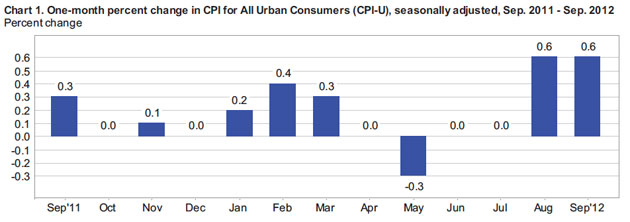
The Labor Department today reported that ‘headline’ inflation – the measure used to adjust the principal on TIPS and the interest rate on I Bonds – rose a strong 0.6% in September, the second strong increase in two months.

Read the full CPI report.

Almost all of the increase was due to higher gas prices. Food prices rose only 0.1 percent. The cost of meat, chicken and eggs fell. Dairy prices rose.

The last two months broke a mid-year string of very low inflation, which is ‘good news’ for holders of TIPS and I Bonds. Although we all hate higher inflation, it’s the reason we buy inflation-protected securities:

2012 CPI increases‘Core’ inflation, which the Federal Reserve watches closely, rose just 0.1 percent in September, and 2% over the last 12 months, pretty much the Fed target.

What this means for I Bonds. The September number closes out the six-month period that determines the new I Bond inflation-adjusted interest rate, which will update Nov. 1. My friends on the Bogleheads forum are saying that the new rate for November to April will be 1.76%, down from 2.2% currently.

What’s next? Since gas prices are again slipping, inflation is likely to be muted in the next few months. This is from today’s Associated Press report:

Paul Ashworth, an economist at Capital Economics, said that with gas prices leveling off, overall inflation should stabilize at around 2 percent for the next several months and then decline.

Posted in I Bond, Inflation | Leave a comment