Next up: Reopening of a 30-year TIPS on October 18, 2012

The U.S. Treasury on Thursday released its formal announcement of a reissue of CUSIP 912810QV3, which will mature on February 15, 2042, making this a 29-year 4-month TIPS. It has a coupon rate of 0.75%, but will likely auction on Oct. 18 with a yield to maturity of about 0.38%.

That means buyers will have to pay money upfront to get this issue, since they will be getting interest payments about 0.37% higher than the auctioned yield. When you project that across 30 years, the cost will end up being about $110 to $111 per $100 of value.

Let’s say a buyer wanted $10,000 of this TIPS. It would cost that buyer about $11,100. In return, the buyer will receive taxable interest payments of 0.75% a year on a principal balance that will rise with the inflation rate for 30 years (and also be taxed each year for the increase, unless the TIPS is in a tax-deferred account).

Simple? Right. The only questions the buyer should ask are: 1) Will I be alive in 30 years? 2) Or if I sell before maturity, what will this TIPS be worth? While it may gain value in the short term, it is highly likely to lose value over the long term … my opinion. 3) Or, if I am committed to holding to maturity, can I live with a record-low interest rate and probable decline over time of this TIPS’ market value, even though I am holding to maturity?

The one appeal of this issue is that it does actually carry a positive yield over the inflation rate. Only TIPS maturing in 2040 and beyond still carry a positive yield, a remarkable plunge in rates that began in mid-2011 as the Fed began manipulating the Treasury market to force interest rates down. You can see that trend in the history of CUSIP 912810QV3.

First auction, Feb, 16, 2012: Yield to maturity of 0.770%

First reissue, June 21, 2012: Yield to maturity of 0.520%

Upcoming reissue, Oct. 18, 2012: Likely yield of about 0.38%

Who would buy this? Getting a yield above the inflation rate would look especially appealing to someone worried about very high future inflation and trying to protect against that inflation in coming years. This TIPS also could be appealing to big money managers (pension funds, international banks, etc.) that need the inflation protection.

But this issue will be very expensive (meaning the yield will be very low and the upfront cost very high). Here is the history of all 30-year TIPS auctions and reissues. Note that in June 2011 – 16 months ago – a 30-year TIPS reissue had a yield of 1.744%:

30 year TIPS history

30-year breakeven rate. We look at the breakeven rate with each TIPS issue to see how it compares with a traditional Treasury. On Friday, the 30-year Treasury yield closed at 2.83%. Since this TIPS reissue will likely carry a yield of about 0.38%, the 30-year breakeven rate is currently 2.45%. So, if inflation runs more than 2.45% on average, the buyer of this TIPS will beat an investment in a 30-year Treasury.

That is a high breakeven rate, but I think a lot of people believe inflation is likely to run higher than 2.45% over the next 30 years. Blogger Michael Ashton produced this chart to show rolling 10-year inflation rates, compared with the then-current 10-year TIPS breakeven rate of 2.48%:

10-year compounded

Ashton notes:

With the exception of the Great Depression, when the Fed tightened policy as money velocity declined in a manifest error, inflation has almost never been below the current level on a compounded 10-year basis. And it has never, with that singular exception, been very far below the current level. Ergo, inflation insurance is very cheap, even though 10-year breakevens are not far from all-time highs (since TIPS began, in 1997).

I advise reading this blog, which ends with a very funny (and brilliant) graphic on inflation-protection decisions. But keep in mind that Ashton is advising big money managers, not small investors. Inflation protection is ‘cheap’ for the big money group, but still rather expensive for the small investor looking for a super-safe investment.
Posted in Investing in TIPS | 2 Comments

Are TIPS expensive? A look back into recent history …

A New York Times article with the headline ‘An Inflation Hedge Carries Its Own Risks‘ spells out why TIPS mutual funds appear to be overpriced, and possibly risky, after substantial gains. Some of its major points:

Investors who placed bets on mutual funds specializing in inflation-protected Treasury securities were among the bond market’s biggest winners over the last two years, even as other Treasury funds struggled. … “TIPS have gone through a period where just about everything has gone right for them,” said Robert Johnson, director of economic analysis at Morningstar. “Now the situation has changed, and they are looking quite expensive.”

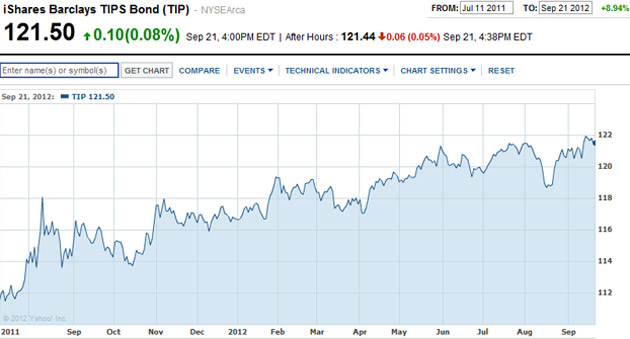
The surprise is that this article was written July 11, 2011, practically to the day that TIPS base yields began moving into negative and TIPS mutual funds started a strong move higher. Here is the chart for the TIP ETF, which has risen about 8.9% since July 11, 2011:

TIP return since July 2011

Obviously, you can’t trust the experts. But …

I will admit that back in July 2011, I agreed with this New York Times article. TIPS seemed pretty expensive. Looking back, boy, were we wrong. Yes, TIPS were expensive relative to history, but not expensive at a time of massive Federal Reserve manipulation in the Treasury market.

Since July 2011, yields have literally turned upside down to what I would call the ‘Real World.’ Now we are living in the ‘Fed World.’

Real World. On July 21, 2011, a 10-year TIPS auctioned with a yield of 0.639%, meaning that buyers would receive 0.639% above inflation over 10 years. That looked expensive at the time, but in retrospect …

Fed World. This week the Treasury reissued a 10-year TIPS with a yield of -0.75%, meaning that buyers were accepting 0.75% less than inflation for the next 10 years. They  were betting big on higher-than-expected inflation.

A yield of -0.75% is expensive, right? Can we finally settle on that? But it was another in a string of record-low yields for TIPS. Until we see that trend turn around, I think we can say the Fed World is still going strong.

Posted in Investing in TIPS | 12 Comments

10-year TIPS auctions at a record low -0.75%

The U.S. Treasury just announced that its reissue of a 10-year TIPS auctioned with a record-low yield to maturity of -0.75%. This is CUSIP 912828TE0, which will mature on July 15, 2022.

The previous record low was for this same Treasury Inflation-Protected Security, when it was first auctioned in July with a yield of -0.637%.

Breakeven rate. The 10-year Treasury closed today with a yield of 1.80%, setting the inflation breakeven rate for this TIPS at 2.55%. This means that inflation will have to average 2.55% for the next 10 years for this TIPS to beat a traditional Treasury. This is a near record-high breakeven rate (I think the record is 2.64%) for a 10-year TIPS, as shown in this chart from Michael Ashton’s E-piphany blog:

TIPS breakeven rate

The higher the breakeven rate, the more expensive the TIPS. Buyers were paying a lot at today’s auction, that is clear. (And I should point out that this same TIPS, when it first auctioned in July, had a much more modest breakeven rate of 2.17%.)

Reaction. The Wall Street Journal cited ‘lukewarm‘ support for this auction, despite the record-low yield. The article notes:

TIPS shield owner from inflation because their payouts increase as the consumer price index rises. But without inflation, buying at a negative yield means the investor will get a smaller amount of money paid back than originally lent out.

Because of newfound inflation concerns, prices on TIPS have soared recently–but perhaps so much so that it made Thursday’s auction a bit too expensive, analysts say.

Posted in Investing in TIPS | 14 Comments

Are TIPS a good investment in 2012?

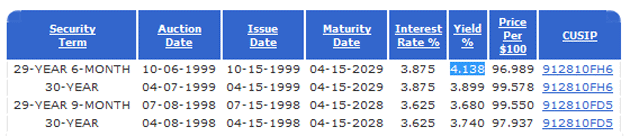
I get that question a lot. My quickest reaction is: ‘No.’ Treasury Inflation-Protected Securities were a really good investment back in 1999, when you could have bought a 30-year TIPS with a yield to maturity of 4.138% – that means 4.138% above the rate of inflation until 2029. That wasn’t just good, it was magnificent. It was auctioned Oct. 6, 1999.

In the 1990s, TIPS were an unknown product and the stock market was booming. No one was really considering TIPS and they were unloved. That resulted in some great buying opportunities:

Early 30-year TIPS auctions

That was then, and now? In 2012, TIPS are very much loved. And buyers are paying for that love. So much so that that the yield to maturity on CUSIP 912810FH6, which I praised above, is now -0.067% on the secondary market. This magnificent creature of 1999 is now a shriveled-up 17-year TIPS with a return that is negative to inflation. It isn’t pretty.

Why are TIPS so loved? TIPS and US Savings I Bonds are the only two investments on Earth that are 1) super safe, and 2) reward the investor for unexpected inflation. When investors feel fear, #1 is appealing. And when investors fear inflation, #2 is appealing. Right now, investors feel both fear and fear of inflation. That has driven TIPS yields to extremely low levels, negative to inflation well up the maturity ladder.

Other investments are super safe: Traditional Treasuries, of course, and Bank CDs with FDIC or NCUA insurance. But they also currently offer returns well below the rate of inflation, which let’s just round up to 2% currently. A 5-year Treasury pays 0.72% today, and a 5-year bank CD pays about 1.7%. A 5-year TIPS pays about -1.691% (plus inflation), which is extraordinarily low.

In rejecting that 5-year CD, a buyer of a 5-year TIPS is betting that inflation will average 3.39% over the next five years. Does that bet make sense at a time of muted inflation and very low economic growth? You’d have to fear something to make that bet.

On the other hand, world banks, huge hedge funds and multibillionaires can’t be investing in insured bank CDs. They are stuck with that 5-year Treasury as a super-safe choice, and then the breakeven inflation rate falls to a more reasonable 2.41%. If I was investing millions, I’d probably want that inflation protection.

So, are TIPS are good investment in 2012? Yes, if you happen to be a world bank, pension fund or hedge fund.

There is logic to the pricing of TIPS. But that logic doesn’t work as well for the small investor in September 2012. (By far, the best super-safe investment for the small investor is the I Bond, which pays the rate of inflation, minus nothing. You can sell it after five years with no penalty. But you can only buy $10,000 per year, per person.)

Who should buy TIPS? In 2012 – at these rates – TIPS are all about capital preservation. There is really no other reason to purchase them. Most likely, the return will be very low. The buyer will get his money back, absolutely. But TIPS and I Bonds are a vehicle for protecting your nest egg from the disaster of inflation.

Capital preservation means you probably have 1) a very large nest egg and 2) are nearing retirement or already retired. If both of those cases are true, I can still see TIPS as a reasonable investment in 2012. Inflation might be your worst enemy, and you should design your portfolio to protect against it.

For you, my suggestion for asset allocation is something like: 1) 25% in super safe investments like TIPS, I Bonds and bank CDS, 2) 25% in low-fee bond funds, 30% in dividend-paying stocks and index funds, and 20% in international stock and bond funds.

(Do I need to remind you that I am a journalist and not a financial adviser? That’s just my suggestion, nothing more.)

But I am young and just starting out investing! Well, the bad news is that TIPS are going to be a lousy investment. Seriously. You have to build wealth before you worry about capital presevation. In 1999, with TIPS paying 4% above the inflation rate, there was an unusual buying opportunity. That does not exist today. TIPS are expensive.

Should I sell my TIPS and TIPS funds?  I am strictly a buy and hold investor in TIPS. I have never sold a single purchase, going back 13 years. That is my style, but it might not be yours. TIPS have had a tremendous run, accelerating in mid 2011, as the Federal Reserve pumped massive amounts of cash into the money supply.

Some people might want to take profits. If you do, ask yourself this: Where will I put this money? Will it be in a similarly safe investment?  Will the money be earning zero percent in a money market fund for two years? Will I be changing my asset allocation?

Of course, parking the money might work, if the TIPS juggernaut somehow loses steam.

Posted in I Bond, Inflation, Investing in TIPS | 15 Comments

‘Headline’ inflation rises a sharp 0.6% in August

As expected, U.S. inflation ticked up sharply in August, rising 0.6% because of higher energy prices. This was the first increase of any kind since March. Higher gas prices accounted for 80 percent of the increase. Food prices rose 0.2 percent.

Read the full August report on inflation

The 0.6% increase in August is the ‘headline’ number (CPI-U) that holders of TIPS and I Bonds care about, because it adjusts the principal balance of TIPS upward and eventually sets the inflation-adjustment interest rate on I Bonds. So, in the crooked logic of TIPS investors, a 0.6% increase is a good thing, given the 0.3% decline in infation from April to July.

Monthly inflationIn the past 12 months, headline inflation has increased 1.7%. That’s down from a peak of 3.9% in September 2011 and below the Fed’s inflation target of 2%.

The Federal Reserve cares about ‘core inflation’ – which strips out the more-volatile energy and food. Core inflation in August was a very muted 0.1%, which should keep the Fed happy. Core consumer prices rose 1.9 percent in the past 12 months, the smallest annual increase in a year.

An Associated Press report notes that food prices have not yet figured into rising inflation:

The modest increase in food prices indicates the drought in the Midwest is not yet pushing up grocery prices. Some economists say that will happen in the comings months.

Posted in Investing in TIPS | 3 Comments