Next up: 10-year TIPS reissue auctions Sept. 20, 2012

10-year TIPS auctionThe U.S. Treasury announced today that it will auction a reissue of CUSIP 912828TE0 on Sept. 20, resulting in a 9-year, 10-month Treasury Inflation-Protected Security investment for buyers.

Read the auction announcement.

This TIPS was originally auctioned July  19, 2012, with a coupon rate of 0.125% and a record-low yield to maturity of -0.637%. Because the principal of a  TIPS investment also grows at the rate of inflation, TIPS buyers back in July were accepting -0.637% less than the rate of inflation over the next 10 years.

What about it? So now, two months later, what can buyers expect? More of the same. This TIPS trades on the open market, and today it closed with a yield to maturity of -0.730%, meaning next Thursday’s auction could set another record low.

You can check the daily yields here. The line you care about looks like this:

current rate

Notice that the accrued principal on this issue stands at 997, when it should be 1000 or more. Why? Because we have seen slight deflation in the last two months, instead of inflation. So July’s buyers got two slaps in the face: 1) negative yield and 2) negative inflation.

But deflation isn’t likely to continue. The August inflation report, due out Friday, could show a monthly rise of as much as 0.6%, which you could speculate indicates an annual rate of 7% or more. Don’t speculate. It won’t be that high. But headline inflation – the number that matters for TIPS buyers – could easily rise back to the 3% to 4% range we saw last year. Reasons? 1) The Fed today again launched a stimulus program with a plan to buy mortgage-backed securities, 2) turmoil in the Mideast threatens a spike in oil prices and 3) drought conditions in much of the country are forcing food prices up.

If  … and it is a HUGE if … inflation were to rise quickly in the next year, this TIPS reissue would end up being a very wise investment. If … on the other hand … the economy continues slogging along (and high oil prices could cause that), and inflation remains muted over the long term, this will be a fairly lousy investment.

I contend that TIPS bought and held to maturity will never be a horrible investment. You will get your money back. You may get a miserable return, but you will get your money back.

Look at the breakeven rate. The Wall Street Journal had an article this week titled ‘Uncle Sam Has an Inflation Deal for You‘ with the very odd premise that because the breakeven rate – comparing a TIPS versus a comparable Treasury – has been rising, TIPS are a good buy.

… the amount that investors have been willing to pay has risen noticeably. Ever since talk heated up that the Federal Reserve will engage in a third round of bond buying, implied bets on inflation have, too. The 10-year break-even rate has risen to 2.376% currently from 2% in late July.

But the article continued:

Perhaps the oddest thing about TIPS, though, is that they aren’t even pricier, whatever the Fed’s immediate plans. Today’s 2.39% break-even rate over 30 years not only is well below the actual average inflation rate of 3.8% since 1950.

OK, but I would still contend that TIPS are most attractive (‘cheap’) when the breakeven rate is around 2%. Where are we today? The 10-year Treasury closed today at 1.75%, well above the rate of 1.54% when this TIPS was auctioned on July 19. So the yield to maturity has declined at the same time traditional Treasuries are paying more.

The result: A breakeven rate, today, of 2.48%. Folks, that is a high breakeven rate. (It was 2.17% back in July, just saying …) When the breakeven rate rises, it means inflation fear is rising. And when inflation fear is rising, TIPS are expensive.

Update: On Friday, the breakeven rate rose even higher. The 10-year Treasury closed the day at 1.88%, while the July 15 2022 TIPS closed at -0.811%, pushing the breakeven rate out to 2.69%. If this trend continues a 10-year Treasury may actually look attractive.

I’d say keep an eye on the market yield of CUSIP 912828TE0 over the next week. Perhaps the breakeven rate will slip. If not, this auction is risky.
Posted in Investing in TIPS | Leave a comment

5-year TIPS reissue auctions at record-low -1.286%

The U.S. Treasury has announced results of today’s reissue of CUSIP 912828SQ4, resulting in a yield to maturity of -1.286%, meaning that today’s buyers are accepting 1.286% less than the rate of inflation over the next four years, 8 months.

Read the Treasury’s auction summary.

This is a record low for any 5-year Treasury Inflation-Protected Security, issue or reissue. The previous low was for this same TIPS, when it was first issued in April at a yield to maturity of -1.080%.

Since this TIPS has a coupon rate of 0.125% – the lowest the Treasury allows – today’s buyers had to pay more than 6.5% above actual value to get the resulting negative yield.

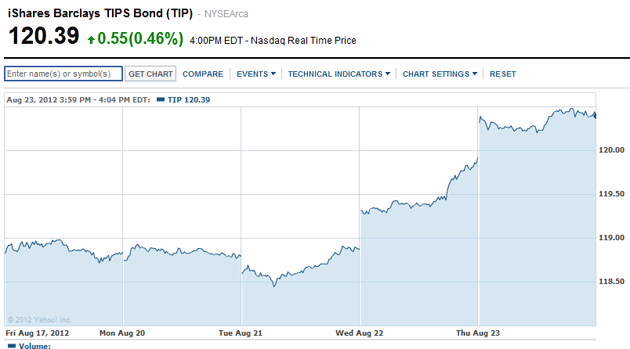
Although TIPS yields had been falling in recent days, demand for today’s auction was considered strong. The open-market yield for this issue had dropped to about -1.1% in recent days. The TIP ETF got quite a bounce this week:

5 day chart for TIP ETF

TIPS yields had been rising a bit in recent days, but this trend turned around with the midweek release of Fed minutes hinting at further economic easing. When TIPS yields fall, values rise, as show in this chart.

From a Bloomberg report:

“It was strong any way you slice it,” Michael Pond, co- head of interest-rate strategy at Barclays, said. … “Clearly, yesterday’s Fed minutes have increased investors’ appetite for TIPS, particularly at the short end of the curve.”

Short-term TIPS are attractive to investors who fear unexpected inflation. Although inflation in 2012 is muted, fears are rising because of possible Fed action to stimulate the economy. Past Fed moves have boosted the prices of stocks, commodities and energy.

TIPS buyers are willing  to accept a meager yield in the short term because TIPS protect against a spike in inflation, which could be devastating to the value of traditional fixed investments like regular Treasuries and bank CDs.

Breakeven rate. The rate on a 5-year traditional Treasury dropped today to 0.71%, 12 basis points below the rate of 0.83% on Aug. 16. Today’s rate results in a 5-year breakeven rate of 1.996%. This means today’s buyers will win against a traditional Treasury if inflation averages 2.0% or more over the next 5 years.

While this isn’t a bad bet, keep in mind that inflation has been running 1.4% over the last 12 months.

Still, TIPS buyers aren’t worried about sacrificing a small amount of yield today, when weighed against a spike in inflation in the future. TIPS buyers ‘gain’ from inflation.

And that is why you get a strong TIPS auction at a record-low yield.

Posted in Investing in TIPS | Leave a comment

An update on U.S. inflation: Nowhere to be found

I was out of town last week and didn’t get a chance to write about the U.S. inflation rate in July, which was unchanged from June, in other words … zero inflation in July.

This is the ‘headline’ inflation rate – the Consumer Price Index for All Urban Consumers (CPI-U) – which is the rate that determines principal adjustments for holders of TIPS and will help to determine the next 6-month adjustment in the inflation-adjusted interest rate for I Bonds.

The core CPI – which excludes volatile food and energy prices – rose by only 0.1 percent in July. The core rate is the one the Fed watches closely, but doesn’t directly affect interest rates for TIPS and I Bonds.

Over the last 12 months, headline inflation has increased a meager 1.4 percent, and core inflation was up 2.1 percent. The trend since spring has been remarkable:

Month                       CPI-U

April                              0.0%
May                              -0.3%
June                              0.0%
July                               0.0%

It’s great that inflation is muted, but for holders of TIPS and TIPS mutual funds this is a four-month double whammy. Many people buying TIPS in the last year have accepted yields to maturity that are negative to inflation. Since April, they have also seen their principal balance decline by 0.3%. Ouch.

I Bond holders also might be affected come November, when the new six-month interest rate will be unveiled. The I Bond inflation component is based on the difference between the March and September levels of the CPI-U. In March, inflation was 0.3%, so for now, I Bond holders are looking at a zero interest rate for six months (November 2012 to April 2013), but we’ll have to wait for the August and September inflation numbers to know for sure.

Even at zero interest, though, I Bonds might be preferable to TIPS paying a negative real yield at a time of zero inflation. Negative plus zero = negative.

Prediction. We can expect the buying appetite for I Bonds to dry up completely if they pay a zero base rate and a zero inflation adjustment beginning in November.

Posted in I Bond, Inflation, Investing in TIPS | 5 Comments

Next up: Reissue of a 5-year TIPS on Aug. 23, 2012

The announcement will come next Thursday  (Aug. 16), but we know the Treasury will be auctioning a reissue of a 5-year TIPS on Aug. 23.

I am guessing that this will be a reissue of CUSIP 912828SQ4, which was first auctioned on April 19 with a coupon rate of 0.125% and an auction-determined yield to maturity of -1.080%. That was an all-time low for a new or reissue of a 5-year TIPS.

Update: Here is the Treasury announcement, confirming it is a reissue of CUSIP 912828SQ4.

This one matures on April 15, 2017, and it currently trades on the secondary market at -1.227%, meaning that investors would get the rate of inflation minus 1.227% for the next five years.

Breakeven rate? The yield to maturity on TIPS is being held down, way down, by the ultra-low rates on traditional Treasuries. As of today, a 5-year Treasury is paying 0.74%, meaning a buyer of this TIPS at -1.227% will be a winner versus the traditional Treasury if inflation averages 1.967% over the next five years. I’d say there is very little risk in buying this TIPS, at least versus a traditional Treasury, which carries a rate priced for economic Armageddon.

But with a five-year TIPS, it’s better to look at other alternatives, such as:

  • I Bonds, which pay the inflation rate and can be sold after five years with no penalty. I Bonds are clearly the winner, bought up to your purchase limit – $10,000 per person per calendar year.
  • A 5-year bank CD, especially one with a minimal penalty for early withdrawal. You can find 5-year bank CDs paying around 1.75%, which pushes the breakeven rate on that five-year TIPS all the way up to 2.977%. Bank CDs are at rates we saw months ago, while Treasury rates have continued falling. Worth considering.
Posted in Investing in TIPS | 4 Comments

U.S. Treasury will offer floating-rate notes

It’s big news when the U.S. Treasury rolls out a new product, since the last new one was Treasury Inflation-Protected Securities in 1997. That one worked out well, for both the Treasury and investors.

These floating rate notes will be of interest to TIPS buyers, I think, because they similarly ease the risk that buy-and-hold investors face with traditional Treasuries. We don’t know many details yet, and the floating rate notes won’t launch for about a year.

The Wall Street Journal says:

… the payments on these new notes would periodically reset to match prevailing market rates, as measured by a market index. The private-sector advisory committee that offers guidance to the Treasury suggested that the notes initially have a maturity of as long as two years.

TIPS pay a base return (lately that is 0.125% for most maturities), plus the principal is adjusted to reflect the overall Consumer Price Index. In reality, though, many TIPS after auction currently pay a negative yield to maturity, plus inflation.

These floating rate notes would react to prevailing interest rates, not inflation. So they could serve as a hedge against rising interest rates, which could harm the value of TIPS.

If they really are issued for two years, they would look make a good buy-and-hold investment today, when interest rates are ultra low. This assumes that the Treasury won’t allow the interest rate to go negative. At the moment, a two-year Treasury is paying 0.24%. I’d guess a floating-rate note would pay less, possibly close to zero interest with the chance of rising interest rates later.

Of course, interest rates could also go down, but if the Treasury didn’t allow a negative rate, that would make a floating-rate Treasury much more attractive than a traditional two-year Treasury.

The floating-rate note would also be a great alternative for investors who continuously turn over short-term Treasuries. The three-month Treasury is now paying 0.09%, practically zero. From the Wall Street Journal:

For buyers of Treasurys looking for a haven rather than an investment, floating-rate notes also might be relatively attractive. These notes will likely pay a higher yield than fixed bills, because investors will lock their money up for a longer period. And because yields on floating-rate notes reset automatically to mirror market rates, they wouldn’t have to be continuously redeemed and repurchased like short-term bills, a process that adds costs.

We won’t be able to buy these for at least a year, and so for now we can only speculate. My thinking is that if they are indeed 2-year issues and come with a guarantee of no negative interest rates, they will be worth considering in this ultra-low rate environment.

More on negative rates from Bloomberg. This was in Bloomberg’s report on the floating-rate Treasuries, but it wasn’t specifically referring to the floating-rate notes. TIPS buyers already know all about negative rates, because after-auction yields on many TIPS have been negative for more than a year:

The Treasury also said it is “in the process of building the operational capabilities to allow for negative-rate bidding in Treasury bill auctions, should we make the determination to allow such bidding in the future.”

Investors who bid at auctions for Treasury bills at negative yields would pay more than face value for the securities, ensuring that if they hold the debt to maturity they will get back less than they paid.

Posted in Investing in TIPS | 2 Comments