Next TIPS auction: 10-year reissue on May 17, 2012

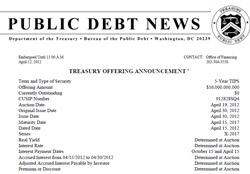
The Treasury announced this week that it will reissue CUSIP 912828SA9, a Treasury Inflation-Protected Security that matures Jan. 15, 2022. That makes this a 9-year, eight-month offering.

This TIPS comes with a lowest-possible coupon rate of 0.125%, and it initially auctioned in January with a rate to maturity of -0.046%, the lowest rate ever for a 10-year TIPS and the first-ever negative yield for a 10-year TIPS.

What can we expect? I wasn’t a big fan of the January auction, at a time when interest rates appeared to be budging off their super-low levels. But the January buyers were smarter than me (not so uncommon). CUSIP 912828SA9 is now trading on the secondary market with a yield to maturity of -0.345%, meaning that buyers are accepting a return -0.345% below the inflation rate for the next 10 years.

Buyers in January paid about $101.66 for each $100 of this issue, and four months later that price has risen to about $104.15, a nice little paper gain.

You can check the current rate daily as this auction approaches, look for the security that matures 2022 Jan 15.

Interest rate trend? Not the buyers friend. The 10-year traditional Treasury closed Friday with a yield of 1.84%, very close to the lowest rate of the year, which was 1.83% on January 31. (Hard to believe that the 10-year rate soared to 2.39% less than two months later, only to start heading down again.)

Check the breakeven rate … I am going to guess that this 10-year TIPS reissue will auction at a rate slightly better than the current market rate – let’s say -0.32%. With the 10-year Treasury paying 1.84%, inflation would have to average 2.16% over the next 10 years to make this issue pay off, versus a traditional Treasury.

It’s not a bad bet at all, and if these rates hold, I expect their could be strong demand among big institutional buyers (and foreign nations, and the Fed itself) for this issue.

(In March, when Treasury rates spiked upward, the breakeven rate rose to 2.31%. At the beginning of the year, the 10-year breakeven was only 1.95 percent.)

Small investors? If you are going to buy and hold this TIPS to maturity, it doesn’t look like a disaster. Of course, this assumes you 1) already bought your 2012 allocation of I Bonds — which are still more attractive than TIPS, and 2) you are financially secure enough to buy and hold this TIPS to maturity.

I don’t see it as a trading purchase (I don’t trade TIPS – ever -and I don’t own TIPS mutual funds at the moment.)

Who would buy it? Anyone wanting protection against out-sized inflation in the next 10 years. That is a legitimate fear, but there is no evidence in 2012 that ‘official inflation’ is a threat in the near term. So a buyer would really need to fear inflation to accept a TIPS that will pay less than inflation for 10 years.

On the other hand, there are no attractive super-safe options, except for your purchase of I Bonds up to the yearly limit.

Here is advice from financial adviser Larry Swedroe’s April update on TIPS:

… one last point to remember is that one of the advantages of TIPS over nominal bonds is that you can take maturity risk with TIPS and earn the term premium without taking inflation risk. Thus, while longer-term TIPS have more interim price risk — which for some investors could be too much volatility to stomach — there’s no risk of loss if you hold to maturity.

Summarizing, it still seems prudent to limit maturities to about 10 years or so, since absolute yields are well below levels that would make longer-term TIPS a compelling buy.
 

Posted in I Bond, Investing in TIPS | 2 Comments

New 6-month rate for Savings I Bonds: 2.20%

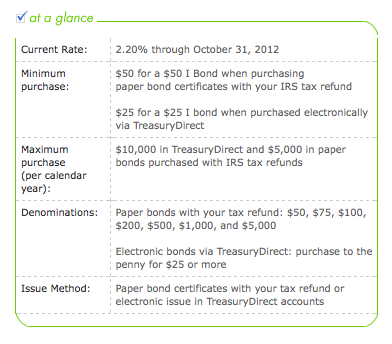
I Bond May 2012 detailsTreasuryDirect.gov just posted the new I Bond rate – 2.20% – that will hold for purchases through Oct. 31, 2012. That is down from the rate of 3.06% that held from November 2011 through April 2012.

I Bonds pay an interest rate that combines two factors: 1) the base rate, which has been set at zero since November 2010, and 2) a rate set to match the rate of inflation. Each semiannual inflation rate applies to all outstanding I Bonds for six months.

Obviously, I Bonds have lost a bit of their appeal. The time to buy your 2012 allotment ($10,00 limit per person, or $20,000 for a couple) was before the May 1 rate change.

I Bonds are unusual in that they pay the existing rate for six months, no matter when you buy them. So a purchase April 30 would pay 3.06% for six months (and then 2.2% for the next six months). A purchase May 1 would pay 2.2% for six months, then a rate to be determined on Nov. 1 for the next six months.

Posted in Investing in TIPS | Leave a comment

An incredible, contrarian run in 2012 for TIPS

If you read investment commentary (it’s hard to avoid, isn’t it?) you surely have seen the rash of stories in 2012 predicting a long-term bear market for traditional Treasuries and their mutant offshoot, Treasury Inflation-Protected Securities. Examples:

I’m not criticizing this train of thought, in fact, I pretty much agree with it. Since the middle of 2011, with massive Federal Reserve intervention in the Treasury market and a boiling economic crisis in Europe, interest rates on traditional Treasuries and TIPS have fallen to all-time lows. Those rates can’t be sustained.

I have been saying that for several months. And I have been wrong.

Here’s the way TIPS have performed in 2012, represented by the widely held TIP ETF:

2012 performance of TIP ETF

The TIP ETF closed Friday at 119.54, just pennies off the all-time high of 119.77. Yields to maturity for TIPS are now negative (before the inflation adjustment) all the way up to 2025 Jan 15, nearly 13 years into the future. And this is happening at a time when:

  1. Inflation is slowing, dropping to 2.7% for the 12 months ending in March.
  2. The Federal Reserve is winding down ‘Operation Twist’ to force down long-term rates and is not committing to a new round of easing.
  3. The stock market has soared, slumped and then recovered, leaving the S&P 500 with a year-to-date return of 11.86%.
  4. The European crisis has stabilized – at least temporarily.

TIPS, so far, have a bit of a ‘safe-haven’ status in the Treasury world. The inflation protection gives them appeal to investors even when their base rates fall into the negative. Look at how the TIP ETF has performed this year versus TLT, the long-term Treasury ETF:

TIP vs. TLT

While the long-term Treasury ETF has rallied, its year-to-date performance is running well behind the TIP ETF, which is up about 2% for the year.

So far, TIPS are the Energizer Bunny of bond investments, they keep going and going. It’s reasonable to expect this long-term, massive move upward will eventually break. But it isn’t happening yet.

What to expect from here? In a New York Times analysis, Jack Duff speculated that the strong run in TIPS could prove to be a loser for future investors:

“TIPS have gone through a period where just about everything has gone right for them,” said Robert Johnson, director of economic analysis at Morningstar. “Now the situation has changed, and they are looking quite expensive.”

But that analysis was written in July 2011, the dawn of a huge surge in TIPS. At the time of the article, the TIP ETF closed at 109.30 and today stands at 119.54, a 9.3% gain since the New York Times article appeared.

Here are some more-recent thoughts from Jeffrey Kosnett’s Kiplinger article I cited above:

Bond markets do not turn around instantly and aren’t vulnerable to a flash crash, as the stock market has shown it is. Pessimists often spin the widespread ownership of Treasuries by people and institutions around the world as a reflection of our dependency on foreign money. But I see the global affection for Treasuries differently: I think it shows that every nation on earth has confidence in the U.S. as a place to keep reserves. But those investors, no matter where they are located, will gradually demand to be paid better by Uncle Sam.

So if you’re a Treasury investor and feel on the spot, you don’t have to rush to decide what to do next.

Posted in Investing in TIPS | 6 Comments

5-year TIPS auctions at all-time low -1.080%

The Treasury just completed its auction of a new 5-year Treasury Inflation-Protected security, which resulted in a yield to maturity of -1.080%.

CUSIP 912828SQ4 has a coupon rate of 0.125%, meaning that today’s buyers had to pay up for this issue – $106.38 per $100 of value.

This is the lowest rate ever for a new or reissue of a 5-year TIPS. The previous low was -0.877% for an auction on Dec. 15, 2011.

Reaction to the auction, from Bloomberg:

“There is still significant demand for inflation protection given the accommodative Fed,” said Michael Pond, co- head of interest-rate strategy in New York at Barclays Plc, one of Fed’s 21 primary dealers that are required to bid at U.S. auctions. “For the largest-ever notional tips auction at the lowest-ever real yield, the Treasury has to be very pleased with these results.”

Bloomberg points out that the auction set a 5-year breakeven point of 1.93%, versus a 5-year Treasury trading today at 0.85%. That is …

down from a year-to-date high of 2.22 on March 14. The average during the past decade is 1.94 percentage points.

I think the breakeven rate on a 5-year is pretty distorted, since you can get a 5-year insured bank CD today at about 1.75%, pushing the breakeven point to 2.83%, higher than the current 12-month rate of inflation of 2.7%, even with gas prices soaring.

Nevertheless, I think the Treasury has to be very happy about this record-low yield, and buyers should just shrug and accept a super-safe investment that is protected against an unexpected surge in inflation.

Posted in Investing in TIPS | 7 Comments

Forget the 5-year TIPS, buy I Bonds … today

The Treasury is offering a 5-year TIPS Thursday that will have zero appeal for small investors. CUSIP 912828SQ4 will auction with a coupon rate of 0.125%, but buyers will have to pay up – way up – to get the likely yield to maturity of around -1.10%. That means buyers will accept 1.10% less than the rate of inflation for 5 years.

Absolutely no appeal.

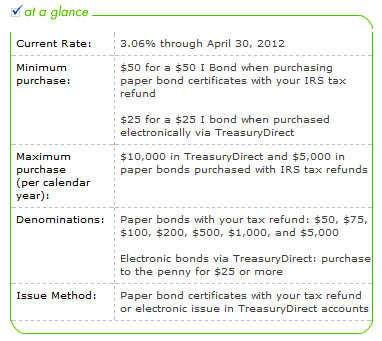
At the same time, this week offers a very attractive buying opportunity, but you need to act fast. Through April 30, you can go to TreasuryDirect.gov to buy I Savings Bonds, up to an annual limit of $10,000  (or $20,000 for a couple), and get an annual rate of 3.06% for six months, and then 2.20% for the next six months.

That is a combined annual interest rate of 2.63%. This assumes you won’t sell the I Bond after a year, but even if you did, and paid a three-month interest penalty, you’d get an annual return of 2.08%.

i bondThe reason you need to act fast? The inflation-adjusted interest rates on I Bonds will readjust on May 1, so all I Bonds purchased after May 1 will earn 2.20% for six months. If you act before May 1, you can lock in the higher rate of 3.06% for six months, then the 2.20% rate for the next six months.

Buy I Bonds up to the limit before May 1. Let me be clear: Do NOT procrastinate.

There is no better super-safe investment out there. An I Bond compares directly with a 5-year TIPS, because you can sell the I Bond after five years with no penalty.

Would you rather earn the rate of inflation for five years (I Bond), or the rate of inflation minus 1.1% for five years (TIPS)?

Plus, I Bonds have tax advantages over TIPS, since interest isn’t reported until you sell them. With TIPS, you pay interest now, even though you don’t get all the money until maturity.

No brainer.

One more thing … I Bonds have a dual interest rate, the base rate (currently zero) and the inflation-adjusted rate (currently 3.06%). We know the inflation-adjusted rate will drop to 2.20% on May 1, but what about the base rate? Is there any possibility it could tick up? No, it will not tick up. It will be zero.

Posted in I Bond, Investing in TIPS, Savings Bond | 14 Comments