Treasury formally announces 5-year TIPS auction on April 19

The U.S. Treasury today posted its formal announcement of the five-year TIPS to be auctioned Thursday, April 19. It is CUSIP 912828SQ4, a new issue. It will most likely auction with a coupon yield of 0.125%.

We already know this is a highly undesirable auction, except for big institutional money funds, pension funds and foreign central banks. For the little guy, this one is not attractive.

Why?

TIPS are near their all-time high values (meaning all-time low yields), and that is magnified in short-term TIPS issues. As of the close today, a TIPS maturing 2017 Jul 15 (very close to 5 years) is paying a yield to maturity of -1.193%. Yes, that is negative. But since TIPS have their principal adjusted to match inflation until maturity, that means this issue will pay 1.193% less than the rate of inflation for five years.

You can go to TreasuryDirect.gov right now, today, and buy an US Savings I Bond paying the rate of inflation (minus nothing!) for 30 years, but sellable after five years without penalty. That I Bond also has preferential tax treatment over TIPS. The problem is you can buy only $10,000 per person, per year, of I Bonds. So that is $20,000 for a couple.

Until you hit the limit, there is no contest … buy I Bonds up to the limit.

Who would buy this TIPS? I have said this many times in the last year: ‘The good thing about a five-year TIPS is that it matures in five years.’ The pain is rather short term. Big money funds, pension funds and foreign nations can afford to lose out to inflation for five years, because every super-safe investment (except I Bonds, which make no sense for big investors) is also paying way less than inflation.

5-year breakeven point? It’s worth comparing this five-year TIPS with a 5-year traditional Treasury. A five-year traditional today is paying 0.85%. I ask you, who would buy that? The same buyers that would consider this five-year TIPS.

For the TIPS to pay off over the Treasury – the ‘breakeven point’ –  inflation would have to run 2.043% over the next five years. That seems like a reasonable bet, and that is why there will be demand for this five-year TIPS from big-money interests who can’t buy I Bonds or bank CDs.

But small investors? No interest.

Posted in I Bond, Investing in TIPS, Savings Bond | 1 Comment

Food, gas costs push up U.S. inflation

The U.S. Labor Department reported today that the Consumer Price Index rose 0.3% in March, mostly because of higher food and gas prices. In 12 months that ended in February, prices rose 2.7 percent. That’s below last year’s peak year-over-year rate of 3.9 percent.

From the Associated Press report:

Core prices have risen 2.3 percent in the 12 months that ended in February, close to the Federal Reserve’s inflation target of 2 percent. … Fed chairman Ben Bernanke has acknowledged that rising gas prices have boosted inflation. But he has maintained that the increases are likely temporary.

From Bloomberg:

“Inflation is going to be slowly decelerating as the energy price impulse that we’ve seen starts to fade,” said Michael Carey, the chief economist for North America at Credit Agricole CIB in New York, who correctly forecast the rise in prices. “The Fed is in wait and see mode. Inflation is not driving policy. They are more concerned about economic growth and the labor market.”

Holders of TIPS get the benefit of a 0.3% increase in principal for all issues. But it does appear that inflation is slowing from the plus-3% annual rate of recent months.


Posted in Investing in TIPS | 4 Comments

Let’s be negative: Making the case for a 5-year TIPS

The Treasury on April 19 will auction a new issue 5-year Treasury Inflation-Protected Security, and it is likely to have a deeply negative base interest rate. I am going to try my best to explain why anyone would buy this issue — skeptics are going to tell you it is a disastrous investment. Negative rates!

Yes, the base rate is negative, but the principal on TIPS continues to grow at the rate of inflation until maturity, at least partly balancing off that negative base rate. So if inflation runs high enough, a 5-year TIPS works out well for the buyer. Otherwise, it can be a loser. But how much of a loser?

Right now, a 5-year TIPS maturing July 15, 2017, is selling on the secondary market with a yield to maturity of -1.148%. The new issue should come in around that rate. (But I suspect the rate will be more favorable, possibly around -1.0%; that has been the trend at recent auctions).

But let’s assume the auction goes off at -1.148%. That looks like a very bad rate, I admit. How does it stack up against similar super-safe investments?

I Bond, zero base rate, plus rate of inflation
5-year TIPS -1.148%, plus rate of inflation
5-year Treasury 1.03% fixed rate
5-year insured CD 1.75% fixed rate

Let’s look at the returns these investments would generate under varying rates of inflation:

Assumption No. 1: Inflation averages 1% over the next five years

  • 5-year insured CD 1.75%
  • 5-year Treasury 1.03%
  • I Bond, 1%
  • 5-year TIPS, -0.148%

The TIPS is the big loser, the bank CD is the winner.

Assumption No. 2: Inflation averages 2% over the next five years

  • I Bond, 2%
  • 5-year insured CD 1.75%
  • 5-year Treasury 1.03%
  • 5-year TIPS, 0.852%

The I Bond edges out the bank CD, the TIPS is the least favorable investment.

Assumption No. 3: Inflation averages 3% over the next five years

  • I Bond, 3%
  • 5-year TIPS, 1.852%
  • 5-year insured CD 1.75%
  • 5-year Treasury 1.03%

The I Bond again leads the way, but now the TIPS has surpassed the bank CD.

Assumption No. 4: Inflation averages 4% over the next five years

  • I Bond, 4%
  • 5-year TIPS, 2.852%
  • 5-year insured CD 1.75%
  • 5-year Treasury 1.03%

Assumption No. 5: Inflation averages 5% over the next five years

  • I Bond, 5%
  • 5-year TIPS, 3.852%
  • 5-year insured CD 1.75%
  • 5-year Treasury 1.03%

The lesson of this exercise: Buy I Bonds, up to the limit ($10,000 per individual and $20,000 for a couple.)

But after you reach that limit, you should weigh a bank CD against a 5-year TIPS. If you can get a rate of 1.75% on a bank CD, you push the TIPS breakeven rate all the way up to 2.898%. The bank CD is a winner unless inflation averages more than 2.9% a year for five years. And with a bank CD, you might be able to get an attractive early withdrawal penalty, making it a more flexible investment.

If you really, really fear inflation in the next five years, this TIPS makes sense for you. If you think inflation will remain under 3%, then a bank CD might be the better option.

Otherwise, it looks like demand for this 5-year TIPS new issue will come from the high-roller investment firms and foreign banks. It isn’t very appealing for the small investor.

Posted in Investing in TIPS | 2 Comments

Stocks versus TIPS: What’s next for the ‘prudent investor’?

Are Treasury Inflation-Protected Securities now an unsafe or unwise investment? Is the Treasury market at the start of a long bear market? Will stocks greatly outperform bonds over the next 10 years?

Burton Malkiel

Burton Malkiel

Burton Malkiel, author of ‘A Random Walk Down Wall Street,’ wrote an intriguing piece for the Wall Street Journal on March 22, titled ‘What Does the Prudent Investor Do Now?

Malkiel makes the case that as the economy continues to improve, investments in bonds – especially Treasuries – are going to make investors weep. One of his key points:

Bonds are the worst asset class for investors. Usually thought of as the safest of investments, they are anything but safe today. At a yield of 2.25%, the 10-year U.S. Treasury note is a sure loser.

While Malkiel doesn’t specifically mention TIPS, he does point out that super-low rates on today’s Treasuries mean that investors will get negative real returns (less than the inflation rate). In the case of TIPS, most buyers today are guaranteeing themselves rates  less than inflation, since the base rate is currently negative all the way up to 10-year issues.

As an alternative, Malkiel suggests investments in low-cost stock mutual funds (he feels that stocks are still a bit undervalued) and real estate (which could be nearing the end of a massive bear market).

Back to being ‘prudent’ … Malkiel makes a sensible, conservative investing argument: Stocks will outperform Treasuries in the next 10 years. Yes, that could very likely happen, as Treasuries are probably ending an amazing 30-year run of lower rates.

But the argument should never be stocks vs. bonds. The argument should be risk investments vs. super-safe investments. I have never argued that anyone hold 100% of their portfolio in TIPS or Treasuries. That would not make sense.

Every investor should decide, how much risk do I want to take? … and allocate assets to match that risk. An investor interested in capital preservation – nearing retirement with a sizable nest egg – could come up with something like:

  • 10% Highest risk: International, small cap stocks
  • 40% Higher risk: Large-cap dividend paying stocks
  • 25% Lower risk: Broadly diversified bond funds, municipal bonds
  • 25% No risk: TIPS, I Bonds, insured bank CDs, Treasuries held to maturity

My contention is that you can change the asset allocations, but you can’t change what’s in them. No matter how safe you think stocks are, you can’t put them into your ‘No Risk’ category. There are only a few ‘No Risk’ investments (money market funds, by the way, don’t qualify).

With the No Risk category, the investor is looking to preserve capital, no matter what happens. Stocks and bond mutual funds (including TIPS funds) can’t fill that role. In recent years, buying and holding TIPS to maturity has been an excellent way to fill this need. Today’s low rates make TIPS less attractive. I Bonds remain the best choice for this category, up to your purchase limit.

The Treasury ‘bear’ market. There are lots of news articles out this weekend pointing out that the Treasury market has taken a hit in 2012, for example: ‘Bonds limp to end worst quarter since 2010.’ And of course, stocks have done very well in the last three months.

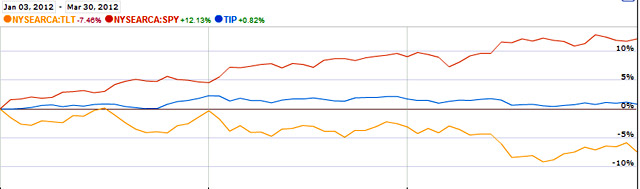
So I want to close today with this chart, which compares the performance of the SPY ETF (S&P 500), the TIP ETF (overall TIPS market) and the TLT ETF (long-term Treasuries):

3 month chartAmazingly, the TIP ETF split the difference between the stock market gains and the long-term Treasury losses, and was actually up slightly in the first quarter. That is not a bear market.

TIPS are a different animal, because of the inflation adjustment to principal. It appears that investors are fleeing longer-term Treasuries, but not TIPS.

And that also means that TIPS remain ‘unattractive’ for near-term buy-and-hold purchases.

Posted in Investing in TIPS | 2 Comments

10-year TIPS reissue auctions at -0.089%, an all-time low

The Treasury just posted the results for CUSIP 912828SA9, a 9-year, 10-month reissue.

The previous low for any 10-year TIPS issue or reissue was this same CUSIP 912828SA9, first issued on Jan. 19. It went off two months ago at -0.046%, the first 10-year TIPS in history to auction at a negative yield.

Since this TIPS carries a coupon rate of 0.125%, buyers at today’s auction had to ‘pay up’ for the purchase, about $102.22 for every $100 of value, and that’s up from the $101.66 buyers paid two months ago.

About that negative yield …  it’s not really negative. The principal balance of a TIPS issue continues to grow with inflation until maturity. In effect, buyers of today’s new issue were accepting the rate of inflation minus 0.089% for 10 years. If inflation averaged 2.5% over the next 10 years, TIPS buyers would be getting 2.411% on their investment. The 10-year traditional Treasury was paying 2.29% today. Pick your poison.

Reaction to the auction, from Bloomberg:

“We are continuing to see inflation expectations gather steam,” said Aaron Kohli, an interest-rate strategist at BNP Paribas SA in New York, one of 21 primary dealers that are required to bid at the sale. “With energy prices running hot the market has priced in inflation over the next 10 years.”

As I have said in previous posts, you should ignore the talk that TIPS are moving into a bear market, along with traditional Treasuries. TIPS are showing surprising strength, too much strength in my opinion. But that is what the fear of inflation does to TIPS investments.

(Bear market = buyers market. We aren’t in one.)

If … if … if … rates on traditional Treasuries continue to climb (no sign of that this week), TIPS yields will be dragged higher. As the 10-year Treasury climbs, the 10-year TIPS rate cannot continue below zero. That won’t happen, because buyers … at the least … will move to traditional Treasuries.

So right now, we are in this limbo, with TIPS setting an all-time low today. There it is.

Posted in Investing in TIPS | 3 Comments