New 30-year TIPS will auction Feb. 16, 2012

The Treasury announced last week that it will auction a new 30-year Treasury Inflation-Protected Security on Thursday, Feb. 16. This will be CUSIP 912810QV3.

As always, you can buy this new issue directly from the Treasury by using TreasuryDirect, but if you are buying it for a tax-deferred account you’ll need to talk to your broker.

What to expect. A 30-year TIPS maturing in February 2041 is trading on the secondary market with a yield to maturity of 0.682%, so that gives a rough idea of the likely yield on this new issue. But new issues can be unpredictable. I’m guessing the rate will be a bit higher.

There have been only five new 30-year TIPS issues in history, because the Treasury stopped issuing them from 2001 to 2010. Here are all the new issues and their reissues:
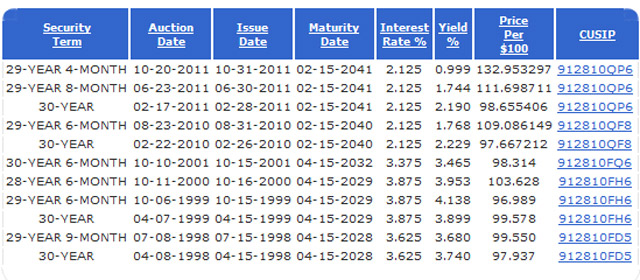
As you can see, one year ago CUSIP 912810QPC auctioned with a yield to maturity of 2.19% (in addition to the inflation adjustment to principal over the 30-year life of the bond.) For buyers, that ended up being a very strong purchase. The market value of that TIPS has risen about 30% in a year as its yield has fallen to around 0.68%.

This happened in one year. Amazing. It demonstrates 1) the massive lack of confidence in the world’s economic recovery, and 2) the Federal Reserve’s aggressive program to buy long-term Treasuries and keep those rates very low.

If you are a trader and you want to buy this week’s issue, you should wonder: How likely am I to see a 30% increase in the value of a long-term Treasury, ever again? Not likely. It would mean TIPS buyers would be willing to take negative real returns over 30 years.

If you are buy-and-holder, and are building a TIPS ladder of varying maturities, this issue could be attractive, especially if the yield ends up being closer to 1%. At least for awhile, you won’t see positive real returns for any TIPS with 10-year maturities, or shorter.

If you are very, very worried about future inflation, then this TIPS also makes sense as a buy-and-hold investment, because you would be protected against that inflation. You can’t get that protection with a bank CD paying 1.2%.

If you decide to wait it out … This TIPS will be reissued on June 21, 2012, so you will get another shot if you suspect long-term rates could begin rising.


Posted in Investing in TIPS | 1 Comment

Charles Schwab to the Fed: Let go of our interest rates!

Charles SchwabCharles Schwab, founder of one of the nation’s great brokerage firms, laid out his case today in the Wall Street Journal that the Federal Reserve, by holding interest rates near zero and committing to this policy for years to come, is damaging the U.S. economy and harming the nation’s savers by forcing them into riskier investments.

Thank you, thank you, thank you, Charles Schwab!

I have been seeing more and more of this sort of commentary. On the one hand, employment is gradually improving and GDP growth is holding around 2%. The stock market is rising nicely. And yet the Fed is determined to hold interest rates down, well below the rate of inflation, which Schwab rightly calls “central government manipulation of the free-market system.”

Schwab makes some excellent points:

Savers are being crushed.

“Average American savers and investors in or near retirement are being forced by the Fed’s zero-rate policy to take greater investment risks. To get even modest interest or earnings on their savings, they move out of safer assets such as money markets, short-term bonds or CDs and into riskier assets such as stocks. Either that or they tie up their assets in longer-term bonds that will backfire on them if inflation returns. They’re also dramatically scaling back their consumer spending and living more modestly, thus taking money out of the economy that would otherwise support growth. “

Fed policy sends the world into alarm.

“… the Fed’s actions, rather than helping, are having the perverse effect of destroying the confidence of businesses and individuals to invest and the willingness of banks to loan to anyone but those whose credit is so strong they don’t need loans. … To any potential borrower, the Fed’s policy is saying, in effect, the economy is still in critical condition, if not on its deathbed. You can’t keep a patient on life support and expect people to believe he’s gotten better.”

The Fed has no confidence in free markets.

“… the economy doesn’t need life support. Just the opposite. The patient needs to get up and start moving. We could get out of this mess, if only the Fed believed in the free-market system.”

What this means for TIPS. There is a new issue of a 30-year TIPS coming up this month, on Thursday, Feb. 16. That TIPS will likely auction with a base interest rate around 0.6%. While that would be a nice rate on a 5-year TIPS, it is ridiculously low for a 30-year TIPS. This is the result of the Fed’s assault on U.S. interest rates, and savers around the world.

I will just point out that one year ago, the Treasury auctioned a new 30-year TIPS, and it went off with a yield to maturity of 2.125%. And this was at a time of Federal Reserve easing! This same TIPS reissued in June at 1.744%. And now … 0.6%?

Really?

Thank you, Charles Schwab, for laying out the case that Treasury investors need to hear: The Federal Reserve is stealing from you.

Posted in Investing in TIPS | 4 Comments

What’s ahead for TIPS in 2012?

Treasury Inflation-Protected Securities had a quite a year in 2011, with the base interest rate dropping dramatically, especially in the second half of the year. This chart shows the deep drop in yields to maturity since Jan. 3, 2011:

One-year TIPS decline in yieldsIn turn, this deep decline in yield made everyone holding TIPS and TIPS mutual funds ‘richer,’ because the value of those investments also rose dramatically. Here is a chart for the performance of the TIP ETF since Jan. 3, 2001 to Wednesday :

Year-long rise in TIP ETFThe year’s low was hit on Feb. 10, 2011, at $104.91 and the high was yesterday (Jan. 31) with a closing of 119.36. That’s a capital gain of 13.7% from low to high, in just less than a year.

TIPS for trading? I remember reading a TIPS investment analysis, maybe 18 months ago, where the analyst said: ‘The only reason to buy TIPS is for a capital gain. You trade them.’ I was floored by that statement (since I buy TIPS as hold-to-maturity investments) and I thought the analyst was a fool. But … that analyst was clearly brilliant and I was, as always, clueless.

That was the past. Yes, it is possible that TIPS could return another capital gain of 13.7% in the next 12 months. But that is getting fairly unlikely.

I like reading the semiannual/annual reports of the Fidelity Inflation-Protected Bond Fund, because its manager, William Irving, seems determined to give a fair appraisal of the fund’s investment potential. Here is what he said in the latest report:

Q. Bill, what’s ahead for the TIPS market?

A. I believe inflation will remain quite low, given the current weakness of the U.S. economy. Against the backdrop of low inflation, coupled with the Federal Reserve’s pledge to keep interest rates low … I believe it will be extremely difficult for TIPS to perform as well on an absolute basis over the near term as they have in the last six months because their yields are already so low. Furthermore, TIPS could come under pressure if economic growth accelerates faster than investors expect or if interest rates drift significantly higher …

I think that is a fair assessment. There are two risks for investors who use TIPS to pursue a capital gain: 1) interest rates are at a 30-year low and could eventually reverse, possibly even violently, and 2) a stronger economy will lessen the appeal of TIPS against other investments (for example, stocks) and that would likely also lead to higher interest rates.

I don’t think the risk is extreme – possibly a 10-15% loss in mutual funds as TIPS yields return more toward the norm.  Is that likely in the near term? No. The Federal Reserve has a two-ton lid on interest rates. I think the TIPS yields could hang at these current rates, or continue to gently decline, as they have this year.

But it does indicate – possibly – that the limited upside isn’t worth that downside risk.

And it’s important to remember that January 2011 was great buying opportunity for TIPS. In February 2012, not so much.

Posted in Investing in TIPS | Leave a comment

Federal Reserve: Let’s keep interest rates low until 2014

Because I am a saver, not a borrower, I am not a big fan of our current super-low interest rates, especially in safe investments like Treasuries, money market accounts and bank CDs. So I have been hoping to see some end to this low-rate tunnel, which in theory was going to come in mid 2012.

But no … as you can see from this Associated Press report today:

The Federal Reserve went further than ever Wednesday to assure consumers and businesses that they’ll be able to borrow cheaply well into the future.

The Fed pushed back the date for any likely increase in its benchmark interest rate by at least a year and a half, until late 2014 at the earliest.

What this means. Obviously, the Fed is very worried about the world economy, especially with warnings this week from the IMF about Europe’s dismal condition. So the Fed is promising (practically) that it will hold short-term rates near zero for 2+ more years. The stock market, in the short term, is going to like this, because when investors have no other options for inflation-beating returns, the stock market looks very attractive. And right now Treasuries – including Treasury Inflation Protected Securities up to 10 years – aren’t offering inflation-beating returns. And we saw the stock market rise today after the Fed announcement.

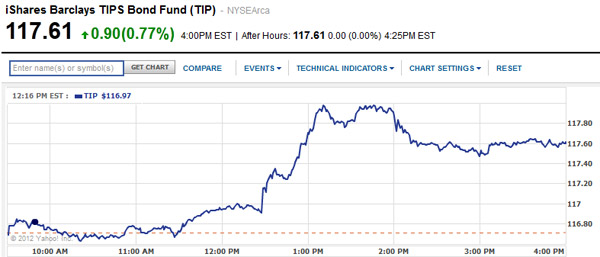
For TIPS you already own. Your past investments look rock solid. I’m still not a fan of over-bought TIPS ETFs and mutual funds, but you can see the Fed gave owners a nice present today:

One day TIP performance

For TIPS buyers in the near future: The news is not so good. We can expect these super-low rates to continue. When a TIPS is paying a real return below zero or near zero, TIPS are not an attractive long-term investment, in my opinion. We possibly face many more months of these sub-par, and unattractive, returns.

The Fed is trying to force you to look to the stock market, especially dividend-paying stocks. That might be a good option, but there is risk. And the stock market has had a very nice run.

Joe Bel Bruno of the Los Angeles Times summed this up nicely today: Savers are getting screwed. Those are my words. not his. Here is his succinct summary:

The Fed’s latest maneuvering to resuscitate the ailing economy has already sent yields on government bonds — already hovering at generational lows — even lower. The yield on the benchmark 10-year sank to a measly 1.96% on Wednesday. Meanwhile, the amount of money you’re making on money markets or savings accounts continues to be microscopic. The average one-year CD yields is just 0.67% — down from 2.4% four years ago and 3.75% in 2007.

Forget the old adage about a penny saved being a penny earned. Borrowers win and savers lose in this environment.

And inflation in the future?  I will refer you to one of my favorite bloggers, Michael Ashton (The Inflation Trader) and his post today:

Despite the obvious train wreck, investors are not fleeing into deflation insurance. Quite the contrary: since September, both spot and especially 5-year forward inflation expectations have been rising sharply. I think these investors have it right: … policymakers clearly will attempt to err on the side of higher prices rather than lower prices.

TIPS buy-and-holders – probably the most conservative investors on Earth – are left with this sad conclusion: Stomach horrible yields and hope for higher inflation.

Yech.

Posted in Investing in TIPS | 4 Comments

10-year TIPS auctions at -0.046%, a record low

The Treasury today announced that its new issue 10-year Treasury Inflation-Protected Security, CUSIP 912828SA9, auctioned at a yield to maturity of -0.046%, the lowest rate ever for a 10-year TIPS and the first-ever negative yield for a 10-year TIPS.

As expected the TIPS has a coupon rate of 0.125%, meaning that buyers of this new issue will need to ‘pay up’ — about $101.66 for each $100 to produce the effective yield of -0.046%. This TIPS matures Jan. 15, 2022.

The previous record low for a 10-year TIPS new issue was 0.639% for the security auctioned  July 21, 2011. That is the only other new issue that has ever gone below 1% yield to maturity.

(The principal balance of a TIPS issue continues to grow with inflation until maturity. In effect, buyers of today’s new issue were accepting the rate of inflation minus 0.046% for 10 years. Keep in mind that a traditional 10-year Treasury is paying 2.01% today, meaning that inflation would have to run just 2.056% over the next 10 years to make this TIPS attractive versus the traditional 10-year. It’s a reasonable conclusion.)

Reaction to the auction, reported by Bloomberg:

“You’re losing purchasing power for the privilege of lending to the U.S. government,” said Eric Van Nostrand, an interest-rate strategist in New York at primary dealer Credit Suisse Group AG. “The success of this auction suggests demand for TIPS remains strong.”

Posted in Investing in TIPS | 5 Comments