Bernanke: ‘It is arguable that the interest rates are too high’

Federal Reserve Chairman Ben Bernanke laid out his argument for super-low interest rates today in an appearance before the House Financial Services Committee. His opening statement included this (insert adjective here) statement on U.S. interest rates:

“It is arguable that interest rates are too high, that they are being constrained by the fact that interest rates can’t go below zero.”

OK, let’s play ‘insert the adjective’:

  • A. insightful
  • B. encouraging
  • C. mysterious
  • D. SHOCKING

Hint … the correct answer is in capital letters. I could add a few other expletives, such as #@$^&*$ and a few !!!, but let’s just say that this statement is SHOCKING, in capital letters.

“Interest rates are too high”

Really? Right now, you can buy a 10-year Treasury at 1.98%, about 1% below the current rate of inflation, which is 2.93%. The inflation rate could go higher, at least short term, if gasoline prices continue the steep rise we have seen so far in 2012.

You can get a 5-year bank CD at about 1.8% (best case) or about 1.45% (typical). Both of those are well below the rate of inflation, but are preferable to a 10-year Treasury, in my opinion, because the term is 5 years and you can bail with a minimal penalty.

Your money market account is paying about 0.5% (best case) and probably more like zero.

For TIPS investors … Ben Bernanke is giving you a secret pat on the back. For nearly a year, you have been suffering through negative base rates, before inflation. The investing world has been in shock (negative rates!) but in reality, a TIPS buyer today is simply recognizing that inflation is a threat and it’s extremely important to have inflation protection.

“interest rates can’t go below zero”

It worries me somewhat the Bernanke seems to be longing for interest rates to drop below zero, and that means a real return (after inflation) of about negative 3%.

What is Ben Bernanke telling us? My interpretation: The United States is Japan of 15 years ago. You can expect near-zero economic growth for the next decade, and you can expect interest rates to hover near zero, possibly even below zero. Why else would Ben Bernanke long for interest rates to drop below zero when inflation is running at about 3%. Why?

For I Bond investors … You can put on a party hat and spin the noise makers. You are the big winners. Not only can your investment not drop below zero, it cannot drop below the rate of inflation (unlike TIPS, which have negative real returns.)

But we all benefit from rising stock prices. Bernanke made the argument that rising stock prices and a growing economy benefit almost all Americans. Here is the quote:

Remember people also own equities, they own money market funds, they own money mutual funds, they have 401ks and a variety of things and those assets depend very much on how strong the economy is. In trying to strengthen the economy we are actually helping savers by making the returns higher, as we have seen in the stock market for
instance.

Sure, I appreciate that my total net worth has increased in 2012, and my wife and I still have a bit more than 50% of our assets in the stock market. But that is not the same as owning a rock-solid Treasury or bank CD investment that you can predict with 99.9% certainty will be worth $X on X date.

The stock market is risky, and we all know that, all too well. Real estate is risky, and we all know that, too. Gold is risky. Copper is risky. Fine art or vintage wine, risky.

Treasuries are not risky. But with Treasuries, the Federal Reserve has decided that you cannot receive a market return (at or above the inflation rate). The Fed is telling you: Put your money elsewhere, in risky investments.

That works … until it doesn’t. When it doesn’t, you can expect losses of 30%, 40%, 50%.

Investors deserve a market rate on their super-safe investments. Investors cannot find that today, anywhere, with the possible exception of I Bonds, which have purchase limits. Why? Why is this one part of the financial market under government manipulation?

Ask Ben Bernanke.

Posted in I Bond, Inflation | 2 Comments

Bill Gross has one word of investment advice: Defense

Bill GrossBill Gross, founder and managing director and of the PIMCO investment firm, is known for laying it all out in his opinion pieces on the PIMCO site. And his March 2012 treatise doesn’t disappoint. Although many investors seem to dislike Gross (example from Forbes: Bill Gross’s Bad Call Cost Investors $5.7 Trillion!), I am a fan.

He was wrongly negative about Treasuries last year, but I agreed with him at the time, so I was wrong too. We both were using too much common sense. Yields certainly cannot go lower? Oops, yes they can, in a world where the Federal Reserve is manipulating the market, forcing interest rates down. It’s called ‘financial repression’ and it might be the overriding force pushing up the price of stocks, gold, oil, gasoline. Gross recognizes this.

His article, titled ‘Defense,’ has many football metaphors (way too many, even mentioning Deion Sanders), but it is based on these three premises:

  • Over the past 30 years, an offensively minded Federal Reserve and their global counterparts were printing money, lowering yields and bringing forward a false sense of monetary wealth.
  • Successful investing in a deleveraging, low interest rate environment will require defensive in addition to offensive skills.
  • The PIMCO defensive strategy playbook: Recognize zero bound limits and systemic debt risk in global financial markets. Accept financial repression but avoid its impact when and where possible. Emphasize income we believe to be relatively reliable/safe; seek consistent alpha.

Gross’ argument is that Fed has been the ‘Wizard of Oz’ acting behind the curtain for 30 years, driving up the price of assets and steadily driving down interest rates. While that has created wealth, it also causes economic destruction. Here is a key line:

Low yields, instead of fostering capital gains for investors via the magic of present value discounting and lower credit spreads, begin to reduce household incomes, lower corporate profit margins and wreak havoc on historical business models connected to banking, money market funds and the pension industry. The offensively oriented investment world that we have grown so used to over the past three decades is being stonewalled by a zero bound goal line stand. Investment defense is coming of age.

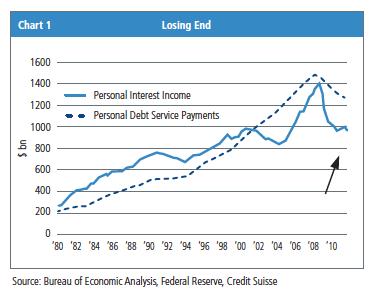
Gross presents this chart to show the destructive force of super-low interest rates on families with savings, who are now facing debt payments much higher than interest earned:

And it’s not just households who are hurt. Gross points out that near-zero interest rates are ravaging the business models of insurance companies and banks.

What do do?

Gross continues his silly football metaphors with a ‘Ready, Set, Hut 1, Hut 2’ offensive strategy that pretty much recommends a PIMCO fund. Oh, well.

His defensive strategy, the real core of this article, just says Emphasize income we believe to be relatively reliable/safe.

And what is that? He doesn’t say.

Just read the article yourself.

My interest in all this is that Gross is joining Charles Schwab in criticizing the Fed’s destructive policy of driving down interest rates, from 30 days to 30 years.

I agree that these artificially low interest rates, well below the current rate of inflation, are dangerous and destructive. Honestly, these rates make no sense. Why do investors accept them?

Answer: The Fed has guaranteed that this policy will continue well into 2014.

Posted in Investing in TIPS | 1 Comment

How risky are TIPS mutual funds and ETFs?

Treasury Inflation-Protected Securities are a super-safe and super-conservative investment, right? That’s true if you buy and hold TIPS to maturity. I think it’s OK to say there is zero risk of default. You might not beat inflation after taxes, and you might miss out on other investing opportunities, but you will always get all your money back at maturity.

But investing in TIPS mutual funds and ETFs do carry risks, because the net asset value of those funds rises and falls in reverse correlation to the interest rate paid by the underlying securities. In 2012, with the base interest rates of TIPS issues near all-time lows, TIPS values have soared to near all-time highs. If those rates reverse, TIPS values will decline and so will the net asset value of the ETFs and mutual funds.

So there is risk, especially at a time of super low interest rates.

But how much risk?

I am going to try to draw a picture with charts. First, take a look of at the one-year performance of the iShares TIP ETF:

TIP ETF, one year performanceThat is an impressive move upward – a gain of 10.5% in net asset value since last February. The all-time high for this fund is $119.38, about 34 cents above where it is trading today. This fund was up 13.4% in calendar year 2011.

That chart might lead you to think the TIP ETF is ‘volatile’ — but actually is isn’t. It has a reported ‘effective’ duration of 4.24, which is fairly low. (See the comments section below for updated information.) The performance was caused by a mighty drop in Treasury interest rates, not by volatility. For evidence, take a look at this next chart:

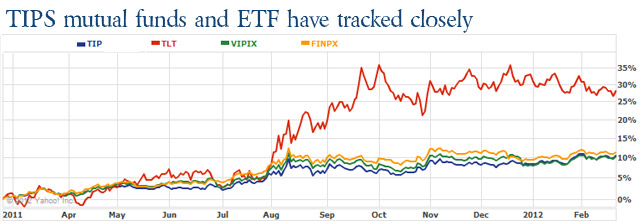
As you can see, long-term Treasuries were tracking close to TIPS until August 2011, just before the Federal Reserve began ‘Operation Twist’ to drive down long-term interest rates. The Fed action sent the value of long-term Treasuries soaring, and holders of the TLT ETF (Barclays 20+ Year Treasury Bond Fund) ended up with a 33.6% gain in 2011. This fund has a duration of 16.6. That is the definition of ‘volatile’ and TLT is therefore much riskier  than the tamer, shorter-duration TIP ETF.

Now I am going to add a couple of popular TIPS mutual funds to this chart, Vanguard Inflation-Protected Securities Fund (VIPIX, duration 8.5) and Fidelity Inflation-Protected Bond (FINPX, duration 6.7):

Interesting … despite some differences in duration, these three funds tracked very closely, all rising about 10% in the last year.

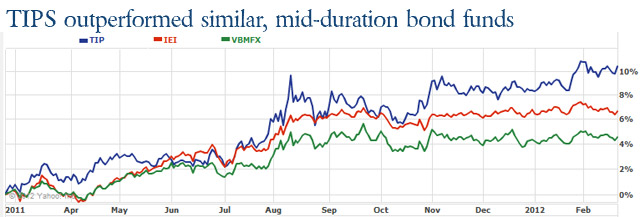
Finally, I am going to drop the volatile long-term Treasuries from the chart, along with the two TIPS mutual funds that track close to TIP, and add IEI (the intermediate-term Treasuries ETF, duration 4.45) and Vanguard’s Total Bond Market Fund (VBMFX, duration 5.0):

TIPS outperformed in 2011These three funds have similar durations, around 5, and yet the TIP ETF has greatly outperformed mid-range Treasuries and the overall bond market, which melds into a giant intermediate-term fund.

Why?

I think the ultra-low Treasury rates, across all maturities, are driving investors to TIPS because these investments are protected against a sudden rise in inflation. And with that flood of money into TIPS comes risk. They have outpaced the overall intermediate Treasury market, and the overall bond market. When interest rates begin to rise — when, who knows? — TIPS could suffer a deeper-than-expected drop as investors pour out of TIPS and into more conventional bonds, CDs and money markets.

That is the risk that buyers of TIPS ETFs and mutual funds face, even if the fund appears on paper low-risk and rather tame.

Posted in Investing in TIPS | 5 Comments

Consumer inflation in January: A modest 0.2%

Here is a summary of the Associated Press report:

Consumer prices rose modestly in January on higher costs for food, gas, rent and clothing. But economists downplayed the increase, saying inflation will likely ease in the coming months as prices for raw materials level off.

The consumer price index increased 0.2 percent last month, after a flat reading in December, the Labor Department said Friday. Excluding volatile food and energy, so-called “core” prices ticked up 0.2 percent.

Here is the full press release from the Bureau of Labor Statistics.

Inflation (CPI-U, which determines the principal adjustment for TIPS) has been slowing in recent months, running at 2.9% for the last 12 months but slowing to zero in October and December 2011 and just 0.1% in November 2011.


Posted in Investing in TIPS | 1 Comment

30-year TIPS auctions at 0.770%

The Treasury has posted the results of today’s auction of a new 30-year Treasury Inflation-Protected Security, with the auction generating a yield to maturity of 0.770%. This is CUSIP 912810QV3 and it will have a coupon rate of 0.750%, meaning that buyers are getting it at a slight discount, about $99.34 for each $100 purchased.

The yield to maturity of 0.77% is the lowest in the history of 30-year TIPS auctions and reissues. But it was an improvement over the expected rate, which in recent days looked like it could dip to about 0.65%. The previous low was 0.999% for a reissue in October 2011.

Commentary on the auction, from Cynthia Lin of  Dow Jones:

 … The government attracted only tepid interest at its 30-year inflation-protected bond sale. The $9 billion offering booked a bid-to-cover ratio of 2.46, the weakest level since sales of this maturity were reintroduced in 2010.

Bloomberg‘s Cordell Eddings tied the weak demand to the record-low yield, a huge factor for investors in a 30-year bond:

Demand declined at the Treasury’s auction of $9 billion in inflation-indexed bonds as investors balk at yields at record lows. … “It’s was a rough auction and there is no way around it,” said Michael Pond, co-head of interest-rate strategy in New York at Barclays plc, a primary dealer. “Investors just have a lower appetite for real yields as low as they are that far out the curve.”

The reaction of the TIP ETF demonstrates that the auction was a ‘downer,’ which is actually a good thing for buyers of this issue (defying expectations, they got a 10-basis point boost in yield over 30 years.)

TIP ETF on Feb. 16

Posted in Investing in TIPS | 1 Comment