Reader asks: Won’t rising inflation make TIPS more valuable?

Reader LDD posted a lot of great questions about TIPS, so I will share them and attempt to provide some answers:

I am new to TIPS. I have only owned some for no more than a few months in my accounts and accounts of relatives that I manage for them. … I am still trying to figure out where prices and yield of existing TIPS go in different circumstances. I just can’t find a place that shows long-term prices and yield for TIPS like they have it all over for stocks. If inflation goes up a lot, say 12% a year, the price of existing already issued TIPS should go up on the secondary market, correct? After all, they will be earning you interest on a 12% greater principal. There are 30-year TIPS you can buy on the secondary market that pay you interest right now that is about 2.5% of the price you’d pay for them. They’re the ones that mature in April of 2029 – they’re all I own as far as TIPS go. (By the way, the two brokerage firms I use do not even offer 10-year TIPS on the secondary market). If Buffett is right and in the next decade or so inflation does get as bad as in the late 70s, the value (and price on the secondary market) of existing TIPS should be going up, correct? It seems really straight forward. Which is why I don’t understand the comment by the Calafia Beach Pundit that “If you expect the economy to eke out at least some degree of growth and if you expect inflation to rise, then you had better be prepared to see TIPS prices fall (since real yields would rise), even as rising inflation improved the effective nominal yield on TIPS.” I must really be missing something, because I don’t see how rising inflation can cause a decrease of the price on my existing TIPS.

Thought one: If inflation rises to 12% in coming years — and stays there — you are going to be extremely happy that you bought those April 2029 TIPS. That is the exact reason for buying TIPS — to protect the super-safe portion of your portfolio against higher-than-expected inflation. (Not that we would be happy about 12% inflation, of course.)

Thought two: You say that you buy TIPS through a broker on the secondary market. That’s fine, and it’s the only way to buy them in a tax-deferred account. But I do suggest opening an account at TreasuryDirect.gov and begin building a ladder of TIPS there, especially if you plan to buy and hold. In 2011, there has been a TIPS auction every month of the year, some new issues and some reissues, 5-, 10- and 30-years. There are no fees for Treasury Direct. You can also buy and hold iBonds there.

Thought three: The market value of a TIPS is established by its yield to maturity. A TIPS pays a coupon rate of interest, plus the inflation adjustment. But when it goes on auction, or when you buy it on the secondary market, you pay more (or less) than the principal value. That establishes the yield to maturity.

For example, the 30-year TIPS that reissued Oct. 20 carried a coupon rate of 2.125% but auctioned at a yield to maturity of 0.999%, meaning that buyers had to pay $132.95 for $100 of this TIPS. A few months earlier, in June this same TIPS auctioned at a  yield of 1.744 and a cost of $111.69 per $100.

So the yield of this 30-year TIPS has plummeted, and the value has soared. Will that continue? It could continue, but not forever.

Thought four: What drives the TIPS yield to maturity to rise or fall? I am not confident I know, but I can say that most experts say it is: 1) the expectation of higher inflation (which makes TIPS more appealing than nominal Treasuries or bank CDs, and 2) the overall state of the economy, with the TIPS yield rising along with the national GDP.

The U.S. inflation rate for the 12 months ending in September was 3.87%, meaning that TIPS investors (and iBond buyers) did pretty well, at least compared to investors in CDs or nominal Treasuries.

The question is: Will this continue? And is that justification for these super-low yields, by far the lowest in the dozen-year history of TIPS?

The economy is going to be the key. Back in 2009, the one-year U.S. inflation rate ran negative for eight months in a row. During this time, 10-year TIPS were yielding above 2.0%, compared with about 0.195% today.

If the fear of inflation declines, the TIPS yield should increase, and the value of existing TIPS will decline. On the other hand, if inflation stays steady in the 2 to 3% range, and there is no fear of higher inflation, TIPS yields could also rise since the fear of inflation is muted.

On the economy, Scott Grannis makes the point that TIPS yields are forecasting a super-weak economy with moderate inflation (not deflation like we had in 2009.) I think that is accurate. So one factor (the economy) is holding TIPS yields down but the other factor (moderate inflation) could cause them to rise.

That is the near term. How about the longer term?

In the life of a 30-year TIPS that you buy today – and pay a premium price to get a record low yield – the economy is going to turn around. When that happens, the 30-year yield will increase to a more normal level (above 2%) and the market value of the TIPS will decline.

Inflation itself doesn’t determine the value of a TIPS — all TIPS give you the inflation adjustment. The one factor that varies is the yield to maturity — the rate that determines the price of the TIPS on the day you buy it.

When that yield rises, the TIPS value goes down. When it falls, as has been the trend for years, the value of the TIPS rises.

If you are a buy-and-hold buyer of TIPS, I still say, ‘Don’t focus on the market price.’ Build a ladder of TIPS, hold them to maturity, and then reinvest. (Many sophisticated investors disagree with me on this. Sometimes, life’s simpler when you are unsophisticated.)

If you are a buy-and-sell investor, then you need to know the risks. The price in the future may be lower. Same goes for investors in TIPS mutual funds, which have sold off a little recently but are still at historically high prices.
Posted in Investing in TIPS | Leave a comment

Reissue of 30-year TIPS auctions at record-low 0.999%

The U.S Treasury has announced the results of its reissue of a 30-year  Treasury Inflation-Protected Security, CUSIP 912810QP6, which drew a yield-to-maturity of 0.999%. In addition, the principal of this TIPS increases with the rate of inflation until maturity.

That was a bit lower than the 1.038% experts were expecting.

The previous record low of 1.744% was set in the last reissue of CUSIP 912810QP6 in June.

Dow Jones called the auction demand ‘impressive’:

The $7 billion offering attracted the strongest demand in the history of 30-year Treasurys Inflation Protected Securities, drawing a bid-to-cover ratio of 3.06, compared to a lifetime average of 2.40. The government was able to sell this debt handing out a yield of just 0.999%–the lowest ever.

Posted in Investing in TIPS | Leave a comment

A rational look at TIPS: Are they overpriced? A poor investment?

Scott Grannis, a SeekingAlpha.com blogger who calls himself Calafia Beach Pundit, has written a crystal-clear, totally rational look at Treasury Inflation-Protected Securities titled ‘TIPS Update: Betting On A Stuck Economy.’

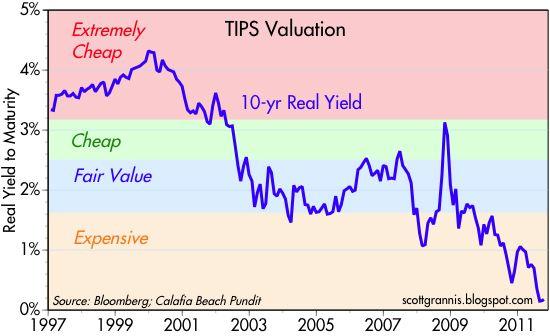
Grannis, an economist, came up with this wonderful chart showing the entire history of the real yield on a 10-year TIPS, along with his judgements of value:

I love this chart because it exactly matches my sentiment. I have been buying TIPS since the late 1990s and while I suspected then that those near- or plus-4% rates were a good investment, who knew then they were so FABULOUS? They were.

If you examine the chart, you can see there was a great buying opportunity to grab TIPS in late 2008 (an excellent time to buy TIPS mutual funds) and even in early 2011 prices approached Grannis’s ‘fair value.’ Right now, though, TIPS are solidly in the ‘expensive’ range and seemingly not very attractive.

But is this rational? Grannis points out that TIPS are tracking expected economic growth and therefore are signalling a miserable economy for the foreseeable future, but with continued moderate inflation. He writes:

10-year TIPS are trading at a real yield of almost zero because the market fears that the outlook for economic growth is absolutely dismal. But buyers of TIPS and Treasuries today have almost no doubt that inflation will be about 2% per year for the foreseeable future. Put another way, if you worry about deflation, then you will shun TIPS and prefer Treasuries instead.

And then the conclusion, which points out the danger of TIPS at these current rates if the economy begins to turn around:

… If you expect the economy to have even the slightest chance of growing in the years to come, then you will find both TIPS and Treasuries to be very unattractive. If you expect the economy to eke out at least some degree of growth and if you expect inflation to rise, then you had better be prepared to see TIPS prices fall.

A very nice analysis that I happen to agree with. Check it out.

Posted in Investing in TIPS | Leave a comment

Next up: Reissue of a 30-year TIPS on Oct. 20, 2011

The U.S. Treasury will auction a reissue of a 30-year Treasury Inflation-Protected Security, CUSIP 912810QP6, on Oct. 20. Although the announcement was to come next week, it is already posted in the official list of upcoming auctions.

Reissues are always interesting, because this 30-year TIPS already trades on the open market, and you can get an idea – but only an idea – of the likely yield to maturity of this auction. Here is the current status (as of Friday) of this TIPS, which matures 2041 Feb 15:

30-year TIPSSo at this point, it looks like buyers will be getting about 0.925% yield to maturity for the next 29 years. In addition, the principal of this TIPS continues to grow with the rate of inflation until it matures.

Is that a good rate? Well, sort of. If you look at the full maturity ladder of TIPS, you can see that the base rate to maturity is negative, all the way up to 2020 Jan 15, almost 10 years out. So buyers of any TIPS less than 10 years are willing  to accept a return less than the rate of inflation. In that context, a payout of 0.9% above the rate of inflation looks pretty good.

On the other hand … a rate of 0.9% would set a record low – in a massive way – for any 30-year TIPS ever auctioned. Here is a chart of all the previous auctions:

As you can see, the current record low of 1.744% was set in the last reissue of CUSIP 912810QP6 (I was a buyer of that one, by the way, in June.) And this issue was first auctioned on Feb. 17, 2011 (this year!) at 2.190%.

I’m not a big fan of 30-year TIPS, because I am a buy-and-hold investor and I might not be around in 30 years. But I am a fan of 1.744% above inflation, and so I was a buyer in June on the first reissue.

This time, I will probably sit it out.

Reminder on I Bonds – act before Oct. 31.

One investment still stands out for the small investor: I Bonds. If you haven’t bought I Bonds this year, you can still buy $5,000 in Treasury Direct and $5,000 in paper bonds. A couple can buy twice that. (Paper bonds will no longer be issued after Dec. 31, except as a tax refund.)

  1. I Bonds currently pay a base rate of zero percent, plus a second rate based on inflation. The current inflation-adjusted rate is 4.6% for half a year, which guarantees that an investor will earn 2.3% (probably more) for the required 1-year holding period. (That 4.6% rate will change on Oct. 31, and probably fall a bit. If you buy before Oct. 31, you will get the 4.6% for six months.)
  2. I Bonds can be sold after one year with a three-month interest penalty, and after five years with no penalty.
  3. Interest payments on I Bonds are not taxed until the bond is redeemed, which can be 30 years from when they are purchased. That is a huge advantage over TIPS.
  4. Because of that tax advantage, I Bonds traditionally offer a base interest rate about 1% lower than a 10-year TIPS. But since I Bonds cannot go below a zero interest rate, the advantage shifts powerfully to I Bonds when TIPS are paying near zero.
  5. I Bonds are a much easier investment to keep track of. There are no yearly taxes due, and you can track your investments with the Savings Bond Wizard.
Posted in I Bond, Investing in TIPS | 3 Comments

Reissue of 10-year TIPS auctions at 0.078%

The U.S. Treasury just announced the result of today’s $11 billion auction, a reissue of CUSIP 912828QV5. It auctioned with a base-rate yield to maturity of 0.078%, which is a record low for any 9- or 10-year TIPS auction. The previous record low was 0.409%, set in July 2010 just before the Fed launched QE2.

There had been some speculation today’s yield could go negative. The rate of 0.078% was up slightly from yesterday’s market rate (0.04%) for this issue, which first auctioned in July 2011.

The very low yield is an indication of very strong pessimism about the U.S. economy. From MarketWatch.com this morning:

With a yield of zero, “you only get inflation protection that’s a very dismal view of the econ over a 10-year horizon,” said Anthony Valeri, fixed-income investment strategist at LPL Financial.

Posted in Investing in TIPS | Leave a comment