Yes or no on 10-year TIPS auction on Sept. 22?

The U.S. Treasury is offering a reissue of CUSIP 912828QV5, which originally auctioned on July 21, 2011, with a yield to maturity of 0.639%. This TIPS has a coupon rate of  0.625% and will mature on July 15, 2021. The auction will close Sept. 22 at 1 p.m.

If you are looking to buy this Treasury Inflation-Protected Security, remember that the yield to maturity is set at the auction. It is likely to be well below the coupon rate of 0.625%, meaning that you will pay more than $1,000 for $1,000 of this reissue. In addition to base yield, the principal of a TIPS continues to rise with inflation until maturity.

What is the likely yield to maturity? Because this TIPS was first issued in July and trades on the open market, you can get a good idea of the likely yield. As of Monday, that yield was 0.047%. You can use this chart to check the yield daily (look for the issue with a maturity of 2021 Jul 15).

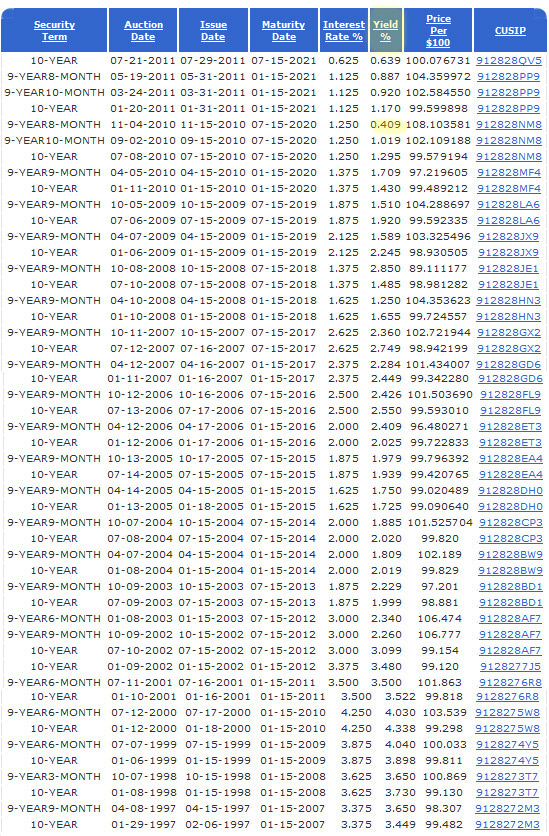
Is that an attractive yield? No. It will be a record low yield – by a wide margin – for any 9- to 10- year TIPS ever auctioned. The current record low is 0.409%, set in July 2010 just before the Fed launched QE2. (I posted a chart recently showing all 10-year auctions in history, check it out.)

Will yields keep falling? They certainly won’t keep falling. They will rise, but the question is: When? And what is the lowest they can go? Some experts say that the 10-year TIPS base yield rises along with the U.S. Gross National Product. A yield near zero seems to indicate investors are very pessimistic about the U.S. economy.

To get an idea of the decline, look at this TIPS being reissued Sept. 22. It was first issued two months ago, on July 21, and it went off at a rate of 0.639%. In two months, that rate has fallen to 0.047%, a drop of 59 basis points. In January 2011, 9 months ago, a 10-year TIPS was auctioned at 1.170%. That is 112 basis points higher than this week’s likely yield.

Incredible. But the near-term history shows that TIPS rates could turn around very quickly, rising to ‘more-normal’ rates of 1% to 2% for a 10-year TIPS. When that happens, TIPS will be much more attractive.

Nevertheless, the rate trend is currently down and has been for all of 2011.

The tax issue. Since this TIPS will pay almost zero as its base interest rate, investors will get very little cash flow from it. The principal does rise with inflation, but it is taxed as income in the year it was added. So that means this 10-year TIPS will have negative cash flow (near-zero base interest minus taxes owed) until maturity.

This wouldn’t be an issue for a TIPS held in a tax-deferred account.

Are there better alternatives? One investment stands out for the small investor: I Bonds. If you haven’t bought I Bonds this year, you can still buy $5,000 in Treasury Direct and $5,000 in paper bonds. A couple can buy twice that. (Paper bonds will no longer be issued after Dec. 31, except as a tax refund.)

  1. I Bonds currently pay a base rate of zero percent, plus a second rate based on inflation. The current inflation-adjusted rate is 4.6% for half a year, which guarantees that an investor will earn 2.3% (probably more) for the required 1-year holding period. (That 4.6% rate will change on Oct. 31, and probably fall a bit. If you buy before Oct. 31, you will get the 4.6% for six months.)
  2. I Bonds can be sold after one year with a three-month interest penalty, and after five years with no penalty.
  3. Interest payments on I Bonds are not taxed until the bond is redeemed, which can be 30 years from when they are purchased. That is a huge advantage over TIPS.
  4. Because of that tax advantage, I Bonds traditionally offer a base interest rate about 1% lower than a 10-year TIPS. But since I Bonds cannot go below a zero interest rate, the advantage shifts powerfully to I Bonds when TIPS are paying near zero.
  5. I Bonds are a much easier investment to keep track of. There are no yearly taxes due, and you can track your investments with the Savings Bond Wizard.

I Bonds versus TIPS. I have been a frequent buyer of TIPS in the last 12 months. The strategy was to move money out of a higher stock market and into the super-safe portion of my portfolio. Since July, the stock market has corrected somewhat and TIPS yields have fallen sharply.

TIPS have lost some of their appeal at these rates.

I Bonds are the clear choice for the first $10,000 to $20,000 you are seeking to place in a super-safe investment.

Posted in I Bond, Investing in TIPS, Savings Bond | Leave a comment

Auction on Sept. 22: Reissue of 10-year Treasury Inflation-Protected Security

Update: Yes or no on this 10-year TIPS reissue? Read my analysis.

The U.S. Treasury will announce tomorrow (Sept. 15) that it will auction a reissue of CUSIP 912828QV5, which originally auctioned on July 21, 2011, with a yield to maturity of 0.639%. It has a coupon rate of 0.625% and will mature on July 15, 2021. The auction will close Sept. 22 at 1 p.m.

Since this is a currently traded TIPS, we can get a decent idea of its likely yield to maturity on the auction date. Here is the rate as of Tuesday, Sept. 13:

The decline in Treasury yields since the original July auction has been remarkable, dropping from a an already-low 0.639% to the current rate of 0.030%. (The principal balance on a TIPS also rises with inflation until maturity, so a buyer of this reissue will get – in effect – the rate of inflation for the next 10 years.)

Is this a good investment? If you buy and hold TIPS to maturity, I would never call a TIPS investment a horrible decision. It won’t be like buying the NASDAQ just before the massive collapse of 2000. But it could mean – potentially – committing to a lousy return for 10 years. One thing for sure: You will get your money back, plus inflation.

It is important, though, to recognize that a yield of near-zero on a 10-year TIPS is an incredible anomaly. (That isn’t to say that rates could go lower, that is certainly the trend of 2011.) Here is a chart for every auction of 9- to 10- year TIPS in history, showing that the record low rate is 0.409% in July 2010, just before the Fed launched QE2:

Posted in Investing in TIPS | Leave a comment

Bill Gross on his bet against Treasuries: ‘Cry in your beer’

I will admit up front that I admire and respect Bill Gross, and that didn’t change with his recent, widely publicized interview with the Financial Times, although a lot of people are using this as an opportunity to dump on Gross, who co-founded Pacific Investment Management (PIMCO).

Gross admitted he was wrong in betting against U.S. Treasuries in January, when the 10-year Treasury was yielding 3.5%. Now it is yielding 2.23%, an astounding decline from an already low yield. As of Monday, PIMCO’s flagship fund, Total Return, ranked 501th out of 589 bond funds in its category, FT.com notes.

“Do I wish I had more Treasuries? Yeah, that’s pretty obvious,” Mr Gross told the Financial Times last week, adding: “I get that it was my/our mistake in thinking that the US economy can chug along at 2 per cent real growth rates. It doesn’t look like it can.”

As 2011 progressed – but before this extremely volatile August – Gross was getting more vocal that ultra-low Treasury yields couldn’t be sustained. I have to admit that I agreed with Gross all along the way. The base yield on Treasury Inflation-Protected Securities was moving to negative all the way up to 10 years. That was amazing. And troubling.

My strategy at first was to sell out of TIPS mutual funds and move into total bond funds, which still have some Treasury exposure, but not 100%. I also have a sizable 401k investment in PIMCO’s Total Return Fund, my only broad-based bond fund option in the 401k. I didn’t abandon TIPS as a buy-and-hold investment, until this latest explosion of lower yields.

Since I hold Vanguard’s Total Bond Fund in other accounts, I appreciated the fact that Total Return was giving me some diversity away from U.S. Treasuries.

I think Gross was right. Except that he was wrong.

From the Financial Times:

Gross started to buy government debt, as well as related securities and derivatives, in recent months. However, he faces a challenge to catch up to the benchmark, which has returned 4.55 per cent for the year so far, versus the Total Return Fund’s 3.29 per cent, according to Lipper, a research group.

“When you’re underperforming the index, you go home at night and cry in your beer,” he said, adding: “It’s not fun, but who said this business should be fun. We’re too well paid to hang our heads and say boo hoo.”

So there it is. Total Return is under-performing its benchmark, 3.29% to 4.55%.

That’s not exactly crushing.

The fund’s five-year average return is 8.80%, versus 6.48% for the Vanguard Total Return Fund.

Posted in Investing in TIPS | Leave a comment

Bond bubble? Jeremy Siegel takes a shot at TIPS

Jeremy Siegel, author of ‘Stocks for the Long Run’ and co-author Jeremy Schwartz took some punches at Treasury Inflation-Protected Securities today in an opinion piece in the Wall Street Journal. They contend that Treasuries – including TIPS -are in a price bubble with yields falling to historic lows.

They specifically call out TIPS for ridicule:

One market that now makes no sense to us is the popular Treasury Inflation Protected Securities (TIPS), where recent yields should be enshrined in Ripley’s “Believe It or Not!” The yield on the benchmark 10-year TIPS turned negative for the first time in history, meaning investors are now lending money to the government with the hope of receiving a sum 10 years from now that is worth less in purchasing power than the dollars they fork over today.

But it is worth pointing out that TIPS buyers – when faced with the option of 10-year Treasuries earning 2.1% – are actually showing logic in preferring TIPS, which have a principal base that grows with inflation. The yield to maturity (before inflation) for a 10-year TIPS is currently -0.002%, meaning that inflation would have to average just 2.102% over 10 years for the TIPS buyer to come out ahead over a 10-year Treasury. Not a bad bet at all.

Still, I personally would not be a buyer of 10-year TIPS at these rates, and I agree with the Jermys that there might be better yield plays out there, at this time of incredibly low Treasury rates. They suggest dividend-paying stocks, and I agree.

However, TIPS play a special role in many portfolios – the rock-solid safe ballast that is protected against inflation. Stocks play a different role in a portfolio, they are more risky and nothing is guaranteed. So it is hard for me to say sell TIPS and buy dividend-paying stocks. I wouldn’t do it.

The Jeremys say:

Some investors who avoid dividend-paying stocks point to the 2007-09 debacle, when the high-dividend financial stocks crashed. But a close look at the data indicates that was a unique event that we see having very little chance of repeating.

They are probably right. But they would have made the same statement before the 2008-09 debacle. Two extra-credit points:

  • The authors could have noted that TIPS were also slapped hard during the 2008 financial crisis, losing almost 14% of their value from early October to late November. But they rebounded fairly quickly.
  • Jeremy Siegel is a senior adviser for WisdomTree,  a company that offers stock-based ETFs, and Jeremy Schwartz is is the director of research at WisdomTree. So their interest is in promoting stocks, obviously, but I don’t doubt their sincerity.

TIPS equal safety. If you holding a portfolio of TIPS to maturity, I say ignore the noise. Continue holding them.You should not be 100% invested in TIPS or any one asset. You should have an allocation in mind, say 25% to 50% in super-safe, boring investments like TIPS.

TIPS in a bubble? I have a hard time thinking ‘bubble’ for something so boring. But if you are holding a TIPS mutual fund, you probably do have downside risk of 10%, at least. Not quite like the tech blowup in 2000, but there is some risk from the recent surge in prices.

Posted in Investing in TIPS | Leave a comment

5-year TIPS auctions at negative 0.825%

The Treasury has posted the auction results for today’s reissue of a 5-year TIPS.

This yield to maturity of -0.825% was right in line with what most experts were predicting. The 4-year, 8-month issue will mature on April 15, 2016.

Four months ago, this same issue was auctioned at -0.18%, which demonstrates the dramatic fall in Treasury interest rates in the last four months. This is a record-low yield for a 4- or 5-year TIPS auction, well below the previous record of negative 0.555% in October 2010.

A negative yield to maturity does not mean TIPS buyers are accepting negative returns. TIPS have a fixed coupon rate (this issue pays 0.125% on the principal total) and the principal continues to rise to match the overall Consumer Price Index. The yield to maturity is set at the auction, and in this case that is -0.825%, meaning that TIPS buyers today had to pay more than $1 for each $1 they bought.

Since year-over-year inflation is running about 3.5% right now, buyers will be getting an overall return of about 2.65% right now, which is far better than the current rate on a 5-year Treasury, running at 0.90%.

So there is some logic in buying negative-yield TIPS, but mainly that is because 1) the inflation rate could be temporarily high and 2) the Treasury nominal rates are extraordinarily low, which also could be temporary.

So there is logic in skipping this TIPS, too. I skipped it.

‘Decent’ demand. That is the verdict from Cynthia Lin of Dow Jones, who writes:

The Treasury Department’s sale of 5-year Treasury Inflation-Protected Securities, or TIPs, offered a negative yield, but was still met with a record amount of direct bidders.

The group scooped up 17.1% of the $12 billion sale, compared to a average of 2.26% in the history of the auction. Indirect bidders, a pool of buyers that include foreign central banks, also bought an above-average portion of 47.2%. An overall measure of demand as seen in the bid-to-cover ratio came in at 2.49–on par with the average.

Posted in Investing in TIPS | Leave a comment