Stocks are plummeting: Interesting day for a TIPS auction

Update: This 5-year TIPS reissue auctioned at negative 0.825%.

Stocks looking punk. The Dow Jones Industrial Average is down 430+ points this morning, on the day that the Treasury is auctioning a reissue of a 5-year TIPS, CUSIP 912828QD5. That reissue was already likely to generate a record low for a 4- or 5-year TIPS. This TIPS, which matures in April 2016, was going for a yield to maturity of negative 0.856% yesterday. (The record low was negative 0.555% in October 2010.)

A decline in the stock market doesn’t necessarily mean lower TIPS yields, but in recent days of volatility, a lower stock stock market has triggered lower TIPS yields as investors move to safe havens.

Mixed news on inflation. Also out today is a bump in overall consumer inflation, but a dip in core inflation:

The Labor Department says the Consumer Price Index rose 0.5 percent in July, following a drop of 0.2 percent in June. Gas prices accounted for much of the swing. They increased by a seasonally adjusted 4.7 percent after dropping sharply in June. The core index, which excludes volatile food and energy, rose 0.2 percent. That’s below the 0.3 percent rise in each of the previous two months.

Thursday’s report showed that on an annual basis, consumer prices were up by 3.6% in July, above the Fed’s target. But stripping out energy and food, inflation was only 1.8% higher over a 12-month span.

Could this TIPS go for negative 1%? One thing I know: I can’t predict a TIPS auction. But I would guess against negative 1%. Let’s see how bad things get today.

Inflation Trader blogger Michael Ashton weighed in on the auction last night:

With the Fed pinning the 5-year nominal Treasury at 0.90% at the moment, consider that even with the real yield of the 5y TIPS bond at -0.85%, all you need to be indifferent is for inflation to average about 1.75% over the next 5 years. … You would be hard-pressed to underperform 5-year nominal Treasuries over the next five years.

The auction results will come at 1 p.m.

Posted in Investing in TIPS | Leave a comment

Coming Thursday, Aug. 18: Reissue of a 5-year Treasury Inflation-Protected Security

We knew this was coming, of course, and today we got the official announcement by the U.S. Treasury. On Thursday, the Treasury will auction a reissue of CUSIP 912828QD5, which was originally issued on April 15, 2011 and matures on April 15, 2016. It has a coupon rate of 0.125% but the real yield to maturity will be set at the auction, 1 p.m. Thursday.

Since it is a reissue, it’s easy to check on the current real yield for 912828QD5 in the open market. As of Friday, it had a real yield of negative 1.096%. Yes, that is a negative real yield, and yes, it is a full percentage point below the rate of inflation for the next five years.

Should you buy it? I always point out that I am a lowly journalist (some call that the lowest life form on Earth), and not a financial adviser. But I still have my opinion.

My opinion is NO, you should not buy it.

That’s based on Friday’s rate of negative 1.096%. Things could change before Thursday, and in fact I think they will change. I suspect this 5-year will end up auctioning at better  than negative 1%, but you never know.

(Update: Tuesday’s rate had risen to negative 0.861%, a bit of an improvement.)

Here are some of my thoughts:

Relive the glory days of April 2011. We can almost get nostalgic. I was a buyer of this 5-year TIPS when it was originally issued, and I did recommend it. I said at the time:

The regular five-year Treasury is paying 2.09%, also not a great deal, with no inflation protection. In fact, I think that rate is insanely low.

The best rate out there for a 5-year CD is from Aurora Bank at 2.43%. I would buy that CD before I bought a regular five-year Treasury. But this has no inflation protection.

The 5-year TIPS ended up auctioning at negative 0.18%, slightly better than I expected. ‘Buy it and forget it’ is my philosophy for TIPS, since I hold them to maturity. So, I did well on that one.

Zoom to four months later. Now the 5-year Treasury is yielding 0.99% and the best rate you can find on an insured 5-year CD, still Aurora Bank, is 2.31%.

Hey, wait a second, 2.31%?

These numbers spell out the problem:

Security                             April              Aug                  Difference

5-year TIPS                      -0.18%         -1.00%                -0.82%

5-year Treasury               2.09%            0.99%                 -1.10%

5-year CD                          2.43%            2.31%                 -0.12%

Back in April, the 5-year TIPS had the advantage over a 5-year CD because of its inflation protection. But now, you are betting on an average inflation rate of 3.31% over the next five years, just to break even with an insured CD. That could happen, sure, but does it seem likely during a time of very slow economic growth?

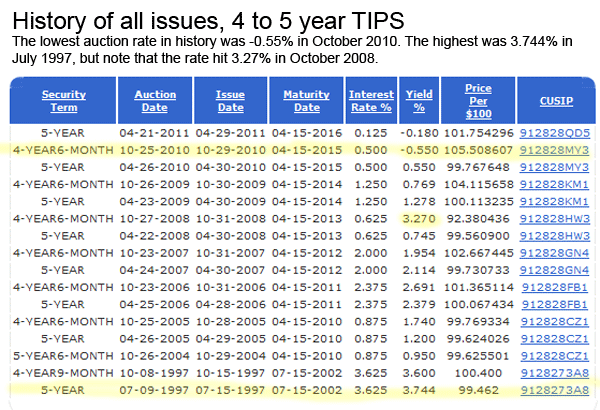
Negative 1% on a 5-year TIPS? Outrageous. I have been saving this chart for the perfect moment, so I guess its time has come:

HIstory of 5-year TIPS issuesObviously, Thursday’s auction is going to set a record low for a 4- to 5-year TIPS, the only question is by how much. It could be nearly double the record low of negative 0.550% in October 2010. This chart also shows that the TIPS yield can swing sharply, rising from 0.745% in April 2008 to 3.270% in October 2008 at ground zero of the financial crisis.

Please, don’t forget I Bonds. If you haven’t bought U.S. Savings I Bonds this year, you need to do that first, before you buy a 5-year TIPS. This is a no-brainer, easiest decision you’ll ever make. Although I Bonds and TIPS differ, they both basically pay you the rate of inflation, with a federal guarantee and no state income taxes.

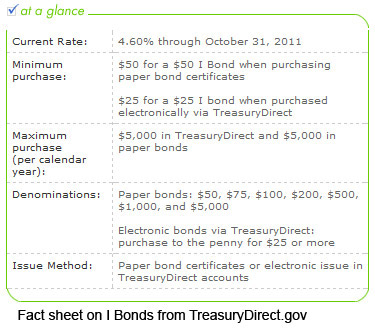
I Bonds issued right now will pay a base rate of zero percent, plus an inflation adjustment that changes every six months. (Right now, that adjusted rate is 4.6% for six months, but don’t get too caught up in that. It is the rate of inflation, minus nothing.) This 5-year TIPS will pay you the rate of inflation minus 1.0%. So this is simple. With an I Bond you get the rate of inflation. With this 5-year TIPS you will get the rate of inflation minus 1.0% (or so).

I Bonds also have huge tax advantages and can be sold after one year with a minimal penalty.

I Bonds are clearly superior.

You can buy $5,000 worth of I Bonds at TreasuryDirect.gov and $5,000 in paper I Bonds at your local bank. That is $10,000 per Social Security number. After Jan. 1, the paper option will be gone so you will have only half the buying power.

If you buy I Bonds before Oct. 31, you will get that 4.6% rate for six months, and then the rate will adjust, probably lower. So you should do this before Oct. 31.

Posted in I Bond, Inflation, Investing in TIPS | Leave a comment

Wall Street Journal: Good analysis of pluses, minuses of TIPS

Min Zeng wrote a good analysis last week on the rising asset values of Treasury Inflation-Protected Securities — at the same time inflation risk seems to be lessening. As Zeng points out, economic turmoil often leads to higher base yields on TIPS (and lower asset prices), because economic distress usually means lower inflation in the short term and also raises the specter of deflation.

Normally, when fears about the economy flare up, investors flee Treasury inflation-protected securities because their need to hedge inflation risk lessens. That was reflected in the selloff in TIPS that occurred in 2008, when the collapse of the Lehman Brothers Holdings Inc. fueled a deflation scare.

Yet prices of TIPS have surged in recent days, pushing down the 10-year benchmark TIPS yield below zero for the first time since the Department of the Treasury started selling this type of bond in 1997.

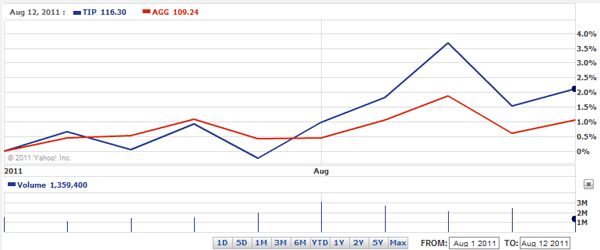
The price swings for TIPS have been rather amazing in the last 10 days, given that this is one of the world’s most ‘boring’ investments. For most investors, TIPS are the super-safe ballast in their portfolio. This chart shows that the TIP ETF (in blue) has been outperforming the AGG (aggregate bond market, red) since Aug. 1, and also shows that TIPS prices soared about 3.6% in about 8 days before coming back down a bit:

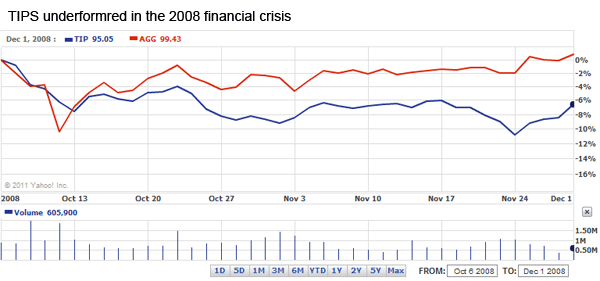
This is the opposite of what happened in the 2008 financial crisis, set off by Lehman Brothers’ collapse, as this chart shows:

The TIP ETF was down almost 10% during the fall of 2008, while the overall bond market stayed close to zero. When people ask me about the risks of TIPS mutual funds, I speculate: The downside risk is probably about 10% — bad, but not a portfolio crusher.

TIPS are at very lofty levels right now, with negative real yields climbing way up the maturity chart, to right about 10 years. Next week’s reissue of a 5-year TIPS could draw a real yield of as low as negative 0.9%. That is shocking because this same TIPS was first auctioned in April 2011 with a real yield of negative 0.18%. That is a huge swing in four months.

Zeng points to the underlying risk of inflation, even amid this turmoil.

Michael Pond, head of inflation bonds strategy at Barclays Capital Inc. in New York, the world’s biggest dealer on TIPS, said the U.S. consumer price index, stripping out of food and energy, has been running at an annualized rate of 2.5% over the past six months and 2.9% over the past three. Some analysts and economists predict they could tick up further in coming months. …

I think another factor is the Fed’s recent guarantee of ultra-low interest rates for the next two years. TIPS investors know they will have almost no super-safe, higher-yielding options in the next two years (except for I Bonds, which are limited to $10,000 per Social Security number this year, $5,000 next year.) As we face across-the-board low rates, TIPS at least have the advantage of inflation protection, a plus in these uncertain times.

One highly discussed factor is completely missing from this equation: The downgrade of U.S. debt by Standard & Poors. Treasury markets have soared since the downgrade, with the 5-year Treasury falling from 1.32% on Aug. 1 to 0.96% on Aug. 12.

Can a TIPS investment go wrong in this environment? Definitely. Zeng also adds this, quoting Mihir Worah of PIMCO:

TIPs may suffer a selloff should the debt-crisis deteriorate continues, feeding into fears about recession, he said, adding that deflation worries could re-emerge.

Posted in Investing in TIPS | Leave a comment

Buy I Bonds? Heck yes, buy I Bonds!

Excellent timing on a question today from reader Slizzle:

With TIPS yields getting more and more negative, the rates on I-bonds are looking more and more superior every day (since they do not drop below zero). Is anyone else speculating that the government might change their I-bond policy because of this? I could speculate on some possibilities: 1) Paper bonds will not be offered in 2012; perhaps they won’t raise the $5,000 purchase cap on electronic bonds, 2) Perhaps they will allow the fixed rate to go negative like TIPS, 3) perhaps they will change the CPI to make inflation look smaller, and 4) perhaps they will phase out I-bonds altogether. I’m not one for conspiracy theories but it seems I-bonds yields are way above market at this point, and something has to give doesn’t it?

I have already purchased $10,000 of I-bonds for myself this year but I could still purchase another $10,000 in my spouse’s name. I was going to hold off until next year for the convenience of having them all in one TreasuryDirect account, but the huge drop in TIPS yields makes me wonder if it might be smart to buy these sooner rather than later. Thoughts?

I must mention that I am a lowly journalist and not a financial expert, and I don’t even play a financial adviser on TV. Given that, my response:

Slizzle, the government is way ahead of you, unfortunately. The Treasury announced earlier this year that it won’t issue paper I Bonds after Dec. 31, and there is no indication that it will budge the $5,000 electronic limit up an inch. So our buying power in I Bonds falls by half after Jan. 1. That news was rather nasty for savers, but you can understand why the government found this attractive: TIPS real yields are dropping into negative way up the yield curve.

And yes, at any time the Treasury could change the I Bond rules. Different CPI? Could be in the works. Eliminate I Bonds? Possibly. But drop the rate base below zero? That I doubt, since it might involve adjusting the amount you pay up front, like a TIPS transaction. Too complicated for a Savings Bond.

So, you get the BEST ADVICE OF THE MONTH: Buy those paper I Bonds right now. If you buy before Oct. 31, you will be guaranteed an interest rate of 4.6% for six months, and you will be required to hold the I Bond for a year.

After those six months,  the inflation-adjusted rate could well be near zero (but not below zero), so you are guaranteed a return of 2.3% over the next year.

If you sell after a year, you would face a 3 month interest rate penalty, but 3×0 = 0. There would be no penalty or it will likely be minimal.

Buying I Bonds up to the limit, right now, is an absolute no-brainer. The best one-year bank CD on the market right now pays 1.19%. I Bonds will nearly double that, guaranteed.

If you wait after Oct. 31, your interest rate could well be zero for the first six months, and that means after Oct. 31, I Bonds will go back on the shelf as an interesting investment no one will buy. (The variable rate was 0.74% before the May 1 adjustment up to 4.6%.)

I Bonds are an unusually attractive option right now. This is easy advice for the super-safe part of your portfolio: Buy I Bonds to the limit before Oct. 31, when that 4.6% rate is going to drop dramatically, possibly to zero. If you buy before Oct. 31, you will get the full six months of 4.6%.

I am not saying you should sell after one year, though. I Bonds purchased now will give you that nice first year, and will match the inflation rate after that, more or less. A 5-year TIPS, which will be auctioned next week, could end up with a real yield of negative 0.6%, maybe much worse.

I Bonds are more attractive than TIPS for 1 year and 5 years, and their tax advantages make them more attractive than a low-yielding 10-year TIPS.

Can’t beat that.

Posted in I Bond, Investing in TIPS, Savings Bond | 10 Comments

At these prices, should we be unloading TIPS?

Great question from reader Drew:

Tipswatch — I hear you on “buy and forget it”. I’ve been doing that for years to build out a 30-year ladder which anchors the ‘safe’ allocation within my portfolio.

But I have a bit of a wrinkle I’d like to ask you about —

I recently noticed that the longer-duration 30yr notes that I bought at auction just over the last two years have appreciated considerably. For example, a 30-year TIPS note with a 2.13% coupon maturing in 2/14/2040 is currently trading at almost 30% above what I paid for it. In other words, if I sold, I’d achieve 12+ years of coupon payments in one fell swoop.

Even the recent 10-yr that clocked in at 0.639%. I bought, spending $10,008 on a note that is now trading at 10,436. If I were to sell it, just a month latter, I’d net $429, or almost 7 years of coupon payments at once. I figure I could just double up the next time 10-years go to auction.

I’m tempted to do this. . . am I missing something? Obviously if I sell I’m left with some gaps in my ladder.

Drew, I am not a financial adviser – I don’t even play one on TV – but my initial reaction is this:

I can see the quandary. I also have some older Treasury Inflation-Protected Securities that pay a real yield of more than 2% and even 3%. I consider those prized assets, but they are aging. I have one issue that pays a coupon of 3.875% and matures in April 2029. No way would I sell that one. I need those higher-yielding issues to balance off some of these more recent lower yields.

But there is logic to what you are saying, since you can sell and reap a large amount of future interest payments in the form of instant capital gains (and a lower tax rate, too). My cautions would be: 1) make sure you get the price you want since TIPS in the open market are thinly traded, and 2) understand that you may never – at least for several years – be able to replace those higher-yielding issues. The real yield on TIPS has been declining for years and that decline has even escalated recently. Eventually, we will hit bottom and start back up.

But you are right that this is a great selling opportunity.

On the 10-year paying 0.639%, that is a yield you could easily see again in a few months. So selling it, if you can get a good price, is a non-issue.

(But then this sort of reminds me of the time when I bought Apple at $80, and then sold it a couple of months later at $11o. Hmm … that worked.)

As of today, I wouldn’t be a buyer of new TIPS issues, or TIPS mutual funds. The rates are ridiculously low for all Treasuries. Treasuries are priced for a deep recession. The Fed’s announcement today of continued near-zero interest rates for two years is a slap at savers. We have few places to turn, and this could last for many more months. The lousy TIPS yields of a few months ago – like your 0.639% on a 10-year – now look very attractive.

Could the entire TIPS yield curve eventually go negative? Whoa, I don’t want to even think about that.

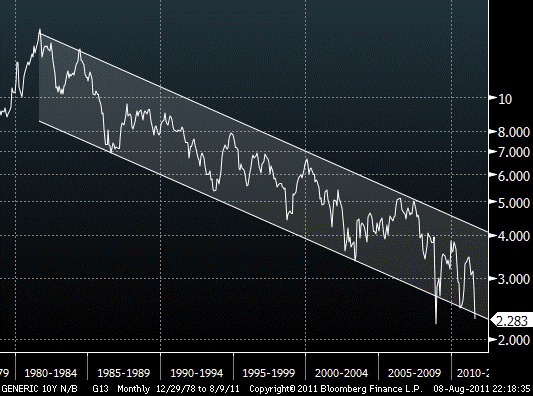
One of my favorite bloggers, Michael Ashton (The Inflation Trader) posted this chart today on the trend in the 10-year Treasury yield:

10-year Treasury yields

If this really is a bubble, selling and getting your profit now does make sense, especially for a 10-year yielding 0.639%!

One nagging question: Where will you put that money that was earning the rate of inflation plus 0.639%, until you can reinvest it in a super-safe asset?

I won’t waver from my buy and hold strategy, though. But sometimes, I say: Don’t buy. This is one of those times.

Posted in Investing in TIPS | 4 Comments