Bernanke: Threat of inflation remains subdued

Buyers of Treasury Inflation Protected Securities care about inflation; in fact, protection against inflation is the whole purpose of TIPS. If you aren’t concerned about inflation, you buy regular Treasury issues.

TIPS are insurance against inflation. When you buy insurance against a danger, it’s sometimes a good thing when the danger never arises. We pay lots of money for house insurance each year, but it’s always better when the house doesn’t burn down.

With TIPS, you get a lower yield than on regular Treasuries, but your principal keeps rising with the rate of inflation. So both your principal and interest payments rise over time, as long as there is inflation.

So if inflation ends up being less than expected – or if deflation strikes – you lose. If inflation runs about as expected, you are OK. And if inflation runs rampant, you win big.

But that doesn’t mean TIPS investors are cheering for rampant inflation. They just fear it and insure against it.

Bernanke speaks

Federal Reserve Chairman Ben Bernanke spoke June 8 at the International Monetary Conference in Atlanta. Here are some excerpts about the economy and the risk of inflation:

Consumer confidence. On the negative side, households are facing some significant headwinds, including increases in food and energy prices, declining home values, continued tightness in some credit markets, and still-high unemployment, all of which have taken a toll on consumer confidence.

What it means: Consumer confidence is shaky, and that puts a damper on future inflation.

Housing. Uncertainties about job prospects and the future course of house prices have also deterred potential buyers. Given these constraints on the demand for housing, and with a large inventory of vacant and foreclosed properties overhanging the market, construction of new single-family homes has remained at very low levels, and house prices have continued to fall.

What it means: The housing market still has not hit bottom.

High government deficits. If the nation is to have a healthy economic future, policymakers urgently need to put the federal government’s finances on a sustainable trajectory. But, on the other hand, a sharp fiscal consolidation focused on the very near term could be self-defeating if it were to undercut the still-fragile recovery. … Consequently, the appropriate response is to move quickly to enact a credible, long-term plan for fiscal consolidation.

What it means: The U.S. desperately needs a plan to cut spending, raise taxes and trim down entitlements

Inflation. As you all know, over the past year, prices for many commodities have risen sharply, resulting in significantly higher consumer prices for gasoline and other energy products and, to a somewhat lesser extent, for food. Overall inflation measures reflect these price increases: For example, over the six months through April, the price index for personal consumption expenditures has risen at an annual rate of about 3-1/2 percent, compared with an average of less than 1 percent over the preceding two years.

  Although the recent increase in inflation is a concern, the appropriate diagnosis and policy response depend on whether the rise in inflation is likely to persist. So far at least, there is not much evidence that inflation is becoming broad-based or ingrained in our economy; indeed, increases in the price of a single product–gasoline–account for the bulk of the recent increase in consumer price inflation.

An important implication is that if the prices of energy and other commodities stabilize in ranges near current levels, as futures markets and many forecasters predict, the upward impetus to overall price inflation will wane and the recent increase in inflation will prove transitory.

the still-substantial slack in U.S. labor and product markets should continue to have a moderating effect on inflationary pressures.

As long as longer-term inflation expectations are stable, increases in global commodity prices are unlikely to be built into domestic wage- and price-setting processes, and they should therefore have only transitory effects on the rate of inflation.

What it means: Inflation is not a short-term problem. Long-term? Who knows.

Monetary policy. … the Federal Open Market Committee (FOMC) has maintained a highly accommodative monetary policy, keeping its target for the federal funds rate close to zero. … The Committee also continues to anticipate that economic conditions are likely to warrant exceptionally low levels for the federal funds rate for an extended period.

What it means: Interest rates are going to stay at very low levels for the near future. The U.S. dollar will remain weak, but the euro is also suffering.

Posted in Inflation, Investing in TIPS | 1 Comment

Threat to TIPS greatly exaggerated?

Richard Leong of Reuters has posted an opinion piece on Treasury Inflation-Protected Securities titled, “Fed’s QE2 end threatens inflation bond rally.”

Leong notes that “Barclays’ TIPS index is up 5.20 percent year-to-date, compared with a 2.62 percent rise on its Treasury index.” He says some analysts fear that the end of quantitative easing will mark the end of the TIPS rally.

TIPS earned a paltry 0.31 percent return in May, worst month since January. This compares with a 1.56 percent gain on regular Treasuries, according to Barclays Capital.

Some believe the recent weakness in TIPS is a precursor of more to come. Last month’s sell-off in commodities has cooled inflation expectations and demand for these investments as a hedge against rising prices.

But he adds, “the death of the TIPS rally may be greatly exaggerated” and notes that core inflation will trend higher the rest of this year.

TIPS perform well – in general – when inflation is rising gently and interest rates are stable. That is the ‘Goldilocks scenario’ for TIPS, not too hot, not too cold.

But as Bill Irving, manager of the Fidelity Inflation-Protected Bond Fund (FINPX) has pointed out, it is hard to see TIPS yields falling much below current levels.

(But, I admit, I have said that many times before and I have been wrong.)

Posted in Inflation, Investing in TIPS | 1 Comment

TIPS a bit tippy? A frank assessment from a TIPS mutual fund manager

I have been pointing out (practically pounding the table) that mutual funds and ETFs investing in Treasury Inflation-Protected Securites are near five-year highs and maybe a little risky. While I endorse buying and holding TIPS at TreasuryDirect.gov, for bond mutual funds right now I prefer intermediate- or shorter-term funds that include corporate bonds. Example: Vanguard Total Bond Fund (VBMFX).

Here’s someone who sort of agrees with me: Bill Irving, manager of the Fidelity Inflation-Protected Bond Fund (FINPX). In the fund’s annual report dated March 31, Irving provides an unusually frank assessment of the value of TIPS:

“On a short-term basis, TIPS’ performance may be hamstrung by the fact that their yields are so low. It’s almost inconceivable that TIPS yields will fall much below current levels. At the end of the period, the yield on a 10-year TIPS was roughly 0.95%, well below its pre-financial crisis 2.00% average. On a relative basis, TIPS’ potential outperformance of Treasuries could be limited because inflation expecations are already near the upper end of the Federal Reserve’s comfort zone.”

Irving also says:

“In my view, it will be difficult for TIPS to perform as well – either on an absolute basis or relative to plain-vanilla Treasuries – in the near term as they did during the last 11 months.”

Since Irving wrote that, the 10-year TIPS base yield has fallen to about 0.65%.

Here is a one-year chart for the FINPX fund (blue) versus Vanguard Total Bond (red):

Posted in Investing in TIPS | 3 Comments

Stock markets plummets, why do TIPS also lose value?

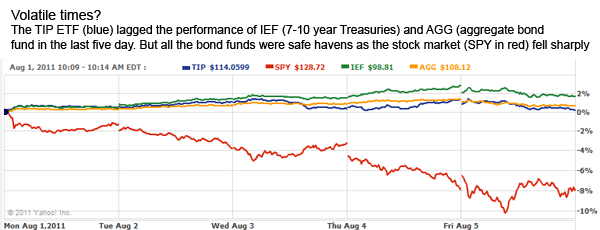
While traditional Treasuries are considered safe-haven investments in times of stock market turmoil, Treasury Inflation Protected Securities aren’t as predictable. In fact, TIPS can perform poorly when the stock market is falling sharply.

Here is a chart of what happened from May 26 to June 2, 2011, 5 trading days ending in a bit of economic turmoil:

TIPS versus Traditional Treasuries
The reason: If investors fear a recession is looming, they will also expect inflation to be held in check, and will see deflation as a possibility. Deflation will reduce payouts from TIPS, and so investors in TIPS would demand a premium on the base yield. When the yield goes up, the market price of TIPS issues declines.

The recent runup in TIPS prices reflects a fear of inflation, which seems reasonable because of massive government spending, soaring deficits and a weakening dollar.

And then June 2011 … This week’s sharp stock market decline has been caused by a fear of a weakening economy. Is a double-dip recession a threat? And could that bring on the theat of deflation? Even a threat of deflation could send TIPS reeling. Here is dramatic evidence:

Traditional Treasuries are boosted by deflation. If consumer prices decline by 2% in a year, and your 10-year Treasury pays 2%, your ‘real yield’ is 4%.  But with a TIPS, your principal would decline by 2% under that same scenario. Your ‘real return’ with a TIPS would be the base rate, or about 0.75% for a 10-year TIPS purchased today, minus the rate of deflation, or 2% in this example.

The result is a real return of -1.25% for the TIPS, versus 4% for the traditional Treasury.

And that is why TIPS – especially TIPS mutual funds and ETFs – are not attractive in a time of economic decline. If you hold TIPS to maturity, this isn’t as serious, since the decline will likely be reversed, as it was after March 2009.

Posted in Investing in TIPS | Leave a comment

Next Treasury Inflation-Protected Securities auction: Reissue of 30-year TIPS on June 23

According to the Treasury’s tentative calendar, the U.S. government will auction a  30-year TIPS at 1 p.m. on June 23. The announcement will come June 16 and the auction will settle on June 30. It will be a reissue, so the term will be close to 30 years, but not quite.

30 years. Is this a good idea? My first reaction is: “I won’t be alive in 30 years, why would I buy this?” OK, I would be 88 in 2041, so maybe I might be alive, but that is an awfully long term. I advocate buying and holding TIPS to maturity at TreasuryDirect.gov, and I don’t consider TIPS a trading investment.

Another reason 30 years is troublesome is that TIPS are paying a historically low base rate right now, in addition to the inflation adjustment to principal. My reason for liking a 5-year TIPS at the moment, even with a slightly negative base yield, is that it lasts for only 5 years. After 5 years, I might be able to reinvest to get a better rate on a 10- or 30-year TIPS.

On the other hand …. You will get a much better yield with a 30-year TIPS than you will get with a 5- or 10-year right now.

Here are current yields on TIPS in the 30-year range:

The 30-year TIPS coming June 23 is likely to pay a base yield of around 1.75%, along with the inflation adjustment to principal. That compares with negative 0.39% for a 5-year TIPS and 0.73% for a 10-year TIPS.

The last 30-year TIPS auction was closed Feb. 28, 2011, with a median yield of 2.19%.

A 30-year issue in February 2009, during the heart of the financial crisis, had a yield of 3.415%. (This was during a time when deflation was a much greater fear than inflation.) It was also a tremendous buying opportunity for TIPS and TIPS mutual funds. Imagine getting 3.4% above inflation on investment for the next 30 years.

So the trend has been a steady downward trend on TIPS yields, even for these ultra-long-term issues. That might continue, might not.

Finally, a story. In 1999 I invested a moderate amount in a 29-year, 6-month reissue TIPS, the only time I have bought a 30-year. I was uneasy about that long term. The yield was 4.069% above inflation — which was normal during the stock market bubble.

In the 12 years since I bought that TIPS, it has steadily paid 4%+ on ever-increasing principal. The accrued principal currently totals $1,359 for each $1,000 invested.

Wish I would have invested more.

Posted in Inflation, Investing in TIPS | 2 Comments