
With a threat of default looming over U.S. Treasuries in just a few days, you might think that Treasuries would be swooning. Amazingly, they aren’t. Either investors don’t believe the threat of default is real, or they just don’t care.
To gauge how TIPS are performing, I like comparing the TIP ETF, which holds U.S. Treasury Inflation-Protected Treasuries, with two other ETFs: IEI (which holds 7-10 year traditional Treasuries) and AGG (an aggregate corporate/Treasury bond fund that is basically a ‘total bond fund’).
This is a good comparison because they all perform as ‘intermediate’ bond funds. Here are the duration numbers:
- TIP = 4.63
- IEI = 4.40
- AGG = 4.56
Here is a chart of the three over the last month.
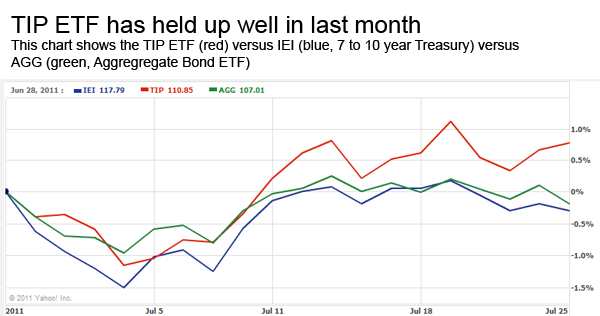
Of the three, the TIP ETF has performed the best, with a positive gain of about .75%. The other two funds are slightly negative over the past month. As the fear of default has increased in the last two weeks, the TIP ETF has performed much better.
I don’t have a conclusion about why. But it appears are investors are seeing TIPS as a safe harbor through this crisis — certainly the view is not negative. If default actually happened, or if the U.S. lost its AAA credit rating, I’d expect these results:
- Interest rates would increase, for Treasuries, corporates, everything
- Investors would demand a higher coupon rate for TIPS
- The stock market would take a major hit
- Economic growth would take a major hit
- Deflation, not inflation, would be a threat (unless the U.S. Treasury could get approval to inflate the money supply)
Jamie Dimon, CEO of JPMorgan Chase, gave the Chamber of Commerce this opinion of the dangers of default, back in March:
If the United States actually defaults on our debt it would be catastrophic … Companies like us, every single company with Treasuries, every insurance fund, every requirement, it will start snowballing. … All short-term financing would disappear.
This wouldn’t be a positive for TIPS, or just about any other traditional U.S. investment. In fact, while TIPS mutual funds might take a hit, they would hardly be the worst of investments.
At this moment, investors don’t seem to believe any of that is likely. Hope they are right.
What I have found troubling in the last two weeks is this: Just about everyone in the government – Republicans and Democrats – agrees that the U.S. budget deficit is a serious problem. We must begin on the path to a solution. And yet our government cannot find the will to find to act. We are witnessing politics, not leadership, by both sides.
I am not sure any investment is ‘safe’ in this environment.


Isnt LTCG just the same as ROC with one more letter?