
Treasury will auction a reopened 10-year TIPS on Thursday.
By David Enna, Tipswatch.com
March 20, 2025 update: 10-year TIPS reopening auction gets real yield of 1.935% after Fed-triggered dip
Real yields have been quite volatile through 2025, with the yield on a 10-year Treasury Inflation-Protected Security falling 54 basis points from a high of 2.34% on January 10 to a low of 1.80% on March 3. That’s a big drop.

But now things have turned around, with the 10-year real yield inching above 2.0% at the market close on Friday. That’s a positive development for investors leading into the Treasury’s reopening auction Thursday of CUSIP 91282CML2, creating a 9-year, 10-month TIPS.
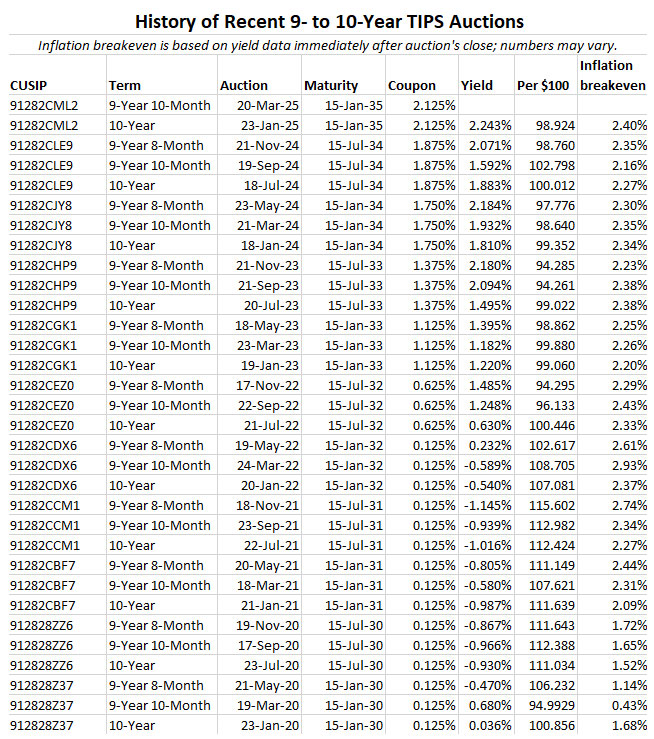
This TIPS had an originating auction two months ago, at the time generating a real yield to maturity of 2.243%, the highest for this term in 16 years. The auction set its coupon rate at 2.125%, also the highest in 16 years.
CUSIP 91282CML2 trades on the secondary market, where it closed Friday with a real yield of 2.00% and a price of 101.09, which is at a premium because the market real yield has now dipped below the coupon rate of 2.125%.
Definition: The “real yield” of a TIPS is its yield above official future U.S. inflation, over the term of the TIPS. So a real yield of 2.0% means an investment in this TIPS would provide a return that exceeds U.S. inflation by 2.0% for 9 years, 10 months.
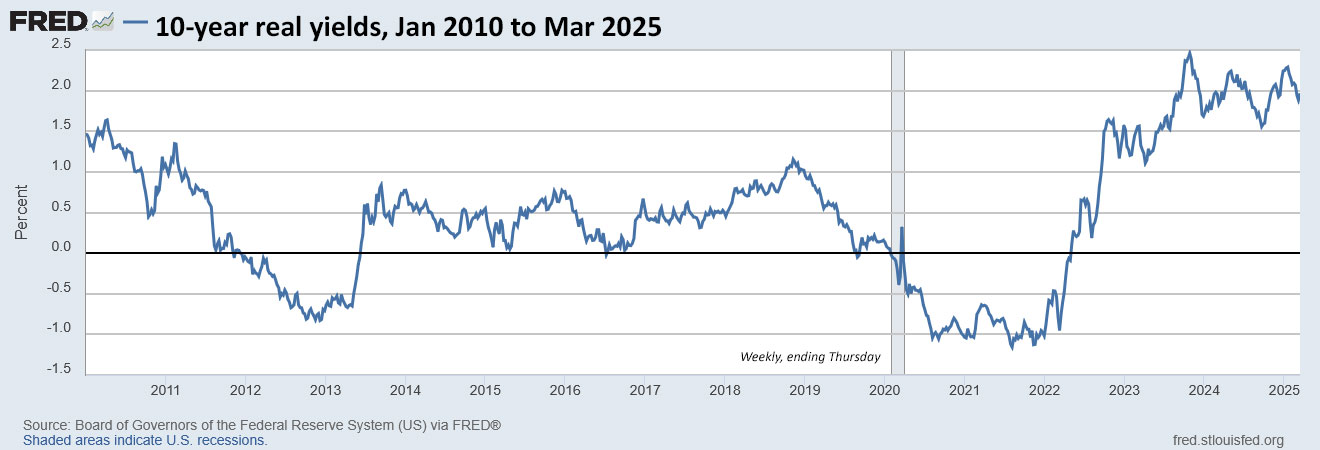
Opinion: If you can find 10-year TIPS with a real yield at or near 2.0%, it is a worthwhile investment, as long as you can hold to maturity. Yes, real yields could continue rising, but 2.0% is historically an attractive yield, as demonstrated in this chart showing the trend over the last 15 years:
Side note: Thursday’s auction size is $18 billion, the largest in history for a 10-year TIPS reopening auction. It is up 12.5% from the $16 billion size of the similar auction in March 2024. This does indicate the Treasury, and the bond market, are committed to TIPS.
And this: Although TIPS have been a fairly reviled investment since a highly negative year in 2022 (total return down 12.2%), this investment class has been doing well in 2025’s volatile markets. The TIP ETF — which holds the full range of maturities — has had a total return of 2.7% year to date, compared to -4.0% for the S&P 500.
Look to the secondary market
Because of the current volatility, I’d recommend skipping this auction (unless you wish to buy at TreasuryDirect) and look for attractive yields on CUSIP 91282CML2 on the secondary market, through your broker. A lot can change before Thursday’s auction closes at 1 p.m. ET. On the secondary market, you can lock in a real yield you find attractive.
Saturday morning, Fidelity was listing CUSIP 91282CML2 with a real yield to maturity of 2.01%. Of course, things will change by Monday. If you want to invest in this TIPS, it’s worth checking the secondary market.
The advantage of buying at auction, especially through TreasuryDirect, is that even small-lot purchases will get the auction’s high yield. The advantage of the secondary market is that you can see exactly the price and real yield you will be receiving. The negative is that you may face a small bid-ask spread. Most of the time, it doesn’t make a huge difference, but if you see a real yield you like, know that you can probably get it on the secondary market without dealing with the auction’s uncertainty.
Pricing
At Friday’s close, CUSIP 91282CML2 was trading with a price of 101.09. Plus, it will have an inflation index of 1.00639 on the settlement date of March 31. With that information, we can estimate the investment cost of $10,000 par value of this TIPS:
- Par value: $10,000.
- Actual principal purchased: $10,000 x 1.00639 = $10,063.90.
- Cost of investment: $10,063.90 x 1.0109 = $10,173.60.
- + accrued interest of about $43.
In summary, at Friday’s pricing, an investor would pay $10,173.60 for $10,063.90 of principal on the March 31 settlement date, and then earn accruals matching future inflation plus an annual coupon of 2.125% for 9 years, 10 months. This is just an estimate. The market will change by the Thursday auction.
Inflation breakeven rate
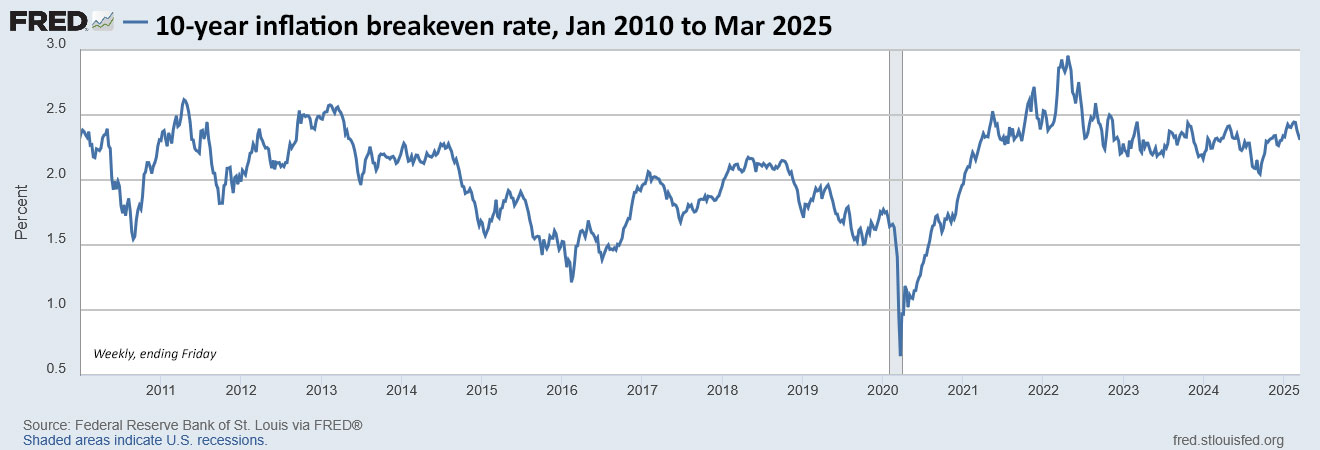
At Friday’s close, a 10-year Treasury note had a nominal yield of 4.31%, giving this TIPS an inflation breakeven rate of 2.31%, relatively high by historical standards but a bit lower than recent auctions of this term. Inflation over the last 10 years, through February, has averaged 3.1%.
Here is the trend in the 10-year inflation breakeven rate over the last 15 years, showing the recent stability in the area around 2.25%:
Thoughts
I was a buyer at the January auction, filling the amount I needed for the 2035 rung of my TIPS ladder. So I won’t be a buyer this week. As I noted above, investors could decide to skip this auction because of the uncertainty caused by volatility, and instead look to lock in an attractive real yield on the secondary market.
If you do make an investment on the secondary market, place a note in the comments to tell us how you did.
CUSIP 91282CML2 will be reopened again at auction on May 22, 2025, and then a new 10-year TIPS will be issued July 24.
This TIPS auction closes Thursday at 1 p.m. ET. Non-competitive bids at TreasuryDirect must be placed by noon Thursday. If you are putting an order in through a brokerage, make sure to place your order Wednesday or very early Thursday, because brokers cut off auction orders before the noon deadline.
I will be posting the auction results soon after the close on Thursday. Here is a history of auction results for this term over the last 5 years:
• Now is an ideal time to build a TIPS ladder
• Confused by TIPS? Read my Q&A on TIPS
• TIPS in depth: Understand the language
• TIPS on the secondary market: Things to consider
• TIPS investor: Don’t over-think the threat of deflation
• Upcoming schedule of TIPS auctions
* * *
Follow Tipswatch on X (Twitter) for updates on daily Treasury auctions and real yield trends (when I am not traveling).
Feel free to post comments or questions below. If it is your first-ever comment, it will have to wait for moderation. After that, your comments will automatically appear. Please stay on topic and avoid political tirades. NOTE: Comment threads can only be three responses deep. If you see that you cannot respond, create a new comment and reference the topic.
David Enna is a financial journalist, not a financial adviser. He is not selling or profiting from any investment discussed. I Bonds and TIPS are not “get rich” investments; they are best used for capital preservation and inflation protection. They can be purchased through the Treasury or other providers without fees, commissions or carrying charges. Please do your own research before investing.









Very helpful information, thanks.