As government shuts down, Trump jettisons his choice to lead BLS

By David Enna, Tipswatch.com

It’s Day One of the U.S. government shutdown, and the crucially important, non-partisan Bureau of Labor Statistics now has one working employee: acting commissioner William Wiatrowski. The other 2,054 employees have been (or will soon be) furloughed.

The Labor Department last week published a contingency plan for the shutdown, which included these details:

  • The Labor Department’s working employees will be reduced from 12,916 to 3,141.
  • The BLS is listed in the group that will “completely cease operations.”
  • No economic data will be released.
  • All active data collection activities for BLS surveys will cease.
  • The quality of data collected in the future could be impaired.
  • The BLS website will not be updated.

The one qualification for the BLS was that activities related to backing up systems may take up to three days.

Antoni

Coinciding with the shutdown, President Trump on Tuesday withdrew the nomination of E.J. Antoni to lead the BLS. A White House official offered the New York Times no reason for the sudden change, saying only that Antoni was a “brilliant economist” and that Trump would announce a new nominee soon.

Antoni turned out to be an extremely controversial choice for a job typically filled by non-partisan, lifelong government statisticians. Trump chose him for the job after firing Erika McEntarfer in August and claiming the BLS “rigged” data to make his administration look bad.

Antoni, who authored parts of Project 2025, has been critical of how the BLS collects data. He also called for McEntarfer’s firing during an appearance on Steve Bannon’s “War Room” podcast, agreeing with the host that they needed a “MAGA Republican” at BLS.

That was a bad look for a non-partisan job, but Antoni’s nomination was further hurt by photos and video showing he was in the crowd at the Jan. 6 riot at the U.S. Capitol. Antoni contends he was a “bystander.” And then his nomination was doomed after CNN’s KFile investigative team discovered Antoni ran a since-deleted X account with sexually degrading and bigoted attacks.

All of this made me wonder if Antoni would even get to a confirmation hearing, where a lot of this inflammatory material would be discussed and Antoni would have to respond under oath. The hearing was “scheduled” for September but was continuously delayed. Apparently Republican senators Susan Collins and Lisa Murkowski refused to even meet with Antoni and others said privately they were not likely to confirm him, according to CNN.

So the nomination was pulled, and this is a good thing for the BLS on a day when 2,054 workers are being furloughed. Trump will name another nominee soon and I have a suggestion: Elevate William Wiatrowski, the interim commissioner, to the job. He was acting BLS commissioner from January 2017 to March 2019, during Trump’s first term.

The BLS shutdown

About 11 a.m. the BLS.gov website finally posted a notice about the shutdown: “This website is currently not being updated due to the suspension of Federal government services. The last update to the site was Wednesday, October 1, 2025. Updates to the site will start again when the Federal government resumes operations.”

These economic reports, among others, will not be issued during the shutdown:

  • Oct. 3: September employment report
  • Oct. 15: Consumer Price Index for September
  • Oct. 16: Real earnings for September
  • Oct. 17: Producer Price Index for September

The Bureau of Economic Analysis, which is part of the Commerce Department, has posted a notice on its site: “Due to a lapse in appropriations, this website is not being updated.” The BEA issues the Personal Consumption Expenditures Index, the Federal Reserve’s favored measure of inflation. The next report is due Oct. 31. Let’s hope the shutdown has been resolved by then.

Things are going to get tense if the BLS cannot release a CPI report for September, which is the last month of data needed to determine next year’s Social Security cost-of-living adjustment and the new variable rate for the U.S. Series I Savings Bond. In addition, that September data is important in calculating next year’s Medicare rates, IRMAA levels and even 2026 income tax brackets.

The Federal Reserve is going to be flying blind until the shutdown is resolved, with both jobs and inflation data being locked down. From the New York Times:

“It pains me that we wouldn’t be getting official statistics at exactly a moment when we’re trying to figure out is the economy in transition,” said Austan Goolsbee, president of the Federal Reserve Bank of Chicago and a voting member on this year policy-setting committee.

What’s ahead?

It’s difficult on day one to see how this crisis will be resolved, since the Trump administration seems perfectly willing to embrace the shutdown and Democrats won’t take action to end it.

Assuming the White House doesn’t go “nuclear” by implementing widespread firings of federal workers, Democrats could possibly work out a separate deal (outside of the continuing resolution) assuring consideration of legislation to extend Affordable Care Act subsidies. A lot of Republicans want those ACA subsidies extended, as noted by the Wall Street Journal:

GOP leaders are already hinting that they are open to negotiating, and some are floating ideas that would give Democrats much of what they want. “I don’t love the policy, OK?” Speaker Mike Johnson said recently. “But I understand the political realities.”

My opinion is that the GOP has the upper hand in the “spin war,” and that is why you see Republican after Republican on television extolling their “clean 7-week continuing resolution,” without any baggage they’ve added in the past (build the wall, abolish Obamacare, etc.)

Any solution is going to take time, ticking toward that crucial Oct. 15 inflation report. From the Wall Street Journal:

House lawmakers aren’t expected to return to Washington until next week and any compromise funding proposal would need their approval. Congress hasn’t passed any appropriations bills, so unlike during the 34-day partial shutdown that ended in 2019, no government offices have been funded.

Nothing about this shutdown is good news.

NOTE: While this posting has triggered ‘healthy debate,’ I have decided to shut down commenting so we can go back to focusing on real yields, inflation and safe investments.

—————————

Donate? This site is free and I plan to keep it that way. Some readers have suggested having a way to contribute. I would welcome donations. Any amount, or skip it, your choice. This is completely optional.

PayPal link / Venmo link

—————————

Follow Tipswatch on X for updates on daily Treasury auctions and real yield trends (when I am not traveling).

Feel free to post comments or questions below. If it is your first-ever comment, it will have to wait for moderation. After that, your comments will automatically appear. Please stay on topic and avoid political tirades. NOTE: Comment threads can only be three responses deep. If you see that you cannot respond, create a new comment and reference the topic.

David Enna is a financial journalist, not a financial adviser. He is not selling or profiting from any investment discussed. I Bonds and TIPS are not “get rich” investments; they are best used for capital preservation and inflation protection. They can be purchased through the Treasury or other providers without fees, commissions or carrying charges. Please do your own research before investing.

Posted in Federal Reserve, I Bond, Inflation, Retirement, Social Security, Taxes | Tagged , , , | 54 Comments

U.S. government shutdown: What does it mean?

AI-generated image. Source: Perchance.org

By David Enna, Tipswatch.com

The U.S. government is highly likely to shut down on Wednesday, with the beginning of a new fiscal year. This is political theater, and the real danger is that the leading actors are both Republicans and Democrats, perfectly willing to go to the brink.

Escalating the threat, the Trump administration this week told federal agencies to prepare for mass firings (not furloughs) if the government shuts down. The Office of Management and Budget said the firings should target any federal program that is “not consistent with the President’s priorities.” From the Politico report:

The move marks a significant break from how shutdowns have been handled in recent decades, when most furloughs were temporary and employees were brought back once Congress voted to reopen government and funding was restored.

Politico quoted an OMB official saying programs that will continue include Social Security, Medicare, veterans benefits, military operations, law enforcement, Immigration and Customs Enforcement, Customs and Border Protection and air traffic control.

Scene II: Cue the Democrats, who pushed back at the firing threat. Or maybe I should say “shoved back,” with House minority leader Rep. Hakeem Jeffries telling the budget director to “get lost.”

Wonderful, huh? As things stand now, a government shutdown — whether short- or long-term — seems a certainty. Both political parties are welcoming the crisis for potential political gain.

What’s this all about?

The government will shut down Wednesday unless lawmakers are able to break their impasse and reach a deal to keep federal funds flowing. Republicans have offered a plan to maintain current spending levels through Nov. 21. That plan passed the House by a 217-212 vote, but was rejected the Senate, where 60 votes are needed for passage.

Democrats have offered an alternative to keep current spending going through Oct. 31 — but with a rider to add more than $1 trillion in spending to extend Obamacare subsidies that are set to expire at the end of the year. Democrats also want to roll back already-approved Medicaid cuts. The GOP says “no.”

Democrats are using the shutdown threat as leverage to restore healthcare spending that was eliminated in the One Big Beautiful Bill (OBBB). Republicans are highly unlikely to agree to that, but have offered to negotiate “in the future” once the shutdown is averted. But at that point Democrats would no longer have leverage.

Behind this is a failure by Congress to to pass a collection of 12 spending bills that would keep the government funded through fiscal 2026. Without approval of those bills, a continuing resolution is needed to keep much of the government going. So far, not one of the spending bills has passed both houses of Congress, which means a government shutdown would be widespread.

The most recent government shutdown occurred during President Trump’s first term, from Dec. 22, 2018, to Jan. 25, 2019.

Treasury issues aren’t threatened

This isn’t a “debt-limit crisis,” like we saw in 2023. The OBBB, passed in August, increased the U.S. debt limit by $5 trillion. So the Treasury will be able to continue to issue Treasury bills, notes and bonds, along with U.S. Savings Bonds. For that reason, you aren’t seeing any disruption in 4-week T-bill yields:

If investors believed T-bills would not be paid off at maturity, you would be seeing the 4-week yield rising sharply. That’s not an issue in this crisis. Instead, yields are falling in line with the Federal Reserve’s decision to cut short-term rates on Sept. 17.

I repeat: There is no risk of a government default, which would be far more serious than a shutdown.

However, some Treasury officials are likely to be furloughed (or maybe even fired), and others will be required to work without pay during the shutdown. That means Treasury services and statistical collection and reporting are going to be impaired.

For example, a shutdown could delay release of the crucially important September inflation report, due Oct. 15. That report will determine both the I Bond’s new variable rate and next year’s cost-of-living adjustment for Social Security. From a Reuters report:

A prolonged shutdown risks delaying or canceling key economic data releases investors use to assess macroeconomic trends, such as the monthly employment and inflation reports, analysts at Nomura said in a note this week.

Sept 30 update: Recent reporting from many sources indicates that a government shutdown will delay statistical reporting by the Bureau of Labor Statistics. The Department of Labor (which includes the BLS) has prepared a contingency plan for the shutdown:

  • The Labor Department’s working employees will be reduced from 12,916 to 3,141.
  • The BLS is listed in the group that will “completely cease operations.”
  • Economic data that are scheduled to be released during the lapse will not be released.
  • All active data collection activities for BLS surveys will cease.
  • A reduction in quality of data collected might impact the quality of future estimates produced.
  • The BLS website will not be updated with new content or restored in the event of a technical failure during a lapse.

What happens in a shutdown?

The potential for large-scale firings by the Trump administration adds a unique twist to this crisis. Those firings might not be legal and court challenges would be likely. However, widespread furloughs — meaning no pay even if you are required to work — are going to happen.

The non-partisan Committee for a Responsible Federal Budget prepared a Q&A on government shutdowns earlier this year.

In prior shutdowns, border protection, in-hospital medical care, air traffic control, law enforcement, and power grid maintenance have been among the services classified as essential, while some legislative and judicial staff have also been largely protected. Mandatory spending that is not subject to annual appropriations – such as for Social Security, Medicare, and Medicaid – also continues.

Some examples of the likely effects:

  • Social Security. Benefit payments would go out, but benefit verification and card issuance would cease.
  • Food inspection. During the 2018-2019 shutdown, the FDA restored some food inspections a few weeks into the funding lapse for products that were considered high-risk.
  • National parks. In 2013, the National Park Service turned away millions of visitors to more than 400 parks, national monuments, and other sites. NPS estimated the shutdown led to more than $500 million in lost visitor spending.
  • Air travel. During the 2018-2019 shutdown, air travel was strained as a result of air traffic controllers and TSA agents working without pay.
  • Health. The National Institutes of Health (NIH) would be prevented from admitting new patients or processing grant applications.
  • Environmental. During the 2013 shutdown, the EPA halted inspections for 1,200 sites that included hazardous waste, drinking water, and chemical facilities.
  • IRS. Essential IRS functions would continue, but some workers would be furloughed and others would be required to work without pay. I suspect some IRS auditors could get ornery in this scenario.

Will the government save money?

Hard to say this time, given the threat of widespread firings instead of furloughs. Generally, after a shutdown concludes furloughed workers receive back pay, even if they were not working. The CRFB says this:

While many federal employees are forced to be idle during a shutdown, they … are now guaranteed back pay, negating much of those potential savings. OMB official estimates of the 2013 government shutdown found that $2.5 billion in pay and benefits were paid to furloughed employees for hours not worked during the shutdown. …

Shutdowns also carry a cost to the economy. The Congressional Budget Office (CBO) estimated that the 2018-2019 shutdown reduced Gross Domestic Product (GDP) by a total of $11 billion, including $3 billion that will never be recovered.

What’s the solution?

Since both sides are digging in — aggressively — it seems highly likely that the government will shut down Wednesday. The blame game is already at 100 decibels with Republicans saying Democrats are refusing to pass a “clean continuing resolution” and Democrats saying Republicans are refusing “to lower health care costs for Americans.”

I suspect the Republicans will win in the end, getting a continuing resolution to fund the government into November. There is no way the GOP will accept a $1 trillion increase in government spending by rolling back legislation passed two months ago.

The Trump administration’s threat to fire federal workers in areas “not consistent with the president’s policies” was a nuclear escalation — and probably not even necessary. But it could indicate the White House will welcome an extended government shutdown.

Eventually, it could take a stock or bond market revolt to bring the crisis to a close.

—————————

Donate? This site is free and I plan to keep it that way. Some readers have suggested having a way to contribute. I would welcome donations. Any amount, or skip it, your choice. This is completely optional.

PayPal link / Venmo link

—————————

Follow Tipswatch on X for updates on daily Treasury auctions and real yield trends (when I am not traveling).

Feel free to post comments or questions below. If it is your first-ever comment, it will have to wait for moderation. After that, your comments will automatically appear. Please stay on topic and avoid political tirades. NOTE: Comment threads can only be three responses deep. If you see that you cannot respond, create a new comment and reference the topic.

David Enna is a financial journalist, not a financial adviser. He is not selling or profiting from any investment discussed. I Bonds and TIPS are not “get rich” investments; they are best used for capital preservation and inflation protection. They can be purchased through the Treasury or other providers without fees, commissions or carrying charges. Please do your own research before investing.

Posted in Federal Reserve, Medicare, Retirement, Social Security, Treasury Bills | 23 Comments

10-year TIPS reopening auction gets real yield of 1.734% to weak demand

By David Enna, Tipswatch.com

One day after the Federal Reserve acted to lower short-term interest rates, the Treasury’s offering of $19 billion in a reopened 10-year Treasury Inflation-Protected Security — CUSIP 91282CNS6 — drew surprisingly weak demand from investors.

The auctioned real yield to maturity for this 9-year, 10-month TIPS ended up at 1.734%, well above the “when-issued” market prediction of 1.684%. This TIPS had been trading on the secondary market with a real yield of 1.69% just before the auction’s close.

Also, the bid-to-cover ratio was a weak 2.20, the lowest in three years for this term. Conclusion: investor demand was lousy.

So the auction goes down as a flop for the Treasury, but a good deal for investors, drawing a real yield to maturity about 4 basis points higher than market trading.

Nevertheless, 10-year real yields have fallen sharply through much of 2025. The originating auction for this TIPS got a real yield of 1.985% on July 24. Its coupon rate was set at 1.875% by that auction.

Definition: The “real yield to maturity” of a TIPS is its yield above official future U.S. inflation, over the term of the TIPS. So a real yield of 1.734% means an investment in this TIPS would provide a return that exceeds U.S. inflation by 1.734% for 9 years, 10 months.

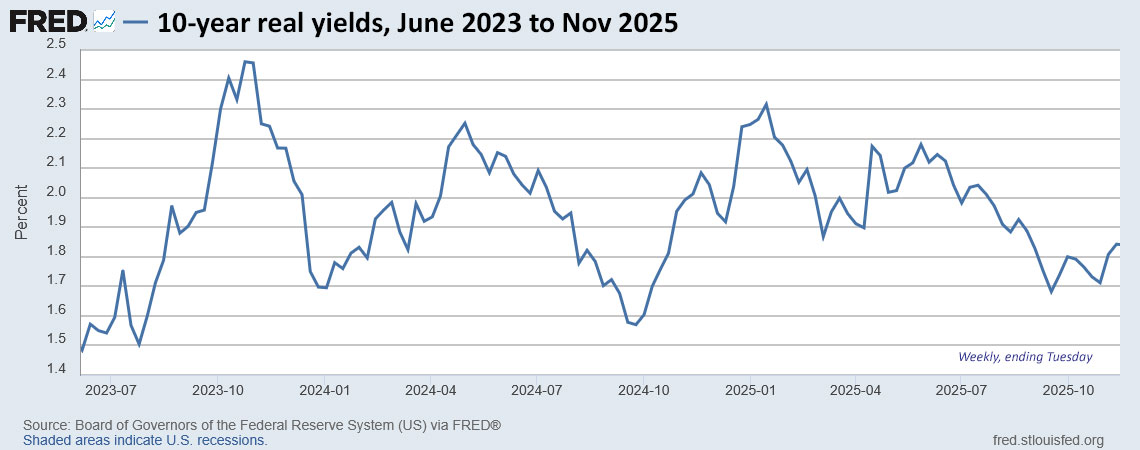
Here is the year-to-date trend in the 10-year real yield, showing the steady downward trend since early summer, as expectations grew for Fed rate cuts:

Click on image for larger version.

Pricing

Because the auctioned real yield was below the coupon rate of 1.875%, investors paid a premium unadjusted price of 101.262744. In addition, this TIPS will carry an inflation index of 1.00602 on the settlement date of Sept. 30. With that information we can calculate the cost of a $10,000 par value purchase at this auction:

  • Par value: $10,000
  • Actual principal purchased: $10,000 x 1.00602 = $10,060.20
  • Cost of investment: $10,060.20 x 1.01262744 = $10,187.23
  • + accrued interest of $39.47

In summary, the investor paid $10,187.23 for $10,060.20 principal on the settlement date of Sept. 30. From that point on, the investor will earn accruals matching future inflation, plus an annual coupon rate of 1.875% for 9 years, 10 months.

Inflation breakeven rate

At the auction’s close, the 10-year Treasury note was trading with a nominal yield of 4.10%, giving this TIPS an inflation breakeven rate of 2.37% — down from 2.40% before the auction’s close. The result is more or less in line with recent results for this term.

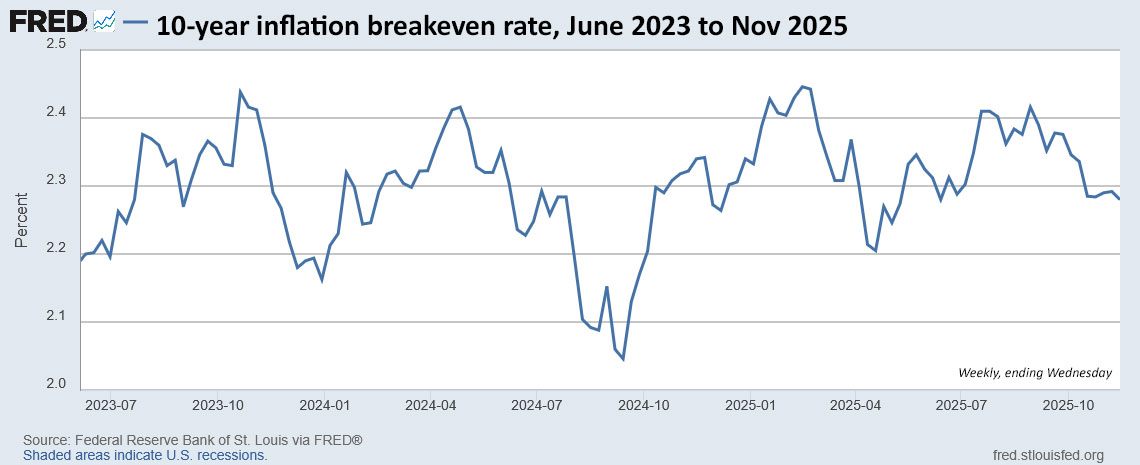
Here is the trend in the 10-year inflation breakeven rate year-to-date. Inflation expectations have been rising since tariff disruptions complicated things in April:

Click on image for larger version.

Reaction to the auction

While the auction result wasn’t way out of line, the lack of demand was surprising. Investors could be trying to calculate the effect of future Federal Reserve rate cuts on bond yields and potential inflation? Or maybe investors aren’t interested in inflation protection? (I’d say that would be odd as the Fed launches rate cuts while U.S. inflation is running at 2.9%.)

I suspect that investors are trying to sort out what will be coming in 2026, as the Federal Reserve moves to new leadership. This is from a follow-up Bloomberg article:

The TIPS drew 1.734%, about five basis points higher than their yield in pre-auction trading. By that measure it was the worst 10-year TIPS auction — of which there are six per year — since 2017.

Interest-rate strategists expected the auction to benefit from perceptions that Fed independence is at risk, which could stoke demand for inflation protection. The auction result suggests that the threat has peaked, said Gang Hu, managing partner at Winshore Capital Partners and a specialist in inflation markets.

The auction also drew ridicule from investors on X:

CUSIP 91282CNS6 will get one more reopening auction on November 20, and then a new 10-year TIPS will be offered at auction in January. Here are results for recent auctions of this term:

—————————

Donate? This site is free and I plan to keep it that way. Some readers have suggested having a way to contribute. I would welcome donations. Any amount, or skip it, your choice. This is completely optional.

PayPal link / Venmo link

—————————

Follow Tipswatch on X for updates on daily Treasury auctions and real yield trends (when I am not traveling).

Feel free to post comments or questions below. If it is your first-ever comment, it will have to wait for moderation. After that, your comments will automatically appear. Please stay on topic and avoid political tirades. NOTE: Comment threads can only be three responses deep. If you see that you cannot respond, create a new comment and reference the topic.

David Enna is a financial journalist, not a financial adviser. He is not selling or profiting from any investment discussed. I Bonds and TIPS are not “get rich” investments; they are best used for capital preservation and inflation protection. They can be purchased through the Treasury or other providers without fees, commissions or carrying charges. Please do your own research before investing.

Posted in Federal Reserve, Inflation, Investing in TIPS, Tariffs | Tagged , , , , , | 18 Comments

10-year TIPS reopening will mark a shift in yields

Are we entering an era of lower real returns?

By David Enna, Tipswatch.com

The U.S. Treasury on Thursday will auction $19 billion in a reopened 10-year TIPS, CUSIP 91282CNS6. This will be a notable auction because the real yield to maturity is likely to fall to a two-year low, a level not seen at auction since July 2023.

CUSIP 91282CNS6 had its originating auction two months ago, on July 24, when its real yield to maturity came in at an attractive 1.985%. The coupon rate was set at 1.875%. But in the last two months, real yields have dipped fairly dramatically.

This TIPS trades on the secondary market, where it closed Friday with a real yield of 1.69% and a price of 101.64. The price is at a premium because the real yield has dropped below the coupon rate. You can track the current yield and price on Bloomberg’s Current Yields page.

Definition: The “real yield to maturity” of a TIPS is its yield above official future U.S. inflation, over the term of the TIPS. So a real yield of 1.69% means an investment in this TIPS would provide a return that exceeds U.S. inflation by 1.69% for 9 years, 10 months.

One day before Thursday’s auction closes at 1 p.m. ET, the Federal Reserve is highly likely to cut short-term interest rates by 25 basis points and signal that future rate-cutting is coming in an effort to support a sagging job market. The 25-basis-point cut is already priced into CUSIP 91282CNS6’s yield, but comments by Fed chair Jerome Powell Wednesday afternoon could set the bond market roiling. In other words: Expect volatility in the hours leading up to the auction.

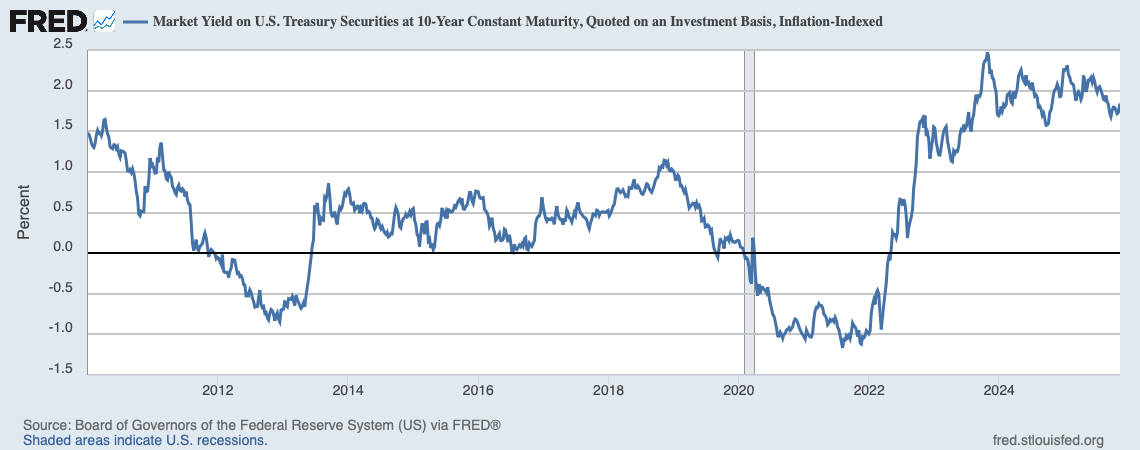
Here is the trend in the 10-year real yield over the last 15 years:

Click on image for larger version.

The chart shows that the current real yield of 1.69% remains historically attractive, but has fallen well off the October 2023 high of about 2.55%.

Pricing

At Friday’s close, CUSIP 91282CNS6 was trading with a real yield of 1.69% and a price of 101.64. In addition, on the auction’s settlement date of September 30, this TIPS will have have an inflation index ratio of 1.00602. With that information, we can estimate the cost of a $10,000 par value investment at the auction:

  • Par value: $10,000
  • Accrued principal on settlement date: $10,000 x 1.00602 = $10,060.20
  • Cost of investment: $10,060.20 x 1.0164 = $10,255.19
  • + accrued interest of about $39.47

Again, this is an estimate based on Friday’s closing price. In this scenario, the investor would pay $10,255.19 for $10,060.20 of principal on the settlement date, and from that point on would earn inflation accruals plus a coupon rate of 1.875% until maturity. Things will change before Thursday, but this gives you an idea.

Inflation breakeven rate

The 10-year Treasury note closed Friday with a nominal yield of 4.06%, giving this TIPS a current inflation breakeven rate of 2.37% –in line with recent auctions of this term. That means CUSIP 91282CNS6 will out-perform a nominal 10-year if inflation averages more than 2.37% over the next 9 years, 10 months. Inflation over the last 10 years, ending in August, has averaged 3.1%.

Here is the trend in the 10-year inflation breakeven rate over the last 15 years, showing the fairly stable pattern since the closing months of 2022:

Click on image for larger version.

Thoughts

Real yields for TIPS of short- to medium-terms have been falling over the last several months, in anticipation of future rate-cutting by the Federal Reserve. This could indicate a trend that will continue well into 2026, especially if the U.S. economy dips into recession. Or … it could be an overshoot to the low side. The Federal Reserve on Wednesday may help clarify this issue (but probably won’t).

I will not be a buyer at this auction because I have my sights on the January 2026 auction of a new 10-year TIPS, to add 2036 to my TIPS investment ladder. Will real yields be quite a bit lower by then? Maybe. I’ll wait it out.

Keep in mind that despite the boost from tariff revenues, the federal deficit is highly likely to continue increasing for years into the future. That will mean more borrowing and — potentially — higher yields. Note that the 20-year TIPS still has a real yield of 2.17% and the 30-year, 2.43%.

Relevant side note: This TIPS auction size of $19 billion will be the highest in history for any 10-year TIPS reopening. This is a 12% increase over last year’s September auction at $17 billion.

Also, note that if you have a brokerage account, there is no compelling reason to buy this TIPS at auction versus on the secondary market, unless you plan to make a small purchase at TreasuryDirect.

The advantage of buying at auction, especially through TreasuryDirect, is that even small-lot purchases will get the auction’s high yield. The advantage of the secondary market is that you can see exactly the price and real yield you will be receiving. The negative is that you may face a small bid-ask spread. Most of the time, it doesn’t make a huge difference, but if you see a real yield you like, know that you can probably get it on the secondary market without dealing with the auction’s uncertainty.

This TIPS auction closes Thursday at 1 p.m. ET. Non-competitive bids at TreasuryDirect must be placed by noon Thursday. If you are putting an order in through a brokerage, make sure to place your order Wednesday or very early Thursday, because brokers cut off auction orders before the noon deadline.

I will be posting the auction results soon after the close on Thursday. Here is a history of auction results for this term over the last 5 years:

—————————

Donate? This site is free and I plan to keep it that way. Some readers have suggested having a way to contribute. I would welcome donations. Any amount, or skip it, your choice. This is completely optional.

PayPal link / Venmo link

—————————

Follow Tipswatch on X for updates on daily Treasury auctions and real yield trends (when I am not traveling).

Feel free to post comments or questions below. If it is your first-ever comment, it will have to wait for moderation. After that, your comments will automatically appear. Please stay on topic and avoid political tirades. NOTE: Comment threads can only be three responses deep. If you see that you cannot respond, create a new comment and reference the topic.

David Enna is a financial journalist, not a financial adviser. He is not selling or profiting from any investment discussed. I Bonds and TIPS are not “get rich” investments; they are best used for capital preservation and inflation protection. They can be purchased through the Treasury or other providers without fees, commissions or carrying charges. Please do your own research before investing.

Posted in Inflation, Investing in TIPS, Retirement, TreasuryDirect | Tagged , , | 18 Comments

U.S. inflation rose 0.4% in August, higher than expected

Annual all-items inflation rose to 2.9%, the highest level since January

By David Enna, Tipswatch.com

In what could be a crucially important report, the Bureau of Labor Statistics reported today that seasonally adjusted U.S. inflation rose 0.4% in August, higher than expected. The annual rate rose to 2.9%, up from 2.7% in July.

Core inflation, which removes food and energy, rose 0.3% for the month and held steady at 3.1% for the year. This matched expectations — meaning that overall this report should not raise market alarms. However, U.S. inflation remains too high.

The BLS noted that shelter costs rose 0.4% for the month, the highest monthly rate since January. The annual rate fell from 3.7% in July to 3.6% in August. More from the report:

  • Food at home costs rose a troubling 0.6% for the month and are now up 2.7% year over year. The index for fruits and vegetables rose 1.6% for the month. Costs for meats, fish and eggs have increased 5.6% over the last year.
  • Gasoline costs increased 1.7% in August after falling 1.9% in July. Gas prices are down 6.6% over the last year.
  • Costs of new vehicles, which have been fairly stable throughout 2025, rose 0.3% for the month and are now up 0.7% for the year.
  • Costs of used cars and trucks popped 1.0% higher for the month and are up 6.0% for the year.
  • Medical care services costs fell 0.1% for the month but are up 4.2% year over year.
  • Airline fares rose 5.9% in August, after rising 4.0% in July.
  • Apparel costs rose 0.5% for the month but are up only 0.2% year over year.

Overall, this August report shows inflation continuing to run at a fairly high level, but so far there appears to be no dramatic “instant” effect from U.S. tariffs on imports. Here is the trend for all-items and core inflation over the last year, showing the steady march higher in all-items inflation since April:

What this means for TIPS and I Bonds

Investors in Treasury Inflation-Protected Securities and U.S. Series I Savings Bonds are also interested in non-seasonally adjusted inflation, which is used to adjust principal balances for TIPS and set future interest rates for I Bonds. For August, the BLS set the inflation index at 323.976, an increase of 0.29% over July.

For TIPS. The August report means that principal balances for all TIPS will increase 0.29% in October, after rising 0.15% in September. Here are the October Inflation Index Ratios for all TIPS.

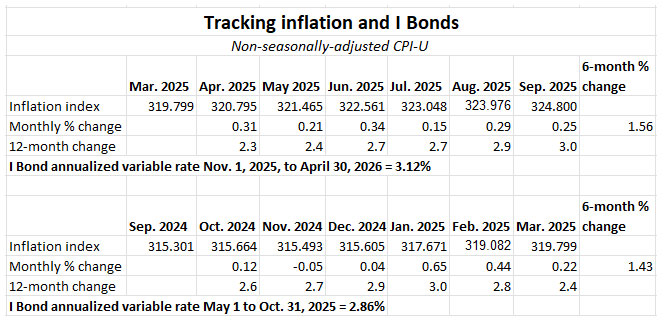
For I Bonds. The August report is the fifth of a six-month string that will determine the I Bond’s new inflation-adjusted variable rate, which will be reset November 1 and eventually roll into effect for all I Bonds. Inflation from April to August has increased 1.31%, which would translate to a variable rate of 2.62%. One month of data remains and we are probably looking at a new variable rate of 3.0% to 3.2%, higher than the current 2.86%.

See historical data on my Inflation and I Bonds page.

What this means for the Social Security COLA

The Social Security cost-of-living adjustment is based on an unusual inflation index – CPI-W – and is determined by averaging the indexes for July, August and September and comparing that number to the same average for the year before. For August, the BLS set the CPI-W index at 317.306, an increase of 0.30% over the June number.

With one month to go, here is where we are:

We are probably looking at a COLA of 2.7% once the September number rolls out on October 15. There is still a shot that my projection of 2.8% will work out.

What does this mean for future interest rates?

Although U.S. inflation remains too high, I believe the Federal Reserve will move forward with a 25-basis-point cut to short-term interest rates next week. A cut of 50 basis points should off the table. From this morning’s Bloomberg report:

While the report underscored that inflation remains above the Federal Reserve’s target, the reassurance that tariff hikes aren’t obviously sparking a generalized escalation in price pressures reinforced expectations for Fed policymakers to cut interest rates by 25 basis points at the Sept. 16-17 meeting.

From the Wall Street Journal:

In recent weeks, more Fed officials, including Chair Jerome Powell, have suggested that softer labor market conditions should give the Fed more comfort that they can assume price increases will be a one-off. … (T)he overall inflation picture in the first six months of the year wasn’t as ugly as many feared it would be in the wake of the tariff increases.

So it is highly likely that a rate cut is coming next week. What happens next will depend on the status of the U.S. job market.

—————————

Donate? This site is free and I plan to keep it that way. Some readers have suggested having a way to contribute. I would welcome donations. Any amount, or skip it, your choice. This is completely optional.

PayPal link / Venmo link

—————————

Follow Tipswatch on X for updates on daily Treasury auctions and real yield trends (when I am not traveling).

Feel free to post comments or questions below. If it is your first-ever comment, it will have to wait for moderation. After that, your comments will automatically appear. Please stay on topic and avoid political tirades. NOTE: Comment threads can only be three responses deep. If you see that you cannot respond, create a new comment and reference the topic.

David Enna is a financial journalist, not a financial adviser. He is not selling or profiting from any investment discussed. I Bonds and TIPS are not “get rich” investments; they are best used for capital preservation and inflation protection. They can be purchased through the Treasury or other providers without fees, commissions or carrying charges. Please do your own research before investing.
Posted in Federal Reserve, I Bond, Inflation, Investing in TIPS, Retirement, Social Security, Tariffs | Tagged , | 23 Comments