
By David Enna, Tipswatch.com
January 26, 1986, was a big day in my life. The Chicago Bears, my longtime favorite team, were playing in the Super Bowl. That afternoon, I was driving with my future wife to a Super Bowl party of Chicago-area folks now living in Charlotte.

We were listening to WBT-AM radio, because I liked to hear talk and there were no sports-talk radio stations in Charlotte back then. At 4 p.m., on came a new show, “Bob Brinker’s MoneyTalk.” OK, let’s give this guy a try.
I swear, within 15 minutes I turned to my future (and still) wife and said, “This guy is good.” There were other financial guys on the radio back then, but they were usually selling something, probably disastrous. Bob Brinker was just doling out excellent advice: 1) invest in low-cost index mutual funds, 2) favor quality companies like Vanguard, 3) commit to the plan, 4) and aim for “critical mass.”
By the way, the Bears won that Super Bowl, 46-10. And I got married in May 1986. It was a very good year.
From that day on, I tried really hard to listen to Brinker’s radio show, which aired from 4 to 7 p.m. ET on Saturdays and Sundays. I’d carve out part of my weekend to try to hear at least some of what he had to say. In later years, the show got preempted on some Sundays by Carolina Panthers post-game shows (my new favorite team), but I’d try to catch the replay later that night.
Here is Brinker in 2011 criticizing the “sharks” circling investors and the do-it-yourself approach to reaching “critical mass”:
Bob Brinker was financial comfort food. His advice was rock solid because it focused on a do-it-yourself approach emphasizing index funds and low-cost investing. In the late 1990s he began talking — often — about newly minted investments called Treasury Inflation-Protected Securities and U.S. Series I Savings Bonds. I had never heard of them. But I did some research and liked what I saw.
Through the year 2001 — triggered by Bob’s advice — I bought TIPS and I Bonds with real yields of 3.0% and higher. At the time, I didn’t realize how great these yields were. I still hold all the I Bonds and one of the TIPS (all the others have matured) with an above-inflation coupon rate of 3.875%, very close to day’s nominal return of 4.2% on a 30-year Treasury bond. It will mature in April 2029.
He also had an occasional segment where he recommended investment books, all solid choices. I read quite a few of them. Here is a top 10 list compiled by his son.
Brinker published a newsletter called “Marketimer,” which I subscribed to for a few months. The title was a misnomer because Brinker rarely advised trading. He just presented model portfolios for various risk levels, and not much changed.
His one big call
While Brinker very rarely made timing calls, he did look at factors like the state of the economy, monetary policy, valuations and investor sentiment. In January 2000 he advised his newsletter readers to switch to a 60% cash reserve after years of high market gains. The radio listeners got that call a few weeks later.
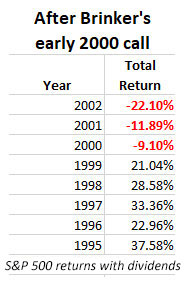
One thing to keep in mind is that the U.S. stock market was soaring after the greatest bull market of our lifetimes. The S&P 500 net asset value increased every year except one from 1982 to 1999. Baby boomers who were investing created a lot of wealth in those years.
I can remember hearing this caution while driving somewhere in the North Carolina mountains. I also remember I owned a Janus mutual fund that had gained 100% over the last year. So when I got home, I sold that fund and moved a bit more to cash. Or, more probably, I bought Vanguard’s GNMA fund, which Brinker was often recommending. It had a total return of 11.2% in 2000, 7.9% in 2001 and 9.7% in 2002.
My feeling is that Brinker did sense doom in early 2000 and he made a great call. He reached legendary status after that call, but his later timing advice was randomly good and bad. Investment researchers have found that his overall track record on market timing was so-so. Reminder: No one can predict the market.
Brinker retired from the radio show in 2018 and his newsletter closed down in June 2023. He died Aug. 18, 2024, at the age of 82. Here is the obituary.
Reaching ‘critical mass’
I feel fortunate to have been investing through all those boom years. The severe bear market after the dot-com bubble taught me a lesson about asset allocation: Don’t swing for a home run every time. Rebalancing after big gains (and losses) is smart. Safety is also a very good thing. TIPS and I Bonds fit a need for me, creating a life-long interest.
Brinker’s idea of critical mass was reaching a level of financial security where your money is working for you and you can just enjoy life, with few concerns. I can remember when I was a teenager and our garbage disposal broke. My mother told me, “We don’t have the money to fix this.” My dad was a corporate accountant. I didn’t want to live like that.
With his solid and sensible advice, Bob Brinker offered a path to a secure financial future, what he sometimes called “the cat bird’s seat.” I am grateful for that financial inspiration. RIP, Bob Brinker.
* * *
Follow Tipswatch on X (Twitter) for updates on daily Treasury auctions and real yield trends (when I am not traveling).
Feel free to post comments or questions below. If it is your first-ever comment, it will have to wait for moderation. After that, your comments will automatically appear. Please stay on topic and avoid political tirades. NOTE: Comment threads can only be three responses deep or the display breaks on the mobile site. If you see that you cannot respond, create a new comment and reference the topic.
David Enna is a financial journalist, not a financial adviser. He is not selling or profiting from any investment discussed. I Bonds and TIPS are not “get rich” investments; they are best used for capital preservation and inflation protection. They can be purchased through the Treasury or other providers without fees, commissions or carrying charges. Please do your own research before investing.


 Treasury Inflation-Protected Securities
For some reason, Bob Brinker came to mind this morning. It’s been years since I’d thought about him. In the 80’s, 90’s, I used to listen to his radio show most weekends…Saturday and Sunday. A ‘perfect weekend’ for me was listening to Bob and working on some woodworking project. Learned a lot of fundamentals I still use today…both professionally as an investment advisor and as personal investment/financial philosophies. Rest in Peace, Bob. God Bless!
bob was the best . I too profited from his early 2000 call .
Bob was the best. I listened to him for 20 years. I learned more from him than my MBA. Great tribute to him. I may add that he was a true gentleman and that clearly revealed in his show. I miss him. One of the greats. RIP.
I listened to Bob in the 80s and 90s and now nearly 40 years later I was able to put 3 kids through college and am now retired in the land of critical mass. Thanks Bob.
Bob was absolutely incredible. I shifted my schedule around so I could be near a radio to catch his show. I learned so much about investing, retirement planning, “shark attacks”, why annuities were bad, etc., etc.
He probably helped me more than any single person, start investing and guided me to invest with vanguard low cost mutual funs which probably saved me tens of thousands of dollars.
He will be missed.
Listened to Bob his entire radio career- every weekend and marketimer newsletter too. Outstanding advice that serves me to this day. He retired from his radio show a couple months before i retired-Thank you Mr. Brinker for helping me reach my land of critical mass-We all miss you very much and those weekend discussions
I found Bob Brinker 1986, then 32 yo working stiff in service sector management, started with $125,000 in savings from real estate . In the beginning listened to Brinker weekly and did not really understand everything he was discussing with his listeners, stayed with it, read some investment books recommended by Brinker. Following about 80% of Brinker’s advice over all these years,reached the land of critical mass at age 56
i too was a Bob Brinker listener. I remember his sell signal. I moved all my 402k to cash, and then moving back into S&P500 3 years later. As an hour employee it allowed me to retire 2022 very neat critical mass. RIP BB. #marketimer
So sad to hear about the loss of such an icon in personal investing, Bob Brinker. I started listening to MoneyTalk in the ’90s. I loved his folksy approach while discussing complex approaches. Toward the end of 1999, I felt jittery about the market—a mix of my asset values increasing significantly and Bob’s analysis of market risks. So, I went 100% out of the market at the end of 1999 and stayed out until mid-March 2003.
While vacationing in Florida in March 2003, I tuned into Bob’s radio show. He famously called the market bottom that day and suggested going “all in.” A couple of days later, back in Illinois, I took his advice and went all in. I’ve never looked back, even through the market’s roller coasters.
Bob’s concepts of “critical mass,” “don’t look into the mouth of a gift horse,” and the “catbird seat” helped me minimize losses, maximize profits, and stay balanced during downturns. Now, having achieved critical mass, thanks to Bob, I’m enjoying a safe and retired life. Thank you, my folk hero, Bob Brinker!
“I’m one of the luckiest people in the world. I found something I enjoy doing. I’ve been able to do it for over three decades. You have made doing this broadcast a pleasure and have proved you are the best of all radio listeners.” … “To all of our MoneyTalk listeners, thank you for making this program a success over such a long time period. Happy investing to all of you. May the odds be ever in your favor.”
-Bob Brinker’s MoneyTalk, Final Sign-Off September 2018
Pingback: Looking back at my longest-held stocks | Treasury Inflation-Protected Securities
Bob was my favorite weekend listening for a couple decades. Either while I was out fishing or coming back from a weekend at the lake, there was an AM radio tuned to his show. His advice helped get me to critical mass and he had so many interesting guests on over the years. His reading list was amazing. RIP and thanks for so many years of great advice.
It was Bob who got me into investing and learning all I could about it. I did take his advice in getting out after the dot-com crash but I didn’t take his advice in buying the NASDAQ. I didn’t feel comfortable in doing it, so I sidestepped the crash, of course my net-worth was a lot lower than it is today lol RIP Bob you provided a great service. Thanks for posting this
In looking back, I realized that Bob Brinker did sometimes recommend trading into QQQ (the Nasdaq 100) in years after the 2000 crash. I never did that either. That was totally out of my style.
I remember there was a blog call Honey’s Bob Brinker Beehive, or something like that, that was specifically dedicated to calling out Bob Brinker for his later questionable market timing advice and newsletter. She really had it in for him.
It is a bit comical, but I have to admit that Bob Brinker educated me on how the market works and how I should invest so that I simply ignored his market timing advice after the 2000 call. I rebalanced when I needed to rebalance, which takes the “magic” out of it.
“I remember when there was the run up in stocks around 2011-12 he said I hope you have been enjoying these gains. Well I never heard him say any particular time to get into stocks between 2008 and 2011 so why would anyone be enjoying the gains? He used to pitch his paid newsletter on the radio which he said would provide ‘buy signals’. I never subscribed though.”
April 2009 Market timer. Time to buy in on weakness with money sitting on the sidelines…
Ok, thanks. You either have a really good memory or good research skills. If I heard Bob Brinker say that then I wouldn’t have acted on it because I was equity averse at the time.
But during that period I thought remember him saying that were were entering a secular bear market meaning that it would continue for 20 years. That’s why when he said in 2012 that you should have been in the market for the run up after 2008 it was confusing to me.
The smart thing to do would have been sell in 2007 and buy back in 2008.
I was a long term MT subscriber and have PDF’s going back many years.
His only real sell that I recall was Jan 2000. He later recommended – for aggressive investors – to put 50% of your cash reserves back into the market by buying QQQ – and that was a bad call. He never went back into the market with his MT portfolios after the Jan 2000 sell signal until March 2003! Great call overall. Those who never paid attention to Brinker until after his Jan 2000 sell signal and then did buy in to his buy call later that year (but not in the measured way he recommended) were unhappy campers. I did very well following his advice.
He did not issue a sell in 2007 and I was able to use his buy signal in 2009 to rebalance, effectively turning fixed income into equities.
His last buy the market call was October 3, 2022 after about a year of market declines. Up about 50% since then but again, he did not issue a sell signal prior to the market declines. Not a problem for me because after a decline I would use his attractive for purchase” buy signal to rebalance.
Instead of sell signals he would recommend checking your asset allocation after a substantial market gain and consider rebalancing – advice I never followed.
For me his real value was listening to him advise callers on a variety of money management issues, his early recommendation of I bonds and TIPS, and his recommendation of index funds well before I became a boglehead.
RIP Mr. Brinker
Excellent perspective. Thanks.
Yes, yes, yes for Bob Brinker! He turned me from someone who knew nothing about investment, to being in the “catbird seat”.
That was a dark day in Boston but the Refrigerator was fun to watch. I guess it was made up for later.
I used to listen to Bob Brinker coming back from our cottage on Sunday afternoons. I remember he thought the market could be broken down into secular markets and cyclical markets. I’m not sure if his theories have been proven but it sounded good. I remember when there was the run up in stocks around 2011-12 he said I hope you have been enjoying these gains. Well I never heard him say any particular time to get into stocks between 2008 and 2011 so why would anyone be enjoying the gains? He used to pitch his paid newsletter on the radio which he said would provide ‘buy signals’. I never subscribed though.
Mort Zuckerman recommended index funds for the ordinary investors too on the McLaughlin Group and now even Buffett. Probably good advice. It’s hard to assemble a portfolio of outperformers.
David – Are you thinking about an article about reallocation strategies with the upcoming rate cuts?
Such a great man and loss. I refer to him as ” Professor” Brinker because that was exactly what he was, an educator, honest and informative to his audience. Listened to every broadcast, even going back to the Saturdays and Sundays. We often refer to certain individuals as ” One of a Kind “, most fitting for Mr. Brinker. Rest in Pease.
Thank you for sharing this reminiscent of times past. Lessons can be learned.
Thanks for posting this David. Not much (any?) coverage of this in the general personal finance press/media, but as you know, a couple of nice threads on Bogleheads over the last couple of years. I’m also a long time Brinker listener – started in 1987 on KGO San Francisco. Bob gave me my foundation in investing, for which I will be forever grateful.
I heard Mr. Brinker quite often when I worked in the oilfields early in my career. If only I had listened
I was an avid listener of his as well but not until around 2010.
By the way was it the Janus Twenty fund? My father started an IRA for me in the fund way back in 1988. Although I was not smart enough to get out when you did it made me a significant amount of money until I moved onto index funds.
It could have been Janus Twenty, but I seem to remember it was the Janus Fund, which probably owned exactly the same stocks, since Janus was into big-roll bets.
I too have some I bonds at 3% I purchases after listening to him talk about them. I also put a lot of money into GenieMe bonds for a few years. I would sit out by the pool after a hard workout and relax listening to him. RIP
Voices of moderation and common sense like Brinker’s are too rarely heard and it is sad to hear of his passing. “Meme” stocks, crypto “bros”.,Instagram and TikTok “influencers”-young people seem to be attracted to a level of charlatanry that is much more damaging than chasing after tech stocks in the late 1990s. Gen Z has had more exposure to financial literacy in the school system than any previous generation but surveys show their knowledge is still shockingly low. Concerning because they are more on their own than past generations with Social Security in doubt and pensions a thing of the past for most.
Thanks for notice on Bob B. – solid advice with rationale.
I remember his phrase “priced to perfection” on Cisco and other Internet stocks at the bubble top.
FWIW, the other people I owe a debt of gratitude to are Luis Rukeyser, John Templeton, and Jonathan Clements.
I also have found a fairly descent Podcast on investing whose vibe I like – Retire Sooner with Wes Moss. Or as my grandchild calls it – Retire Sooner with Wet Moss. Kids!
Yes, Bob Brinker joins a select group of people to whom I owe a debt of gratitude.
I remember him advising retired people with social security and a truly huge pile of investment dollars that their problem was “you’re not spending enough”. He had that sense of balance that I admired.
Hi David, my wife and I are listed as co-owners on all of our I-Bonds, half listing her name first along with her Social Security number. When sending our paper I-Bonds purchased from 1998 to 2001 to be converted to electronic form, can they all be deposited to my TreasuryDirect account, or do the ones under her Social Security number have to be sent separately for deposit into her account? If that’s the case, then rather than sending two separate packages, maybe including two inner envelopes inside of a single mailing might be an option. The process is complicated enough that consolidating them into one account might make it slightly simpler. Thanks!
Great question. When my wife and I converted our 2001 I Bonds, some were listed with her name first, and some with mine first. But they all had OR registration, which isn’t used with electronic I Bonds. We were able to submit them all into one account, which was the one with my wife listed first.
Thanks for posting news on Bob Brinker. I listened to show all the time and looked to him for common sense advice. He promoted literacy on finance instead of those who pushed the latest trend. Brinker was very level-headed and I respected his opinion. Your column’s follow in that tradition and I’m very thankful for your knowledge and passing on value information for the average investor.
Thanks for sharing.
I grew up near Chicago and was also a Bears and Brinker fan of many years. I also agreed with his advice to get out of the stock market in 2000 although I had started to reduce my stock exposure before his call. I appreciated Bob’s common sense approach to investing and amassing wealth without chasing shooting stars. He was a gem.
You apparently have some iBonds nearing maturity. The Treasury will involuntarily cash them out for you at 30 years (paper or not) with taxes due on all interest.
if you will be on Medicare then, this sudden influx of taxable income may raise your premium. And perhaps push you into a higher bracket.
it may be worthwhile doing a proforma tax return for future years and cashing out some of this iBonds before maturity.
it depends on your specific details.
Yes, I wrote about this in February: https://tipswatch.com/2024/02/04/long-time-i-bond-investors-face-a-tax-time-bomb/
And that was a very good point to bring up, because the bomb is going nuclear by the month, for me. Investigating Vanguard municipal bond funds myself to lessen the blow. Plus early, partial redemptions. Best to plan ahead.
Cheers
Hi Alan, you said the Treasury will involuntarily “cash” your paper I-Bonds out for you at 30 years. Do you really mean that they “cash them out” rather than just making your taxes due, and if so, how does that “cash” get to the owner?
One point about paper I Bonds: The Treasury won’t (or can’t) involuntarily cash those out. (It does do this for electronic I Bonds at TreasuryDirect.) However, the technical IRS rules say that the taxes for a savings bond are due for the year of redemption or maturity.
Len, keep in mind that interest from municipal bonds is added to your modified adjusted gross income for purposes of the Medicare surcharges. But that may not be your biggest issue.