
I Bonds remain an attractive investment for capital preservation.
By David Enna, Tipswatch.com
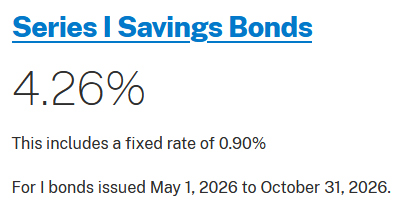
The Treasury announced this morning it is holding the fixed rate of the U.S. Series I Savings Bond at 0.90%, the rate in effect since since November 2025. This decision sets the I Bond’s six-month composite rate at 4.26% for purchases from May to October 2026.
This is exactly as I predicted, which means the Trump administration is carrying forward the basis of a decade-long formula for determining the fixed rate. That is very good news for I Bond investors.
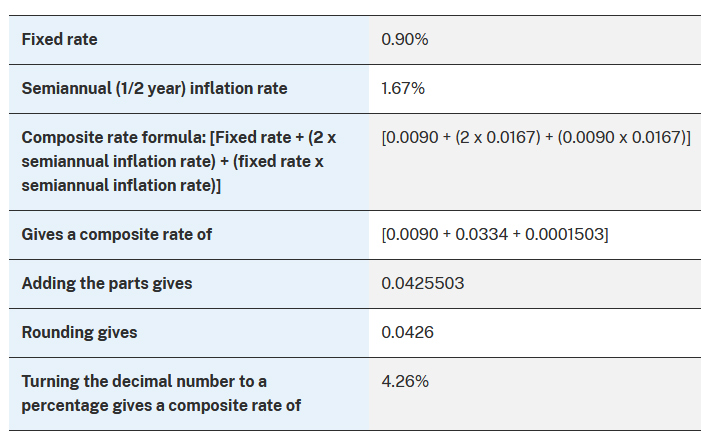
An I Bond pays interest based on a semi-annual inflation rate (in this case 1.67% from October 2025 to March 2026) and a fixed rate (which remains at 0.90%). Here is how the Treasury combines the two rates to get a composite rate of 4.26%:
The variable rate
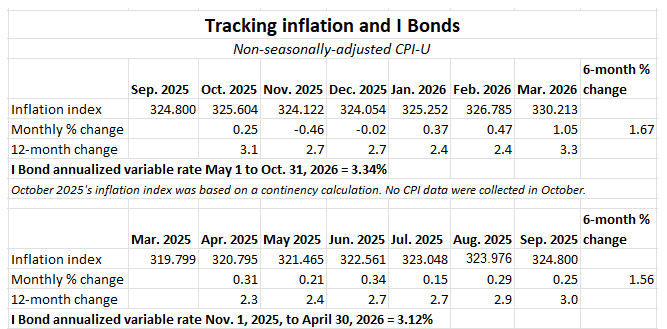
The inflation-adjusted rate (often called the I Bond’s variable rate) is now 3.34%. That rate will apply to all I Bonds ever issued, with the starting date depending on the original month of purchase. I Bonds purchased in April will get an annualized composite rate of 4.03% for six months, and then 4.26% for six months beginning in October.
The variable rate of 3.34% means that even I Bonds from past years with fixed rates of 0.0% will earn 3.34% for six months, a yield on a par with high-quality money market funds.
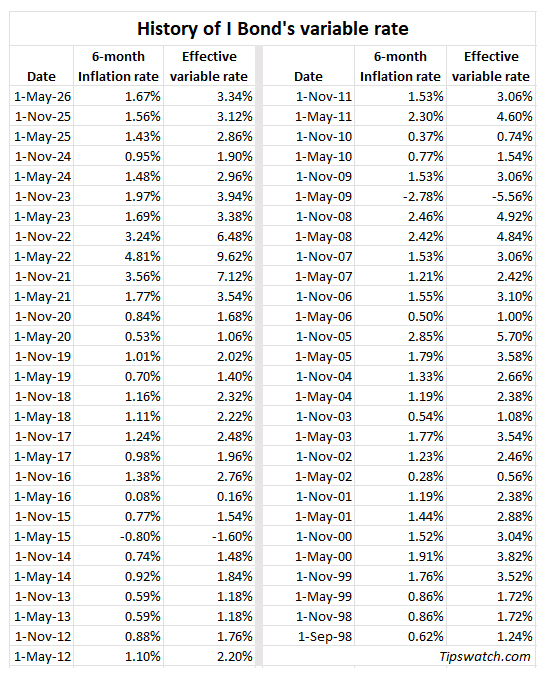
Here are the inflation numbers used to determine the variable rate:
The fixed rate
Here is the formula — devised by Boglehead geniuses — I have been using to forecast the Treasury’s fixed-rate decision: Apply a ratio of 0.65 to the average real yield of the 5-year TIPS over the last six months. This formula has worked, without fail, for 13 fixed-rate resets since November 2017. it is reassuring to see past practices continued.
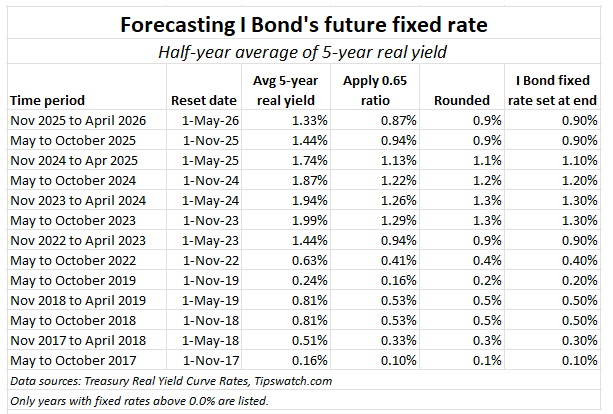
The fixed rate is crucial for I Bond investors because it creates the real yield over inflation. A fixed rate of 0.90% means an I Bond will out-perform future inflation by 0.90%. This is a solid fixed rate, in my opinion, and it means your investment can continue to surpass official U.S. inflation for as long as you hold the I Bond, up to 30 years.
The composite rate
Because the fixed rate held at 0.90%, I Bonds purchased in April (too late for that now) will have a full-year return of 4.16%, combining six months of 4.03% and six of 4.26%. I Bonds purchased any time from May to October will earn six months of 4.26%, and then an undetermined composite rate based on the next rate reset on November 1.
This annualized yield of 4.26% is highly attractive in today’s market for safe investments, but keep in mind that an I Bond has to be held for 1 year and then any redemption before 5 years will lose the last three months of interest. In my opinion, I Bond investors should be looking to hold for 5 years and then cash in when they need the money.
FYI: Today’s update from the Treasury continues to carry the purchase limit of $10,000 per person per calendar year. However, it is possible to add to your holdings through gift-box, trusts, or business-owner strategies.
EE Bonds
The Treasury set the fixed rate for Series EE Bonds at 2.40% for purchases from May to October. That is down from 2.50% for purchases through April. After 20 years, EE Bonds automatically double the original purchase amount, which creates an effective return of 3.53% if held for 20 years. Treasury says:
For EE bonds you buy now, we guarantee that the bond will double in value in 20 years, even if we have to add money at 20 years to make that happen.
I suspect the Treasury gets very little investor support for EE Bonds. You can do better with short-term investments (3.75% on the 1-year T-bill) and better with long-term investments (4.97% on the 20-year Treasury note).
I Bonds remain attractive
New investors through October 2026 will be getting a six-month annualized return of 4.26%, better than the current market for short-term Treasury bills. I remain a fan of and advocate for I Bonds. I bought my 2026 allocation in April.
I Bonds work well as a secondary emergency fund, constantly adjusting to inflation. There are no state income taxes, federal taxes are deferred, the maturity date is flexible, and the value of the investment can never decline with “market trends.” You won’t get rich, but this is a strong investment for preserving capital.
If you didn’t buy in April. No problem. This was a “toss-up” decision and now you can buy in May (later in the month is wise) or better yet, just wait it out until October to decide on a purchase. On October 14, the Bureau of Labor Statistics will release the September inflation report, which will set in stone the next variable rate. And by that point we will have a pretty good idea of the next fixed rate. You’ll have a two-week period to make a decision.
If you did buy in April. If you bought your full 2026 allocation before today, you can sit back and await the November rate decision. Whatever that is, it will be available through April 2027, so the purchase cap will reset on January 1. Or … you could be daring and jump into the gift-box loophole.
For the nerds
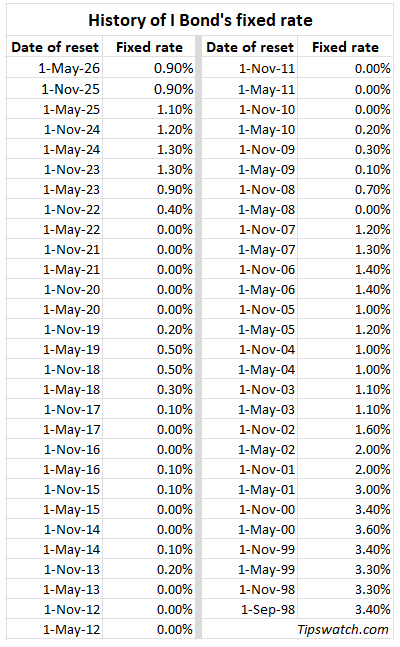
Here is the entire history of the I Bond’s fixed rate:
And here is the variable rate history:
• Confused by I Bonds? Read my Q&A on I Bonds
• Let’s ‘try’ to clarify how an I Bond’s interest is calculated
• Inflation and I Bonds: Track the variable rate changes
• I Bonds: Here’s a simple way to track current value
• I Bond Manifesto: How this investment can work as an emergency fund
—————————

Donate? This site is free and I plan to keep it that way. Some readers have suggested having a way to contribute. I welcome donations, any amount. And FYI, ads on this site pay for about one visit to Costco.
—————————
Follow Tipswatch on X for updates on daily Treasury auctions and real yield trends (when I am not traveling).
Feel free to post comments or questions below. If it is your first-ever comment, it will have to wait for moderation. After that, your comments will automatically appear. Please stay on topic and avoid political tirades. NOTE: Comment threads can only be three responses deep. If you see that you cannot respond, create a new comment and reference the topic.
David Enna is a financial journalist, not a financial adviser. He is not selling or profiting from any investment discussed. I Bonds and TIPS are not “get rich” investments; they are best used for capital preservation and inflation protection. They can be purchased through the Treasury or other providers without fees, commissions or carrying charges. Please do your own research before investing.


 Treasury Inflation-Protected Securities
Completed 10,000 purchase last Monday. Also one last time being “daring”, on Tuesday purchased 2,000 additional I-bonds in Wife’s gift box and will try to deliver next week. Guess I am stlll trying to catch up after completing my secondary goal of improving the I-bond portfolio by getting rid of low fixed rate I-Bonds. Redeemed all 0%, 0.10%, and about 65% of 0.20% I-Bonds.
At what point does one consider cashing out of existing I BONDS and rolling into the newest I BOND to capture the .9% fixed rate? I’ve got a position started back in dec 21 and added in jan 22 that still isn’t past the 5 year penalty. Don’t need the money right now, treating as a second tier “emergency fund” / hedge. Would definitely want to take the income before the OBBB extra Senior deduction possibly phases out in 2028.
If you plan on holding the 0.9% I Bond for about 5 years or more, rolling over makes sense. If you bought $10,000 of that Dec 2021 I Bond, for example, it is now worth $12,232. That means you have a gain of 22.3%. All of the interest would be federally taxed. If you redeemed “just” $8,170 of that amount, you could get back about $10,000 in total with $1,822 taxable (approximate). Then you could reinvest the $10,000 proceeds. It would take some time to breakeven.
Any further updates on Savings Bond Calculator. I saw your last update. I use Safari and it still isn’t updating. Thank you.
I have tested this today (Windows & Firefox) and I could successfully open the file, link back to the calculator, update the file and save it. Once complete, I could repeat the process. So it is working with Windows/Firefox. Do you have a way to test it with Firefox?
I use Safari only. I log on to Treasury Direct to see my account . The calculator just makes it easier on me. Thank you.
This was the first year I didn’t buy in April since 2021. While the one-year return of 4.16% was tempting, I thought the same thing in April 2023 when the first-year return was 5.4% but the fixed rate was only 0.4%. It turned out I would have been better off waiting.
Now I only focus on the fixed rate. A sustained rise in the 5-year real yield to ~1.5% is all it would take to raise the I Bond’s fixed rate to 1% at the November reset. Sure, it’s a difference of only 10 basis points. However, a 1% real yield sounds a lot better than 0.9%. Most of my I Bonds have fixed rates above 1%, so that’s my benchmark for adding to my holdings. That being said, if the fixed rate looks likely to drop later this year, I will consider buying in late October.
This is true. The November 2023 I Bond had the fixed rate of 1.30%, very attractive. It’s had a nominal return of 4.28% through May, better than the April version at about 3.94%, and the 1.3% will continue to outperform year after year. I also bought in April 2023. The great thing about that 1.30% rate is that it transitioned to 2024 when I bought the full allocation plus two sets of gift boxes. So I was still able to load up on the 1.3% rate even though I “despise” the gift box strategy. (I pays to be pragmatic.)
I also used the gift box strategy in 2024 when the fixed rate was 1.3%. I bought again in 2025, but am now in “wait and see” mode, as is the bond market.
>Now I only focus on the fixed rate.
This is where my head’s been since I mathed things out.
In retirement, if (big if!) tax rates stood where they are today, my I-Bonds redemptions would be at 17% federal and 5% state income tax given my expected retirement income and where I live. I determined that I need a blended fixed rate of >= 0.6% to entirely preserve my initial capital net of taxes paid. That is, every $1 I put in now, is still $1 after inflation and taxes 20-30 years from now. If it’s higher than 0.6%, I get some net return.
I did buy some bonds with 0.0 – 0.4% fixed rates, but that’s OK, as newer issues were higher. Despite those lower fixed rate bonds I’m at a blended fixed rate of 0.8%, so I’m ahead of where I want to be.
For me, I-Bonds diversify my emergency fund (vs. FDIC-insured HYSA and SIPC-insured MMF), so my only intent for them is capital preservation. Granted, if the I-Bonds survive until retirement, they turn into a small self-funded annuity that supplements SSA as my income floor. Low-cost index funds are intended to provide the bulk of my retirement income, but that larger income floor makes it easier to mitigate early retirement SOR Risk.
It’s not an exciting instrument, but it does its job very well!
Pip pip!
Where do you think your Ibonds may taxed at the state level? Need to recalibrate? And, less expenses coupled with less income NEEDED may reduce the Fed tax too!
Interest won’t be taxed at the state level.
I like your calculations on the after-tax returns. I’m fortunate in that we have no State income tax.
@Dr, @Tipswatch
Ah, yes! Forgot about that! :0)
Well, I guess I could be in the 22% federal bracket and still have a 0.6% fixed rate maintain after-tax/inflation parity.
Though with no state taxes assessed means I only need ~0.46% blended fixed rate to fully preserve initial capital.
A 0.34% compounding return isn’t much, but when my goal is merely for $1 to remain $1, I’ll always take that win! Plus if I can grow that blended fixed-rate over time, it increasingly turns into the self-funded annuity I intend it to be.
Pip pip!
Great prediction!