U.S. annual inflation ticked higher in May, but below expectations

By David Enna, Tipswatch.com

U.S. inflation continued rising at a moderate rate in May, with all-items prices increasing only 0.1% on a seasonally adjusted basis, the Bureau of Labor Statistics reported today. The annual inflation rate for May increased to 2.4%, up from 2.3% in April.

Core inflation, which strips out food and energy, also increased 0.1% and at an annual rate of 2.8%, down from 2.9% for April. All of these results were below economist expectations and should be viewed positively today by financial markets.

May’s result continues a recent string of lower-than-expected inflation reports.

The BLS said shelter costs rose 0.3% in May and were the primary factor in the all-items and core inflation increases. Shelter costs were up 3.9% year over year. Here are other notable items from the report:

  • The cost of food at home increased 0.3% for the month and 2.2% year over year.
  • Gasoline prices fell 2.6% for the month and are down 12.0% for the year.
  • Apparel costs — which could be affected by tariffs in the near future — fell 0.4% for the month.
  • Prices for new vehicles fell 0.3% for the month and are up only 0.4% year over year.
  • Costs for used cars and trucks also fell 0.5% for the month.
  • The cost of motor vehicle insurance rose 0.7% in May and was up 7.0% year over year.
  • Airline fares fell 2.7% in May and 7.3% over the last year.

Overall, U.S. prices seems to be showing little effect from U.S. tariffs, which began rolling into effect in May. Overall inflation appears to be being held down, at the moment, by declining gasoline prices and held higher by increasing shelter costs.

Here is the one-year trend in annual all-items and core inflation, showing the relatively stable pattern over the last three months:

What this means for TIPS and I Bonds

Investors in Treasury Inflation-Protected Securities and U.S. Series I Savings Bonds are also interested in non-seasonally adjusted inflation, which is used to adjust principal balances on TIPS and set future interest rates for I Bonds. For May, the BLS set the CPI-U inflation index at 321.465, an increase of 0.21% over the April number.

For TIPS. Based on the May inflation number, principal balances for all TIPS will increase 0.21% in July, after increasing 0.31% in April. For the year ending in July, principal balances will have increased 2.4%. Here are the new July inflation indexes for all TIPS.

For I Bonds. The May inflation report is the second in a six-month string that will determine the I Bond’s new variable rate, which will be reset on November 1 based on inflation for April through September. Two months in, inflation has increased 0.52%, which translates to a variable rate of 1.04%. It’s too early to draw any conclusions from that. Here are the data:

See historical data on my Inflation and I Bonds page.

What this means for future interest rates

The current string of moderately low inflation reports should be clearing the way for future cuts in short-term interest rates by the Federal Reserve. But the overhanging uncertainty about tariffs is a roadblock to any Fed decision.

Bloomberg’s headline this morning is: “Cool US CPI Boosts Bets on Two Fed Rate Cuts by Year-End.” I’d say we were probably heading that way anyway, and today’s inflation report solidifies that trend. But inflation traders still see inflation picking up later this year to around 3.2%.

Inflation expert Michael Ashton posted this analysis this morning:

While we haven’t seen a major impact from tariffs yet, and my view is that it won’t be a huge impact in any case except for particular items, I am pretty sure we will see something and median and core inflation will see acceleration over the balance of this year and into next year.

Uncertainty remains. While we may see cuts in short-term rates later this year, longer-term Treasury rates could continue rising as the U.S. heads toward higher future deficits and higher borrowing. We are going to see a lot of “crisis talk” in coming weeks as we march toward a massive tax bill and debt-ceiling limit.

* * *

Follow Tipswatch on X for updates on daily Treasury auctions and real yield trends (when I am not traveling).

Feel free to post comments or questions below. If it is your first-ever comment, it will have to wait for moderation. After that, your comments will automatically appear. Please stay on topic and avoid political tirades. NOTE: Comment threads can only be three responses deep. If you see that you cannot respond, create a new comment and reference the topic.

David Enna is a financial journalist, not a financial adviser. He is not selling or profiting from any investment discussed. I Bonds and TIPS are not “get rich” investments; they are best used for capital preservation and inflation protection. They can be purchased through the Treasury or other providers without fees, commissions or carrying charges. Please do your own research before investing.

Posted in Federal Reserve, I Bond, Inflation, Investing in TIPS | Tagged , , , | 18 Comments

Inflation data collection is getting scaled back: What does it mean?

By David Enna, Tipswatch.com

The Bureau of Labor Statistics, which compiles and publishes monthly U.S. inflation reports, posted a cryptic announcement this week noting it was scaling back collection of data on prices.

BLS is reducing sample in areas across the country. In April, BLS suspended CPI data collection entirely in Lincoln, NE, and Provo, UT. In June, BLS suspended collection entirely in Buffalo, NY.  

Sample reduction and collection suspension affect both the commodity and services survey and the housing survey. These actions have minimal impact on the overall all-items CPI-U index, but they may increase the volatility of subnational or item-specific indexes. The number of imputed items and the response rates increased in April due to these actions. BLS makes reductions when current resources can no longer support the collection effort. BLS will continue to evaluate survey operations.  

The cutbacks are a reaction to staffing shortages after deep job cuts earlier this year in the Labor Department and other U.S. agencies. The BLS acknowledged a “staffing shortage” in an email sent to economists, the Associated Press reported.

These cuts and others have raised alarms that U.S. economic reports could be sliding toward inaccuracy or be otherwise compromised. The AP noted:

The cutbacks have intensified worries among economists that government spending cuts could degrade the federal government’s ability to compile key economic data on employment, prices, and the broader economy. The BLS also said last month that it will no longer collect wholesale prices in about 350 categories for its Producer Price Index, a measure of price changes before they reach the consumer. …

“The PPI is cutting hundreds of indexes from production, and the CPI is now being constructed with less data,” Omair Sharif, chief economist at the consulting firm Inflation Insights, said in an email. “That alone is worrying given that we’re heading into the teeth of the tariff impact on prices.”

The BLS, however, said the cuts would have “minimal impact” on overall inflation data, while noting volatility could increase for some items and regions.

What does it mean?

At this point, the move appears to be a reaction to staffing cuts and not an attempt to “cook” the U.S. inflation numbers, as some people have feared. Erica Groshen, a former commissioner of BLS, told the AP the agency has lost about 15% of its personnel since the beginning of the year.

But that doesn’t mean we shouldn’t be wary. Earlier this year, the Trump administration disbanded the Federal Economic Statistics Advisory Committee, which worked with BLS on fine-tuning data-gathering. The latest calendar item for the FESAC, dated June 13, says: “Meeting Canceled.”

That was an odd move at a time of staffing cuts. Members of the FESAC, which was chartered to continue through September 2026, essentially worked for free, receiving only travel expenses. The agency’s total annual budget was about $120,000 for five staff people.

Don’t panic. Yet.

From Wall Street Journal coverage yesterday:

Economists say the staffing shortage raises questions about the quality of recent and coming inflation reports. There is no sign of an intentional effort to publish false or misleading statistics. But any problems with the data could have major implications for the economy. …

If the government’s enumerators can’t track down a specific price in a given city, they try to make an educated guess based on a close substitute: say, cargo pants instead of slacks. But in April, with fewer workers on hand to check prices, statisticians had to base their guesses on less comparable products or other regions of the country—a process called different-cell imputation—much more often than usual, according to the BLS.

The WSJ article included a chart showing the large spike in “estimation” used in the April inflation report. (Remember, estimation is just a fancy word for educated guessing.)

Michael Ashton, an inflation expert who founded the firm Enduring Investments, posted on X a non-alarmist reaction to the BLS announcement:

So, without any evidence to the contrary, I will accept that the U.S. inflation numbers will continue to be “relatively accurate,” which is about as good as they ever were. But we have to accept that budget and staffing cuts at the BLS are going to lead to less accuracy, not more accuracy.

Accuracy, while not perfectly attainable, should be the ultimate goal. These U.S. inflation reports are hugely important because they lead to:

  • Cost of living adjustments for Social Security recipients.
  • Federal Reserve decisions on future interest rates.
  • Interest rate changes for Series I Savings Bonds.
  • Principal adjustments for Treasury Inflation-Protected Securities.
  • Wage increases under some union contracts.

Be aware. Or to put it another way: “Beware.”

* * *

Follow Tipswatch on X for updates on daily Treasury auctions and real yield trends (when I am not traveling).

Feel free to post comments or questions below. If it is your first-ever comment, it will have to wait for moderation. After that, your comments will automatically appear. Please stay on topic and avoid political tirades. NOTE: Comment threads can only be three responses deep. If you see that you cannot respond, create a new comment and reference the topic.

David Enna is a financial journalist, not a financial adviser. He is not selling or profiting from any investment discussed. I Bonds and TIPS are not “get rich” investments; they are best used for capital preservation and inflation protection. They can be purchased through the Treasury or other providers without fees, commissions or carrying charges. Please do your own research before investing.

Posted in Federal Reserve, I Bond, Inflation, Investing in TIPS | Tagged | 38 Comments

What happened while I was gone? Good things!

By David Enna, Tipswatch.com

Long-time readers of this site know when I go on holiday, bad things happen. There’s consistently a debt crisis overload, a banking crisis, housing collapse, Fed reversals, lavish tariff announcements and roll-backs, etc.

I’ve been touring Scandinavia since May 10. That’s three weeks, but it feels like a lifetime in an era of financial unrest. During that time, I saw very little financial news. Although I could sometimes watch CBNC on board the Viking Vela, my wife usually nixed that channel immediately. Plus, I was dealing with a 6-hour time shift.

So now, knowing little about what happened since May 10, I am going to look at what matters: the actual results.

Our net worth

From May 10 to June 1, our family net worth increased 1.78%. Case closed. This is the only financial measurement that matters, right? Things worked out well, no matter the potential chaos between those dates. But keep in mind that my stock allocation is only 35%. If yours is higher, you did even better.

Total U.S. stock market

Using Vanguard’s VTI ETF as the baseline, the net asset value of the total stock market had a positive return of 4.28% from May 10 to May 30. Over the last month, its total return (including dividends) was 6.25%.

Total international stock market

Using Vanguard’s VXUS ETF as the baseline, the net asset value of the total international stock market had a positive return of 3.03% from May 10 to May 30. Its total return over the last month was 4.82%.

Total bond market

Using Vanguard’s BND ETF as a baseline, the net asset value of the U.S. total bond market increased 0.28% from May 10 to May 30, despite fairly large swings in Treasury yields during that period. However, its total return for the full month of May was -0.67%.

Real yields

Throughout 2025, the real yield curve of Treasury Inflation-Protected Securities has been steepening. Longer-term investors are being rewarded with higher yields to compensate for the higher risk of a long-term investment. This is actually a return to “normalcy,” but we haven’t seen it often in the last dozen years.

Based on tax and spending proposals moving through Congress, U.S. deficits appear likely to continue increasing (possibly sharply) over the next five to ten years. The bond market is unhappy — and the result is higher yields, especially for mid- to longer-term Treasury investments. Here is what happened over the last three weeks:

What’s interesting in this chart is that real yields ended May at their lowest level of the three-week period. The shorter end of the curve is much lower, possibly reacting to potential Federal Reserve interest rate cuts later in 2025. But the longer-term end of the curve is holding solidly higher. These are attractive levels, in my opinion, for hold-to-maturity investors. Others disagree, as reflected in this report from Bloomberg this morning:

For DoubleLine Capital, there are two approaches to consider when it comes to 30-year US Treasuries: either avoid them, to the degree they can, or outright short them.

Wary of America’s swelling federal budget gap and growing debt burden, the money manager led by Jeffrey Gundlach is part of a wave of investment firms — including Pacific Investment Management Co. and TCW Group Inc. — that are steering away from the longest-dated US government bonds in favor of shorter maturities that carry less interest-rate risk but still offer a decent yield.

Bob Michele, the global head of fixed income at JPMorgan Asset Management, said last week that the long bond isn’t trading now like the risk-free asset Wall Street always believed it to be, and that the possibility of a reduction or cancelation of the auctions is real.

“I don’t want to be the one to stand in front of the steamroller right now,” Michele said in a Bloomberg Television interview. “I’ll let somebody else help stabilize the long end. I’m concerned that it’s going to get worse before it gets better.”

So, despite the positive news that the stock market brought in the last three weeks, the U.S. Treasury market remains troubled. It is impossible to say where real yields are heading, but higher is a definite possibility if the bond market stages a revolt.

In my headline I used the phrase “good things.” I am not sure that the events of the last three weeks match that phrase, but so far the markets are adapting.

What’s ahead

I’ll try to catch up on financial news, of course. We will get the May inflation report at 8:30 a.m. on June 11, then get a 5-year TIPS reopening auction on June 17 (a Tuesday)!

Eventually the debt-limit debacle will reach crisis mode before it is solved. That could end up creating aberrations in the short-term Treasury market. I will be watching for that.

If you have ideas for new content, or just strong (but not overly political) opinions, let everyone know in the comment sections below.

Now is an ideal time to build a TIPS ladder

Confused by TIPS? Read my Q&A on TIPS

TIPS in depth: Understand the language

TIPS on the secondary market: Things to consider

TIPS investor: Don’t over-think the threat of deflation

Upcoming schedule of TIPS auctions

* * *

Follow Tipswatch on X for updates on daily Treasury auctions and real yield trends (when I am not traveling).

Feel free to post comments or questions below. If it is your first-ever comment, it will have to wait for moderation. After that, your comments will automatically appear. Please stay on topic and avoid political tirades. NOTE: Comment threads can only be three responses deep. If you see that you cannot respond, create a new comment and reference the topic.

David Enna is a financial journalist, not a financial adviser. He is not selling or profiting from any investment discussed. I Bonds and TIPS are not “get rich” investments; they are best used for capital preservation and inflation protection. They can be purchased through the Treasury or other providers without fees, commissions or carrying charges. Please do your own research before investing.

Posted in Federal Reserve, Inflation, Investing in TIPS, Treasury Bills | Tagged , , , , , | 36 Comments

10-year TIPS reopening auction gets real yield of 2.220%, 2nd highest in 16 years

By David Enna, Tipswatch.com

At this moment, I am on a Viking cruise ship sailing out of Gdansk, Poland, and could lose internet access at any moment. So this is going to be quick.

The U.S. Treasury’s $18 billion reopening auction of a 10-year Treasury Inflation-Protected Security — CUSIP 91282CML2 — generated a real yield to maturity of 2.220%, the second highest result at auction for this term in 16 years. This result exactly matched the “when issued” prediction, released just before the auction’s close. The bid-to-cover ratio was 2.36, a decent level. In other words, demand was acceptable.

Definition: The “real yield to maturity” of a TIPS is its yield above official future U.S. inflation, over the term of the TIPS. So a real yield of 2.20% means an investment in this TIPS would provide a return that exceeds U.S. inflation by 2.20% for 9 years, 8 months.

CUSIP 91282CML2 had its originating auction on January 23, when it generated a real yield to maturity of 2.243%, just slightly higher. That set its coupon rate at 2.125%.

I have been in Scandanavia for 10 days now, and from what I can see the U.S. bond market has been a bit volatile, due primarily to congressional action on future tax cuts. The end result (as always) is that federal deficits are likely to rise fairly dramatically over the next 10 years. The bond market is not happy, but so far it isn’t throwing a fit.

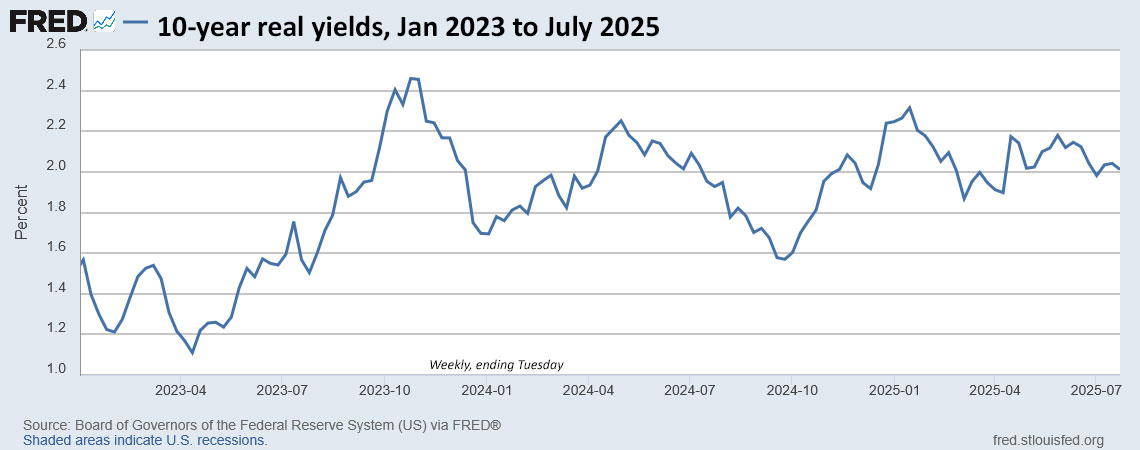
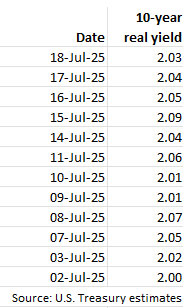
So we have real yields bumping on 16-year highs. This is a trend that could continue throughout 2025, unless the Federal Reserve decides to take extreme action, which seems unlikely. Here is the trend in the 10-year real yield over the last two years:

The data on this chart ended Monday. Today’s auction result was higher.

Opinion: A real yield of 2.220% offers an attractive above-inflation return for an investor willing to hold to maturity. And it’s very possible that real yields will continue rising. We are in an “era of uncertainty.” But getting 2.220% above inflation, guaranteed, is attractive.

Pricing

This auction’s real yield of 2.220% was slightly above the coupon rate of 2.125%, so investors got CUSIP 91282CML2 at a discount, with an unadjusted price of 99.178357. In addition, this TIPS will have an inflation index of 1.01320 on the settlement date of May 30. With that information, we can calculate the cost of $10,000 par value of this TIPS:

  • Par value: $10,000.
  • Principal purchased as of May 30: $10,000 x 1.01320 =$10,132.00.
  • Cost of investment: $10,132.00 x 0.99178357=$10,048.75.
  • + accrued interest of $80.29.

To summarize, an investor buying $10,000 par value at today’s auction paid $10,048.75 for $10,132.00 of principal as of May 30. From then on, the investor will earn adjustments to principal equaling U.S. inflation over the next 9 years, 8 months, plus collect a coupon rate of 2.125% annually on adjusted principal. The accrued interest will be returned at the first coupon payment in July.

Inflation breakeven rate

The 10-year Treasury note was yielding 4.56% at the auction’s close, meaning this TIPS has an inflation breakeven rate of 2.34%. The TIPS will outperform the nominal Treasury if inflation averages more than 2.34% over the next 9 years, 8 months.

I’ve seen speculation recently that the 10-year note’s yield could exceed 5% in the near future because of bond-market unease. That would probably drag the 10-year TIPS yield up to at least 2.6%, possibly higher. I’d consider a 5% 10-year Treasury note an attractive nominal investment. Same for the 20-year TIPS with a real yield of 2.68%, the current rate.

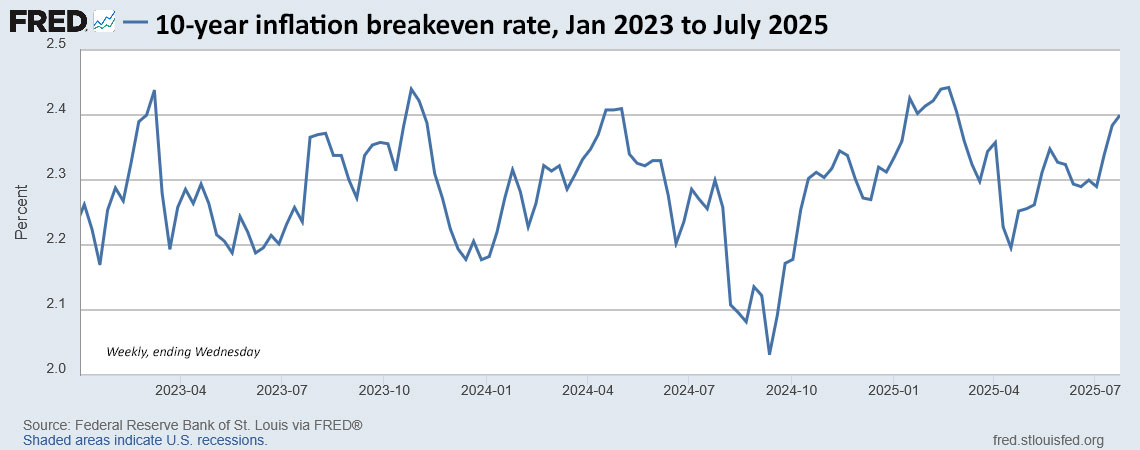
Here is the trend in the 10-year inflation breakeven rate over the last two years, showing a fairly wild ride in inflation expectations:

Thoughts

My internet held out, so now I can add a brief rant.

I admit to being out of touch. It seems like a lot of craziness has been happening in the last 10 days (or six months, honestly). I don’t have a grasp on where we are heading. Inflation “appears” to be moderating, but tariffs could cause extreme disruptions. For example, should Walmart raise prices to match its tariff costs? The answer seems obvious: Of course it should. (I am a Walmart shareholder; maybe I am biased.) Walmart could “eat” some of the costs, but their competitors face the same disruptions. So everyone will be raising prices.

The bigger issue right now is the path of future U.S. deficits. I agree we face a “spending problem,” but adding in huge new tax cuts is only going to make the problem worse. I just want a responsible federal government, making sure tax revenues and spending are coming more into line.

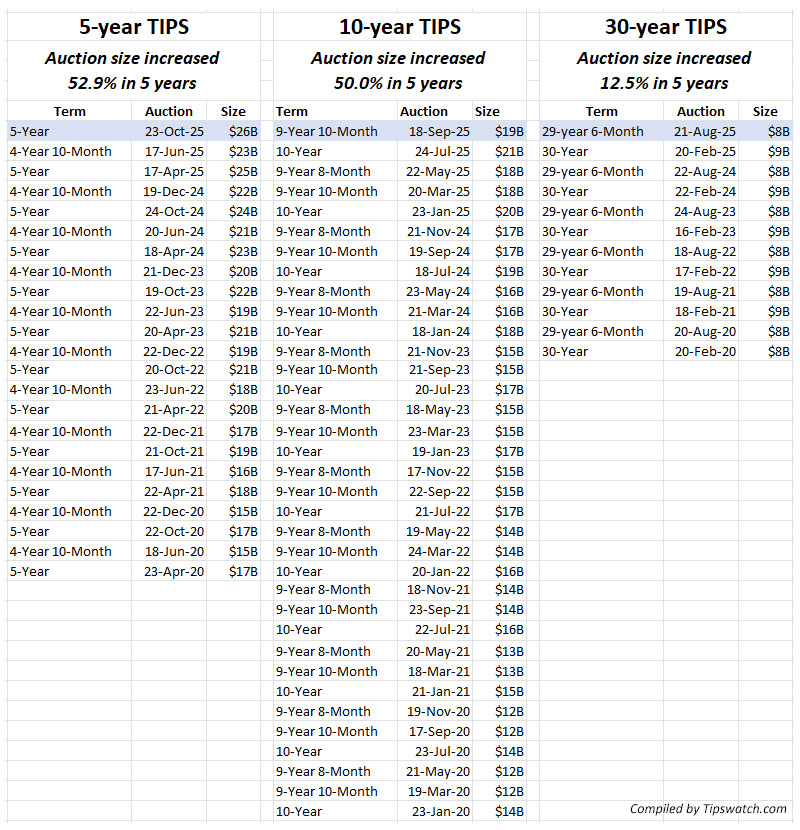
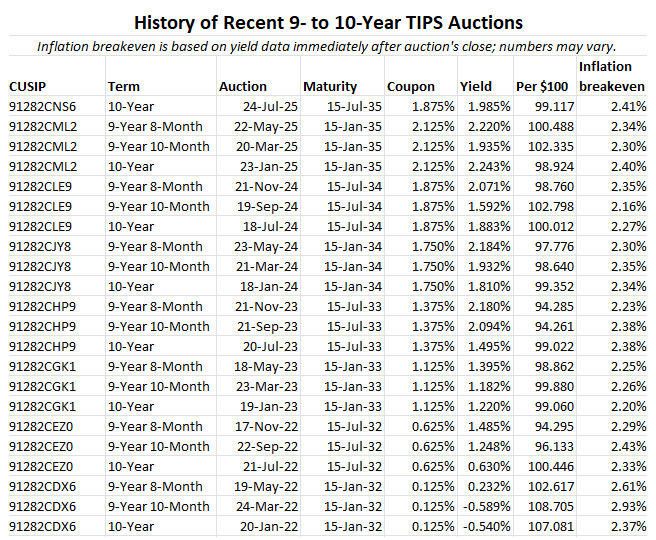
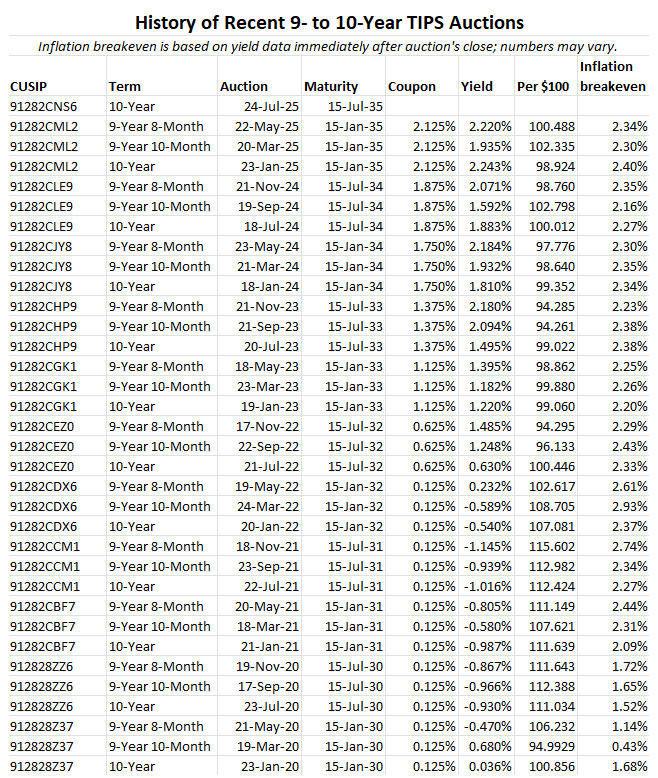
Tipswatch is not about politics, though. I congratulate investors at today’s auction for getting an attractive result. Here is a look at auctions of this term over the last 5 years:

Now is an ideal time to build a TIPS ladder

Confused by TIPS? Read my Q&A on TIPS

TIPS in depth: Understand the language

TIPS on the secondary market: Things to consider

TIPS investor: Don’t over-think the threat of deflation

Upcoming schedule of TIPS auctions

* * *

Follow Tipswatch on X for updates on daily Treasury auctions and real yield trends (when I am not traveling).

Feel free to post comments or questions below. If it is your first-ever comment, it will have to wait for moderation. After that, your comments will automatically appear. Please stay on topic and avoid political tirades. NOTE: Comment threads can only be three responses deep. If you see that you cannot respond, create a new comment and reference the topic.

David Enna is a financial journalist, not a financial adviser. He is not selling or profiting from any investment discussed. I Bonds and TIPS are not “get rich” investments; they are best used for capital preservation and inflation protection. They can be purchased through the Treasury or other providers without fees, commissions or carrying charges. Please do your own research before investing.

Posted in Federal Reserve, Inflation, Investing in TIPS, Tariffs | Tagged , , , , , | 19 Comments

Thursday’s 10-year TIPS reopening auction deserves attention

May 22 update: Reopening option gets real yield of 2.220%

By David Enna, Tipswatch.com

The U.S. Treasury on Thursday will auction $18 billion of a reopened 10-year Treasury Inflation-Protected Security, CUSIP 91282CML2. The result will be a 9-year, 8-month TIPS with an already-set coupon rate of 2.125%.

At this point — Sunday a week before the auction — it looks like the real yield to maturity could be around 2.11% and the inflation breakeven rate at 2.32%. But a lot can change before the auction, which will close at 1 p.m. Thursday. These are volatile times in the U.S. bond market.

Definition: The “real yield to maturity” of a TIPS is its yield above official future U.S. inflation, over the term of the TIPS. So a real yield of 2.11% means an investment in this TIPS would provide an annual return that exceeds U.S. inflation by 2.11% for 9 years, 8 months.

CUSIP 91282CML2 had its originating auction on January 23, when it generated a real yield to maturity of 2.243%, the highest auction result for this term in 16 years. That auction set the coupon rate at 2.125%.

It then had its first reopening auction on March 20, with a real yield to maturity of 1.935%. Thursday’s auction will close the books on CUSIP 91282CML2, and the Treasury will auction a new 10-year TIPS on July 24.

So now — potentially — investors have a chance to grab a 10-year TIPS (either at auction or on the secondary market) with a real yield above 2%, a historically attractive milestone. Of course, real yields can continue rising; there is no guarantee. But a 2% yield above future inflation is a solid investment, if the TIPS is held to maturity.

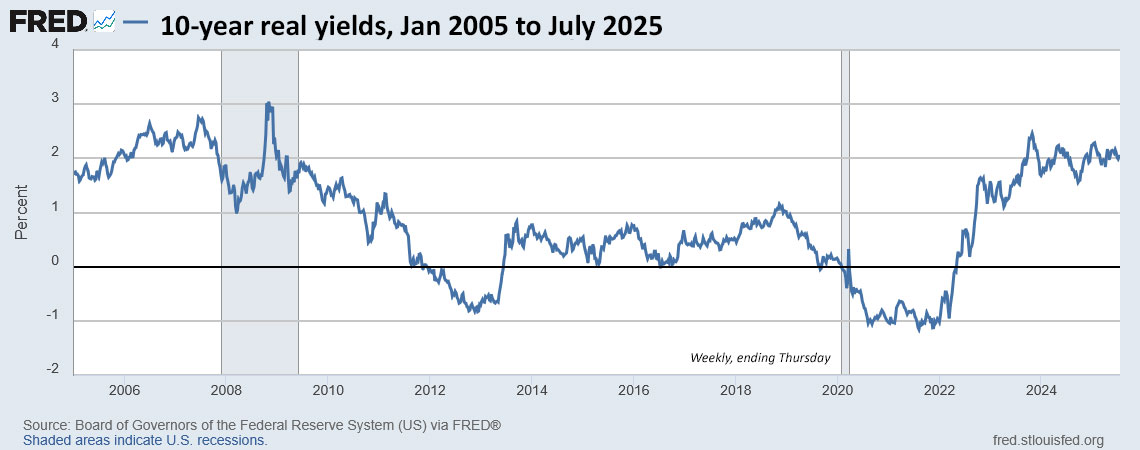
Here is the trend in the 10-year real yield over the last 15 years, showing that yields remain near 15-year highs:

Click on image for larger version.

Pricing

Friday’s closing real yield of 2.11% is just slightly below the coupon rate of 2.125%, so CUSIP 91282CML2 is currently trading at a slightly premium price of 100.13. In addition it will have an inflation index of 1.01320 on the settlement date of May 30. So if the real yield holds at 2.11% at the auction (it won’t be exactly that, but this is an example) here is the investment cost of a $10,000 par value purchase:

  • Par value: $10,000.
  • Inflation-adjusted principal: $10,132.
  • Cost of investment: $10,132 x 1.00132 = $10,145.37
  • + accrued interest of about $80.

In summary, under this scenario an investor would pay $10,145.37 for $10,132 of principal. From that point on, the investment would grow with accruals on principal matching U.S. inflation, plus receive annual coupon interest of 2.125%.

Inflation breakeven rate

The 10-year nominal Treasury note closed Friday with a yield of 4.43%, giving this TIPS an inflation breakeven rate of 2.32%, a historically high number but in the range of recent auctions. Inflation over the last 10 years, ending in April, averaged 3.1%.

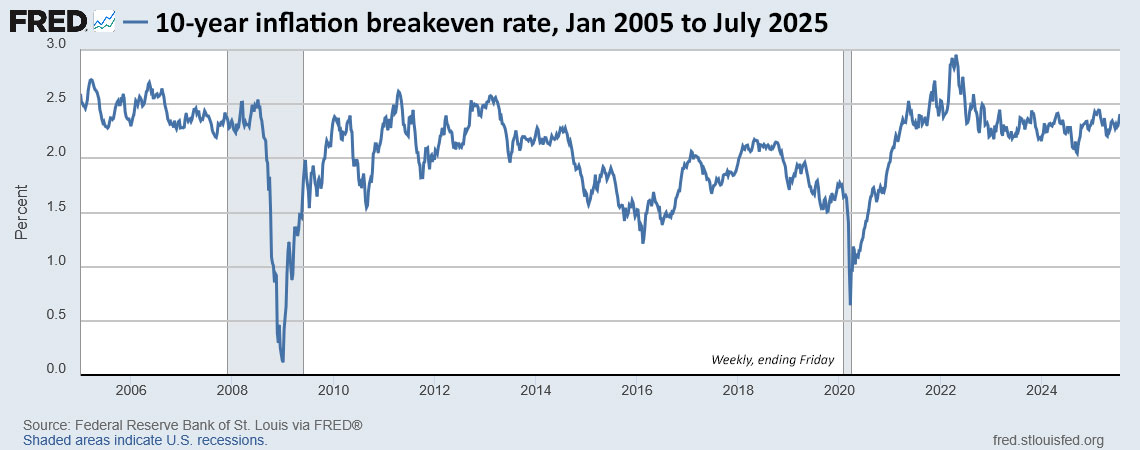
If you think inflation is going to average higher than 2.32% over the next 9 years, 8 months, buy the TIPS. If not, invest in the nominal Treasury. Here is the trend in the 10-year inflation breakeven rate over the last 15 years, showing the breakeven hovering in the 2% to 2.5% range over the last three years:

Thoughts

If you are interested in CUSIP 91282CML2, you can swoop in at any time and buy it on the secondary market, if you see a real yield you like. The advantage there is you will know the exact real yield you are receiving. The advantage of buying at auction, especially through TreasuryDirect, is that even small-lot purchases will get the auction’s high yield.

Either way, if the real yield holds around 2.11%, this will be an attractive auction. I won’t be a buyer, since I purchased my 2035 allotment at the January auction, when the real yield was slightly higher. Reminder: There is no way to know where real yields are heading. Higher U.S. deficits certainly could result in higher yields for longer-term Treasurys.

You can track the real yield of this TIPS in real time on Bloomberg’s Yields Curve page. It is the 10-year TIPS listed there.

This TIPS auction closes Thursday at 1 p.m. EST. Non-competitive bids at TreasuryDirect must be placed by noon Thursday. If you are putting an order in through a brokerage, make sure to place your order Wednesday or very early Thursday, because brokers cut off auction orders before the noon deadline.

I will be posting the auction results soon after the close, but my timing is uncertain since I am traveling this week in Scandanavia, with a six-hour time difference. Here is a history of auction results for this term over the last 5 years:

Now is an ideal time to build a TIPS ladder

Confused by TIPS? Read my Q&A on TIPS

TIPS in depth: Understand the language

TIPS on the secondary market: Things to consider

TIPS investor: Don’t over-think the threat of deflation

Upcoming schedule of TIPS auctions

* * *

Follow Tipswatch on X for updates on daily Treasury auctions and real yield trends (when I am not traveling).

Feel free to post comments or questions below. If it is your first-ever comment, it will have to wait for moderation. After that, your comments will automatically appear. Please stay on topic and avoid political tirades. NOTE: Comment threads can only be three responses deep. If you see that you cannot respond, create a new comment and reference the topic.

David Enna is a financial journalist, not a financial adviser. He is not selling or profiting from any investment discussed. I Bonds and TIPS are not “get rich” investments; they are best used for capital preservation and inflation protection. They can be purchased through the Treasury or other providers without fees, commissions or carrying charges. Please do your own research before investing.

Posted in Inflation, Investing in TIPS, TreasuryDirect | Tagged , , , | 27 Comments