5-year TIPS auction gets real yield of 1.702% to apparently weak demand

By David Enna, Tipswatch.com

The Treasury’s auction of a new 5-year TIPS, CUSIP 91282CNB3, was a hard one to predict. Real yields have been sliding all over the place in the last week.

You might have seen real yield predictions as low as 1.53%, where the most recent 5-year TIPS was trading this morning. Or as high as 1.62%, the Treasury’s estimate at market close Wednesday. I expected a yield a bit higher than that.

The end result was a real yield of 1.702%, which I would consider a nice result for investors. The “when-issued” yield prediction, revealed just before the auction’s close, was 1.68%. The bid-to-cover ratio was a low-to-middling 2.28. All of this indicates weak investor demand for this auction.

In my preview article, I noted that the Treasury’s 5-year real yield estimate closed at 1.82% on Friday. But I expected volatility this week. And so it goes.

Here is the trend in the 5-year real yield over the last two years. The chart closes with the yield estimate on Tuesday. Note the higher auction result:

Click on image for larger version.

Pricing

The auction set the coupon rate for CUSIP 91282CNB3 at 1.625%, same as the October auction of a new 5-year TIPS, issued just days before the November presidential election. That auction got a real yield of 1.670%, lower than today’s result.

Because the coupon rate for this new TIPS was below the real yield of 1.702%, buyers got it at a discounted price of 99.634784. In addition, it will carry an inflation index of 1.00222 on the settlement date of April 30. With that information, we can calculate the exact cost of $10,000 par value at this auction:

  • Par value: $10,000
  • Principal purchased as of April 30: $10, 022.20
  • Cost of investment: $10, 022.20 x 0.99634784 = $9,985.60
  • + accrued interest of $6.67

In summary, an investor buying $10,000 par value at this auction paid $9,985.60 and will receive $10,022.20 in principal on the settlement date of April 30.

Inflation breakeven rate

With the 5-year Treasury note trading with a nominal yield of 3.93% at the auction’s close, this TIPS gets a 5-year inflation breakeven rate of 2.23%, a rather low number given our uncertain inflation future. This partly reflects weak demand at this auction, with the real yield rising while the 5-year nominal yield was stable this morning.

Here is the trend in the 5-year inflation breakeven rate over the last 2 years, showing the strong dip in inflation expectations since February:

Click on image for larger version

Thoughts

I knew this 5-year TIPS auction was going to be hard to predict — this is the case with all 5-year TIPS auctions. The October new issue tends to get a real yield lower than “market,” and the April auction in turn tends to get a higher real yield than expected. The reason is the way the non-seasonal inflation affects the final months to maturity of the April issue. Investors expect some deflationary months in the October to December quarter and want a higher real yield as compensation.

So today’s real yield of 1.702% looks good for investors, in my opinion. I was expecting something more in the 1.65% to 1.68% range. It could be that the holiday week and the early auction time contributed to weak demand, resulting in a higher yield.

This TIPS will be reopened at auction on June 17 and then another new 5-year TIPS will be auctioned in October. Here is a history of 4- to 5-year TIPS auctions over the last five years, showing that we’ve come a long way from the -1.685% real yield of the October 2021 auction:

Now is an ideal time to build a TIPS ladder

Confused by TIPS? Read my Q&A on TIPS

TIPS in depth: Understand the language

TIPS on the secondary market: Things to consider

TIPS investor: Don’t over-think the threat of deflation

Upcoming schedule of TIPS auctions

* * *

Follow Tipswatch on X (Twitter) for updates on daily Treasury auctions and real yield trends (when I am not traveling).

Feel free to post comments or questions below. If it is your first-ever comment, it will have to wait for moderation. After that, your comments will automatically appear. Please stay on topic and avoid political tirades. NOTE: Comment threads can only be three responses deep. If you see that you cannot respond, create a new comment and reference the topic.

David Enna is a financial journalist, not a financial adviser. He is not selling or profiting from any investment discussed. I Bonds and TIPS are not “get rich” investments; they are best used for capital preservation and inflation protection. They can be purchased through the Treasury or other providers without fees, commissions or carrying charges. Please do your own research before investing.

Posted in Federal Reserve, Inflation, Investing in TIPS, TreasuryDirect | Tagged , , , , | 21 Comments

5-year TIPS auction presents a dilemma

You can find better real yields by stretching out the maturity date, just a bit.

By David Enna, Tipswatch.com

Important note, April 16: Treasury posted an amended announcement for this Thursday auction, moving up the closing times (probably because of the holiday week):

If you are planning on participating, note the earlier times. If you are buying through a brokerage, I’d recommend placing the purchase order Wednesday evening.

————————————————-

The U.S. Treasury market experienced a disturbing rout last week, with both nominal and real yields soaring on longer-term issues.

And, in fact, the rout hit Treasury Inflation-Protected Securities harder than it did nominal notes and bonds, as noted in a Bloomberg article over the weekend:

Inflation-linked bonds (TIPS) have been the biggest losers in the recent Treasury market selloff, with yields rising more than those on regular Treasury bonds. … The TIPS market is smaller and more prone to dislocation from fundamentals, and a mismatch between supply and demand has exacerbated the current episode.

The article ended with a lovely quote from Michael Pond, head of global inflation market strategy at Barclays Capital: “The TIPS market has a tendency to break.”

Also read: The Treasury market seems to be crumbling. Why?

While that sounds a bit scary, the rout has actually opened nice investment opportunities for buyers of medium- to long-term TIPS. Yields have increased about 40 basis points for 7- to 30- year TIPS since April 1, and those maturities now have real yields solidly above 2%.

Here’s a look at the TIPS yield spectrum over the last two years:

Click on image for larger version.

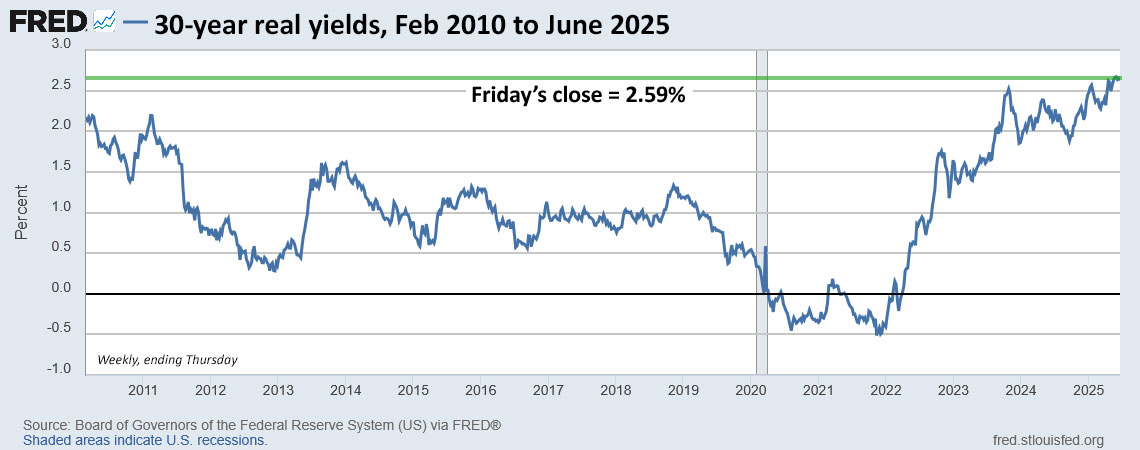
Note that the yield spectrum was tightly bunched over much of the last two years, but has widened dramatically in 2025. Although 5-year real yields have been rising, they remain well below the yields of 10- and 30-year TIPS. The 5-year real yield closed Friday at 1.82%, versus the 10-year at 2.28% and 30-year at 2.68%.

But keep this in mind: In chaotic April 3 trading after “Liberation Day” the 5-year TIPS real yield dropped as low as 1.12% midday, and closed that day at 1.25%. It has since increased 57 basis points. So when (or if) things settle down, where will it be?

Monday evening update: The Treasury’s estimate of the 5-year real yield dropped to 1.67% as of Monday’s close. That is down 16 basis points from Friday’s close.

5-year TIPS auction

That’s the current situation as of Friday’s close. But you can expect more volatility this week, leading up to Thursday’s offering of $25 billion in a new 5-year TIPS, CUSIP 91282CNB3. This will be the largest 5-year TIPS offering in history, up from $23 billion last April. The coupon rate and real yield to maturity will be set by the auction results.

Definition: The “real yield” of a TIPS is its yield above or below official future U.S. inflation, over the term of the TIPS. So a real yield of 1.82% means an investment in this TIPS would provide a return that exceeds U.S. inflation by 1.82% for 5 years.

You can get an idea of the potential auction yield by 1) looking at the Treasury’s Yields Curve page, which updates at the close of each market day, or 2) looking at Bloomberg’s U.S. Yields page, which updates in real time for secondary market trading of the most recent TIPS for each term.

Saturday, Treasury was estimating a real yield of 1.82% (as of Monday, this dropped to 1.67%) and Bloomberg showed a trading yield of 1.73% (dropped to 1.59% Monday). That’s a pretty big spread. But there is a reason: Bloomberg is showing the real yield of the TIPS issued in October 2024. The October issues always have a lower real yield than the April issues. I tried to explain the reasons here.

So most likely the Treasury estimate is going to be a better indicator. Don’t trust what you see on your trading platform. Vanguard on Saturday was showing an “indicative yield” of 1.728% for an auction order, which clearly is based on the October issue’s trading. The real yield should be higher. But a lot could change in the days leading up to Thursday’s auction.

If this TIPS auctions with a real yield around 1.82%, that result would be in the mid-range of 4- to 5-year auctions over the last two years. However, I have to admit I have no idea where real yields will be heading this week.

Here is the trend in the 5-year real yield over the last 15 years:

Click on image for larger version.

The chart shows how real yields have fallen off from recent highs, but still remain attractive versus the long-term trend. The 5-year real yield tends to be sensitive to potential interest rate cuts by the Federal Reserve, which could explain why the yields have been a bit suppressed versus the overall TIPS market.

By extending the TIPS maturity out a bit, an investor can find real yields topping 2%. Here are some weekend examples from Vanguard’s trading platform for TIPS maturing from 2032 to 2034:

One advantage of buying on the secondary market is that you can see exactly the real yield and price you will pay at that moment, avoiding the potential volatility leading up to Thursday’s auction.

Inflation breakeven rate

With the 5-year Treasury note closing Friday with a nominal yield of 4.15%, this TIPS currently would have an inflation breakeven rate of 2.33%, close to the result of recent auctions. This means it would outperform the 5-year nominal Treasury if inflation averages more than 2.33% over the next five years. Seems fair. Inflation over the last 5 years, ending in March, has averaged 4.4%.

Here is the trend in the 5-year inflation breakeven rate over the last 15 years, showing a fairly stable trend in the 2.0% to 2.5% range in recent years:

Click on image for larger version.

Pricing

This is a new TIPS, so the investment price should end up being close to par value. The inflation index on the settlement date of April 30 will be a minimal 1.00222, meaning investors should pay slightly less than par value, based on a coupon rate set slightly below the auctioned real yield.

The alternatives

A 5-year Treasury note yielding a nominal rate of 4.15% is pretty appealing. But given the uncertainties surrounding inflation, I’d prefer a 5-year TIPS with a real yield around 1.82%.

Best-in-nation 5-year bank CDs are currently yielding about 4.5%, also appealing. That stretches the inflation breakeven rate out to about 2.7%. These are worth considering if you are looking for a guaranteed nominal return over five years.

The Series I Savings Bond currently has a fixed rate of 1.2%, well below the 5-year real yield. If you are looking for a cash-equivalent, tax-deferred investment with rock-solid deflation protection, you should invest in the I Bond. TIPS work better for defined inflation-protected cash flow in future years, in a bond ladder.

Final thoughts

I like the 5-year TIPS because … the term is only 5 years. If you are likely to live that long and can hold to maturity, this is a very safe investment that will outperform inflation. If the real yield ends up around 1.80%, that is fine. But you can do a little better by stretching out the maturity, using the secondary market. So it just depends on your needs.

I won’t be a buyer because I have filled the 2030 rung of my TIPS ladder. Right now I am focusing on the new 10-year TIPS to be issued in January 2026, which seems like a lifetime away.

CUSIP 91282CNB3 will be reopened at auction on June 17 and another new 5-year TIPS will be issued in October.

This TIPS auction closes Thursday at 11:30 a.m. ET, which is earlier than normal because of the holiday week. Non-competitive bids at TreasuryDirect must be placed by 11 a.m. Thursday. If you are putting an order in through a brokerage, make sure to place your order Wednesday or very early Thursday, because brokers will cut off auction orders well before the 11:30 a.m. final deadline.

I will be posting the auction results soon after the close on Thursday. Here is a history of auction results for this term over the last 5 years:

Now is an ideal time to build a TIPS ladder

Confused by TIPS? Read my Q&A on TIPS

TIPS in depth: Understand the language

TIPS on the secondary market: Things to consider

TIPS investor: Don’t over-think the threat of deflation

Upcoming schedule of TIPS auctions

* * *

Follow Tipswatch on X (Twitter) for updates on daily Treasury auctions and real yield trends (when I am not traveling).

Feel free to post comments or questions below. If it is your first-ever comment, it will have to wait for moderation. After that, your comments will automatically appear. Please stay on topic and avoid political tirades. NOTE: Comment threads can only be three responses deep. If you see that you cannot respond, create a new comment and reference the topic.

David Enna is a financial journalist, not a financial adviser. He is not selling or profiting from any investment discussed. I Bonds and TIPS are not “get rich” investments; they are best used for capital preservation and inflation protection. They can be purchased through the Treasury or other providers without fees, commissions or carrying charges. Please do your own research before investing.

Posted in Bank CDs, Cash alternatives, I Bond, Inflation, Investing in TIPS, TreasuryDirect | Tagged , , | 56 Comments

Welcome to the I Bond ‘buying season’

Buy in April to lock in the 1.2% fixed rate? Or buy in May to start with a higher composite rate?

April 30 update: I Bond gets a new fixed rate of 1.10%, composite rate of 3.98%

By David Enna, Tipswatch.com

Long-time investors in U.S. Series I Savings Bonds know there are a few weeks a year when conditions are ideal for making a decision: Purchase now or purchase later?

With Thursday’s release of the March 2025 inflation report, we have entered one of these “buying seasons,” which will continue through the end of April. But before we get to the details, let’s look at some basics of this investment:

An I Bond is a Treasury security that earns interest based on combining a fixed rate and an inflation-adjusted rate.

  • The inflation-adjusted rate (often called the variable rate) changes each six months to reflect the running rate of inflation. That annualized rate is currently set at 1.90% and will increase to 2.86% after May 1. All I Bonds will eventually get the 2.86% variable rate, with the start date depending on the original month of purchase.
  • The fixed rate will never change. So if you bought an I Bond in 2014 with a fixed rate of 0.2%, it will continue to have a 0.2% fixed rate for the life of the bond. Purchases through April 29, 2025, have a permanent fixed rate of 1.2%.
  • The composite rate is a combination of these two rates, currently 3.11% annualized for a full six months for any bond purchased through April 2025.

The variable rate

Here is where we have certainty. The March CPI report provided the final number needed to set the I Bond’s new variable rate. Inflation ran at 1.43% from October 2024 to March 2025. Double that number and you get the new variable rate, 2.86%, up from the current 1.90%.

tracking inflation
View historical data on my Inflation and I Bonds page.

The new variable rate, 2.86%, is a big jump from the current rate of 1.90%. It makes an I Bond purchase in May more attractive, but remember that the variable rate changes every six months. All I Bonds, including those purchased in April, will get this new variable rate for six months.

The fixed rate

Here is where we lack certainty, except for one thing: If you purchase an I Bond in April, you will lock in the 1.20% fixed rate for the life of the I Bond, up to 30 years. We don’t know for sure how the Treasury will reset that fixed rate on May 1, which will apply to purchases from May to October.

The Treasury has no announced formula for setting the I Bond’s fixed rate, but I Bond watchers have settled on a forecasting tool that seems to work: Apply a ratio of 0.65 to the average 5-year TIPS real yield over the preceding six months. This formula has worked without fail at least since 2017.

On Friday I updated my 5-year real yield data from the date of the last reset on November 1, 2024, to Thursday’s close. The data predict the I Bond’s fixed rate will fall to 1.10% at the May 1 reset:

The I Bond’s fixed rate is always set to the one-tenth decimal point and that means the result of the 0.65 ratio calculation has to be rounded, which results in a projection of 1.10%. With only 12 market days remaining to the reset, that level is likely to stick.

However … We have a new administration running the Treasury Department at a time of some fairly dramatic employee reductions. There is no way to be sure what formula, if any, the Treasury will use to set the new fixed rate. I think it will be 1.10%, but this is not certain.

The composite rate

If you purchase I Bonds in April, you have one year of certainty: You will earn a composite rate of 3.11% for six months and then 4.08% for six months. Combine the rates and you get to a annual compounded rate of 3.64%. According to Bogleheads genius #Cruncher, a $10,000 investment will grow to $10,364 in one year (ignoring the 3-month interest penalty for redemptions before 5 years.)

Obviously, 3.64% isn’t going to make you wealthy over the next year, but I Bonds are more about protecting wealth than building wealth. An I Bond purchased in April is going to earn 1.2% above official U.S. inflation for as long as you hold it.

Purchasing in May opens a couple of unknown variables: 1) we don’t know for certain what the new fixed rate will be, and 2) we don’t know what will happen with inflation over the next six months. But it is certainly possible that a purchase in May will end up with a higher one-year return than a purchase in April, if inflation continues at a brisk pace.

Keep in mind that the difference between a 1.20% fixed rate and 1.10% (if that is the new fixed rate) is only 10 basis points, which equals just $10 of annual interest on $10,000 of principal. Not life changing.

Conclusion. I have been recommending buying in April (and I completed my purchases for 2025 in March). I’d still recommend April, but this decision is a bit of a toss-up and most likely both April or May purchases will work out well. If you want certainty, buy near the end of April (no later than April 28). If you want to wait it out, then buy in late May or …

What about October?

I Bond purchases are limited to $10,000 per person per year unless you add to your holdings through gift-box, trusts, or business-owner strategies. Some people like to spread I Bond purchases over the year, for example $5,000 in April and then $5,000 in October, or possibly even in November at the next reset.

The next “buying season” will open Oct. 15 with the release of the September inflation report, when we will know the next I Bond variable rate. And what about the fixed rate? I have been saying I know with 100% certainty that the November fixed rate will fall into the range of 0.0% to 4.0%. In other words … who knows? We have entered a year of wild financial possibilities.

One important thing to remember is that the November rate decision will be available for purchase in January 2026 when the purchase cap resets.

Are I Bonds that attractive?

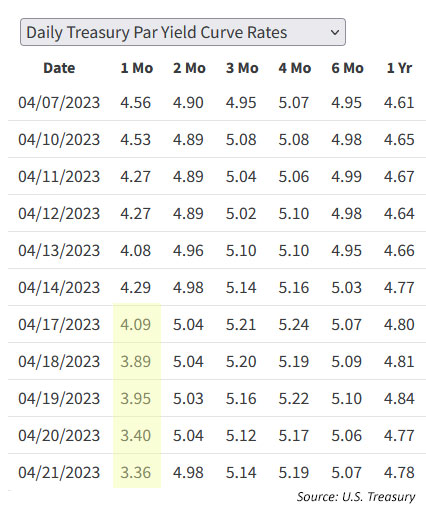
With short-term T-bill rates still topping 4%, many investors are shunning I Bonds because of the potentially lower nominal return plus the three-month interest penalty for redemptions within five years. Some thoughts:

  • We just went through a phase of inflation hitting 40-year highs, and higher prices could be returning in 2025 as we enter a turbulent era. Inflation protection, for part of your portfolio, looks like a wise choice.
  • Eventually, the Federal Reserve would like to resume cutting short-term interest rates and then the T-bill returns will begin falling. But, yes, the future of rate cuts is unclear. T-bills remain attractive.
  • I Bonds, if held for 5 years, create an inflation-protected store of cash you can use for future needs, with no penalty for redemption except for federal taxes on the interest.

Is this a short-term investment? I Bonds aren’t a good choice for money you will need in the next one or two years. You can get a 1-year T-bill paying about 3.9%. That nominal yield will beat the return of an I Bond after the three-month interest penalty is applied. I Bonds are best viewed as a longer-term, cash-equivalent investment.

Thoughts

I am a long-time advocate for investing in I Bonds, which create a tax-deferred, totally safe, inflation-protected investment with a flexible maturity date. If inflation heats up again as it did in 2022, you will sleep better at night with a treasure chest of I Bonds.

Again, this investment is not designed to make you rich. It is designed to protect a portion of your nest egg against inflation. April or May? It may not matter much, but I still stand behind I Bonds as an investment in 2025.

Confused by I Bonds? Read my Q&A on I Bonds

Let’s ‘try’ to clarify how an I Bond’s interest is calculated

Inflation and I Bonds: Track the variable rate changes

I Bonds: Here’s a simple way to track current value

I Bond Manifesto: How this investment can work as an emergency fund

* * *

Follow Tipswatch on X (Twitter) for updates on daily Treasury auctions and real yield trends (when I am not traveling).

Feel free to post comments or questions below. If it is your first-ever comment, it will have to wait for moderation. After that, your comments will automatically appear. Please stay on topic and avoid political tirades. NOTE: Comment threads can only be three responses deep. If you see that you cannot respond, create a new comment and reference the topic.

David Enna is a financial journalist, not a financial adviser. He is not selling or profiting from any investment discussed. I Bonds and TIPS are not “get rich” investments; they are best used for capital preservation and inflation protection. They can be purchased through the Treasury or other providers without fees, commissions or carrying charges. Please do your own research before investing.

Posted in Cash alternatives, Federal Reserve, I Bond, Inflation, Retirement, Savings Bond, Treasury Bills, TreasuryDirect | Tagged , , , , , | 56 Comments

I Bond’s variable rate will rise to 2.86% on May 1

March prices slipped into deflation, a bit of a surprise.

By David Enna, Tipswatch.com

April 30 update: I Bond gets a new fixed rate of 1.10%, composite rate of 3.98%

The just-released March inflation report gives us something we desperately need: Some clarity.

A U.S. Treasury security.

Now we know that the inflation-adjusted variable rate for the U.S. Series I Savings Bond will increase to 2.86% on May 1, up from the current 1.90%. This was finalized by the inflation report, which had non-seasonally-adjusted inflation rising 0.22% in March.

Non-seasonally-adjusted inflation increased 1.43% during the six months from October 2024 to March 2025, which translates to the new six-month annualized variable rate of 2.86%. This rate will apply to all I Bonds purchased from May to October, but will eventually roll into effect for all I Bonds no matter when they were purchased. The data:

The current variable rate, in effect for purchases through the end of April, is 1.90%. When combined with the current fixed rate of 1.2%, the I Bond’s composite rate is now 3.11% annualized. The new variable rate will increase to 2.86%, but it seems likely that the I Bond’s fixed rate will fall to 1.1% on May 1, creating a new composite rate of 3.98%.

If you buy in April, you lock in the 1.2% permanent fixed rate for up to 30 years. You will get six months of 3.11% and then six months of 4.08%. I think it makes sense to purchase in April, if you view this as a longer-term holding.

I will have more on this later this week.

The inflation report

Let the conspiracy theories begin! No, I am just kidding. However, the March inflation report, just released by the Bureau of Labor Statistics, was unusually mild.

Seasonally-adjusted all-items inflation declined 0.1% for the month and the annual rate fell from 2.8% in February to 2.4% in March. Core inflation, which removes food and energy, rose 0.1% in March and 2.8% year over year, down from 3.1% in February. All of those numbers were below consensus estimates.

Annual inflation at 2.4% is the lowest rate since last September. And it’s unusual to see a deflationary month in March. The last time that happened was March 2020, when COVID fears were sweeping the nation. So what exactly happened?

One important factor, the BLS noted, was a 6.3% decline in the price of gasoline, which is now down 9.8% year over year. On the other hand, the cost of food at home increased 0.5% for the month and 2.4% year over year.

Shelter costs increased just 0.2% for the month and are up 4.0% for the year. That was the smallest 12-month increase since November 2021. Other items from the report:

  • The cost of piped gas service increased 3.6% in March after rising 2.5% in February. Those costs are now up 9.4% year over year.
  • Prices for used cars and trucks fell 0.7% for the month and are up only 0.6% year over year.
  • Costs of new vehicles rose just 0.1% for the month and were flat year over year. (It will be interesting to see how this changes as tariffs roll into effect.)
  • Apparel costs rose 0.4% for the month and were up only 0.3% year over year. (This is another item that could be hit by rising tariffs.)
  • Motor vehicle insurance costs fell 0.8% for the month but are up 7.5% year over year.
  • Airline fares fell 5.3% for the month and 5.2% for the year.

Apparently, the sharp decline in gasoline prices and the moderation in shelter costs were enough to push the all-items index into deflation in March. That trend for gas and shelter could continue into much of 2025, but could be balanced off by the unknown costs of unknown future tariffs.

Here is the trend in all-items and core annual inflation over the last year:

This is exactly the type of chart President Trump and the Federal Reserve would like to see, with both core and all-items inflation falling for two consecutive months. However, the current chaos over tariffs and the brewing debt-limit crisis puts a lid on celebrations.

Do we know where inflation is heading for the rest of this year? Inflation? Deflation? It’s anyone’s guess.

What this means for TIPS

The BLS set the non-seasonally-adjusted CPI-U inflation index for March at 319.799, an increase of 0.22% from the February level. That means that principal balances for all TIPS will rise 0.22% in May, after rising 0.44% in April. Here are the new May inflation indexes for all TIPS.

What this means for future interest rates

Bloomberg is leading with the perfect headline this morning: “Trump Tariff Concerns Overshadow Upbeat US CPI Report.” This March inflation report was good news, but the positive vibes are overshadowed by tariff-related turmoil in the stock and bond markets. And, of course, tariffs seem likely to trigger higher inflation in coming months.

Bloomberg does a survey of 67 inflation forecasters and not one predicted a negative number for all-items inflation in March, and not one predicted a core increase of only 0.1%. From their economists Anna Wong and Stuart Paul:

March’s surprisingly soft CPI report showed little to no pass-through from President Trump’s initial tariff increases on Chinese imports. Apparel, furnishing, and recreation items – goods that have high import content from China – all saw either price declines or only soft price gains in March.

The real signal is that consumers are pulling back on discretionary spending. Services categories like airfares, car rentals, hotels, all saw deflation.

In all, we think the report provides space for the Fed to cut rates.

The financial markets have begun pricing in multiple rate cuts by the Federal Reserve this year, up from possibly one from earlier readings. That assumes the U.S. economy is slowing down. This March inflation report helps support the rate-cut theory, but the Fed still needs to pause and see the actual effect of tariffs on prices.

It also indicates an increasing chance of stagflation — a slowing economy combined with rising prices. From Edward Harrison, via Bloomberg:

That speaks to the Fed holding rates steady for the foreseeable future until the full economic effects of Trump’s policy changes become clearer.

Confused by I Bonds? Read my Q&A on I Bonds

Let’s ‘try’ to clarify how an I Bond’s interest is calculated

Inflation and I Bonds: Track the variable rate changes

I Bonds: Here’s a simple way to track current value

I Bond Manifesto: How this investment can work as an emergency fund

* * *

Follow Tipswatch on X (Twitter) for updates on daily Treasury auctions and real yield trends (when I am not traveling).

Feel free to post comments or questions below. If it is your first-ever comment, it will have to wait for moderation. After that, your comments will automatically appear. Please stay on topic and avoid political tirades. NOTE: Comment threads can only be three responses deep. If you see that you cannot respond, create a new comment and reference the topic.

David Enna is a financial journalist, not a financial adviser. He is not selling or profiting from any investment discussed. I Bonds and TIPS are not “get rich” investments; they are best used for capital preservation and inflation protection. They can be purchased through the Treasury or other providers without fees, commissions or carrying charges. Please do your own research before investing.
Posted in Cash alternatives, Federal Reserve, Inflation, Retirement, Savings Bond, TreasuryDirect | 24 Comments

The Treasury market seems to be crumbling. Why?

By David Enna, Tipswatch.com

Update, 2:15 pm April 9: Just about 12 hours after enforcing crippling tariffs on much of the world, President Trump changed course and announced a 90-day pause on reciprocal tariffs (above the new baseline 10%) on every country except China, which now will face tariffs of 125% on exports to the United States.

The stock market has reacted positively, with the S&P 500 index now up about 8% from where it was trading at 1:19 p.m. But the 10-year Treasury nominal yield remains elevated at about 4.42%. A reopening auction for a 10-year Treasury note was well received today, getting an attractive high yield of 4.435%, up from 4.310% last month.

So now we get a 90-day reprieve. It is hard to see what will change in three months if the White House continues to demand an even balance of trade with every nation.

——————————————–

Just a week ago, in the early stages of our brand-new “Tariff Crisis,” the stock market was falling sharply and the U.S. Treasury market was acting as a safe haven, with yields falling as buyers poured into the Treasury market.

This crisis isn’t even a week old and yet the S&P 500 has already lost about 13% of its value since closing at 5671 on April 2. That was last Wednesday, and since then we have had only four full trading days. Over that time, short-term Treasury yields have been fairly stable, while longer-term nominal yields have been climbing.

As the chart shows, Treasury yields dropped initially, as expected, but then after the weekend began rising quickly, up 40 basis points on the benchmark 10-year note and 45 basis points on the 30-year bond. That’s a big jump, especially at a time when you’d expect yields to be at least holding stable.

Treasurys are traditionally considered to be among the safest of safe-haven assets. Investors rushing to sell Treasurys during a time of crisis is a sign of market distress.

So why and how is this happening? I’ve heard countless experts interviewed on this topic in the last two days and not one could give a definitive answer. But here are some theories:

China and other nations are dumping Treasury investments.

I think this is probably a factor and it would make sense for China to try to use its longer-term Treasury holdings to disrupt President Trump’s desire for lower interest rates. From an article on Investing.com:

Venture capitalist and Trump supporter Chamath Palihapitiya … said Tuesday afternoon that he is hearing from people that China has been dumping U.S. Treasuries in an effort to move yields up and shift the narrative.

“I’m hearing they are dumping UST to try and move rates to shift narrative and make our upcoming Treasury auctions more expensive,” Palihapitiya commented on X. “May make sense to delay auctions to next week. China can’t sell indefinitely.”

Investors are losing confidence in U.S. Treasurys

This also makes sense as our nation careens toward another debt-limit and budget crisis. From BusinessInsider.com:

Analysts at Deutsche Bank said in a note on Tuesday that the heavy sell-off “spoke to broader concerns about the safety of US assets and their capacity to act as a haven in times of market stress.” …

“A trend which will be watched closely is an apparent loss, whether temporary or otherwise, of US assets’ safe-haven status. Treasurys sold off heavily amid some speculation China and other parties are dumping their holdings as a retaliatory tool,” said Russ Mould of UK-based investment platform AJ Bell.

Hedge funds are unwinding losing bets.

From the Wall Street Journal:

Many analysts have been pointing the finger at leveraged hedge-fund trades. The strategy at the heart of concerns is known as the basis trade, and was a key driver of the 2020 “dash for cash.”

Hedge funds buy cash Treasurys and sell a Treasury futures contract to another investor, betting that the two prices will converge as the settlement date nears. The difference, or spread, is often very small, but hedge funds use leverage to increase the profits.

When the market makes large moves—as seen in the past few days—traders who had been betting on what they viewed as the sure thing of convergence can find their positions taking on water. They are often forced to sell.

This theory was embraced by Treasury Secretary Scott Bessent this morning in an interview with Maria Bartiromo of Fox Business:

Some highlights from that interview:

Bessent: Maria, I wanted to address in the meantime there is one of these — I’ve seen it very often in my career — there is one of these deleveraging convulsions that’s going on right now in the markets and I think it’s in the fixed-income market. There’s some very large leverage players who are experiencing losses they’re having to deleverage. I believe there is nothing systemic about this.

I think that it is uncomfortable but normal deleveraging that’s going on in the bond market and I expect that as we see the leverage come down … the market will come down.

Jump to 16:24

Bartiromo: You know, the fixed-income issue has been a debacle this morning that is why I assume rates are moving up. The yield on the 10-year, we were wondering if there was a deleveraging issue and whether or not China is dumping Treasuries. Is that what you see right now? Is China dumping Treasuries to try to put pressure on this market?

Bessent: You know, Maria, I think it works against their purposes if they’re dumping Treasuries because they have to buy something else. If they sell dollars and they strengthen their currency and as I said earlier they’ve actually been weakening their currency, which is a loser for everyone.

And again, when I hear all these stories, the dollar’s no longer the reserve currency, you know, if you end up with the Chinese who are willing to use their currency as a trade tool, that doesn’t seem like a very good reserve to me.

Thoughts

I have been saying for some time that the United States is heading into a period of unprecedented economic uncertainty. Some of the cause of that uncertainty has roots stretching back a decade or more. But this Tariff Crisis has brought everything to the surface, on fire. It is hard for me to imagine a solution in the near term.

The Treasury market seems to have been weakened, but most of the probable causes seem like they could be short-term effects as the stock and bond markets struggle through this chaotic period. Most likely, it will recover.

And then, could the Federal Reserve come to the rescue? I hope that doesn’t have to happen, but I have been predicting a major bailout of some sort as U.S. big-money investors grab at high-risk investments. In this case, most likely, the Fed would try to calm the market by buying longer-term Treasurys, not by cutting short-term interest rates.

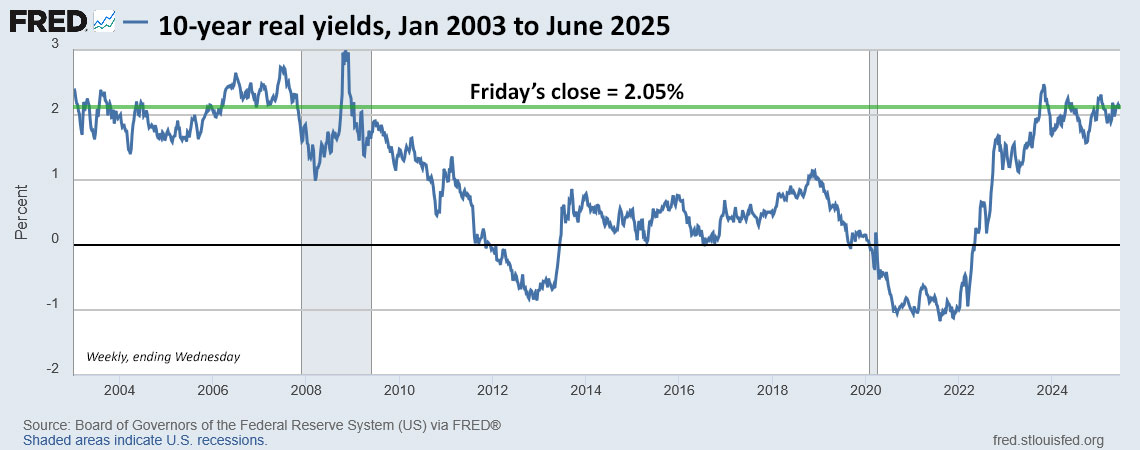
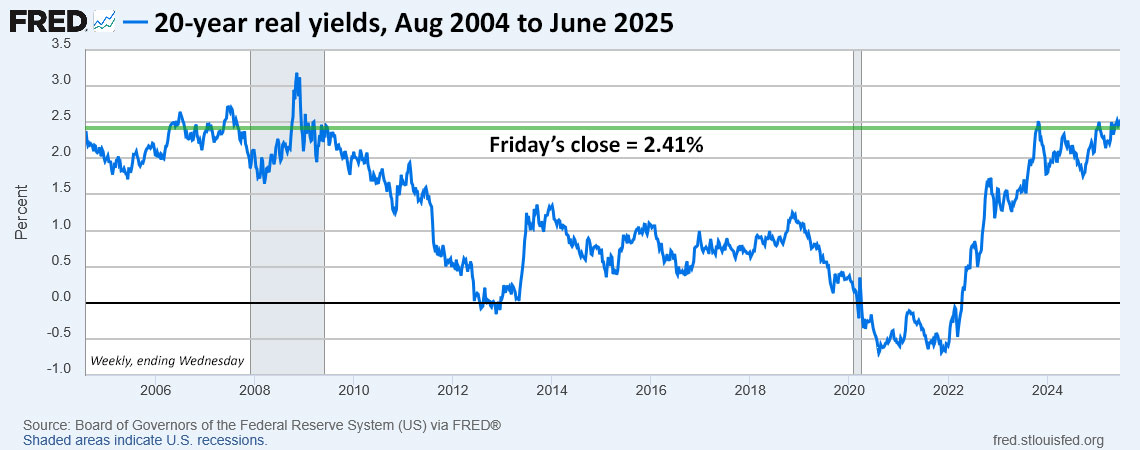
If I wasn’t finished building a TIPS ladder at this point, I would probably be diving into the secondary market to take advantage of this disruption and attractively high real yields on longer-term TIPS: 2.17% on the 10-year, 2.46% on the 20-year, 2.61% on the 30-year. But yeah, that would take an investor with guts.

Do I have the answers or solutions? No. Let’s hear your ideas.

See you tomorrow with news of the March inflation report and finalized I Bond variable rate.

* * *

Follow Tipswatch on X (Twitter) for updates on daily Treasury auctions and real yield trends (when I am not traveling).

Feel free to post comments or questions below. If it is your first-ever comment, it will have to wait for moderation. After that, your comments will automatically appear. Please stay on topic and avoid political tirades. NOTE: Comment threads can only be three responses deep. If you see that you cannot respond, create a new comment and reference the topic.

David Enna is a financial journalist, not a financial adviser. He is not selling or profiting from any investment discussed. I Bonds and TIPS are not “get rich” investments; they are best used for capital preservation and inflation protection. They can be purchased through the Treasury or other providers without fees, commissions or carrying charges. Please do your own research before investing.

Posted in Cash alternatives, Federal Reserve, Inflation, Investing in TIPS | Tagged , , , , , , | 43 Comments