TIPS are taking a hit on positive job news

I just noticed that the TIP ETF, which holds a broad range of maturities, is trading at $112.01 today, down 1.1% for the day. The ETF reached $114.14 on Feb. 27, and has since fallen 1.9% in just five trading days.

Part of the reason, at least, is increasing signs of an improving economy. Today’s evidence was news that U.S. nonfarm payrolls grew by a seasonally adjusted 295,000 jobs in February. The economy has now added more than 200,000 jobs for 12 straight months, the longest such streak since 1995, according to the Wall Street Journal. The U.S. unemployment rate fell to 5.5% in February, down from 5.7% in January.

An improving economy raises the possibility that the Federal Reserve will finally relent and begin raising short-term interest rates. Rates have held near zero since 2008.

So far, very weak inflation has allowed the Fed to avoid any move on interest rates. But if the economy continues to improve and the jobless rate continues to fall, wages should begin to increase, and that is a huge first step toward inflation.

While rising inflation would appear to create higher demand for TIPS, higher interest rates in the overall Treasury market would force TIPS yields higher and prices lower.

  • The yield on a nominal 10-year Treasury is currently trading today at 2.25%, up 14 basis points for the day and up a rather enormous 57 basis points since Feb. 1. And this yield could easily move higher — it stood at 3.0% on Jan. 1, 2014.
  • The real yield to maturity of a 10-year TIPS is currently trading today at 0.41%, up from a close of 0.27% yesterday. That is also 14 basis points, so TIPS and nominal Treasurys seem to be moving in lockstep.

However, a five-day chart comparing TIP with IEI (the intermediate Treasury bond market) and GOVT (the overall Treasury market) shows that TIPS are taking Friday’s news much harder, with yields rising as the ETF price falls (click on image for a larger version):

5- day tradingAnother factor to watch is the 10-year inflation breakeven rate, which has been rising from extremely low levels. Today’s implied inflation breakeven rate is 1.84%, still low by historical standards but up sharply since the 1.57% posted on Jan. 14. This indicates inflation expectations are rising – and also that TIPS are getting slightly more expensive versus traditional Treasurys. Here is the recent trend in the 10-year inflation breakeven rate:
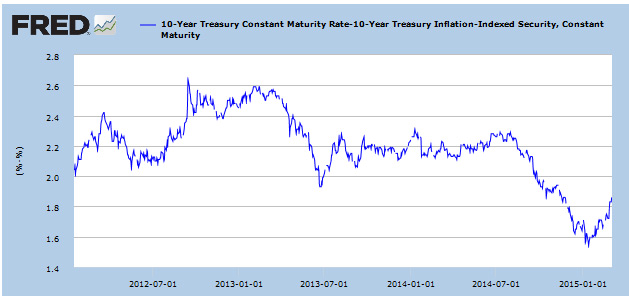
10-year inflation breakevenThis month’s TIPS auction – on Thursday, March 19, will be a reopening of CUSIP 912828H45, a 10-year TIPS that originated on Jan. 22 with a real yield to maturity of 0.315% and a coupon rate of 0.250%. It will be interesting to watch how yields react in the next two weeks leading up to the auction.

Posted in Investing in TIPS | 2 Comments

Deflation strikes hard in January: What does it mean for TIPS and I Bonds?

The Consumer Price Index for All Urban Consumers (CPI-U) declined 0.7% in January on a seasonally adjusted basis, the U.S. Bureau of Labor Statistics reported today. Over the last 12 months, U.S. inflation decreased 0.1%.

Gasoline prices were the major factor in the decline, dropping a whopping 18.7% in January. Over the last 12 months, gasoline prices have fallen 35.4%. Food prices were stable for the month, while apparel costs rose 0.3%. Medical care commodities fell 0.3%, after rising 0.9% in January.

Core inflation – which strips out food and energy – was up 0.2% in January and 1.6% over the last six months. This indicates that even without the steep drop in energy prices, overall inflation has been muted over the last year.

Holders of TIPS and Series I Savings Bonds are also interested in the non-seasonally adjusted CPI-U, which is used to adjust the principal balance of TIPS and set future interest rates for I Bonds. In January, the inflation index stood at 233.707, a drop of 0.47% from December.

I have updated my Tracking Inflation and I Bonds page with these new numbers.

What this means for TIPS. January’s inflation index of 233.707 sets the TIPS principal adjustments through March 31, 2015. It means that accrued principal balances of all TIPS you own will be declining over the next two months. These balances go up with inflation and decline with deflation.

As an example, take a look at CUSIP 912810QV3, a 30-year TIPS that was issued in February 2012. Let’s say you bought $10,000 of that TIPS at the original auction. On Aug. 31, 2014, its inflation index stood at 1.05474, meaning your principal balance had risen to $10,547.74. But since then, we’ve entered a deflationary period. Today’s inflation index for that TIPS is 1.03981, meaning its balance has fallen to $10,398.10. On March 31, the index will be 1.03444, dropping the accrued balance to $10,344.40.

This TIPS has a coupon rate of 0.750% which it pays on the accrued principal balance. So even your interest earned has been declining during this period of deflation.

Grim news, but rising gasoline prices in February should mark a turn-around to at least moderate inflation this month.

What this means for I Bonds. The same inflation index is used to set the future interest rate paid by I Bonds. The next adjustment in this variable rate comes May 1, based on inflation from September 2014 to March 2015. Here is what has happened so far:

Current inflationIt’s extremely unlikely that inflation in February and March will be enough to turn around a four-month decline of 1.82%. So on May 1, I Bonds are likely to get a sharply negative inflation-adjusted rate, which is added to the I Bond’s fixed rate to determine the composite rate. So I Bonds with a positive fixed rate could see that fixed rate wiped out when the negative inflation-adjusted number is added in. However, the worst possible outcome is that the I Bond pays zero percent interest for six months. The I Bond’s principal balance is unaffected.

Strangely enough, a concentrated period of deflation is a ‘positive’ thing for holders of I Bonds, because the principal balance cannot decline and the composite interest rate can’t fall below zero. So, go ahead, dump a lot of deflation into one six-month period — a bigger negative number is no worse than a tiny negative number. If prices turn around in the next adjustment period, which seems likely, I Bond holders will get a much higher inflation-adjusted interest rate.

TIPS versus I Bonds. When you buy a TIPS at auction, you get a ‘real yield to maturity’ – and that yield will never change. If your yield to maturity was 0.50%, that means you are going to earn 0.5% over inflation. Period. If we see deflation of 1%, your principal balance falls by 1%, you earn your coupon and the result is 0.5% over inflation.

With I Bonds, in a time of 1% deflation, the ‘real’ return is at least 1%, because the I Bond holds its current value, even when it earns zero interest. If deflation hit 5%, the I Bond’s real return would be 5%. See my previous post: TIPS versus I Bonds during deflationary times.

Here is the inflation trend over the last 12 months:

Inflation year

Posted in Investing in TIPS | 3 Comments

30-year TIPS auctions with a yield to maturity of 0.842%

A new 30-year Treasury Inflation-Protected Security auctioned today with a coupon rate of 0.750% and a yield to maturity of 0.842%, the Treasury announced.

This is the only 30-year TIPS to be created in 2015, but the Treasury will reopen it in June and October auctions. The real yield (after inflation) of 0.842% was far below last year’s 30-year TIPS, which auctioned on Feb. 20, 2014, with a yield of 1.495% and a coupon rate of 1.375%. Today’s TIPS – CUSIP 912810RL4 – generated the lowest yield for any 29- to 30-year TIPS auction since February 2013.

At creation auctions, the coupon rate of a TIPS is always set to the nearest 1/8% below the yield. That means buyers at today’s auction are getting the TIPS at an adjusted price of $97.33 per $100 of value. The inflation index on this TIPS starts at 0.99756 because of deflation (-0.57%)  back in December when the index was set.

Inflation breakeven rate. With a 30-year nominal Treasury trading today at 2.74%, we get an inflation breakeven rate of 1.89%. That means this new TIPS will outperform a 30-year Treasury if inflation averages more then 1.89% over the next 30 years. A number that low makes this TIPS ‘cheap’ versus a nominal Treasury.

Reaction to the auction. The yield was in line with expectations, and the market seems to be reacting positively in the minutes after the 1 p.m. close of the auction. Here is the 1-day chart for the TIP ETF, which holds a broad range of maturities:

30-year TIPSThe Reuters report on the auction noted ‘heavy investor demand’ for this new TIPS:

“This is the most aggressively bid new issue 30-year TIPS auction since February 2011,” Thomas Simons, money market strategist at Jefferies & Co. wrote in a note about the auction.

“Fund managers, foreign central banks and other indirect bidders bought 69.04 percent of the latest 30-year TIPS supply. This was their largest share at a 30-year TIPS auction since data were available going back to February 2010, Treasury data showed.”

Posted in Investing in TIPS | 2 Comments

Checking in on today’s 30-year TIPS auction; any appeal?

The Treasury is auctioning a new 30-year Treasury Inflation-Protected Security on Feb. 19. This is CUSIP 912810RL4 and the coupon rate and yield to maturity will be determined by the auction. Non-competitive bids, like those made through TreasuryDirect, need to be placed by noon. The auction closes at 1 p.m.

A lot has been happening in the Treasury market this month, with 30-year yields rising from rock-bottom levels. Here is where we stand at 10:45 a.m. EST:

  • A 29-year TIPS currently trading on the secondary market today is yielding 0.83% (plus inflation), according to Bloomberg’s Current Yields. That is up 10 basis points from a week ago.
  • That same TIPS closed yesterday at with a yield to maturity of 0.791%, according to the Wall Street Journal’s Closing Prices.
  • The US Treasury estimated yesterday that a full-term 30-year TIPS would yield 0.82%.
  • The TIP ETF, which holds a broad range of maturities, is trading right now at $112.49, down slightly from yesterday’s close.

These numbers are a bit contradictory, but it looks like this TIPS will auction with a yield to maturity of about 0.80% to 0.85%, maybe on the higher side, so say 0.85%. That would result in a coupon rate of 0.750%. Buyers at today’s auction should be cheering for a slightly higher yield, enough to boost the coupon to 0.875%. It’s possible.

Today’s auction shouldn’t threaten the all-time low yield for a full-term 30-year TIPS, which was 0.639% in February 2013. But it doesn’t have much appeal for a small investor as a 30-year commitment, and it could be a very volatile issue for traders. (This TIPS will be reopened in June and October; if yields rise it could be a lot cheaper then.)

Today’s buyers will be the big-money folks – central foreign banks, hedge funds, pension funds, etc. With the 30-year nominal Treasury yielding about 2.70%, you’re looking at an inflation breakeven rate of 1.88% – up 6 basis points from last week but still an attractive number for a TIPS investor.

I will be posting the auction results after 1 p.m., but I might be delayed for an hour or two, because I will be away from a computer this afternoon.

Posted in Investing in TIPS | 2 Comments

Up next: New 30-year TIPS will auction February 19, 2015

The Treasury just announced that it will be auctioning a new 30-year Treasury Inflation-Protected Security on Feb. 19. This is CUSIP 912810RL4 and the coupon rate and yield to maturity will be determined by the auction.

Here is how this auction is shaping up:

  • A 29-year TIPS currently trading on the secondary market today is yielding 0.73% (plus inflation), according to Bloomberg’s Current Yields.
  • That same TIPS closed yesterday at with a yield to maturity of 0.723%, according to the Wall Street Journal’s Closing Prices.
  • The US Treasury estimated yesterday that a full-term 30-year TIPS would yield 0.75%.

TIPS 30-year yields have been rising a bit in last two weeks, up 23 basis points from the low of 0.52% on Jan. 30. Getting the yield above 0.750% is highly desirable for buyers, because it would lock in a 0.750% coupon rate. Anything slightly below 0.750% would push the coupon rate down to 0.625%.

I generally advise buyers of very-long-term TIPS to hold them in a tax-deferred account, because it takes a coupon rate of about 0.50% to cover the yearly taxes resulting from 2% inflation, which is added to principal and taxed in the current year, but not paid out until maturity, or when the bond is sold.

I also advise that a 30-year TIPS with a coupon rate of 0.75% can be a very dangerous investment if you can’t afford to hold it to maturity. If you are a TIPS buy-and-trader, you could be sitting on a time bomb. At least it will be very volatile on the secondary market. Traders might like that, but it’s a risk when the yield is this low. Only one 30-year TIPS in history has ever had a coupon rate below 0.75% – CUSIP 912810RA8 from February 2013, with a coupon of 0.625%.

Inflation breakeven rate. A 30-year nominal Treasury was yielding 2.57% yesterday, creating a 30-year inflation breakeven rate of 1.82% – a fairly low number that will probably make this TIPS appealing to big investors like pension funds and foreign central banks. The financial markets are pricing in long-term inflation well below 2%. That doesn’t happen often as shown in this chart of 30-year breakevens:

30A breakeven rate of around 1.8% gives investors a ‘margin of safety’ because it means that 30-year TIPS yields could rise more slowly than the overall bond market. Say the breakeven rate gradually rises to 2.2%, a fairly common number. If a 30-year nominal Treasury rose 100 basis points to 3.57%, this TIPS would rise only 62 basis points, to 1.37%. But that would still be painful for buy-and-traders.

Here is a chart of all 29- to 30-year TIPS auctions in history, showing that we are currently fairly close to the rock-bottom yields the market seems to bear:

30yeartipsI’ll be checking in on this auction next Thursday morning, and then again after it closes at 1 p.m. on Feb. 19.

Posted in Investing in TIPS | 4 Comments