
Treasury Inflation-Protected Securities are often cited as being reasonably safe against deflation, because when held to maturity they will return the original ‘par’ value, even if deflation strikes with vengeance. In other words, the value can never go below ‘par’ – the original purchase allocation.
But TIPS do lose value when deflation strikes, because deflation eats away at the accrued principal each TIPS carries. If you buy a TIPS at a reopening auction or on the secondary market, you are paying for that accrued principal. When deflation strikes, you lose it, because it isn’t ‘par value,’ it’s an inflation adjustment that goes up with inflation, but will go down with deflation.
An example. To make this simple, I am going to talk about one TIPS – CUSIP 912828C99 – which I bought at a reopening auction on Dec. 18. This was a 4-year, 4-month TIPS with a coupon rate of 0.125%. It auctioned with a yield to maturity of 0.395%.
If you look at the auction results announcement, down at the bottom in tiny type you can see that this TIPS had an inflation index of 1.01337 on Dec. 31, the settlement date. Here it is, a little enlarged:
 I bought $10,000 of this TIPS, and on Dec. 31 Treasury Direct withdrew $10,020.14 from my bank account. The par value was $10,000 and the inflation-adjusted value was $10,133.70, as of Dec. 31. I got it at a discount because the auctioned yield was higher than the coupon rate.
(In this article I am using ‘value’ to mean the current held-to-maturity value, not the value on the secondary market.)
CPI and the TIPS inflation index. The Treasury adjusts the value of TIPS based on the non-seasonally adjusted Consumer Price Index for All Urban Consumers. Each month’s CPI inflation index number establishes the TIPS inflation index two months into the future. So the Dec. 31 number was based on non-seasonally adjusted inflation in October, which was -0.25%.
The January inflation index was set by non-seasonally adjusted inflation in November, which was -0.54%. Because of that deflated number, on Jan. 31 the inflation index for this TIPS will drop to 1.00799 and the inflation-adjusted value of my TIPS will be $10,079.90.
The February inflation index was set by non-seasonally adjusted inflation in December, which was -0.57%. Because of that deflated number, on Feb. 28 the inflation index for this TIPS will drop to 1.00231 and the inflation-adjusted value of my TIPS will be $10,023.10.
So, in summary, here is what I received for my $10,020.14 purchase, one month after the auction: $10,023.10 and a 0.125% coupon rate.
Future deflation would continue to drop that inflation-adjusted number, but my value can never drop below $10,000. However, the inflation index can drop below 1.000, and would require future inflation to bring it back above that level. There is one TIPS – CUSIP 912828WU0 – currently trading with an index of 0.997 and that will drop to 0.989 on Feb. 28. This TIPS originated in July 2014, just before the current deflationary swoon.
You can track these inflation index numbers on the Treasury Direct site. Here are the numbers for CUSIP 912828C99.
I Bonds do have an advantage. I Bonds pay a fixed rate for the 30-year life of the holding – currently 0.0% – and an inflation-adjusted rate that changes each May and November – currently 1.48% annualized. The principal of an I Bond grows with each interest payment and can never go down. Deflation could mean six months of zero interest payments, which looks likely beginning May 1. But even at a time of severe deflation, the value of I Bonds will never go down. It’s an advantage they hold over TIPS.


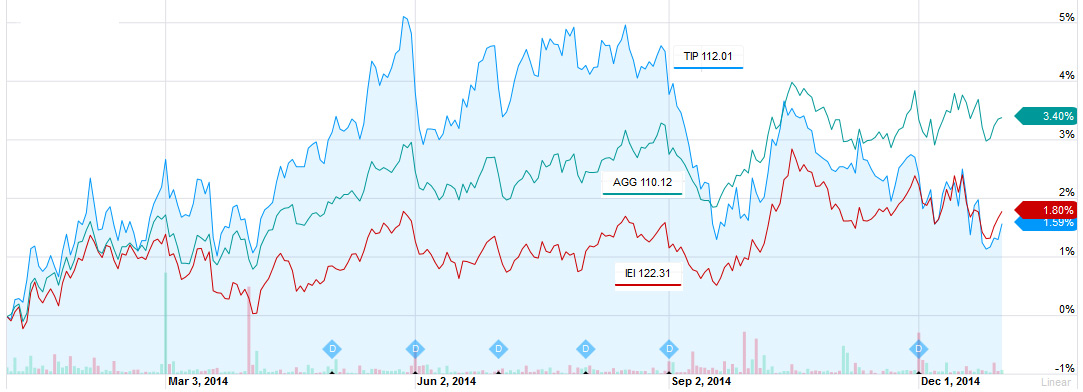






 Treasury Inflation-Protected Securities
That's a sensible idea, especially if you fear the chance of prolonged deflation. I tend to use nominals for investments…