U.S. inflation rose a moderate 0.1% in July

The Consumer Price Index for All Urban Consumers (CPI-U) increased 0.1% in July on a seasonally adjusted basis, the U.S. Bureau of Labor Statistics reported today. Over the last 12 months, this ‘headline’ inflation rate increased 2.0%.

The 0.1% number matched the consensus estimate and broke a four-month string of 0.2%-or-higher monthly increases. Today’s inflation report was a mixed bag – food prices increased a sharp 0.4% in July, but where offset by a 0.3% decline in energy costs, including gasoline. New vehicle prices were up 0.3%, but used vehicle prices declined by the same amount.

Holders of Treasury Inflation-Protected Securities and I Bonds are also interested in the non-seasonally adjusted CPI-U, which is used to adjust the principal on TIPS and set the future inflation-adjusted interest rate on I Bonds. In July, the non-seasonally adjusted inflation index declined slightly to 238.250, down 0.04% from the June index.

I have updated my Tracking Inflation and I Bonds page to reflect the new July number. With two months of inflation numbers remaining, the I Bond inflation-adjusted interest rate would reset to an annualized 1.64% on Nov. 1. But remember, two months remain.

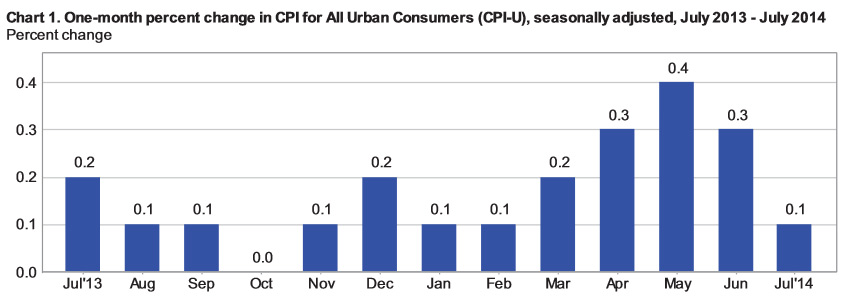
Here is the one-year trend in CPI-U, which still shows a bump in the inflation in recent months:

2014 inflation

Posted in I Bond, Inflation, Investing in TIPS | Leave a comment

Up next: 5-year TIPS will reopen at auction Aug. 21, 2014

The US Treasury just formally announced it will reopen CUSIP 912828C99 at auction next Thursday, creating a 4-Year 8-Month Treasury Inflation-Protected Security with a coupon rate of 0.125%.

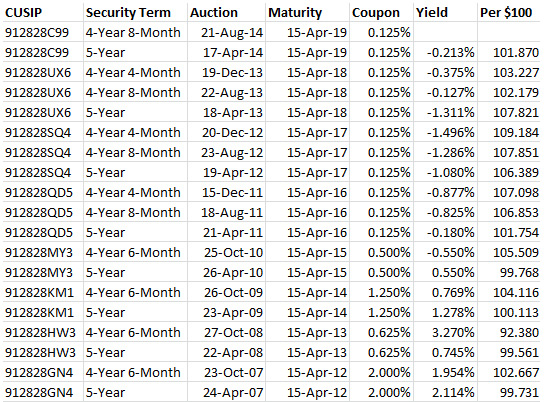
This TIPS was originally auctioned on April 17, with a yield to maturity of -0.213%, plus inflation. Buyers at that auction paid about $101.87 for $100 of value because of the spread between the yield and the coupon rate.

What can we expect? Since April, yields on TIPS have been sinking, dropping to a low for the year of -0.44% in late May. Recent strength in the overall bond market has again pushed TIPS yields to near their yearly lows.

  • Bloomberg’s Current Yields page shows a yield of -0.44% for CUSIP 912828C99 on today’s secondary market.
  • The Wall Street Journal’s Closing Prices page shows a closing yield of -0.418% for this TIPS on Wednesday.
  • The Treasury’s Real Yields page – which estimates the yield on a full-term 5-year TIPS – shows -0.29%, a fairly wide variance from the other two real-world measurements.

Let’s set aside the Treasury’s number and for now let’s estimate a yield of about -0.420% for next week’s auction. That would mean buyers will pay about $102.50 for $100 of value, plus chip in more than $1 for accrued inflation. That’s pretty pricey for a 0.125% coupon rate.

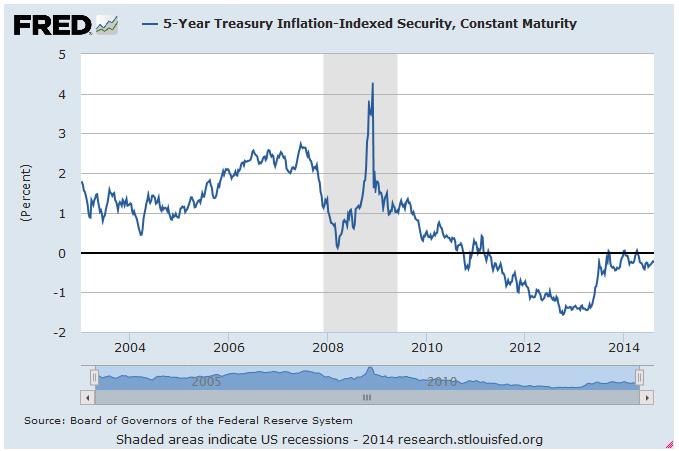
This chart tracks the longer-term trend for yields on 5-year TIPS, showing the wild swing of more than 500 basis points from the depth of the recession to Fed-induced ultra-low rates of 2012:

5-year yieldsIt’s impossible to figure what’s ‘normal’ from that chart, but certainly the peak and the nadir can be ruled abnormal. The pre-recession yields above 1% generate nostalgia, but that’s about it. Let’s work on getting above zero.

I personally won’t be participating in next week’s auction, unless yields climb dramatically in the next seven days.

Alternative? I repeat again that buying US Savings I Bonds up to the limit is a much better investment than a 5-year TIPS paying -0.41%. I Bonds currently pay 0.1% above inflation. That is 51 basis points better than a TIPS, and I Bonds are more flexible investments and the interest is tax deferred.

Here is a chart of 4- to 5-year TIPS auctions since 2007. Check it out and tell me if you can figure out what would pass for a ‘normal’ yield in 2014, minus Fed manipulation and simmering world turmoil:

TIPS auctions

Posted in Investing in TIPS | 3 Comments

2014: What a strange year for stocks, bonds

Here is the chart of the day, captured at 9:34 a.m. Eastern time:

TIP versus SPYLooking at net asset value, the TIP ETF, which holds a broad range of Treasury Inflation-Protected Securities, has performed almost exactly the same as the SPY ETF, which holds the Standard and Poors 500.

  • Net asset value for both funds is up about 5% year-to-date as of Aug. 11.
  • In addition, the TIP ETF has paid out $1.354 in dividends, an additional return of about 1.2%.
  • The SPY ETF has paid out $1.762 in dividends, an additional return of about 0.9%.

You won’t often see two remarkably different assets classes performing in lockstep for such a long period of time. I have said in a previous post that I don’t think this can continue. We should see returns breaking away, especially if stocks continue to rise.

The other possibility is that both assets classes will decline. I think the longer the trend continues upward for both, the more likely a fall for both follows.

Posted in Investing in TIPS | Leave a comment

The 10-year TIPS quandry: What should the Treasury do in January 2015?

UPDATE (Sept 4, 2014): The Treasury has posted its newest preliminary auction schedule, which shows that it will auction a new 10-year TIPS on Jan. 28, 2015, with a maturity date of Jan. 15, 2025. That means there will be two TIPS maturing on that date; the existing one has a coupon rate of 2.375% and sells at a 20% premium to par, so there shouldn’t be too much confusion in the secondary market.

——————————————————

Awhile back reader Bill noticed something interesting: The Treasury is tentatively scheduled to auction a new 10-year TIPS in mid January, with a maturity date of Jan. 15, 2025. But it already has a TIPS maturing on Jan. 15, 2025: CUSIP 912810FR4, a 20-year, 6-month TIPS that was first issued July 15, 2004.

As far as I can tell, the Treasury has never had two separate TIPS maturing on the same day. I’ve poured over the excellent charts at eyebonds.info (this one in particular) and can’t find any two TIPS that matured on the same day.

After Bill pointed this out, I emailed Treasury Direct with the question: What will the Treasury do in January 2015? In return, I got an email with a chart showing the typical auction schedule and this stock narrative:

The Treasury Department endeavors to be as predictable as possible in the scheduling of auctions to assure that the commercial market works smoothly and efficiently. The following chart illustrates the general pattern of securities offerings. While this chart does provide a reference for when securities are likely to be sold, an offering of securities isn t official until Treasury makes a public announcement (press release) of the details of the issue.

Treasury financing policy decisions and borrowing needs will sometimes change the general pattern of offerings.

In other words … stay tuned. I think it’s possible – maybe most likely – that the Treasury will just create a new 10-year TIPS and live with two maturities on the same date. It would create a little confusion in the secondary market, however, because TIPS are usually listed by maturity date. If anyone has any ideas why this would cause problems, let me know.

But let’s use our imaginations for ‘possibilities’ for January 2015:

  • Issue a new 10-year TIPS. Follow the auction schedule and live with the dual maturities and possibility of some confusion in the secondary market.
  • Issue a new 10-year, 6 month TIPS. This would push the maturity to July 2025, which is currently open, but would mess up the scheduled July 2015 auction of another new 10-year. So, not likely.
  • Issue a new 20-year TIPS. This would be a ‘coup’ – the ultimate surprise. The Treasury issued 20-year TIPS from 2004 to 2009, always in January except for the oddball CUSIP 912810FR4, which was created as a 20-year, 6-month TIPS and then reopened in January 2005. That is the TIPS that matures in January 2025.
  • Reopen CUSIP 912810FR4. Not likely. This TIPS carries a coupon rate of 2.375% and about a 26% principal increase in accrued inflation. That would be massively expensive for the investor of a TIPS likely to yield around 0.26%. (It is currently trading at about $121 for $100 of value on the secondary market.)
  • Switch January to a 5-year auction. This doesn’t work because there is already a TIPS maturing January 2020.
  • Switch January to a 30-year auction. This would work if the Treasury wanted to totally reshuffle its auction lineup. But it would complicate getting two 10-year auctions into one year, each with two reopenings.

Let’s get behind the 20-year! I love the idea of a 20-year TIPS because for the baby-boom investor, a 20-year term still fits in our lifespan. It also substantially raises the yield, from 0.26% to about 0.70% in the current market. (It also substantially raises the volatility for a buy-and-trade investor.)

A 20-year TIPS would allow the Treasury to lock in today’s ultra-low yields for a longer term. So it makes sense for both the Treasury and the investor.

But would the Treasury do this? Why not?

Posted in Investing in TIPS | 2 Comments

Federal Reserve gives savers another slap in the face

Ouch. But it’s OK. We’re used to it.

The Federal Reserve’s Open Market Committee on Wednesday issued minutes from its June meeting, with the headline being: ‘Economy is improving, inflation is rising, but Fed stands by ultra-low interest rates well into the future.’

Here’s a summary of key points from the minutes:

  • The economy. (G)rowth in economic activity rebounded in the second quarter. Labor market conditions improved, with the unemployment rate declining further.
  • Jobs. However, a range of labor market indicators suggests that there remains significant underutilization of labor resources.
  • Inflation. Inflation has moved somewhat closer to the Committee’s longer-run objective. Longer-term inflation expectations have remained stable.  
  • Jobs vs. inflation. The Committee sees the risks to the outlook for economic activity and the labor market as nearly balanced and judges that the likelihood of inflation running persistently below 2 percent has diminished somewhat.  
  • Tapering continues. Beginning in August, the Committee will add to its holdings of agency mortgage-backed securities at a pace of $10 billion per month rather than $15 billion per month, and will add to its holdings of longer-term Treasury securities at a pace of $15 billion per month rather than $20 billion per month.
  • The Fed’s massive balance sheet. The Committee’s sizable and still-increasing holdings of longer-term securities should maintain downward pressure on longer-term interest rates, support mortgage markets, and help to make broader financial conditions more accommodative.
  • Short-term rates will remain near zero. In determining how long to maintain the current 0 to 1/4 percent target range for the federal funds rate, the Committee will assess progress–both realized and expected–toward its objectives of maximum employment and 2 percent inflation. The Committee continues to anticipate, based on its assessment of these factors, that it likely will be appropriate to maintain the current target range for the federal funds rate for a considerable time after the asset purchase program ends, especially if projected inflation continues to run below the Committee’s 2 percent longer-run goal.

There are absolutely no surprises in this. The Federal Reserve will soon end its bond-buying quantitative stimulus, and then the clock will start ticking on the end of its near-zero federal funds rate. Will that rate begin rising in mid-2015, as Fed Chair Janet Yellen hinted earlier this year? We don’t know. The Fed says only that these rates will continue near-zero ‘for a considerable time.’

It is important to note that headline inflation is now running at 2.1%, so it has crossed the Fed’s initial target of of 2% (although it uses a different measure). Unemployment has declined to 6.1%, well below the Fed’s initial target of 6.5%.

And yet short-term interest rates remain near zero, and will continue there for a considerable time. That policy, along with the Fed’s balance sheet of reinvesting Treasuries and mortgage securities, will also tend to hold down long-term interest rates. And that means borrowers gain and savers lose. Thrifty Americans looking for safety can find – at best – interest rates that barely beat inflation, or more likely lag severely below it.

The Wall Street Journal today is speculating that the Fed committee is beginning to feel pressure to raise interest rates, at least symbolically:

Some Fed officials are reluctant to wait too long before acting to raise interest rates. Philadelphia Fed President Charles Plosser dissented from a portion of the Fed’s statement because it failed to reflect “considerable economic progress” officials had witnessed.

The TIPS market, which has been on a tear this year, took a hit Wednesday, as investors speculated that the easy money can’t last forever (plus, let’s face it, they took profits out of overvalued TIPS). Here’s a five-day chart of the TIP ETF, showing the Wednesday reaction:

5-day TIP ETF

Michael Ashton, who writes about inflation in his excellent E-piphany blog, is speculating that the Fed is ‘gearing up to stand down’ and that the stock market will be the primary victim when that happens:

It will certainly be interesting to see how long markets can remain levitated when the Fed’s buying ceases completely. Frankly, I am a bit surprised that these valuation levels have persisted even this long, especially in the face of rising global tensions and rising inflation. …

Ashton also makes the case that the Fed is ill-equipped to 1) recognize or 2) act on rising inflation, and that it will very likely overshoot its target. It’s a great piece of writing, so head over there now to check it out.

Posted in Inflation, Investing in TIPS | 5 Comments