10-year TIPS auctions at 0.249%, lowest yield since May 2013

The Treasury just announced that a new 10-year Treasury Inflation-Protected Security – CUSIP 912828WU0 – auctioned with a yield to maturity of 0.249% and a coupon rate of 0.125%, the lowest rate the Treasury allows on a TIPS.

Today’s result produced the lowest yield of any 9- to 10-year TIPS auction since May 2013, when a 9-year, 8-month TIPS auctioned at -0.225%. Just seven months ago, a new 10-year TIPS auctioned at 0.661%, about 41 basis points higher.

Because the yield came in just under 0.250%, the Treasury set the coupon to the next lowest 1/8 percentage point, which is 0.125%. That is the rock-bottom coupon rate the Treasury allows on any TIPS.

It also means buyers at today’s auction are getting CUSIP 912828WU0 at a discount, with an adjusted price of $98.9591 per $100 of value, which includes a small amount of interest and inflation adjustment.

Inflation breakeven rate. With the nominal 10-year Treasury currently trading at 2.51%, this sets up an inflation breakeven rate for this TIPS of 2.26%. This means that if inflation runs higher than 2.26% over the next 10 years this TIPS will outperform a traditional Treasury. (Inflation is currently running 2.1%.)

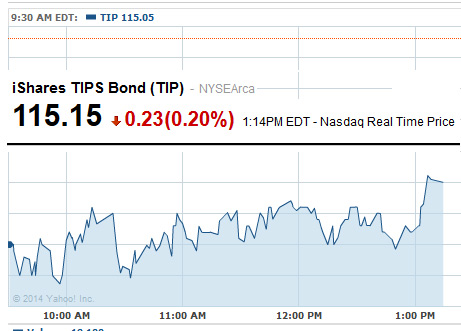
Market reaction. A higher yield looked possible in the hours before the auction, so that indicates a warm reception for this new TIPS. A look at today’s chart for the TIP ETF shows a slight bump (meaning lower yields) immediately after the auction:
reactCoverage by Reuters noted ‘solid demand’ for inflation protection:

“There’s still pretty solid demand for inflation protection,” said Stanley Sun, a New York-based strategist at Nomura Holdings Inc., which as one of the Fed’s 22 primary dealers is required to bid in U.S. debt sales. “People are still wanting inflation protection for the long term.”

The Wall Street Journal report noted that Treasury yields have been inching up, but not dramatically. A positive jobs report Thursday indicated that the economy continues to improve, which should mean some pressure on Treasury yields.

Thursday afternoon, the U.S. sold $15 billion in Treasury Inflation Protected Securities, or TIPS, maturing in 10 years. The auction drew solid interest, with enough bids to cover the sale 2.49 times even though the TIPS offered a low 0.249% yield. That is the lowest rate at an auction of its kind since May 2013.

Although inflation in the U.S. remains subdued, there are signs pricing pressure is rising in pockets of the economy. Many analysts say once wages start to increase, that could open the door to broader inflation and help boost the return on TIPS.

Posted in Investing in TIPS | 4 Comments

Checking in on today’s 10-year TIPS auction

The auction for CUSIP 912828WU0 – a new 10-year Treasury Inflation-Protected Security – will close today at 1 p.m. Noncompetitive bids – like those submitted through TreasuryDirect – must be place before noon.

Here’s how this auction is shaping up:

  • Bloomberg’s Current Yields page is flashing a yield of 0.25% for the 10-year TIPS first issued in January. We can assume the yield on a full 10-year TIPS would be a bit higher.
  • The Wall Street Journal’s closing prices chart shows that the same January TIPS closed yesterday at 0.213%, so it appears yields are on the rise today.
  • The Treasury’s Real Yields chart pegs a full-term 10-year TIPS at a yield of 0.25%.
  • The TIP ETF is trading right now at $115.04, down 0.3% on the day, also indicating that yields are on the rise.

From this data, buyers at today’s auction are looking at a yield above 0.25%, possibly up to 0.30%. In fact, 0.30% would not be a surprise, given weakness in the TIPS market today. This should set the coupon rate at 0.250%. A yield below 0.25% would drop the coupon rate – which is set at this initial auction – down to 0.125%.

But as I have noted frequently in the past, it is very difficult to predict precisely the yield on a new TIPS. Surprises can result when new inventory enters the market.

I’ll be posting after 1 p.m. with the auction results, and have more reaction later one.

Posted in Investing in TIPS | Leave a comment

Before you buy that 10-year TIPS … consider an I Bond

There’s an auction of a new 10-year Treasury Inflation-Protected Security on Thursday, and it looks like it will generate a yield to maturity of about 0.25% (plus inflation), well below the 0.661% buyers of the last new TIPS got six months ago, in January.

I’ve already noted that this won’t be an attractive auction for CUSIP 912828WU0, and that  potential buyers will have a chance to snag it in two reopening auctions later this year, in September and November, when conditions might be more attractive.

There is another alternative: Forget buying this TIPS and buy an I Bond instead, up to the limit.

Savings-Bond-IThe way I Bonds work. An I Bond is a security that earns interest based on combining a fixed rate and an inflation rate.

The fixed rate – now 0.10% for as long as you hold the bond, up to 30 years – will never change. So if you bought an I Bond in 2012 with a zero fixed rate, it will continue to have a zero fixed rate. Purchases through Oct. 31, 2014, will have a fixed rate of 0.10%. I Bonds I bought back in 2000 still carry a fixed rate of 3.4% and will continue to do so through 2030.

The inflation-adjusted rate changes each six months to reflect the running rate of inflation. That rate is currently set at 1.84% annualized (for a combined rate of 1.94%). The inflation adjusted rate will change again on Nov. 1, 2014, for all I Bonds, no matter when they were purchased. (However, the effective start date of the new interest rate can vary depending on the month you bought the I Bond, a Treasury oddity. Learn more on my Tracking Inflation and I Bonds page.)

Why they are a great investment.

  • First, I Bonds are the most conservative and most safe of all investments. Your principal is 99.9999999% safe and it will never decline, ever. If inflation falls to below zero, the inflation-adjusted rate will fall to zero, but not below zero. This is not true of TIPS, where accrued principal declines when deflation strikes. This means I Bonds are a superior investment to TIPS in times of deflation.
  • I Bonds allow you fantastic flexibility. You can redeem them after one year, costing you three months of interest. Or redeem them after five years and pay no penalty, or just hold them for 30 years and cash out.
  • I Bonds protect you against unexpected inflation. If inflation in the next 30 years suddenly soars to 7%, 10%, 15%, your principal will increase by that amount because of the inflation-adjusted interest rate.
  • I Bonds allow you to defer federal income taxes until you redeem them, so you pay zero in taxes until they are sold. This is a big advantage over TIPS, which carry current-year income taxes for both the coupon rate and the inflation adjustment to principal. (Both TIPS and I Bonds are free of state income taxes, an advantage over bank CDs.)
  • I Bonds are very simple to track as an investment. Just download the Savings Bond Wizard, update your information, and check it a couple times a year. This is another huge advantage over TIPS held at TreasuryDirect, which is a do-it-yourself proposition, even for downloading yearly tax forms. Want to track current value of your TIPS? Open up Excel and get to work. TreasuryDirect is not going to tell you.

The big negative? You can buy only $10,000 per person per year, in a Treasury Direct account, plus an additional $5,000 a year in paper I Bonds through an income tax refund.

Because of these advantages, I Bonds ‘typically’ carried a fixed rate about 1.0% less than the yield-to-maturity of a 10-year TIPS. Today, that spread has dwindled to about 0.15%, and that is the reason that I consider an I Bond more attractive than a 10-year TIPS yielding 0.25%.

A 10-year TIPS is a locked-in investment. You can sell it on the secondary market, but you might face a loss in principal, possibly a dramatic loss. And if held in a taxable account, you will pay ‘phantom’ income taxes on the principal appreciation until maturity.

I Bonds, by contrast, can be sold after one year with a minimal penalty, or after five years with no penalty, or at any other time in future, up to 30 years. All interest is tax deferred. You decide when to cash them in, so you can spread the tax burden across many years.

Or should you wait? The I Bond fixed rate will be re-set on Nov. 1, and it is impossible to predict what the Treasury will do. The fixed rate dropped from 0.2% to 0.1% on May 1, and given current trends in interest rates, it could drop to 0.0% on November 1. But we don’t know, and won’t know.

Unless interest rates begin rising dramatically, though, I can’t see the Treasury raising the I Bond rate above 0.1%.

Posted in I Bond, Investing in TIPS, Savings Bond | 6 Comments

U.S. inflation rose 0.3% in June

The Consumer Price Index for All Urban Consumers (CPI-U) increased 0.3% in June on a seasonally adjusted basis, the U.S. Bureau of Labor Statistics reported today. Over the last 12 months, inflation increased 2.1%.

The June increase – which hit the expected number – was primarily driven by the gasoline index, which rose 3.3% and accounted for two-thirds of the all items increase, the BLS reported. Balancing off that increase was a decline of 2.6% in piped gas services and declines in prices for new and used vehicles. Apparel costs were up 0.5% and medical care commodities, 0.7%.

Holders of TIPS and I Bonds are also interested in the non-seasonally adjusted CPI-U, which is used to adjust the principal of Treasury Inflation-Protected Securities and set future interest rates of US Savings I Bonds. This number was up 0.19% in June, and the same 2.1% for the last 12 months.

I have updated my Tracking Inflation and I Bonds page to reflect these new numbers.

Today’s inflation report continues the trend of annual inflation rising above 2.0%, which is the Federal Reserve’s goal, although it does not set policy base on CPI-U. Core inflation, which strips out food and energy, was up 0.1% in June and 1.9% over the last 12 months, down from May’s 2.0% but higher than the 1.7% average annualized increase over the past five years.

Here is the inflation trend for the last 12 months:

12 months

Posted in I Bond, Inflation, Investing in TIPS | 1 Comment

Up next: New 10-year TIPS auction July 24, 2014

The US Treasury hasn’t posted the formal announcement yet (it will be coming later this morning), but we know it will auction a new 10-year Treasury Inflation-Protected Security on Thursday, July 24. It will be CUSIP 912828WU0, and because this is a new issue, both the coupon rate and yield to maturity will be set when the auction ends.

Advantage of a new issue. Some TIPS followers don’t like the uncertainty of buying at auction, especially reopening auctions, because the price they pay can vary from what they expect. This happens when the yield to maturity is well above or below the coupon rate. This happens with reopenings, and the price swings can be dramatic (while somewhat predictable for those who follow the market).

But with a new issue, when the yield to maturity is above zero, the Treasury always sets the coupon rate one ‘click’ below the yield to maturity, meaning that buyers should be getting the TIPS at a slight discount, or at least extremely close to par after accrued interest is added in. The last two new-issue 10-year TIPS auctions demonstrate this:

CUSIP Auction Coupon Yield Per $100
912828B25 23-Jan-14 0.625% 0.661% 99.548
912828VM9 18-Jul-13 0.375% 0.384% 100.004

Disadvantage of a new issue. While there is less uncertainty about the dollar amount you will pay, a new issue isn’t currently trading on the secondary market and thus has no set coupon rate. Until the auction ends, you won’t know the coupon rate, or the yield to maturity, and this can be hard to predict for new issues. A new issue creates added ‘inventory’ for the TIPS market, and the pricing at auction can be slightly volatile.

What we know today about CUSIP 912828WU0. It’s possible that this new TIPS will auction with the lowest yield to maturity for any 9-to 10-year TIPS since May 2013, when the yield was -0.225%. Since then – for six consecutive auctions – the lowest yield to maturity has been 0.339%. Next Thursday’s yield could be lower:

  • Bloomberg’s Current Yields page is flashing a yield of 0.25% for a less-than 10-year TIPS currently trading on the secondary market.
  • The Wall Street Journal’s closing price chart is showing that a TIPS maturing Jan. 15, 2024, closed yesterday at 0.285%.
  • The Treasury’s Real Yield Curve chart – which estimates the price of a full-term 10-year TIPS – is showing a yield of 0.32% at the close Wednesday.

A lot can happen in a week, especially with a new issue, but right now we are looking at a yield of maybe 0.285% to 0.325% for this TIPS, and a coupon rate of 0.25%. The last new issue 10-year TIPS – auctioned Jan. 14, 2014 – went off with a yield of 0.661% and a coupon rate of 0.625%.

That’s a drop of more than 30 basis points in half a year, and it makes a big difference in the secondary market value of that TIPS. The January TIPS auctioned with a price of $99.548 per $100 of value, but now is much more expensive – about $103.15 on the secondary market. This price swing will work in reverse if (when?) interest rates begin to rise.

The inflation factor. One factor driving demand for TIPS – which causes yields to decline – is that inflation has been steadily rising this year. On top of the coupon rate, the principal balance of TIPS rises with the Consumer Price Index for all Urban Consumers (CPI-U). I chart recent inflation rates on my I Bonds page.

Inflation is currently running at 2.1% over the last 12 months. However – and this is crucial for buyers at next Thursday’s auction – the June 2014 inflation number will be announced Tuesday at 8:30 a.m. That number could have an effect on TIPS prices. Wait to see that number, and the reaction in TIPS prices, before making a buying decision.

Inflation breakeven rate. With the nominal 10-year Treasury closing yesterday at 2.55% and a 10-year TIPS at 0.32%, this creates a 10-year inflation breakeven rate of 2.23%. This means that if inflation averages more than 2.23% over the next 10 years, a TIPS will outperform at traditional Treasury. Back in January, the last new TIPS auction generated a breakeven rate of 2.12% — more attractive, in my opinion.

In summary, next week’s TIPS auction is not looking like an attractive buying opportunity. If you believe interest rates will be rising in the next few months, you will have an opportunity to get this same TIPS at a discount at reopening auctions in September and November. On the other hand, if you believe inflation will continue to rise without interest rates rising, this issue could be appealing.

Here is a chart of recent 9- to 10-year TIPS auctions showing how yields have risen from negative levels of 2012 to 2013, but remain well below historical norms:

10-year TIPS history

Posted in Investing in TIPS | 9 Comments