Wall Street Journal prediction: No Fed tapering anytime soon

The_Scream_lithography

Edvard Munch painted four versions of The Scream, plus the lithograph shown above.

One of the side effects of the U.S. government fiscal circus of the last few weeks is that  Federal Reserve officials must be sitting on the sidelines, mouths open in horror. Sort of like Edvard Munch’s famous paintings and lithographs. What are they doing?

So, today, the Wall Street Journal’s ‘Heard of the Street’ column (‘Shutting the Fed’s Taper Plans‘) confidently predicted a complete shutdown of taper talk until the federal government comes up with some sort of consensus on the budget and debt limit.

Up until Sept. 19, the markets had been betting the Federal Reserve would begin a gradual tapering of its bond-buying economic stimulus program. But on that day, the Fed decided to put taper on hold. That was probably a wise move, given the huge disruptions this month caused by the government shutdown and debt-ceiling brinksmanship.

Now, with only a short-term agreement in place, Congress has effectively given the Fed a free pass to continue the bond buying into 2014. The Wall Street Journal notes:

If the numbers look good, Fed policy makers at their December meeting might feel justified in scaling back the central bank’s bond-buying program. But that would ignore one crucial consideration: With the budget deal funding federal agencies only through Jan. 15, and raising the debt ceiling only through Feb. 7, another battle could be brewing.

The Fed will probably want to avoid doing anything to discomfit markets until the risk of another showdown has passed. That pushes the likely timing for starting the tapering process to the Fed’s March meeting …

What does this mean for holders and buyers of Treasury Inflation-Protected Securities? I think we can see yields lingering in this current range, around 0.40% for a 10-year TIPS and 1.35% for a 30-year TIPS, well into next year. Yields have fallen more than 50 basis points since an early-September peak. We probably won’t get that 50 back in the near term, and I don’t think we’ll see much of a fall from here, if the economy remains stable.


Posted in Investing in TIPS | Leave a comment

In September, U.S. inflation was … well, what was it?

We don’t know the answer to this question because of the partial U.S. government shutdown. The Bureau of Labor Statistics was due to release its September inflation report today at 8:30 a.m., but it is has not been gathering data since Sept. 30. So … no report. Instead we get this notice on the BLS site:

This website is currently not being updated due to the suspension of Federal government services. The last update to the site was Monday, September 30. During the shutdown period BLS will not collect data, issue reports, or respond to public inquiries. Updates to the site will start again when the Federal government resumes operations. Revised schedules will be issued as they become available.

Update: The BLS now says it will release the CPI report on Wednesday, Oct. 30. Here is the update – 0.2% inflation in September.

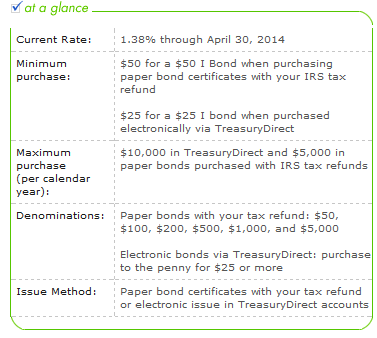
This inflation number, known as the Consumer Price Index, is important. For example, the September inflation rate is the final piece used by the Social Security Administration to determine its annual cost-of-living adjustment for beneficiaries. Of course, CPI-U is also used to set the daily principal adjustment for Treasury Inflation-Protected Securities, and goes into the data determining the future interest rate paid by US Savings I Bonds.

So now what? The Wall Street Journal reports today that the Treasury will now be forced to generate its own data. The figure will be based on the last available 12-month change in CPI, which was a meager 1.5% (one of the lowest of recent years). From a Treasury document:

(iv) If the CPI for a particular month is not reported by the last day of the following month, we will announce an index number based on the last available twelve-month change in the CPI. We will base our calculations of our payment obligations that rely on that month’s CPI on the index number we announce.

(The principal adjustment for TIPS has already been established through Oct. 31, so there is no immediate effect from the delayed data. For example, here are the data for the 30-year TIPS being reissued on Oct. 24.)

The Journal also notes that the BLS has already gathered the September data, so once the shutdown ends, it can issue the report very quickly. But the October report is in jeopardy because the agency has not been gathering data for more than half a month.

Posted in Investing in TIPS | Leave a comment

Up next: 30-year TIPS reissue will auction Thursday, Oct. 24

The U.S. Treasury will formally announce this Thursday, but it has already indicated it will reopen CUSIP 912810RA8 at auction on Oct. 24, creating a 29-year, 4-month Treasury Inflation-Protected Security.

Update: Here is the Treasury announcement

This will be an especially interesting auction because the announcement comes on the very day the Treasury predicts it will hit its debt ceiling. If this political crisis continues on for days or even a week beyond Oct. 17, it could roil Treasury, stock and bond markets. But I doubt that will happen.

This auction will also be interesting because buyers will be getting this TIPS at a huge discount from its original price on Feb. 21, when it auctioned with a coupon rate of 0.625%, and a yield to maturity of 0.639%. CUSIP 912810RA8 is now trading with a yield of about 1.4% and a price of about $81 for $100 of value. (The price buyers pay will also reflect about $1.70 in inflation adjustment since the February auction.)

A TIPS with a yield well above 1% (plus inflation) has been a rare thing recently. The only other auction with a yield above 1% was for this same TIPS in a June reissue, which netted a nice yield of 1.42%.

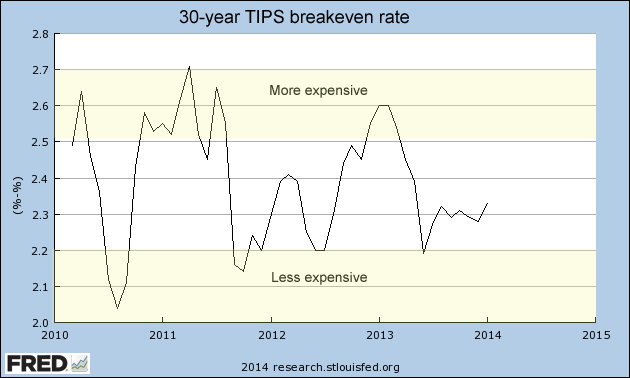
TIPS were under attack in June. On that auction date, the 30-year traditional Treasury was yielding 3.49% and it has since risen 25 basis points to 3.74%. The 30-year TIPS yield has actually declined a couple of basis points. That puts a pinch on the 30-year inflation breakeven rate, which currently stands at about 2.34%.

My theory is that a 30-year TIPS should pay at least 2% above inflation, which approximates the historical return for U.S. Treasurys. Looking back at historical data supports this, but there’s a big gap in the history because the Treasury halted 30-year TIPS auctions from 2002 to 2009, when TIPS yields were in a fairly stable pattern.

30-year TIPS auctionsAt this point, this auction will be very interesting to watch, maybe the most interesting of the year. If you are looking to give your TIPS ladder an interest-rate boost, and you can tolerate the ups and downs of a volatile 30-year issue, this will be one to consider.

Posted in Investing in TIPS | 2 Comments

For TIPS, so far, U.S. debt crisis has been a non-event

The U.S. Treasury market has been surprisingly mundane during a month when the government partially shut down for lack of continued funding, and a potential default on U.S. debt and other obligations looms just seven days away.

The stock market is taking this crisis seriously, but the Treasury market seems to be saying: ‘Ho hum. We’re the safe haven. Bring it on.’ So, at a time when bonds are nearly  universally scorned as an investment, TIPS have outperformed stocks in the last one- and three-month periods, as these charts show:

TIP vs SPY

TIP vs. SPY

All this indicates that the Treasury market still isn’t taking the threat of default seriously, but the stock market sees the shutdown as potentially harming the economy and cutting into corporate profits. Also, stocks had a mighty run leading into this crisis, while TIPS and Treasurys had been hammered by climbing interest rates.

There’s a 30-year TIPS auction coming up Thursday, Oct. 24, 2013. It will be a reissue of CUSIP 912810RA8, which carries a coupon rate of 0.625%. This one will be going off at a substantial discount, because this TIPS currently trades with a yield of about 1.378% and sells at a price of about $81.28 for $100 of value.

Some readers have told me they were expecting this yield to rise dramatically as the auction approaches in the middle of a crisis. However, that hasn’t been happening (and there could be some sort of temporary solution before the crisis actually arises). Here is the yield trend for a 30-year TIPS:

  • Jan. 2, 2013: 0.47%
  • Feb. 1, 2013: 0.58%
  • Mar. 1, 2013: 0.52%
  • Apr. 1, 2013: 0.58%
  • Jun. 3, 2013: 0.95%
  • Jul. 1, 2013: 1.28%
  • Aug. 1, 2013: 1.40%
  • Sep. 3, 2013: 1.54%
  • Sep. 5, 2013: 1.64%
  • Oct. 1, 2013: 1.39%

So after hitting a high of 1.64% on Sept. 5, the 30-year TIPS yields has been trending downward, about 25 basis points in all. This drop has coincided with the funding and default crisis in Washington.

If there actually were a default on U.S. debt, and bond holders did not receive interest payments and matured principal (highly unlikely, I’d say), then everything would change. First of all, short-term lending would freeze up, and there’s already some anxiety building about that prospect. From a Wall Street Journal story:

Yields on some Treasury debt are rising and the price to borrow cash against Treasurys is climbing as some lenders are unwilling to accept U.S. debt securities maturing in late October and early November as backing for their loans. …

The prospect of a U.S. default in coming weeks has prompted many banks, securities dealers and money-market funds to sell any U.S. debt that they believe bears default risk, including securities that would be used as collateral for repo loans.

BlackRock’s Matt Tucker, head of iShares fixed-income strategy, said in a CNBC interview this week that an actual default could lead to a sell-off in Treasurys. That didn’t happen in the 2011 debt crisis, when Treasurys soared as a haven investment. From the CNBC account:

“The difference here is that in 2011, we had a lot of concern about what was happening in Washington. This triggered a flight to safety, and Treasurys rallied,” Tucker said. But, he added, “if we actually saw a default, whether it was a technical or otherwise default by the Treasury, that could be a very different reaction. You actually could see a more mixed response from Treasurys, even a selloff.”

Today’s news seems to indicate some softening on both sides, which could lead to at least a short-term resolution of the debt-limit issue, if not the shutdown. The Wall Street Journal is reporting: “GOP to Unveil Temporary Increase to Debt Ceiling.”

The measure, which runs through Nov. 22, deals with just one of two major components of the spending standoff. It doesn’t reopen the government, which has been partially closed for 10 days, leaving that question to additional deliberations between lawmakers and the White House over government spending.

Interesting side note: The U.S. Treasury will formally announce the reopening of the 30-year TIPS on Thursday, Oct. 17, 2013, the very day the debt-ceiling crisis is supposed to go ‘live.’ How ironic. We’ll be watching.

Posted in Investing in TIPS | Leave a comment

Year-later update: TIPS versus booze, which is the better investment?

Last October, after a wonderful trip to Ireland and visits to Diageo’s Bushmills (whiskey, in northern Ireland)  and Guiness (beer, in Ireland) facilities, I had a thought: “Better long-term investment: 30-year TIPS or … booze?”

What was interesting at the time was how similarly the stock prices of Diageo plc (ticker DEO) and the TIPS ETF (ticker TIP) had performed over the previous five years. Here was the 5-year chart as of Oct. 15,2012:

DEO versus TIP

The TIP ETF, shown in blue, was up about 20% from 2007 to 2012, slightly trailing the performance of Diageo, shown in red. But Diageo was much more volatile.

In the posting, I noted that both Treasurys and Diageo were fully priced after strong runs. I speculated that an investment in a 30-year TIPS would beat Diageo for safety, but Diageo’s dividend and earnings growth meant it it would probably outperform a 30-year TIPS, which at the time was yielding just 0.38% above inflation.

So what has happened in the year since I wrote this? Here you go:

TIPS versus Diageo

Since Oct. 15, 2012:

  • TIPS yields have risen dramatically, with the 30-year reissue scheduled for Oct. 24 likely to draw a yield of about 1.38% , a 100-basis point increase.
  • The TIP ETF closed Thursday at $112.65, down 6.6% from the $120.61 close on Oct. 15, 2012. This negative number comes even after a recent run-up in TIPS prices.
  • Diageo closed Thursday at $125.89, up 13.1% from the $111.30 close on Oct. 15, 2012. This positive number – nearly 20% better performance – comes despite a recent dip in Diageo’s stock price.

What does it mean? Nothing really. Stock prices and Treasurys have benefited from Federal Reserve stimulus. But if the bond-buying stimulus tapers away or ends, TIPS and Treasurys will see yields rise and prices fall.

Booze won’t be much affected. People will still drink.

Posted in Investing in TIPS | 3 Comments