5-year TIPS reissue auctions at -0.375%

Treasury logoThe Treasury just announced the results of today’s reopening of CUSIP 912828UX6, a 4-year, 4-month TIPS that auctioned with a yield to maturity of -0.375%, plus inflation.

Because this TIPS carries a coupon rate of 0.125% – the lowest the Treasury allows on TIPS – buyers today will be paying up, about $103.22 for $101 of value, after accounting for about $1 of inflation-boosted principal since April.

The yield was slightly higher than the recent market on this TIPS on the secondary market, but yesterday’s tapering announcement from the Federal Reserve probably helped boost the number, at least a bit.

Today’s yield fell between the very low -1.311% of the original auction on April 18 and the more attractive -0.127% for the first reissue on Aug. 22. It’s interesting to note that the high-point of yield came during fears of tapering; now that tapering is official, the yield remains lower. Fear affects markets.

Inflation breakeven rate. With the 5-year nominal Treasury trading today at about 1.65%, this sets up an inflation breakeven rate of 2.025% for this TIPS, meaning that it will outperform a traditional Treasury if inflation averages more than 2.025% over the next five years. Inflation is currently running a very low 1.2% over the last 12 months.

Reaction to the auction. The TIP ETF is trading down very slightly today at $110.19, down 0.25%, and the market barely budged with the auction announcement.

From the Wall Street Journal report:

One positive reflection of the auction, however, was that end-investors bought nearly 60% of the total offering. That included 44.5% taken by indirect bidders and 14.3% taken by direct bidders, who often represent domestic fund interest.

Still, the market’s overall appetite for the new government debt was weighed down by the Fed’s decision to start trimming its asset purchases. In addition, overnight selling by money managers in Asia and Europe “started us on a negative tone to begin the trading session,” said Guy LeBas, chief fixed-income strategist at Janney Montgomery Scott LLC.

Posted in Investing in TIPS | 1 Comment

Federal Reserve launches ‘tapering’ with small cut in bond-buying

The Federal Reserve, in an announcement that slightly surprised the financial markets, announced today that it will reduce its $85 billion a month in bond purchases by $10 billion starting in January.

The move was anticipated, but most market-watchers expected the Fed to make the move early in 2014 instead of now. This week’s inflation  report – with CPI running at just 1.2% over the last 12 months – kept the pressure off the Fed for immediate action.

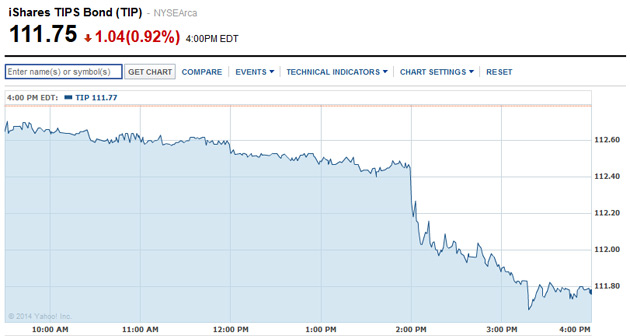
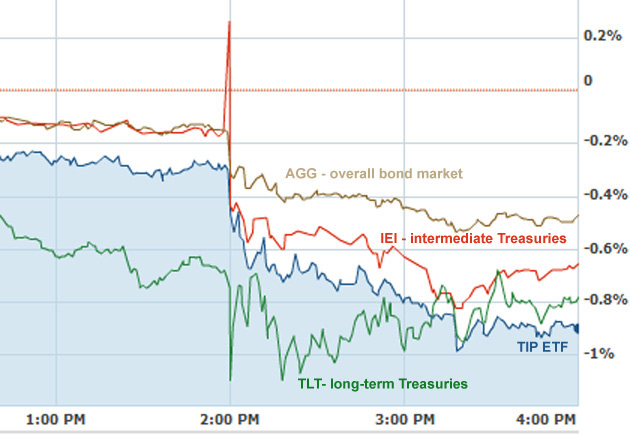
The immediate effect on TIPS and Treasurys appeared minimal, with the TIP ETF trading at $110.69 at 2:45 p.m., down just 0.23% for the day.

The move is important, however, because it demonstrated that the Federal Reserve is willing to cut back and possibly end its program of bond-buying, which has been used to suppress long-term interest rates.

The TIPS market began pricing in this move six months ago, and so it is possible we won’t see a dramatic move upward in yields. I suspect, though, that yields will begin gradually rising in 2014.

Posted in Investing in TIPS | 2 Comments

U.S. inflation remained flat in November

Inflation – as measured by the Consumer Price Index for All Urban Consumers (CPI-U) – was unchanged in November on a seasonally adjusted basis, the U.S. Bureau of Labor Statistics reported today. Over the last 12 months, this index – often called ‘headline’ inflation – has increased just 1.2 percent.

Energy prices overall fell 1.0% in the month, aided by a 1.6% drop in the price of gasoline. Food prices were up just 0.1% and shelter costs increased 0.3%.

Holders of TIPS and I Bonds watch the unadjusted CPI-U, which is used to set the inflation-adjusted interest rate on TIPS and future interest rates on I Bonds. This unadjusted number was -0.2% in November, but remains 1.2 percent for the last 12 months.

‘Core inflation’ – stripping out food and energy – rose 0.2% in November and 1.7% over the last 12 months. This is the number most watched by the Federal Reserve, which has set an implicit goal of 2.0% for annual inflation and a ‘danger level’ of 2.5%.

Today’s numbers still leave the door open for the Fed to continue economic stimulus, a hot issue at today’s Fed meetings.

This chart of the seasonal-adjusted CPI-U shows the dramatic slowdown in inflation since the middle of 2013:

1 year inflation

Posted in Investing in TIPS | Leave a comment

Up next: 5-year TIPS reissue will auction Dec. 19, 2013

The Treasury announced Thursday it is reopening CUSIP 912828UX6, creating a 4-year 4-month TIPS with a coupon rate of 0.125%. Because of upcoming holidays, the auction on Thursday, Dec. 19, will end earlier than usual: 11 a.m. for noncompetitive bids and 11:30 a.m. for competitive bids.

Scoping out the auction. Since this TIPS trades on the secondary market, we can get a pretty good idea of its likely yield at auction, currently about -0.44%, plus inflation. While that definitely is a modest return, it is much better than the -1.311% this same TIPS generated at its original auction on April 18, 2013.

(Side note: The Treasury’s Resource Center is showing a much higher yield for a full 5-year TIPS, -0.11%. I would take this as a strong hint that buyers at Thursday’s auction will get a better yield than -0.44%.)

The record low for any 5-year TIPS at auction was -1.496% on Dec. 20, 2012. This shows how much the Treasury market has changed in one year, with yield rising 105 basis points. While TIPS are being scorned by many investors, they certainly are a much better bargain today than they were a year ago.

The problem with a 4-year, 4-month TIPS is that it creates a small window for inflation to begin rising, and inflation protection is the reason you buy a Treasury Inflation-Protected Security. Right now, inflation has been running just 1% over the last 12 months. So buyers at the original auction in April – who paid $107.82 per $100 of value – are collecting a 0.125% coupon on $100 of value and getting paltry appreciation from inflation. For them, CUSIP 912828UX6 has been a horrible investment.

Yeah, I own it. I was a buyer of 912828UX6 at the August reopening, a small amount to fill a gap in my TIPS ladder. That auction generated a yield to maturity of  -0.127%, the highest yield for any 4- or 5-year TIPS issued in more than three years. Soon after, the Fed backed off on tapering and yields declined again.

You have alternatives. There are other great, super-safe, super accessible 5-year investments out there, and you should judge this TIPS against those. For example:

  • I Bonds are paying inflation plus .2%, which beats -0.44% by 64 basis points. You can sell an I Bond after five years with no penalty. No brainer, buy I Bonds up to the limit.
  • The 5-year Treasury is yielding 1.55%, up a dramatic 85 basis points from a year ago. This sets up an inflation breakeven point of 1.99%. If inflation continues to average less than 2%, a traditional Treasury will be the better investment.
  • Bank CDs are paying about 2% (and a whopping 3.04% at the Pentagon Federal Credit Union). But let’s say 2%. You’d do better with a bank CD if inflation averages less than 2.44% over the next five years.

I always have one good thing to say about 5-year TIPS: They mature in 5 years. Or in this case, 4 years, 4 months. It’s not a long-term commitment. Buyers at the Dec. 19 auction will still be paying up to get that 0.125% coupon rate, about $102 for $100 of value. That premium is at risk if inflation continues at extremely low rates, but I think that is unlikely.

Posted in Investing in TIPS | 2 Comments

Why the U.S. budget deal might lead to higher interest rates

The new, bipartisan budget deal in Congress – crafted to avert another government shutdown – could have a ‘surprise’ effect: It could lead to higher interest rates in 2014.

  • The big reason is that it opens the door for the Federal Reserve to begin tapering its bond-buying economic stimulus. This fall, just before the shutdown, the Fed backed off on tapering, a move the market had already anticipated with higher interest rates. Part of the Fed’s reasoning was the budgetary gridlock and its possible effect on the U.S. economy. Now, with that threat apparently gone, the Fed has a freer hand to begin the tapering, which should in turn cause Treasury rates to rise.
  • Also the budget deal does nothing to slow down government spending, it just rearranges it. But it does soften the blow of coming sequester cuts to defense spending, which should in turn help the economy continue improving. This also opens the door to tapering.

From a Wall Street Journal report:

“The budget deal takes away uncertainty and the deal adds to spending marginally which should help economic growth be a bit stronger than expected next year,” said Thomas Roth, executive director in the U.S. government bond trading group at Mitsubishi UFJ Securities (USA) Inc. in New York.

I was surprised Wednesday that the TIPS market reacted to the budget deal with a yawn. The TIP ETF dropped about 0.1%, a meaningless move after trading slightly higher through the day.

But yields have risen noticeably as the budget deal became more likely. The 10-year nominal Treasury is yielding 2.86%, 12 basis points off the high for the year – 2.98% on Sept. 5. The 10-year TIPS is yielding 0.71%, 21 basis points off its high – 0.92% on Sept. 5.

So far, TIPS yields haven’t made a ‘giant’ move in reaction, but the trend is up. The 10-year inflation breakeven point stands at 2.15%, better than it has been recently.

Posted in Investing in TIPS | 2 Comments