Monday: More blood in the streets for TIPS

After a month of very sharp rises in the yield on Treasury Inflation-Protected Securities, the trend continued Monday, with the yield on the benchmark 10-year TIPS rising to 0.11%, plus inflation, marking two trading days in a row the yield has gone positive.

That is an incredible gain of 75 basis points since May 1, when the yield stood at -0.64%. This is the first time the 10-year TIPS yield has gone positive since Dec. 15, 2011. That has been a very long, painful slog for net buyers of TIPS (buying more than mature each year).

The trend has reversed. TIPS are interesting again, for the buy-and-hold investor.

Buy and hold is my TIPS philosophy. That means buying TIPS at TreasuryDirect and holding them to maturity. There is very little risk in this strategy. You aren’t trading, you can ignore the secondary price and never consider ‘duration.’ Along with I Bond purchases, it is a very conservative way to preserve capital, for a portion of your portfolio. (And a poor way to build wealth, I must say.)

However, buyers should be choosy. I stopped buying TIPS in June 2011, a 30-year TIPS with a yield of 1.774%. Nearly two years later, last month, I got back in the game, purchasing the 10-year TIPS reissue with a yield of -0.225%.

Painful day. But for investors in TIPS mutual funds and ETFs, these are painful times. The flagship ETF, with the ticker TIP, declined $0.80 today to close at $114.64, down 0.69% on the day and down 5.9% since May 1.

Obviously, money is pouring out of TIPS funds, just as it poured in during a heady 20-month period from July 1, 2011, to April 30, 2013, when TIP increased from $105.96 to $122.15, or 13.3%.

Unlike a stock mutual fund, there are no ‘fundamentals’ to support the price of the ETF or other TIPS mutual funds. No one looks at 200-day moving averages or strange chart formations. The value of TIPS is determined by the yield to maturity, and the yield is rising. That means the price is falling, and will keep falling as long as the yield increases.

There are several factors at work here:

  • Overall interest rates are rising. The nominal 10-year Treasury closed today at 2.22%, up 56 basis points since May 1.
  • The yield on TIPS is rising even faster – 77 basis points since May 1. That means TIPS are getting cheaper versus traditional Treasurys. Today’s 10-year inflation breakeven rate stands at 2.11%, getting close to my 2.0% ‘cheap’ marker.
  • Inflation is currently muted, running just 1.1% over the last 12 months. Since TIPS offer extremely low yields, low inflation is a double whammy for TIPS holders.
  • Despite the pain for traders and mutual fund investors, TIPS are a much better deal for investors today than they were 40 days ago. This chart shows just how rarely the breakeven rate drops below 2.0%:
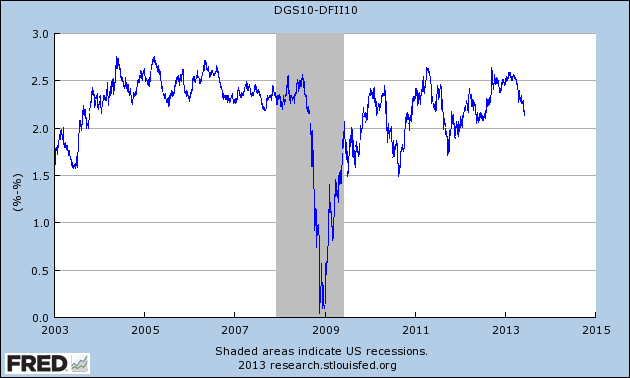
10-year breakeven

At some point, I might get interested in TIPS mutual funds. I speculate (not with money, just my mind) that the TIP ETF is heading down to about $110 and the 10-year Treasury will hit 2.75%. At that point, a 10-year TIPS would be yielding maybe 0.55%, maybe higher, but still substantially below the 1% to 2% that TIPS investors saw in the past.

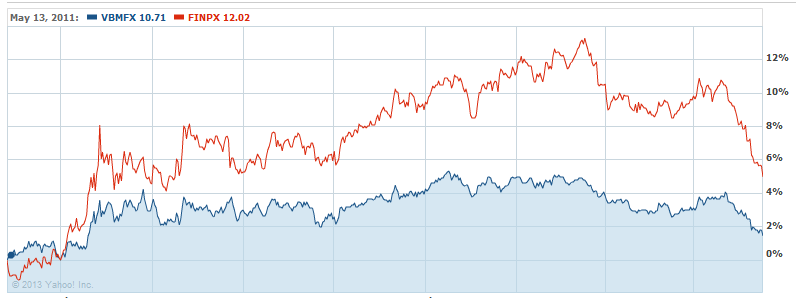
I am often wrong. Very wrong. Back in May 2011, I wrote a blog explaining why I was exiting Fidelity Inflation Protected Bond (FINPX) in favor of Vanguard Total Bond Fund. I was doing this at EXACTLY the wrong time, and to my embarrassment, this was one of my most popular blog posts of all time. It still gets viewed, every day.

Oh well, here is how that worked out:
FINPX

I looked wise for about a month, then very stupid as the Federal Reserve launched QE after QE, buying Treasurys and creating money to stimulate the economy.

But my bond portfolio is more about preserving capital, along with a minimal interest-rate return. Vanguard Total Bond Fund is still one of my favorites. And here’s how it has gone since May 1:
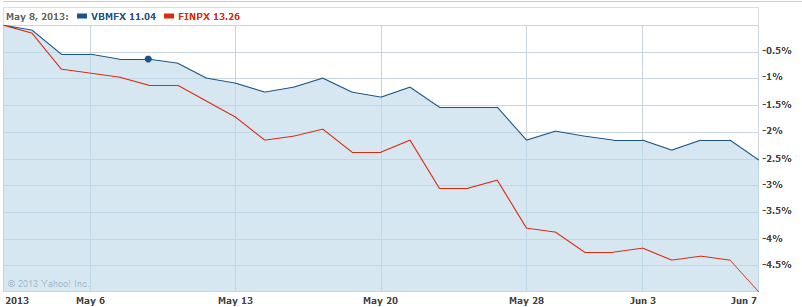
total bond

I won’t claim to know what the future holds. I have long believed that yields on TIPS were unnaturally low, and that trend had to – and would – reserve. I think that trend has started. Let’s watch to see if I am right.
Posted in Investing in TIPS | Leave a comment

Two weeks off, and look what happens to TIPS …

I was on vacation and away from a computer (an iPad is NOT a computer) the last two weeks, and blog-writing was impossible. Enjoy the glories of Vancouver Island, B.C., or struggle with writing a blog on an iPad? Easy choice.

But it has been an amazing three- to-four weeks for TIPS, with yields rising sharply and the price of the TIP ETF falling sharply, all starting about two weeks before the May 23 reissue auction of a 10-year TIPS.

Recapping how the yields have risen:

Date 10-year Treasury 10-year TIPS yield Breakeven
1-May 1.66 -0.64 2.30
6-May 1.80 -0.51 2.31
10-May 1.90 -0.45 2.35
16-May 1.87 -0.40 2.27
20-May 1.97 -0.31 2.28
24-May 2.01 -0.26 2.27
29-May 2.13 -0.10 2.23
3-Jun 2.13 -0.07 2.20
7-Jun 2.17 0.03 2.14

The 10-year TIPS yield rose a dramatic (!) 67 basis points in little over a month, while the rate on a nominal 10-year Treasury rose 51 basis points. That means TIPS got cheaper, pushing the 10-year breakeven inflation rate to a decent 2.14%. Remember it was running at 2.53% in January 2013, when TIPS were in much greater demand.

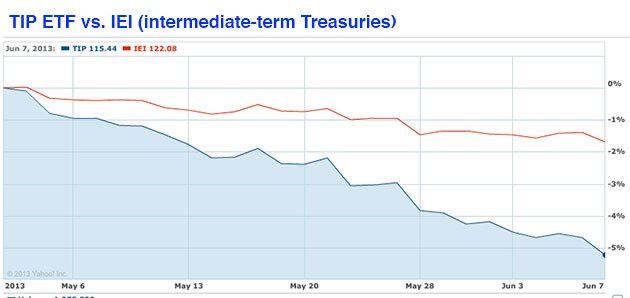
The rise in yields took a toll on the TIP ETF, which fell from $121.81 on May 1, all the way down to $115.44 on June 7. That’s a decline of 5.3% in 38 days — and demonstrates why I have not been a fan of owning TIP ETFs or mutual funds since July 2011. As these funds continued to hit all-time highs, risk was being built into the price.

And the decline may not be over: TIPS are the ugly stepchild of Treasurys right now, because they are being hit by the worst-case ‘perfect storm’: 1) higher interest rates, and 2) lower inflation. With inflation running just 1.1% over the last 12 months, TIPS have little appeal to the average investor, offering a low (or negative) base yield plus a paltry inflation adjustment.

This chart demonstrates what a rising breakeven rate looks like, at a time when Treasury yields are also rising. The TIP ETF has performed much more poorly than the IEI (intermediate-term Treasurys, a fund with a similar duration):

tipiei

Should buyers avoid TIPS? No way. For the buy-and-hold investor of Treasury Inflation-Protected Securities, the trend means that TIPS are getting interesting again. The yield on a 10-year TIP has inched back into positive, and this month’s 30-year auction should generate a yield well above 1%. Not stellar, but at least interesting.

And inflation? The current very low rate can’t and won’t continue if the economy continues to improve and central banks across the world continue creating money. The inflation  protection that TIPS offer continues to be valuable.

What about the ETF? My theory is that the 10-year Treasury could rise to about 2.75% by the end of the year, and if it does, that would set the 10-year TIPS yield at about 0.5%, about 47 basis points higher than it is today. If that happens, the TIP ETF would fall another 4%, or maybe to the $111 to $110 range. At that point, I might be a buyer.

Posted in Investing in TIPS | 2 Comments

10-year TIPS reissue auctions with a yield of -0.225%

The Treasury just announced that today’s auction of a 9-year, 8-month Treasury Inflation-Protected Security resulted in a yield of -0.225%, the highest yield on a 10-year TIPS in more than a year. This was a bit better than the -0.244% experts were predicting just before the auction.

Here is the Treasury announcement.

CUSIP 912828UH1, with a coupon yield of 0.125%, was first auctioned in January with a yield to maturity of -0.630% and then reissued in March with a yield of -0.602%.

The rise in yield means that buyers at today’s auction will be paying a much lower price for that 0.125% coupon, about $104.27 per $100 of value. That is down from $107.50 from the January auction.

The principal balance of TIPS is adjusted to reflect inflation, so a buyer at today’s auction is accepting a return of 0.225% less than inflation each year over 10 years.

TIPS yields, which have been as low as -0.750% for a 10-year issue, have been rising in the last month because of a trend of weakening inflation, plus a fear among investors that the Federal Reserve soon could halt or slow its bond-buying stimulus.

10-year breakeven rate

At midday today the 10-year Treasury was trading with a yield of 2.03%, making the 10-year inflation breakeven rate 2.255%. This is substantially lower than the lofty 2.54% resulting from the March reissue of this same TIPS. That means TIPS have become cheaper relative to traditional Treasuries.

Analysis of the auction

Carolyn Cui of the Wall Street Journal writes:

With real yield rising to the highest in more than a year, the inflation-adjusted Treasurys attracted decent demand from investment funds and foreign investors. …

One negative reflection of the auction, however, was that it had a light ratio of bidders to the amount of debt sold, at 2.52 times compared with the average of 2.66 times for 10-year TIPS during the past six auctions. As a result, the auction stopped at -0.225%, higher than the -0.246% for similar notes already in circulation before the auction.

Daniel Kruger of Bloomberg writes:

“Investors felt like this was meeting their support levels where they felt it was time to jump back in,” said Michael Lorizio, senior trader at Manulife Asset Management in Boston. “Digging deeper into the data really does spell this as a really solid auction.”


Posted in Investing in TIPS | 9 Comments

Yes or no on the May 23 10-year TIPS reissue?

I am going to say yes on this auction, and that is significant: It will be the first TIPS I will have bought at auction since June 2011, a 30-year TIPS with a yield of 1.774%. I won’t be going ‘all in’ but I will be reinvesting money from a TIPS that matured earlier this year.

I am pretty thankful that a series of economic events have driven the likely yield on this TIPS up to somewhere around -0.28%. That is 35 basis points higher than the yield of this TIPS, CUSIP 912828UH1, when it was first auctioned on Jan. 24, just four months ago.

Yes, I know that -0.28%, plus inflation, is not an attractive yield. But look at the history of recent 9- to 10-year TIPS auctions, and you can see that Thursday’s reissue will be the most attractive since March 2012:

recent TIPS auctions

Back in March 2012, by the way, the auction set an all-time low for a 9- to 10-year TIPS. But things were about to get a whole lot worse, as the Federal Reserve ramped up its bond buying and stoked fears of inflation.

Jump forward to May 2013, and inflation is running an extremely mild 1.1% over the last 12 months. Inflation is currently out of the picture as a major concern. Just look at what Fed Chairman Ben Bernanke said today:

“I would point out that even though we have a dual mandate, that inflation if anything is a little bit too low. Inflation has been very low; the dollar has been strong. We have not in any way failed on that responsibility.”

So inflation fears are dwindling, but at the same time interest rates are rising. Here are numbers for yields on the 10-year nominal Treasury:

  • May 1, 2013 = 1.66%
  • May 10, 2013 = 1.90%
  • May 20, 2013 = 1.97%
  • May 22, 2013 = 2.03%

And then, this is the important point: TIPS are getting cheaper. We have seen a very gradual decline in the 10-year TIPS breakeven rate (nominal Treasury yield minus TIPS yield = breakeven rate). Here is the trend in breakeven rates, drawn from Treasury data:

  • March 16, 2012 = 2.43%
  • Jan. 2, 2013 = 2.53%
  • March 21, 2013 = 2.54%
  • May 1, 2013 = 2.30%
  • May 10, 2013 = 2.35%
  • May 20, 2013 = 2.28%
  • May 22, 2013 = 2.27%

It’s not a dramatic change, but TIPS have been getting steadily cheaper versus nominal U.S. Treasurys.

Thursday’s auction offers a chance to reload with a buy-and-hold 9-year, 8-month TIPS at a yield that is a definite improvement over more than a year of auctions.

The future (for TIPS buyers) may be even brighter. Who knows?

I think it’s time to jump cautiously back into the pool.


Posted in Investing in TIPS | 3 Comments

U.S. inflation drops a sharp 0.4% in April

Is this what deflation looks like? At least for spring 2013, yes.

The Bureau of Labor Statistics announced today that ‘headline’ inflation – known technically as the Consumer Price Index for All Urban Consumers (CPI-U) – decreased 0.4% in April on a seasonally adjusted basis. This was a much sharper fall than the 0.1% drop that experts were expecting.

The non-seasonally adjusted number for April was -0.1%, and has been running at 1.1% over the last 12 months.

This non-seasonally adjusted inflation number is especially important to holders of TIPS and I Bonds, because it is used to adjust the principal balance of TIPS and set the future inflation-adjustment interest rates for I Bonds.

Therefore, TIPS holders will see their principal balances adjusted down 0.1%. Not nice, and this trend seems very likely to force TIPS yields higher, even versus traditional Treasurys. When inflation fear is out of the pictures, TIPS are not in high demand.

(Meaning … possible buying opportunity.)

Read the full CPI report.

As in March, the big deflationary factor was the price of gasoline, which fell 7.9% in April and resulted in a whopping 4.3% one-month decrease in the energy index. The food index, unchanged in March, rose 0.2% in April. The only category showing any real inflation was ‘used cars and trucks,’ which rose 0.6% in the month.

Over the last six months, seasonally-adjusted inflation has netted out to -0.1%, creating a half year of deflation, as shown in this chart:

12 months of inflation

Core inflation? The Federal Reserve tends to ignore headline inflation and watches ‘all items less food and energy.’ Core inflation rose 0.1% in April and has increased 1.7% for the last 12 months. This is well below the Fed’s ‘implied’ inflation top of 2.5%, and seems to open the door for continued bond buying in 2013.

Commentary from the Associated Press report:

Unusually low inflation means consumers can stretch their paychecks and buy more goods and services. But if it were to fall further, it could stoke fears of deflation.

“Subdued demand means that core inflation is likely to edge lower, as retailers will be forced to pass previous falls in raw material costs onto customers,” Paul Dales, an economist at Capital Economics, said in a note to clients. “The Fed may soon put more emphasis on fading inflation trends.”

Posted in Investing in TIPS | Leave a comment