Next up: 10-year TIPS reissue will auction May 23, 2013

The Treasury will issue its formal announcement Thursday, but it’s clear the May 23 auction will be a reissue of CUSIP 912828UH1, which first auctioned in January with a coupon rate of 0.125% and a yield to maturity of -0.630%.

Update: Here is the Treasury announcement.

This one is worth watching. TIPS yields have been rising this year – not drastically but enough to make TIPS interesting again. CUSIP 912828UH1 is now trading on the secondary market with a yield of -0.461%, 17 basis points above the January auction price. Next Thursday’s rate could be even higher, possibly in the -0.410% range.

Although I’ve been writing about TIPS for two years, I haven’t actually bought an issue since June 2011, a 30-year TIPS with a yield of 1.774%. Now I am seriously considering buying this upcoming 10-year reissue, and here’s why:

  • Nominal Treasury rates are beginning to rise. The 10-year Treasury closed Monday at 1.92%, 26 basis points above where it stood on May 1.
  • At the same time, TIPS inflation breakeven rates have been easing. Using that -0.41% yield, the current 10-year breakeven rate is 2.37%, down from 2.51% on the day CUSIP 912828UH1 was issued. This is still high, but better than January. Here is a chart of historic 10-year breakeven rates, showing the recent decline:
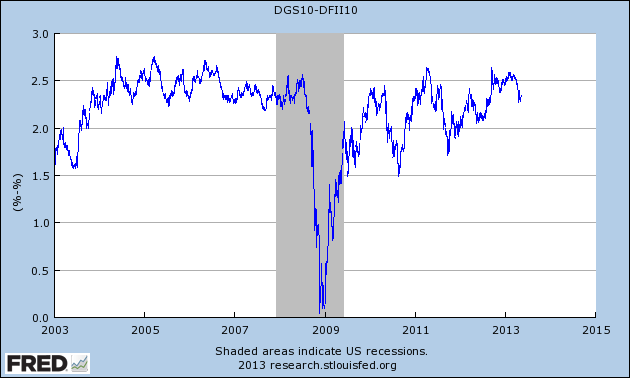
  • 10 year breakeven rates
  • As buy-and-hold investment, this 10-year TIPS basically ‘parks’ my money for 10 years, with little income guaranteed but with protection against inflation. The stock market is hitting all-time highs, housing prices are rising, unemployment is declining. Can inflation be far behind?
  • On a personal note, I have two TIPS maturing this year and I need to bolster the super-safe portion of my asset allocation. A yield of -0.410% (plus inflation) isn’t really attractive, but it will park that money in a safe place.
  • Although I hold TIPS that will go down in value if yields rise, I am cheering for higher TIPS yields. I want to be a net buyer of TIPS. Since I am holding to maturity, I don’t care what happens on the secondary market.
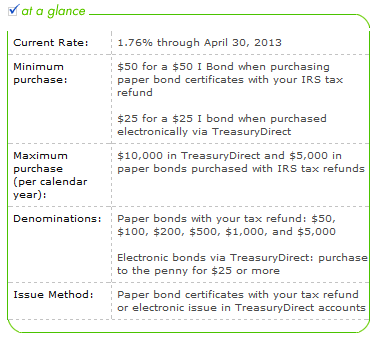
  • And of course, a purchase of TIPS only follows an annual maximum purchase of I Bonds ($10,000 per person at TreasuryDirect). I Bonds remain the superior investment when TIPS have a negative real return.

It was interesting to see the TIP ETF finally break through the 120 level this week, closing at 119.65 on Monday.  This six-month chart of TIP shows how it has been teasing a decline, then rising. The recent decline looks more forceful however.
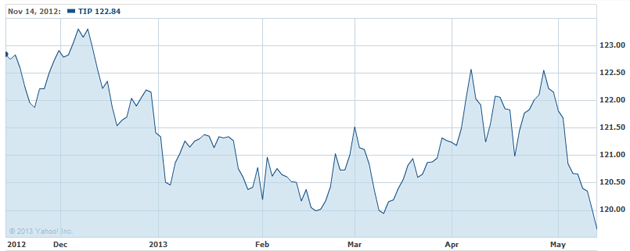
6-month TIPS

Next week’s auction will definitely be worth watching. If yields continue to rise, it will become a definite buy.
Posted in Investing in TIPS | 3 Comments

The TIPS earthquake: When did it happen, and why?

When I started writing this TIPSwatch blog two years ago, I figured I was carving out a boring, staid corner of the investment world, a place where I could share ideas and learn from others. But excitement? Never. Not with TIPS.

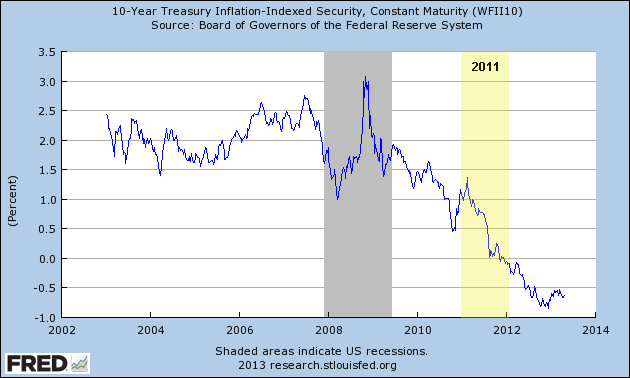
But it just so happens that in April 2011, rumblings were beginning in the world of TIPS and Treasury investing. When I look back at TIPS yields in the last two years, I’ve been fascinated to note that in mid-2011, something shifted. Yields dropped dramatically to levels that then seemed impossible: Negative to inflation? At the same time, TIPS grew in popularity, a trend that has continued for two years. Why?

The background

On Jan. 20, 2011, the Treasury auctioned a 10-year TIPS with a coupon rate of 1.25% and a yield to maturity of 1.170%. This was a routine auction and a routine yield. Eight months later, on Sept. 22, this same TIPS was reissued with a yield of 0.078%. A drop of 109 basis points!

This chart shows the amazing drop in TIPS yields over the course of 2011:

2011 10-year TIPS

Below is a chart of month-to-month TIPS yields in 2011, with the month of July highlighted because yields dropped as much as 50 basis points in that single month, sending TIPS prices soaring:

TIPS yields in 2011

But was this a surge in the entire bond market? Or did this earthquake strike selectively and suddenly? The chart below compares the TIP ETF with the AGG (aggregate bond index). The funds have similar intermediate-term durations, and sometimes track fairly closely. But not in 2011:

TIP ETF vs. AGG

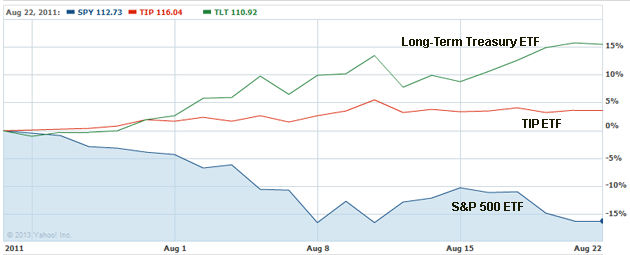
This particular chart fascinates me, because again it seems to point to July-August 2011 as the turning point, with TIPS leaping in demand, while the overall bond market was performing mildly. In this next chart I’ve added the volatile long-term Treasury ETF (TLT) and the S&P 500 (SPY) to show that yes, indeed, the earthquake struck precisely in mid 2011 and hit Treasuries (positively) and stocks (negatively):

Splitting point

The earthquake: A surprise ending

I have always been quick to blame Federal Reserve manipulation of the Treasury market for the pathetically low yields on TIPS. So one of the QEs must be behind this sudden shift? Wrong.

  • QE1 began in November 2008
  • A second phase of QE1 began in March 2009
  • QE2 began in November 2010
  • Operation Twist began in September 2011
  • QE4 began in December 2012

Operation Twist, it turns out, was a reaction to the earthquake, not the cause of it. And while the Fed certainly has succeeded in keeping Treasury rates extremely low, it wasn’t the direct cause of the earthquake.

How about the crisis in Europe? Could that have been the cause? No, the Euro crisis had been brewing well before mid 2011. Again, it was only a contributing factor.

Something else happened exactly in late July to early August 2011, and it was the direct cause of Treasurys soaring and the stock market plummeting. Here are some headlines from that time:

All leading to this, epicenter of the earthquake event:

The amazing thing: At the time, I was convinced that the S&P action would put pressure on U.S. government debt, causing interest rates to rise. Instead, it caused massive discontent with the U.S. government and fear for our nation’s future.

Fear was the trigger: The stock market dropped and Treasurys soared. The Federal Reserved stepped in – one month later – to begin Operation Twist, but at that point it had no option. The president and Congress had no answer. One last chart to show the massive one-month moves in Treasurys and the stock market:

August 2011

We now know the S&P action had zero effect on the appeal of Treasurys. And TIPS became even more popular because of their inflation protection. Runway federal spending, combined with Federal Reserve stimulus, raised the specter of inflation.

Not much has changed in the last 20 months, and inflation is still a specter, not a reality.

Posted in Investing in TIPS | 9 Comments

New I Bond interest rate coming May 1, 2013: 1.18%

I Bond Fact SheetI Bonds,  a U.S. Savings Bond you can buy and hold at TreasuryDirect.gov, are currently paying a base rate of 0.0% and an inflation-adjustment rate of 1.76%, but that rate only applies to bonds purchased by April 30.

On May 1, the inflation-adjustment rate will fall to 1.18%, and the base rate will continue at 0.0%.

What this means. If you buy before April 30, you can lock in the 1.76% rate for six months, then get the 1.18% rate for six months, for an annual rate of 1.47%. You can sell the I Bond after one year, but you will forfeit 3 months’ interest. You can sell after 5 years with no penalty.

I Bonds don’t seem exciting at this point, and the interest rate you’ll get in the next year is barely competitive with a 5-year Bank CD. But I highly recommend buying them, and I’d suggest buying to the $10,000 per person limit by April 30. Reasons:

  • I Bonds are the best inflation-protected investment right now. You can buy a bond this week and hold it for 30 years. Although the base rate is zero, the add-on rate will ensure your holding matches the growth in inflation. Compare that with a 5-year TIPS, paying -1.33% to inflation, or a 10-year, paying -0.64%. With a TIPS, you have to go all the way out to 20 years to get positive to inflation, and that’s just 0.04%.
  • Federal income taxes are deferred on I Bonds until you sell them, a big advantage over TIPS and bank CDs.
  • There are no state taxes on I Bond interest, another advantage over bank CDs.
  • I Bonds are completely deflation proof. Your principal grows with inflation, but can never go down with deflation. The worst you can earn is zero percent. This isn’t true of TIPS, where deflation will eat away at accrued principal.
  • I Bonds are excellent for retirement savings because you can pick the maturity date. You can space out your maturities to provide steady income.
  • The current value of I Bonds is much easier to track than that of TIPS. You just download the Savings Bond Wizard, enter your holdings and update the data every so often.

There are no negatives? Obviously, I am a big fan of I Bonds for their inflation protection. The return is acceptable, better than you will currently receive with 5- or 10-year TIPS. As a long-term holding, they are tax deferred and protected against inflation and deflation.

Because of the I Bond tax advantage, TIPS traditionally paid up to a 1% higher return than I Bonds. Today, that is reversed. In my opinion, this makes I Bonds a ‘gift’ from the federal government. Take the gift.

If, at some point in the future, the I Bond base rate rises above 0.0%, you can sell these 2013 I Bonds and buy the new ones (assuming you have held them more than 1 year).

Well, there is one negative … Each person can only buy $10,000 per calendar year. That means $20,000 for a couple, but you have to create separate accounts at TreasuryDirect. (You can also get paper I Bonds with your tax refund, but I am not a fan of that strategy.)

So, if you haven’t purchased $10,000 in I Bonds this year, take a look at buying before May 1 to lock in that 1.76% for six months.

Posted in I Bond, Savings Bond | 7 Comments

TIPS, the suddenly hot topic

Yesterday’s weak auction of a 5-year Treasury Inflation Protected Security, along with last week’s deflationary inflation report, is putting TIPS into the news this week, sometimes in a very negative light. Well, at least it’s nice to see TIPS getting attention.

Remember, just a few weeks ago many of the headlines were strikingly positive, even with TIPS offering pathetically low yields: Why You Should Own TIPS (April 6), State Street Plans Two New TIPS ETFs (March 11), 5 Solid ETF Investment Picks for Retirement (Feb. 28) and TIPS Bond Fund (TIP) Enters Oversold Territory (Jan. 28).

Now we are getting a different view:

‘TIPS are starting to look like Treasurys’ ugly stepsister’: My favorite headline, by far. I love a good headline. This April 18 MarketWatch piece (pre-auction) by Ben Eisen nailed the factors that led to a weak 5-year auction: sagging inflation combined with TIPS’ negative yields to inflation. It’s a bad combination.

“It’s pretty intuitive to think that absence of strong inflationary pressures and a pullback in commodities [would slow] any otherwise perceived demand for TIPs,” said Ian Lyngen, senior rates strategist at CRT Capital Group LLC.

‘Investors Tire of TIPS As Inflation Remains Absent’: Michael Aneiro at Barrons.com (April 17) makes the case that TIPS simply don’t offer enough return to be attractive, and fixed-income investors are moving on.

Investors who have poured money into Treasury inflation-protected securities, or TIPS, however, aren’t really getting the respectable income part of that equation, and they’re getting tired of waiting around for something that isn’t happening …

‘To TIP Or Not To TIP’: Howard Gold at SeekingAlpha.com (April 11) points out that even ultra-cautious economist Robert Shiller thinks stocks might be a better investment than TIPS (for part of your portfolio), given the run-up in TIPS over the last two years.

It’s the negative yield that really bothers Shiller. “Right now, they’re yielding a negative return over the long run, and over the short run it might be even more negative if interest rates go up again,” he said in a recent interview on PBS’s Consuelo Mack WealthTrack.

“Ten-year TIPS are negative substantially, even now to 15 years … which means you’ll get less back in real terms 15 years from now than you have today.”

‘How Much Should Retirees Stake in TIPS?’:  Here’s a thoughtful piece by Christine Benz at Morningstar.com (April 19) that examines the difficulty retirees face in earning income without risk (thank you, Federal Reserve). She remains a fan of TIPS as a hedge against future inflation, especially for retirees, who face heightened risk from inflation.

At first blush it might appear that you’d want all of your fixed-income portfolio in TIPS; that’s the tack embraced by some academics and other investment theorists. After all, if there’s a bond investment that helps offset the corrosive effects of inflation, why would you want to forgo it for one that doesn’t offer that protection? …

The key reason is diversification. … So the answer to the question about how much retirees should hold in TIPS falls somewhere between zero and 100%. But where?

Posted in Investing in TIPS | 1 Comment

5-year TIPS auctions at -1.311%, breaking a string of record lows

A new 5-year Treasury Inflation Protected Security auctioned today with a coupon rate of 0.125% and a yield to maturity of -1.311%, plus inflation. The resulting yield for CUSIP 912828UX6 was  higher than expected, indicating weak demand. Experts had been predicting -1.384% just before the auction, and a similar TIPS that matures in July 2018 closed yesterday on the secondary market with a yield of -1.582%.

Today’s TIPS auction broke a two-year string of 4- or 5-year TIPS issues that set record low yields. Today’s yield of -1.311% is above the record low of -1.496% set in December 2012.

What it cost buyers. The Treasury’s announcement says buyers paid $107.82 per $100 of value for this TIPS, the cost of getting a coupon rate of 0.125% when the actual yield is -1.31%, a boost of 1.435% a year to ‘income.’ That’s still pretty pricey, especially in a time of softening inflation.

Reaction to the auction

On April 5 I posted a blog titled ‘Is buying a 5-year TIPS the most insane move ever?‘ and I guess a lot of people must have agreed. Here are some quotes from the Wall Street Journal report on the auction:

The U.S. Treasury’s sale of $18 billion in five-year inflation-index notes went poorly, drawing the smallest investor interest since October 2008, as inflationary fears faded away. …

The yield was almost seven basis points above the negative 1.380% yield right before the auction results were released, an indication of weak demand.

TIPS are often used by investors to hedge their exposure to commodity prices. “Given the falling commodity prices recently, I think there might be less hedging needs,” said Gennadiy Goldberg, a U.S. strategist with TD Securities. “I have never seen that much struggle for a 5-year TIPS auction.”

From the Bloomberg report:

“TIPS have had a rough time recently with the commodities selloff and renewed fears of deflation,” said Jason Rogan, director of U.S. government trading at Guggenheim Partners LLC, a New York-based brokerage for institutional investors. “People are again more concerned about deflation than they are about inflation. When that occurs, it will affect this market.”

Michael Ashton offers an interesting counter view in his E-pihany blog:

But the main reasons the auction failed were far simpler. Prime among these is that the 5-year TIPS have always had more problems being sold, because people who want inflation protection tend to primarily want long inflation protection. … (T)he 5y TIPS are mainly of interest to (a) indexers and (b) foreign central banks. As such, they are prone to occasional disasters …

Today’s auction might be a signal of a changing trend for TIPS, which have seen steadily declining yields since the Federal Reserve began its aggressive bond-buying programs in mid 2011.

But today certainly wasn’t an Armageddon for TIPS, with the TIP ETF closing at $120.98, down only 0.7% and well above its 52-week low of $118.43. If TIPS are heading into a time of rising yields (which I would love, since I want to be a net buyer of TIPS) there’s still a lot of room to run.

The breakeven rate

Today’s buyers could have purchased a 5-year nominal Treasury paying 0.71%, and so they need to see inflation average 2.02% over the next five years. Not a bad bet, but who is really buying 5-year Treasurys these days? I think a 5-year TIPS compares better with a 5-year insured bank CD, where you can get 1.7% at at least one bank, pushing the breakeven rate up to a more daunting 3.01%.

Posted in Investing in TIPS | 3 Comments