Is buying a 5-year TIPS the most insane move ever?

Investors get another chance to demonstrate insanity on Thursday, April 18, 2013, when the U.S. Treasury will auction a new 5-year Treasury Inflation-Protected Security.

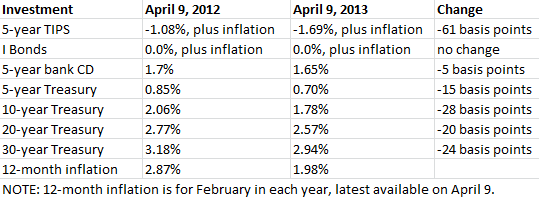
This thing will be expensive. CUSIP 912828UX6 will have a coupon rate of 0.125% and will probably auction with a yield of about -1.7%. That means buyers will be paying up for a 1.825% boost to yearly income, probably about $109 for every $100 of value. (The last new issue of a 5-year TIPS went off in April 2012 with a yield to maturity of -1.080% and a cost of $106.38 per $100 of value.)

I get a lot of feedback from readers who dismiss buying short-term TIPS because of the negative yield, and I understand that. And paying up for a TIPS is a poor strategy because it undercuts the deflation protection TIPS provide. When you pay $100 for $100 of a TIPS (as in the good old days), at maturity you get back $100 plus inflation. When you pay up, your premium is at risk because at maturity you get back $100 plus inflation. If there was no inflation, you get back $100.  Bad deal.

But is buying this 5-year TIPS an act of insanity? No, it is not. Actually, it makes some sense for the big-money folks: Hedge funds, foreign banks, foreign governments. They are looking to stash money in a super-safe, inflation-protected investment and can afford to make little or no income.

And … it matures in five years. That makes it easy to buy and hold-your-nose.

For the small investor, though, this 5-year TIPS looks like a loser. The 5-year time-frame opens up competing investments, such as bank CDs and especially U.S. I Bonds, that aren’t practical for the super-big-money investors. When comparing these investments, you need to look at how they will perform under varying inflation rates.

Actual 5-year returnsThis chart of actual returns shows that a bank CD paying 1.7% (you might find better) will outperform a 5-year TIPS and I Bonds up to an inflation rate of 1.7%. Once inflation reaches 1.8% – the current rate is 2.0% – or higher, I Bonds outperform. A 5-year TIPS won’t outperform a bank CD until inflation reaches 3.5% or higher.

But what if you look at after-inflation return?

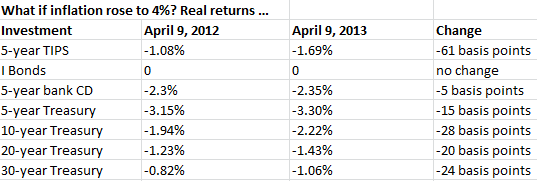
real 5-year returnsThe bank CD outperforms up to an inflation rate of 1.7%. The I Bond outperforms at inflation rates of 1.8% and higher. The TIPS outperforms the bank CD only when inflation reaches 3.5% or higher.

Conclusion: When there’s actual inflation, I Bonds are clearly superior, and you should buy them to the max ($10,000 per person per year at TreasuryDirect). Purchases through April will pay the inflation-adjustment rate of 1.76% for six months. Earnings are tax-free until you sell the bonds.

After the I Bonds, where do you go with money you want in a super-safe investment, a 5-year TIPS or a 5-year bank CD?

  • If you think we are heading toward deflation and economic Armageddon, buy insured bank CDs or traditional U.S. Treasurys.
  • If you think inflation will remain tame over the next five years, buy bank CDs.
  • If you believe inflation will average 3.5% or higher over the next five years, feel free to buy the new 5-year TIPS being auctioned April 18.

It’s not insanity. It’s math.

Posted in Investing in TIPS | 4 Comments

TreasuryDirect, TIPS and the dreaded 1099-OID

If you buy and hold Treasury Inflation-Protected Securities at TreasuryDirect, as I do, you’re violating a conventional wisdom rule of investing: Don’t hold TIPS in a taxable account.

I disagree with that conventional wisdom, more or less, but mainly because holding TIPS in a tax-deferred account generally means buying TIPS mutual funds instead of the actual issues. Or, a brokerage like Vanguard or Fidelity will allow you to buy TIPS at auction and  hold them in an IRA account. But then you end up trying to find ways to invest and/or reinvest cash distributions and maturities.

So while holding TIPS in a tax-deferred account is preferable, I say holding them as a taxable investment at TreasuryDirect is also acceptable as part of your overall fixed-income asset allocation.

But, TIPS are different. TreasuryDirect, I have to say, is absolutely not user friendly. While every brokerage and investment firm on Earth mails you tax forms (or at least notifies you they are ready to download), TreasuryDirect does nothing. You will get nothing in the mail, you will not receive an e-mail alert. You are expected to remember to log in to TreasuryDirect.gov and retrieve your tax forms:

  • Form 1099-INT shows the sum of the semiannual interest payments made in a given year. This income is generated by the TIPS’ coupon rate, and is taxable at the federal level but tax-fee at the state.
  • Form 1099-OID shows the amount by which the principal of your TIPS increased due to inflation or decreased due to deflation. Increases in principal are taxable for the year in which they occur, even if your TIPS hasn’t matured, so you haven’t yet received a payment of principal.

So 1) you find your own tax forms, and 2) you print them and 3) these Treasury forms are like no other you’ll see from Vanguard or Merrill Lynch. They just list the amounts paid for each TIPS and give you a total. At the bottom are some definitions for IRS box numbers that are never specified on the form itself. Very weird. The Treasury could do better.

Form 1099-OID is the one behind the conventional wisdom to invest in TIPS in tax-deferred accounts. You are paying tax on money you have not yet received. This is often called ‘phantom income.’ However, if you have a Total Bond Fund or GNMA Fund in a taxable account and reinvest the dividends, or have a 5-year CD at a bank and are reinvesting interest, you are doing exactly the same thing. You are paying tax on money you have not yet received.

(Read this for a scholarly treatise, including incomprehensible formulas, debunking the conventional wisdom about holding TIPS in a taxable account.)

When the TIPS matures, here’s the good thing: You don’t owe any tax on the accumulated inflation-adjusted principal, because you’ve prepaid it. So if you bought a $10,000 10-year TIPS in 2010 and it matures in 2020 with a 23% inflation boost to principal, you get $12,300 and you owe no tax. This could work in your favor for allocating spending money in retirement.

But the dreaded 1099-OID is the big reason I Bonds are preferable to TIPS, especially when they offer a favorable return, as they do now well up the maturity ladder. With I Bonds, your principal keeps increasing by the rate of inflation plus the base interest rate (which is currently zero for new I Bonds). You owe no tax on I Bonds until you redeem them, and you can hold them for 5 to 30 years before redeeming without any penalty.

I Bonds also offer a strategic advantage for retirement spending money because you could redeem them gradually to space out the tax owed. They are the ultimately flexible super-safe investment: 1) inflation protected, 2) deflation protected, 3) tax protected and 4) you choose the maturity date.

Big question mark over 30-year TIPS. If you buy a 30-year TIPS at auction – your next chance is a reissue on June 20, 2013 – you will get a coupon rate of about 0.625%. That means if you bought $10,000 in June, you’d get about $62.50 in annual interest, but that would grow as the principal grows with inflation.

However … let’s say inflation averages 3% in coming years. Your taxable adjustment to principal would be $300 a year, and it would also grow as your principal rises.

In this example, you’d owe federal taxes on $362.50, resulting in a tax of $100 or more. But you got only $62.50 in actual interest payments. So this TIPS will have a negative cash flow for 30 years.

The big question is: Will you be alive in 30 years? If not, you will never see the money that you are paying tax on. That makes no sense.

If you buy a 30-year TIPS and plan to hold to maturity, make sure you live 30 years.

Posted in Investing in TIPS | 18 Comments

10-year TIPS reissue auctions at -0.602%

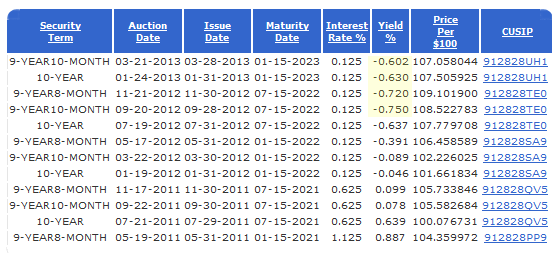
Treasury logoThe Treasury just announced that its reissue of CUSIP 912828UH1 – creating a 9-year, 10-month TIPS – auctioned with a yield to maturity of -0.602%.

That means buyers of this Treasury Inflation-Protected Security are accepting 0.602% less than the rate of inflation over the next 10 years. This TIPS has a coupon rate of 0.125%, the lowest possible. Buyers will therefore ‘pay up’ to earn the auctioned yield, about $107.06 per $100 of value.

Today’s rate, though, is slightly higher than the -0.630% yield generated at auction when this TIPS was born in January.

Read the Treasury’s auction results summary.

Today’s auction continued a trend of TIPS offerings with yields rising above record lows. The record low yield for any 9- or 10-year TIPS offered at auction is -0.750%, set last September. But as recently as 10 days ago, a -0.5% yield looked possible for today’s auction. That trend turned when economic turmoil in Cyrpus gave Treasury markets a boost.

The breakeven rate. The 10-year Treasury is currently trading at 1.94%, down from 2.06% as recently as March 7. That sets the 10-year breakeven rate for today’s TIPS at 2.54% – meaning that buyers are betting that inflation will average 2.54% over the next 10 years.

Any number over 2.5% is historically high for the breakeven rate. Inflation has been running at 2.0% over the last 12 months.

Reaction to the auction. The Wall Street Journal’s Cynthia Lin called demand for this auction ‘decent,’ despite the negative yield.

Despite the negative yield and little sign of inflation in the U.S. economy, some investors are still willing to pay up for inflation protection because of the Federal Reserve’s ongoing easy monetary policy. The central bank aims to induce inflation by buying bonds, currently set at $85 billion a month. The Fed on Wednesday affirmed this policy. …


Posted in Investing in TIPS | Leave a comment

Another 10-year TIPS auction, and another world crisis …

I am getting tired of this pattern. I will attempt to offer no proof, but I am getting a strong feeling that just before every significant TIPS auction, we get a world crisis that drives up the prices of Treasurys, especially TIPS.

Thursday, we will get a reopening of a 10-year TIPS, and yields to maturity had been trending up toward the lofty level of -0.5%, meaning a half percentage point less than inflation over 10 years. That’s a lousy investment, but better than several recent 10-year TIPS auctions.

At the same time, Europe unloads the most idiotic scheme ever — taxing bank accounts in Cyprus to bail out banks for their foolish investments. Simply put, taxing the wise to bail out the fools. From New York Times coverage:

In a rare move, Cyprus is trying to raise around 5.8 billion euros ($7.5 billion) from a one-time bank charge on local deposits. … “If the problem escalates, the entire euro zone banking system could implode,” said Cormac Leech, a banking analyst at Liberum Capital, in London.

Fearing similar moves to those in Cyprus, local depositors in countries like Spain and Italy may look to shift their money to banks in stronger European economies. … “This is certainly new territory,” said Pete Hahn, a banking professor at Cass Business School in London. “What is confronting Cyprus is a unique situation, but the idea could be applied in other places in Europe.”

For even more fun, read Michael Ashton’s E-phinay post today, ‘Stealing Really Is That Bad.’:

Here is the problem: you didn’t ask them if they would “accept” at least a “minor” bailing out. You ordered people who didn’t need a bailout – savers with earned balances in the banks – to pay for the bailout. I daresay that it doesn’t seem “minor” to those who had their money stolen to save someone else. …

Now, in the micro picture none of those reflections are very market-oriented, but in the macro picture they certainly are. We all have to deal on a day-to-day basis with the reality that markets are nakedly manipulated by central banks these days.

In the face of this amazing stupidity, investors (the wise ones, not the fools) are naturally heading to safety, and that means U.S. Treasurys. The 10-year Treasury closed today at 1.96%, 5 basis points up from Friday. The TIP ETF was up 0.2% today.

OK, that’s not Earth-shattering, but it broke the trend toward a favorable rate in Thursday’s 10-year TIPS auction. Today, CUSIP 912828UH1, the one being reopened Thursday, closed on the secondary market with a yield to maturity of -0.617, down from Friday’s close of -0.582%.

Again, not disastrous, but the trend is now moving against buyers of this week’s auction.

All in all, TIPS-week Monday could have been a lot worse.

Posted in Investing in TIPS | Leave a comment

Inflation shot up sharply in Feburary

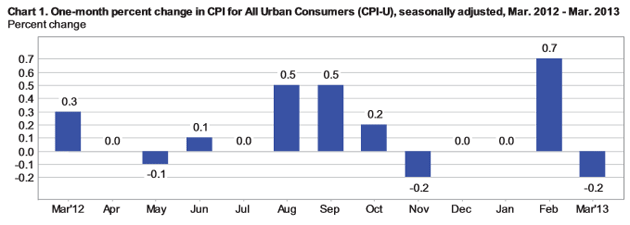
‘Headline’ inflation – properly called Consumer Price Index for All Urban Consumers (CPI-U) – rose a very sharp 0.7% in February, the Bureau of Labor Statistics reported this morning. It was the biggest monthly rise since June 2009.

This was somewhat expected, because gas prices have risen sharply in the last two months. Gasoline prices – up 9.1% in February – accounted for about 3/4 of the overall increase in prices, the BLS said. The food index was up a tame 0.1%.

Read the CPI summary from the BLS.

Headline inflation is important, because it is the number (minus seasonal adjustment) used to adjust the principal on TIPS holdings and to set the future inflation-adjustment interest rates on I Bonds.

Without the seasonal adjustment, CPI-U rose 0.8% in February. Today’s number sets inflation over the last 12 months at 2.0%, up from 1.6% in January.

Here’s a summary of month-by-month changes in headline inflation:

one-year inflation

The Federal Reserve watches ‘core’ inflation more closely, stripping out the volatile food and energy indexes. Core inflation was mild in February — 0.2% versus 0.3% in January. For the last twelve months, it is running at 2.0%, still giving the Fed room to continue monetary stimulus.

The takeaway for TIPS  holders is … you got a 0.8% boost to your holdings, long overdue after four months of zero inflation. What’s ahead? Gasoline prices have been moderating, and today’s coverage by the Associated Press downplayed inflation fears:

“Aside from the spike in gasoline prices, which is already being reversed, it is hard to find any evidence of major price pressures,” said Paul Dales, senior U.S. economist for Capital Economics.


Posted in Investing in TIPS | Leave a comment