More ‘Operation Twist’? So far, no big deal for TIPS

The Federal Reserve announced June 20 that it will extend its program of selling short-term Treasuries and buying long-term Treasuries, effectively extending ‘Operation Twist’ beyond its scheduled expiration at the end of this month. From the McClatchy Newspapers report:

Because of the deteriorating conditions, the Fed said, benchmark interest rates are likely to remain near zero through at least late 2014. And a program set to expire this month, where the Fed swapped out $400 billion in short-term bonds for bonds of longer duration, will continue through the end of the year.

The Fed did not indicate the size of the swap for the rest of the year, but said it would trade out bonds with maturities of three years or less for those with maturities of six years to 30 years.

The expected result would be for Treasury values to strengthen, but the market for Treasury Inflation-Protected Securities, already at record-high prices (and low yields), has responded with a ‘ho-hum.’

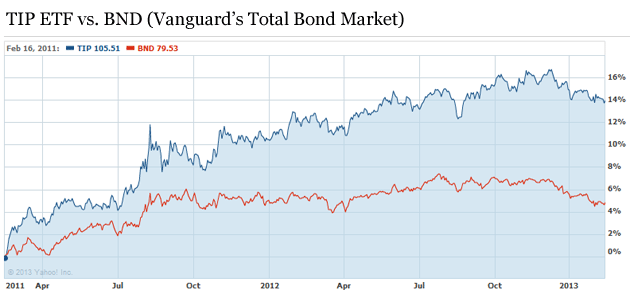
Here’s a chart comparing prices over the last five days for TIP (the TIPS ETF) and TLT (the long-term Treasury ETF, shown in red in the chart):

So far, Operation Twist is doing little to support the very-lofty values for TIPS.

However, the Fed’s commitment to holding short-term interest rates very close to zero through 2014 will provide support for TIPS because yields on traditional Treasuries will remain very low. If break-even rates remain around 2.0%, TIPS will continue to provide negative yields to inflation for many more months.

Posted in Investing in TIPS | 3 Comments

30-year TIPS reissue auctions at record-low 0.520%

The Treasury today auctioned a 29-year, 8-month reissue of CUSIP 912810QV3, resulting in a yield to maturity of 0.520%. That’s a record-low yield for an 30-year TIPS issue or reissue; the previous low was 0.77%, for this same TIPS when it was first auctioned on Feb. 16, 2012.

The record low isn’t a surprise – this TIPS was trading in the secondary market yesterday at about 0.479%, so the 0.52% was a bit of a positive move for today’s buyers. The auction continues a one-year trend of steadily lower TIPS yields, across all maturities.

The 30-year breakeven rate, which is the difference between yields on a traditional 30-year Treasury and 30-year TIPS, is about 2.17%. This rate ran as high as 2.56% in March, when the U.S. economy appeared to be gaining momentum.

Posted in Investing in TIPS | Leave a comment

Headline inflation turned to deflation in May

‘Headline’ inflation – the measure that determines the inflation adjustment to principal for TIPS – took a dive in May, falling 0.3%, pulled down by a plunge in gas prices. It was the biggest drop since December 2008 – the dark days of the global financial crisis.

Gas prices sank 6.8 percent, also the most since December 2008. Food costs were unchanged.

But ‘core’ prices, which exclude food and energy and are closely watched by the Fed, rose 0.2 percent for the third straight month. From the Washington Post report:

Over the past 12 months ending in May, consumer prices rose 1.7 percent, much less than the pace for the 12 months that ended in April. Core prices have risen 2.3 percent in the past year, the same as for the 12 months ending in March and April. That’s close to the Fed’s 2 percent target for inflation.

In the Fed’s view, inflation is just about on target. Blogger Michael  Ashton points out that  ‘core inflation didn’t show any signs of rolling over. ‘ Although ‘deflation’ would seem to open the door to new Federal Reserve stimulus, Ashton says:

We’re unlikely to see core CPI dipping any time soon, so if the Fed wants to do QE, they’ll need to suddenly grow interested in headline inflation.

But weakening headline inflation means lower returns for holders of TIPS, which are currently carrying negative base interest rates far up the maturity ladder. When you combine a negative base rate with a weak inflation rate, TIPS holders get double dose of weak returns.

Posted in Investing in TIPS | Leave a comment

Next TIPS auction: 30-year reissue on June 21, 2012

The Treasury announced today that, as expected, it will auction on June 21 a reissue of the 30-year Treasury Inflation-Protected Security, CUSIP 912810QV3. The result will be a 29-year, 8-month maturity. Here is the fact sheet, which points out that the coupon rate is 0.75%, and the final maturity is February 15, 2042.

What can we expect. Back in January, this new issue auctioned at a rate to maturity of 0.777%, very close to the coupon rate. While that rate was the lowest ever for a 30-year TIPS, it looks slightly more attractive today, after months of financial turmoil overseas.  On the secondary market today, this TIPS is trading with a yield of 0.516%, so it looks like next’s week auction will set another record low.

Record lows aren’t a surprise. The rate on a traditional 30-year Treasury closed today at 2.73%, creating a break-even rate for this issue of about 2.2%. Do you think inflation is likely to exceed 2.2% over the next 30 years? If so, this issue might be attractive, at least more attractive than a traditional 30-year Treasury.

The fact is, it is very difficult to find any super-safe investment paying a premium to inflation. (Even I Bonds – my favorite investment at the moment, up to your purchase limit – can only match inflation. But I still recommend buying I Bonds first, then TIPS.) And while inflation is an insignificant threat today, over the next 30 years it could very well ignite into something frightening.

If you have been building a ladder of TIPS, this issue at least gives you a plus to inflation for your overall return. Hard to find that in 2012, and I don’t expect things to get better anytime soon.

If you were a buyer back in January (I wasn’t), I can’t see any problem with adding to your position with this TIPS.

If you were not a buyer then, I can’t see this reissue as attractive.

Posted in Investing in TIPS | 2 Comments

10-year TIPS reissue auctions at record low -0.391%

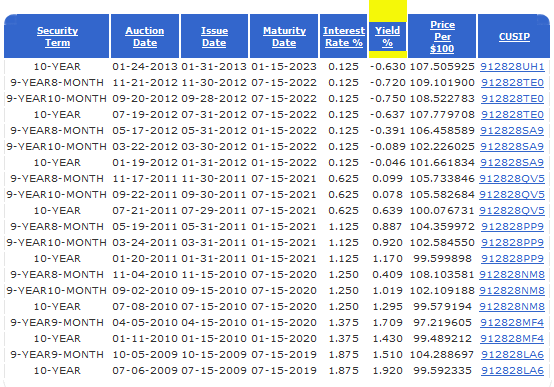
The Treasury just announced that Thursday’s reissue of a 10-year TIPS, CUSIP 912828SA9, auctioned with a yield to maturity of -0.391%, meaning that buyers were accepting a return that will lag inflation by 0.391% over 10 years.

This TIPS will mature on Jan. 15, 2022, making it a 9-year, 8-month issue. It carries a coupon rate of 0.125%,  so today’s buyers will pay up — about $105.07 for $100 of value, resulting in the negative yield.

The previous record low yield for a 9- to 10-year TIPS was for this same TIPS, when it was reissued in March at a yield to maturity of -0.089%. This TIPS originated way bay (ancient history) in January 2012 with a yield of -0.046%. (Thanks to commenter Bob for pointing out the March reissue.)

U.S. Treasury can celebrate. The yield on this TIPS was dragged down by economic turmoil in Europe, which sent the yield on a traditional 10-year Treasury plummeting, down to 1.70% today, the lowest rate of the year.

That set the breakeven rate at a still-reasonable 2.091%, meaning buyers of this TIPS will do better than buyers of a traditional Treasury if inflation averages more than 2.091% over the next 10 years. This auction also seems to be pricing in further Fed stimulus, which would 1) bolster artificial demand for Treasuries and 2) strike a match to fears of future inflation. Both of those prospects would benefit TIPS, but like I said, the market has already priced them in.

From the Wall Street Journal report:

Richard Gilhooly, rates strategist at TD Securities, says that the strong demand suggests investors’ hopes for another round of monetary stimulus are rising. “The QE3 trade appears to be shaping up after the FOMC minutes took a step closer last night,” he said.

The impressive auction results came amid a broad flight into U.S. government bonds. The regular Treasurys market has rallied throughout the session, dragging the yields on 10-year notes and 30-year bonds to new lows for the year. The fact that investors are seeking the safety of bonds issued by the U.S. government is likely another reason why the auction went as well as it did.

Posted in Investing in TIPS | 4 Comments