Despite Treasury slump, will 10-year TIPS auction at all-time low yield?

It’s been an interesting month for Treasuries – just read the reports, all over the Web, about the end of the Treasury bull market, the coming Treasury bear market, steeply rising interest rates, and on and on. But if you were an investor in TIPS, you would have seen maybe a blip in your holdings. The fact is, very little has changed.

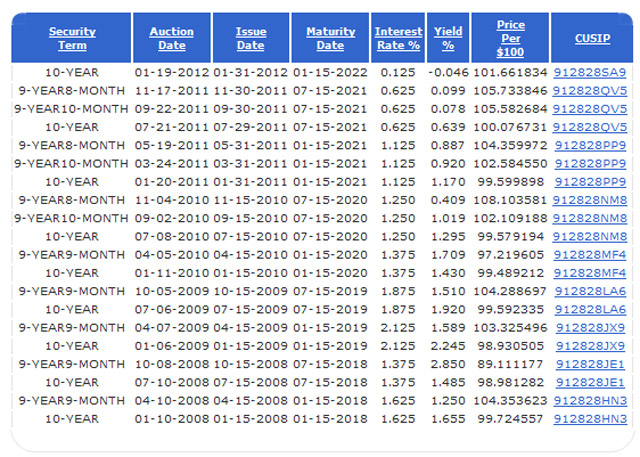
Tomorrow (March 22) the Treasury will auction a reissue of a 10-year Treasury Inflation-Protected Security, CUSIP 912828SA9, that was first issued on Jan. 19, with a coupon rate of of 0.125%, but it auctioned at -0.046%, the lowest rate ever for a 10-year TIPS.

Tomorrow’s auction is going to threaten that lowest-ever record. Here is the current value of CUSIP 912828SA9, at the close of today’s market:

market valueSo, to recap … Treasuries are in a bear market. However, this TIPS, which was issued three months ago, has gone up in value about 2% and pays a yield of -0.109%, lower than the issued yield of -0.046% three months ago.

Some bear market.

TIPS are not yet in a bear market. As Treasuries slumped last week, TIPS did take a hit, but it appeared some investors were leaping from traditional Treasuries into TIPS to take advantage of the inflation protection. That explains the rise in breakeven rate, which today settled in at 2.41%. (Here’s why that is important.)

I consider Thursday’s auction to be unattractive, especially if it goes off at a record-low base yield. Right now, that looks very likely. I should mention that predicting TIPS yields is very difficult, and I am lousy at it. I’d expect this auction to be a bit better than the current yield, maybe something along the lines of -0.08%? My guess is based on the fact that recent auctions have been coming in with better-than-market rates.

I have to ask: Who is buying this? Treasuries are under fire, and yet buyers want to take a TIPS issue at an all-time low yield?

For the record, here are all the 10-year TIPS issues and reissues from recent years. Check out that yield column. The time to buy is not yet here, just my opinion.

10-year TIPS auctions

Posted in Investing in TIPS | Leave a comment

TIPS buyers: Beware of the ‘breakeven rate’

A curious thing happened last week. The Treasury market took a hit, with the yield on a traditional 10-year Treasury rising to 2.31%, its highest level since Oct. 28, 2011. With that increase in yield came a decline in the value of all Treasuries, including Treasury Inflation-Protected Securities.

But at the same time, the ‘breakeven rate’ for 10-year TIPS issues went up, meaning that even as TIPS values went down, they were becoming more expensive.

What is the breakeven rate? If you are interested in buying the 10-year TIPS being auctioned this Thursday (March 22), you should be looking at the breakeven rate, which reached a very high level at the end of last week. Here is the formula:

10-year Treasury yield – 10-year TIPS yield = 10-year breakeven rate

As of Friday, this equation was 2.31 – (-0.118) = 2.428.

Is this important? Very. Here’s why: On Friday, you could get a 10-year Treasury with a yield of 2.31% or a 10-year TIPS with a yield of negative 0.118%. If you buy that TIPS, inflation must average 2.428% over the next 10 years for you to ‘breakeven’ over a traditional Treasury.

It is as simple as this: When the breakeven rate rises, TIPS are more expensive, at least compared with traditional Treasuries. Here is a breakeven chart for 10-year TIPS auctions over the last five years, with Friday’s rates at the top for comparison:

10-year 10-year Breakeven
Date TIPS base rate Treasury rate
16-Mar-2012 -0.118 2.31 2.428
19-Jan-2012 -0.046 2.01 2.056
21-Jul-2011 0.639 3.03 2.391
20-Jan-2011 1.170 3.47 2.300
8-Jul-2010 1.295 3.04 1.745
11-Jan-2010 1.430 3.85 2.420
6-Jul-2009 1.920 3.52 1.600
6-Jan-2009 2.245 2.51 0.265
10-Jul-2008 1.485 3.83 2.345
10-Jan-2008 1.655 3.91 2.255
12-Jul-2007 2.749 5.13 2.381
11-Jan-2007 2.449 4.74 2.291

As you can see, Friday’s breakeven rate popped well above the rate of recent auction dates. It’s also interesting to see the extraordinarily low breakeven rate of 0.265% in January 2009, when the world feared deflation and economic meltdown. That was the single greatest day to buy TIPS at auction in the last five years.

This chart shows the one-year and one-month trends in the breakeven rate:

What happened last week? I have been speculating that the soaring stock market, relative calm in Europe and waning Federal Reserve stimulation might result in higher interest rates, especially for Treasuries. The market took a step in that direction last week. Will this continue? Who knows.

If you invest in the TIP ETF (or any TIPS mutual fund), you took a hit, as this 5-day chart shows, but the damage was not severe:

One weekI included IEI (red line) in this chart because it is an ETF of traditional Treasuries, with a similar duration to TIP. The damage was worse for IEI, and note that on Friday, the TIP ETF recovered more of its losses than IEI. That is the breakeven rate rising.

This week’s auction. My feeling is that the breakeven rate needs to come down and the TIPS base yield must rise for Thursday’s 10-year TIPS auction to be attractive. If Treasuries continue their decline next week, and Treasury yields rise, how much appetite will there be for TIPS with negative real yields?

Posted in Investing in TIPS | 4 Comments

Consumer inflation jumps 0.4% in February

This wasn’t a big surprise, with gas prices soaring in the last few weeks. From the Associated Press report:

The Labor Department says the consumer price index rose 0.4 percent in February, the largest increase in 10 months. Gas prices rose 6 percent to account for most of the gain. … Excluding food and energy, so-called “core” prices rose just 0.1 percent. In the past 12 months, consumer prices have risen 2.9 percent, the same year-over-year change as last month.

TIPS investors will get the benefit of the 0.4% increase, a mixed blessing but appreciated when overall interest rates are so low. That’s the reason we buy TIPS, to protect against inflation.


Posted in Investing in TIPS | Leave a comment

Coming March 22: Auction to reissue 10-year TIPS

The formal announcement is supposed to come Thursday, but the Treasury has already let it slip that it will auction a reissue of CUSIP 912828SA9 on March 22. This Treasury Inflation-Protected Security was first issued on Jan. 19, with a coupon rate of of 0.125%, but it auctioned at -0.046%, the lowest rate ever for a 10-year TIPS.

What can we expect? Since this is a reissue, you can check the current market value of this TIPS at sites like this. Here is the value as of Tuesday, March 13:

The yield, as has been the trend, has continued to decline and is currently -0.114%, which means that buyers yesterday were willing to accept 0.114% less than the rate of inflation over the next 10 years.

While that sounds like a miserable deal, it is … well, it is miserable. But it all depends on what you think the rate of inflation will be over the next 10 years, and how much you fear an unexpected bump in the rate of inflation. As of Tuesday, a 10-year traditional Treasury was paying 2.14%, meaning that this TIPS would be a better investment if inflation runs at 2.254% or more over 10 years.

While I think inflation might be higher than 2.254%, I can’t say that is a sure thing. And that is the dilemma for investors in this TIPS reissue.

Here is an interesting fact: On Jan. 19, when this TIPS was first issued, a 10-year traditional Treasury was selling for 2.01%. Since then it has increased to 2.14%, or 13 basis points. But the interest rate for this TIPS trading in the open market has fallen by about 7 basis points. That means the inflation breakeven point has risen by 20 basis points, or 0.20%. That is not a good thing.

From a Bloomberg report today:

The difference in yield between Treasury Inflation Protected Securities and nominal bonds, known as the break-even rate, indicated that investors expect consumer prices to rise 2.2 percent annually over the next five years, the highest since May. The average over the past year is 1.88 percent.

That was yesterday. Today … I’d say keep an eye on the 2022 Jan 15 TIPS value  in the next week. We could see some changes. With the stock market on a very steep incline, TIPS values should be decreasing and rates should be increasing.

The TIP ETF today fell fairly dramatically to $117.37, a 0.93% percent one-day loss. That means the yield on this 10-year TIPS will be getting more attractive. For TIPS buyers, this is good news.

If that 10-year TIPS rate appears to be heading toward zero or above, this looks like an attractive issue. If it dips even lower, buyer beware.

Posted in Investing in TIPS | 5 Comments

TIPS in the news: More negative views

It seems like Treasury Inflation-Protected Securities are getting a lot of attention in 2012, and a lot of the attention isn’t positive. Then again, we’ve been hearing dire predictions for Treasuries in general for well over a year. But I do think that some of the current criticism is valid enough to consider when you are making investing decisions.

Dividend hunt? MarketWatch.com has an article titled ‘Why dividend stocks top TIPS for income investing‘, which lays out the pluses and minuses of the two investments:

… one income strategy is capturing the attention of investors and investment advisers alike: Swapping inflation-protected Treasurys, or TIPS, for dividend stocks yielding 3% or more.

“When someone says ‘I need more yield,’ my response is ‘You mean you need more risk in your portfolio,’” said Larry Swedroe, director of research for Buckingham Asset Management, LLC. “A dividend-paying strategy isn’t necessarily a bad one, but it’s much riskier. It’s not a substitute for fixed-income.”

… If inflation stays in a 1%-3% long-term range, dividend stocks should outperform TIPS, said Rob Arnott, chairman of asset manager Research Affiliates LLC and an expert in asset allocation.

But if inflation spikes, he noted, then stocks will get hit and even a fat dividend yield won’t offset the loss of capital.

Good article. I am a fan of dividend-paying stocks, really solid companies that have been steadily increasing their dividends. But those stocks are for the ‘risk’ portion of my portfolio, not for the ‘safe’ portion. Current super-low interest rates are forcing investors to look at riskier investments, and that is partly the reason stocks and commodity prices have been increasing. Does moving money out of safety and into risk make sense, especially with the stock market hitting multi-year highs?

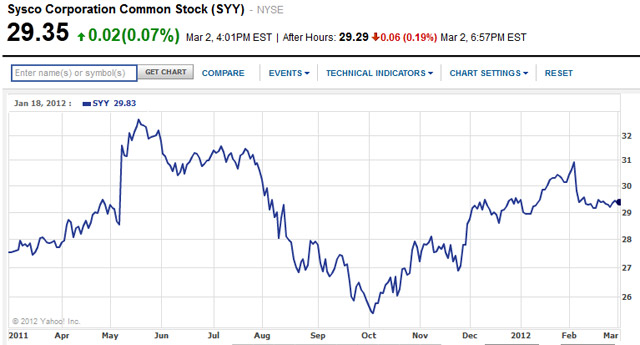
For example, here is a one-year chart for a stock I own, a fairly boring (but solid) company in the food-service business. It pays a dividend of 3.4% and its stock price is up 7.2%, for a total gain of more than 10% — about the same as the TIP ETF last year.
sysco one year chart

Note the volatile path on the way to that 10% gain. This is a low-beta stock (0.64). This isn’t the picture I have in mind for my ‘safe’ investments.

Dire prediction for Treasuries. Bloomberg is carrying an article with the tantalizing headine, ‘Treasuries May Experience 20-Year Bear Market.’ It’s based on an interview with Paul Griffiths, head of fixed income at Aberdeen Asset Management.

Yields have fallen to historically low levels that are not justified by fundamentals … This makes the bond markets vulnerable to a sudden reversal. “Over time, and I’m talking about several years, bond yields may move dramatically. Our bias is towards a bear market, which may take 20-odd years to play out.”

Since Treasuries have been in a 30-year bull market, outperforming the stock market in that time, I can see the case for a reversal, with rates rising to ‘more normal’ levels, meaning higher than inflation for even short-term investments. If that happened suddenly, it would ravage the bond market (and probably the stock market, too). The Federal Reserve seems determined to keep short- and long-term rates low for the next two years, so the danger appears to be out in the future, but it is out there.

Warning from ‘the nation’s newspaper.’ You know a topic has reached its peak when USA Today weighs in on it. John Waggoner has an article titled, ‘The mystery: Why buy inflation-protected bonds?‘ He makes the case that TIPS prices have soared too high as interest rates have declined to record lows.

TIPS aren’t cheap right now. The yield on 10-year TIPS is -0.26%. At current yields, you won’t get enough interest to make up for the price of the bond. “We tell people that you have to be aware of what you’re buying,” Wright-Casparius says. “And you’re paying a premium at this juncture.”

If you think that inflation is going to rise sharply, TIPS will likely fare better than regular Treasury bonds. And if you buy TIPS from the Treasury and hold them to maturity, you won’t lose money. Even so, with rates so low, the big mystery will be how you’ll make much money with TIPS.

That’s actually a fair analysis. I think anyone buying TIPS today and expecting the out-sized gains of recent years is going to be disappointed. TIPS have become a ‘capital gain’ investment, instead of a super-safe source of inflation protection and income. If you buy and hold TIPS, they are really boring. They are the ballast of your portfolio, not the rising star.

A positive view. Larry Swedroe, a TIPS proponent, has an article on MarketWatch titled, ‘Time to slay these myths about TIPS.’ If offers the counter view that inflation protection makes TIPS an essential investment, and less volatile that nominal Treasuries:

Because TIPS fully hedge inflation, you can extend their maturity and earn the term premium without taking inflation risk. This is an important point many seem to miss. TIPS also have lower expected volatility than conventional Treasury bonds of the same maturity due to lower sensitivity to nominal interest rate movements.

Swedroe’s argument is primarily that TIPS are preferable to traditional Treasuries, even when they have a negative ‘real yield’ (after inflation). He makes the point that Treasuries also have a negative real yield against expected inflation, but no protection against unexpected inflation. He also recommends looking at the PIMCO 1-5 Year US TIPS Index Fund (STPZ) for investors worried about a future rise in interest rates.

Posted in Investing in TIPS | 2 Comments