Would U.S. default create a ‘perfect storm’ for TIPS?

Update: How are TIPS holding up through this debt crisis?

Update 18 months later: The TIPS earthquake: When did it happen, and why?

Two years ago, Richard Ferri laid out the worst-case scenario for Treasury Inflation-Protected Securities in an article titled, ‘The Dark Side Of TIPS.’ The Forbes.com article is getting more attention right now as the U.S. grinds toward a potential default on its debt obligations. If that happened,  it could mean a ‘perfect storm’ for TIPS … higher interest rates combined with stable or even declining inflation.

Ferri, founder and director of research at Portfolio Solutions, wrote this in April 2009, well before the talk of default, but he makes many points that apply to this looming issue:

I would not argue with those who say that most long-term investors should have at least some of their retirement money in inflation-indexed bonds. However, there is another side to this story that is rarely discussed. There is a dark side to inflation indexed bonds. …

Overrated risk of inflation?

Let me first say the financial markets have a way of doing things that we least expect. When everyone expects something to happen, it usually doesn’t. Today, a majority of people expect inflation to be a problem in the future because the Fed has increased the money supply significantly …

Currently, monetary policy has placed interest rates near zero percent. The Fed cannot be any more accommodative unless they pay banks to borrow money. The only place interest rates can go is up–and higher interest rates will likely squeeze any inflation out of the system rather quickly as loan demand will drop as soon as rates increase. Consequently, inflation is probably not the big threat that investors think.

Loss of confidence in U.S. debt?

The risk is a loss of confidence by our trading partners who hold trillions of dollars in U.S. Treasury bonds. … Selling may beget selling as one country tries to dump ahead of others. The only way to make U.S. debt attractive again is for real interest rates to go up substantially to match the level of perceived risk in U.S. obligation. That is the big risk for TIPS investors.

That last quote sums up the current risk: If the U.S. defaults on its debt in August, or the rating agencies downgrade U.S. debt before then, would the immediate effect be higher interest rates on U.S. debt? (And, ironically, even higher U.S. debt?)

What this means for TIPS. If you are holding TIPS to maturity, and you have laddered them over many maturity dates and base interest rates, you wouldn’t see much of an effect with a short-term default. Since TIPS just paid semiannual interest July 15, you aren’t likely to miss an interest payment.

Your current, more recent holdings might pay a lower interest rate than new issues, if the higher interest rates continued. But that is the whole idea of laddering. Buy the new issues, get a higher rate.

TIPS mutual funds, though, could take an immediate hit if the base interest rate on TIPS rises. The duration of the TIP ETF is 4.01, so a 2-percentage-point increase in the base rate — which is not out of the question — could cost you 8% or so of your principal. But even that is hardly a ‘perfect storm.’

This scenario would set up a buying opportunity in TIPS mutual funds, in my opinion. (I don’t own any TIPS mutual funds at the moment, so this would be something to watch.)

Will the U.S. default? I hope not. That would be a true disaster, in my opinion. On the other hand, the bond market does not seem worried. Here is a seven-month chart of the TIP ETF:

7 month chart of TIP ETF

Does this look like a bond market that is worried about a U.S. default, two weeks from now?

Ferri posted a note today in the Bogleheads forum referencing his April 2009 article and gave this updated opinion:

I don’t believe there is a high probability of the dark side scenario. More likely, Treasury will print as much money as we need to pay our debts, thereby creating an inflationary scenario. This scenario would make TIPS attractive.
Posted in Investing in TIPS | Leave a comment

No more paper I Bonds: ‘Saving is for suckers?’

Rather shocking news today: The Treasury Department will halt sales of paper U.S. savings bonds as of January through banks and other financial institutions.

This is from a Bloomberg report:

The end of paper savings bonds, which were introduced in 1935, continues the Treasury’s goal of becoming entirely electronic. Series EE and I savings bonds will remain available through the TreasuryDirect website, which has been in operation since 2002, the Bureau of the Public Debt said in a statement.

“They are a part of American history and culture. We get that,” wrote Joyce Harris, director of public and legislative affairs at the Bureau of the Public Debt, in an e-mail. “But when you look at the numbers – decline in sales over the years and the costs to store bond stock, print and mail bonds – and you consider the push to find savings and efficiencies in government, particularly as of late, this was the right decision.”

Actually, I get their point. I have been a continuous buyer of TIPS since 1999, through the original Legacy Treasury Direct and now through TreasuryDirect.gov. My last purchase of I Bonds was in October 2001. I also have EE Bonds from July 1992. All of them were lovely investments, but as time went on, the new issues lost their attraction.

But here is the weird thing … I have been blogging recently about the advantage I Bonds currently hold over TIPS. It’s a clear-cut advantage over a 5-year TIPS and a solid advantage over a 10-year TIPS.

This is a recent development. I Bonds weren’t so attractive when TIPS paid a 1% or more premium over an I Bond. But now, with TIPS rates in negative ranges for shorter terms, and only about .6% for a 10-year, I Bonds are suddenly way more attractive.

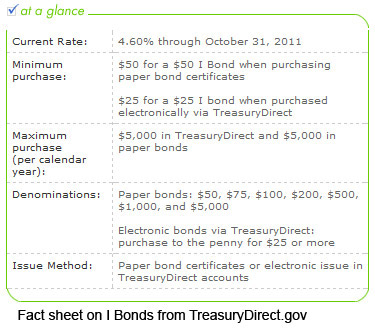
Realize this … I Bonds bought today are paying an annualized rate of 4.6% over the next few months. Can you find a comparable rate elsewhere?

By eliminating the paper I Bonds, the U.S. appears to be limiting your annual purchases to $5,000 per Social Security number, instead of $10,000 with an electronic/paper combo.

(More details on this could be coming later. Would the U.S. allow $10,000 in one account in TreasuryDirect? All would be forgiven …)

But if the U.S. is telling small investors: Stick your money in banks or money market funds paying near zero interest, what is the real message?

Saving is for suckers?

A saver’s revenge: We have until Dec. 31 to load up on I Bonds. I endorse this. If you are married, you can put $20,000 into I Bonds this year … $5,000 per Social Security number at Treasury Direct, and $5,000 each in paper I Bonds.

Send the Treasury a message. Buy I Bonds.

Posted in Investing in TIPS | Leave a comment

10-year TIPS vs. I Bonds? No contest

If you are looking to invest in the July 21 auction of a 10-year Treasury Inflation-Protected Security, and you haven’t bought US Savings I Bonds this year, my advice is: Stop right there and read this.

I Bonds are the better investment right now. It’s a slam dunk when you compare an I Bond to a 5-year TIPS. The I Bond pays you the rate of inflation over the next five years, and then you can sell it without penalty. A 5-year TIPS has a real yield of negative 0.620%.

Would you rather have a bond paying the inflation rate, or a 5-year TIPS paying the inflation rate minus 0.62%. Easy choice.

Comparing an I Bond with a 10-year TIPS is a little more complicated.

THE CASE FOR I BONDS

Right now, looking at current yields (July 11), a 10-year TIPS is paying a real return of 0.549%. So with a 10-year TIPS, you get a 0.549% premium over an I Bond. Advantage TIPS.

The problem with that equation is that 10-year TIPS traditionally pay a 1% premium, or more, over I Bonds. There are good reasons for that:

1) I Bonds have a tax advantage. Your interest compounds and your principal base continues to grow over the 30-year life of the the I Bond. But you never have to pay income tax on that growth until you sell the I Bond. A disadvantage of TIPS is that the inflation adjustment to principal is taxable in the year it was earned. So you ‘prepay’ that tax until maturity.

(Both I Bonds and TIPS are protected against state income taxes, by the way.)

2) I Bonds can be sold after five years, with no penalty. (But income tax becomes due when you sell, so the tax advantage disappears at that point.) I Bonds give you flexiblity. If rates are more attractive five years from now, sell and buy the new issue, or a bank CD, or TIPS or just go on a cruise.

3) Record-keeping with I Bonds is much easier. Download the Savings Bond Wizard and enter your info. When the time comes, sell the I Bonds. Pay the tax. Simple.

TIPS are more complicated, and if you ever tried to navigate the TreasuryDirect.gov site to log your interest payments and principal adjustments, you will know what I mean. There are no ‘simple’ reports on TreasuryDirect. You are even on your own to seek out and download tax statements. The government won’t mail them to you.

THE NEGATIVES

I Bonds are pointed at small investors. Each year, you can only buy $5,000 at TreasuryDirect.gov and $5,000 in paper I Bonds, per one Social Security number. That would mean a couple could buy $20,000 a year in I Bonds. Still, the thought of two TreasuryDirect accounts and paper I Bonds sitting in a safe-deposit box … tires me out.

(Update 7/13/11: From Bloomberg: The Treasury Department will halt sales of paper U.S. savings bonds as of January through banks and other financial institutions to reduce costs by about $70 million over the next five years.)

With I Bonds, right now, you are getting the rate of inflation, nothing more. That means you are probably looking at a five-year investment, then selling them, paying the tax and reinvesting into TIPS or better-yielding I Bonds or CDs. They don’t look like a good long-term investment.

THE CONCLUSION

Yes, I Bonds are a flawed investment, but they are also the best super-safe investment around right now. They protect you against inflation. They defer your taxes. They can be sold after five years.

For the super-safe portion of your portfolio, I think the first $5,000 you invest should be in I Bonds (or $10,000 or $20,000 if you are willing to endure the pain of two TreasuryDirect accounts and paper holdings) .

After you do that, go ahead and take a look at the 10-year TIPs being issued July 21.

I’ll probably pass on that one, though.

Posted in I Bond, Investing in TIPS, Savings Bond | 2 Comments

10-year TIPS yield: How low can it go?

There’s a new issue of a 10-year Treasury Inflation-Protected Security coming up July 21, so prospective buyers will want to keep up with the likely yield (which is the base interest rate of a TIPS; in addition, the owner’s principal keeps rising with inflation until maturity.)

Boring info, but necessary … A lot of people don’t know what a TIPS is, or how it auctions. So I will try to explain. You can find lots of information at TreasuryDirect.gov, but I admit that government site is a bit hard to navigate. So I will try …

That base yield is set at auction. The TIPS also has a ‘coupon rate’ — the actual amount of interest it will pay over the next 10 years. If the coupon rate is 1% and the TIPS auctions at 0.9%, buyers will have to pay more than $100 for each $100 of this issue. If it auctions at 1.1%, buyers will pay less than $100 to get that 1% coupon rate.

As of Tuesday, the market yield for a 10-year TIPS was 0.676%. I get that by going to this Barron’s chart and looking at the yield for the TIPS maturing 2021 Jan 15. Since July 21 is a few weeks away, this number is going to change. But keep it in mind.

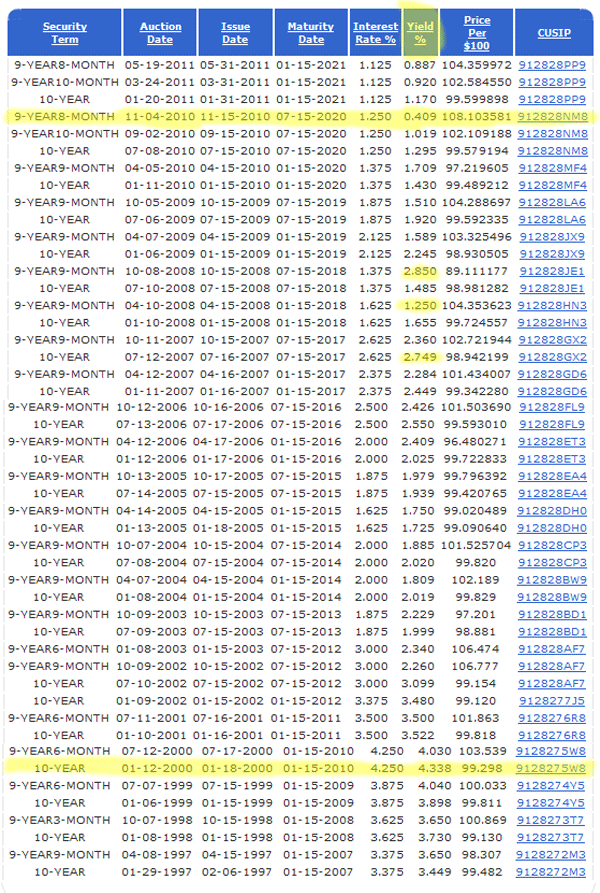
Here are the auction yields for every 10-year TIPS ever issued or reissued:

I highlighted the record low yield, 0.409% in November 2010, and the record high yield, 4.25% in January 2000. (I was a buyer of that one, but unfortunately it has matured. That is a fond memory.)

I also highlighted an unusual low point in April 2008 (1.25%), which is bracketed by higher numbers in July 2007 (2.749%) and October 2008 (2.85%). I think this is important because it shows that the 10-year TIPS yield can move fairly dramatically in a year or less.

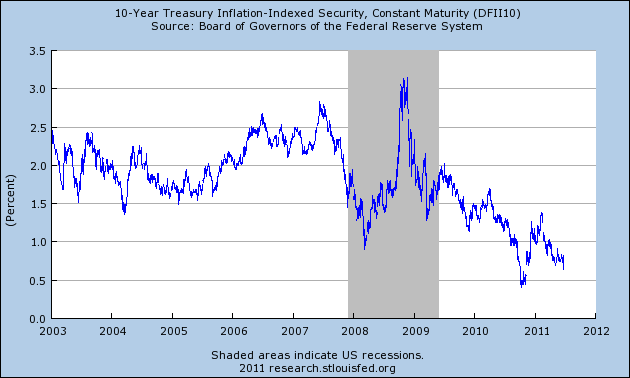
This chart from the St. Louis Fed shows the eight-year pattern for 10-year TIPS yield:

The trend is definitely down. The recessionary period, shaded in gray, is interesting. It initially dipped, then rose as the Fed and U.S. government poured money into stimulating the economy. The peak in late 2008 may be an aberration, because financial institutions were selling off everything, including TIPS, to raise cash.

So, is a record low likely? TIPS yields are very hard to predict, and institutional geniuses out there are often wrong. But I doubt the 10-year TIPS auctioned July 21 will go below 0.409%.

I don’t know a lot about what charts can tell you, but the one above indicates to me that the 10-year yield is unusually low, but not insanely low. We could very well hang around in this sub 1.0% range unless 1) the economy severely worsens, creating a fear of deflation, or 2) the U.S. launches into yet another giant stimulus program. I am ruling out 3) the U.S. government defaults — hope we don’t get drawn into that mess.

What does that mean to you? If you are going to buy this TIPS at auction and hold it to maturity … well, you are going to get a subpar base rate. However, on all other counts you have a buy-it-and-forget-it investment, and you are protected against future inflation.

If you are holding a lot of money in TIPS mutual funds, your money could be at risk if the 10-year TIPS yield returns to a 1.5% to 2.0% range. As I showed in the chart above, that can happen pretty quickly.

Posted in Investing in TIPS | Leave a comment

PIMCO manager: TIPS will hold value as ‘Goldilocks era’ ends

Mihir Worah, PIMCO portfolio manager, is discussing inflation and TIPS in a new economic outlook titled, ‘Higher Commodity Prices and the End of Economic Growth Without Inflation‘.

Worah is manager of the $19.8 billion Pimco Real Return Fund (PRRIX),  which has about 78% of its investment in Treasury Inflation-Protected Securities.

Here are some excerpts:

Commodity prices are rising. Given the global supply/demand imbalances that we see, we expect commodity prices to be generally rising going forward, noting, of course, that commodity prices are volatile and that there will be differentiation among commodities. Much of this is related to the dynamics in and between developed and emerging economies. …

Inflationary pressure from commodities will be even higher within emerging markets. The reason: commodities are such a large part of their consumption basket – for example, nearly 60% in India, compared to about 25% in the U.S. …

Currency issues. Currencies may become another strong driver of inflation, especially among developed economies. We anticipate policymakers in the developed world will attempt to make their economies more competitive via a cheaper currency, which likely will, for net importers like the U.S., lead to higher inflation. …

Finally, in our view, the biggest implication for the global economy of these dynamics is that the goldilocks days of the ’90s where nations could have strong growth and low inflation simultaneously are gone.

Worah goes on to endorse Treasury Inflation-Protected Securities as a hedge against rising inflation. (Remember, however, that he manages a fund that specializes in TIPS, so he has an interest in promoting them.)

To be sure, there is currently a valuation issue with inflation-linked bonds as real rates on such bonds are low. But we believe those rates are likely to stay low – one way for developed markets to escape from their debt overhang is by artificially keeping real rates low, either through regulation or through higher inflation via inflationary/low-rate policies. So in our view, inflation-linked bonds have the potential to hold their value while serving as a cornerstone of an inflation-hedging strategy. …

Investors should seek out prudently managed active strategies that provide the benefits of inflation-linked bonds while attempting to enhance the offered yields.

Posted in Investing in TIPS | Leave a comment