
But there is danger of an ‘outlier’ decision by the Treasury.
By David Enna, Tipswatch.com
It’s already Oct. 7 and we are closing in on Treasury’s November reset of the fixed and variable rates for U.S. Series I Savings Bonds.
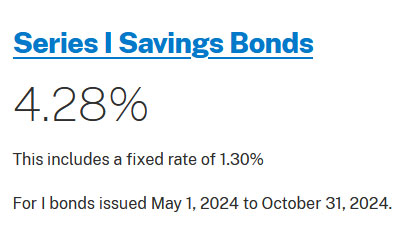
The current composite rate is 4.28%, which is calculated by combining a permanent fixed rate of 1.3% with a six-month inflation-adjusted variable rate of 2.96%. Both of those numbers will reset for I Bond purchases beginning November 1.
The variable rate. Thursday at 8:30 am EDT, we will learn the new variable rate, which will be set in stone by the release of the September U.S. inflation report, completing the March to September data used to set the rate.
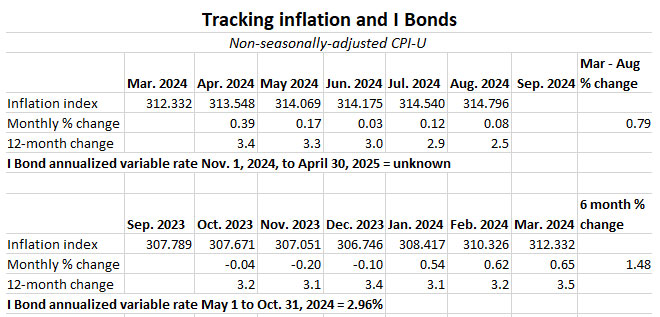
For the months of April to August, non-seasonally adjusted inflation has run at 0.79%. It seems likely that September inflation will be around 0.1% (or possibly less) which would give a six-month total of 0.89% and result in I Bond variable rate of 1.78%. That’s a guess. We will know for sure on Thursday.
The key thing is that the six-month variable rate, which eventually rolls out to all I Bonds depending on the month they were purchased, will be significantly lower than current 2.96%.
The fixed rate. The Treasury does not disclose exactly how it determines the I Bond’s fixed rate, which appears to track at a discount to the real yield of a 5-year TIPS. This is the cryptic information it provides:
The Secretary of the Treasury, or the Secretary’s designee, determines the fixed rate. The rate is based on market rates that have been adjusted to account for the value of components unique to savings bonds. These include the early redemption put option, tax deferral feature, deferred purchase feature, and Treasury’s administrative costs.
That statement makes it clear the Treasury examines “market rates,” and adjusts the I Bond’s fixed rate lower to account for the safety, tax-deferral and flexible maturity of I Bonds. I’ve tracked this decision for 13 years, and with the help of some Boglehead geniuses, I’ve settled on this predictive formula:
Take the six-month average of 5-year real yields and apply a ratio of 0.65.
I also look at the 10-year average, just as a back check. In this case, I am using the average of real yields from May 1 to Oct. 4, 2024. After applying the 0.65 ratio, the actual averages, so far, are 1.228619% for the 5-year TIPS and 1.235716% for the 10-year TIPS. The Treasury rounds the I Bond fixed rate to the tenth decimal point, or 1.20% for both these calculations.
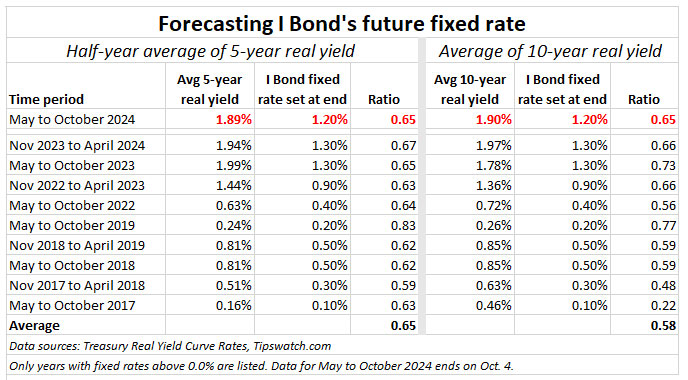
You can see from the 5-year side of the chart that the ratio of 0.65 has been quite accurate, even for the November 2019 reset, when it appears the Treasury might have used a higher ratio to set the fixed rate at 0.20%. But it didn’t. The average of 5-year real yields was 0.24%. Apply a ratio of 0.65 and you get 0.156%, which rounds up to 0.20%.
So based on this data, which isn’t likely to change dramatically by the end of October, I’d predict that the I Bond’s new fixed rate will be 1.20%.
The tricky part
There is one thing I don’t know: Does the Treasury try to look forward to predict a trend in real yields? Based on the trend since 2017, when real yields have tended to move higher, it doesn’t look like it does.
October 2024 is an unusual case. The real yield on a 5-year TIPS dipped to as low as 1.41% on September 24. That is just 11 basis points higher than the I Bond’s fixed rate of 1.30%. Since then, however, in the aftermath of Friday’s positive U.S. jobs report, the 5-year real yield surged to close at 1.67%.
I follow real yields almost daily and here’s one thing I do know: You can’t assume to accurately predict the future. It is almost certain that the Federal Reserve will continue a series of short-term rate cuts well into 2025. But that doesn’t necessarily mean longer-term real yields will decline in lockstep.
Example: When the Fed announced a 50-basis-point rate cut on Sept. 18, the 5-year real yield closed at 1.49%. Today it stands at 1.67%.
So, in my opinion, the Treasury should not enter predictive mode and lower the I Bond’s fixed rate to adjust for potential future rate declines. That kind of decision would be an outlier and would be wrong.
I Bond strategy?
A new fixed rate of 1.20% would be a positive thing for I Bond investors, ensuring that this attractive rate would stay in effect for purchases through April 2025. The purchase cap resets on January 1, meaning everyone will have access to the new rate.
We will learn the new variable rate on Thursday, and it is likely to fall to a number around 1.8%, which combined with a fixed rate of 1.2% would translate to a composite rate of around 2.9% to 3.0%. Not exciting, for sure, but the key factor is the permanent fixed rate of 1.20%, which could end being quite attractive in 2025.
On Sept. 25 I posted an article about using the gift-box strategy to add to your I Bond holdings before the end of October. I am using this strategy, which I also used earlier this year, to lock in the 1.30% fixed rate. But it isn’t available to everyone, since it requires a trusted partner.
If the fixed rate remains at 1.20% into 2025, I Bonds will remain attractive as a way to build longer-term, inflation-protected and tax-deferred savings, with total safety.
Let’s hope the Treasury avoids the outlier route and sticks to its predictable formula.
• Considering an I Bond rollover? Do it the right way.
• Confused by I Bonds? Read my Q&A on I Bonds
• Let’s ‘try’ to clarify how an I Bond’s interest is calculated
• Inflation and I Bonds: Track the variable rate changes
• I Bonds: Here’s a simple way to track current value
• I Bond Manifesto: How this investment can work as an emergency fund
* * *
Follow Tipswatch on X (Twitter) for updates on daily Treasury auctions and real yield trends (when I am not traveling).
Feel free to post comments or questions below. If it is your first-ever comment, it will have to wait for moderation. After that, your comments will automatically appear. Please stay on topic and avoid political tirades. NOTE: Comment threads can only be three responses deep. If you see that you cannot respond, create a new comment and reference the topic.
David Enna is a financial journalist, not a financial adviser. He is not selling or profiting from any investment discussed. I Bonds and TIPS are not “get rich” investments; they are best used for capital preservation and inflation protection. They can be purchased through the Treasury or other providers without fees, commissions or carrying charges. Please do your own research before investing.






 Treasury Inflation-Protected Securities
I plan on selling some SGOV and buying before the end of the month as well. I had one I…